Loading...
Qin Er Shi vs Sahure
Sahure leads by 0.7 pts · 2 figures compared
…
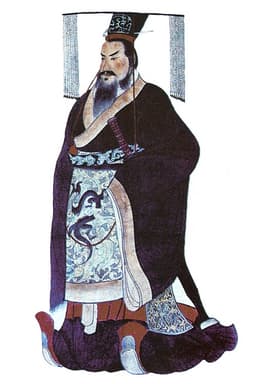
Qin Er Shi
Emperor · Ancient
44.1Total

Sahure
Emperor · Ancient
44.8Total
Basic Information
Born
-229
-2450
Died
-207
-2440
Era
Ancient
Ancient
Nationality
China
Old Kingdom Egypt
Occupation
Emperor
Emperor
Civilization
Eastern
Middle Eastern
Score Comparison
Military (10%)
20.2
50.0
Political (20%)
68.0
37.9
Influence (20%)
42.4
48.6
Legacy (20%)
35.0
40.0
Leadership (15%)
43.6
55.3
Strategy (15%)
60.0
36.8
TOTAL
44.1
44.8
Qin Er Shi — Complete Timeline
210 BC
Accession as Second EmperorPolitical Action◆ Major
After Qin Shi Huang's death, Zhao Gao and Li Si forged a decree to force the crown prince Fusu to commit suicide and installed Huhai as Qin Er Shi. This illegitimate succession undermined the dynasty's legitimacy and placed an incompetent ruler on the throne.
SuccessionPalace IntrigueZhao Gao
Impact: nationaldestructive
209 BC
Outbreak of Dazexiang UprisingWar
Chen Sheng and Wu Guang led a rebellion of conscripted farmers at Dazexiang, sparking widespread revolts across the Qin empire. Qin Er Shi's harsh policies and heavy taxation had created widespread discontent, and the uprising quickly spread, leading to the dynasty's collapse.
RebellionQin CollapseChen Sheng
Impact: nationaldestructive
208 BC
Execution of Li SiPolitical Action◆ Major
Zhao Gao falsely accused Chancellor Li Si of treason. Qin Er Shi ordered Li Si's execution by the Five Pains method, along with his entire family. This removed the last capable administrator from the Qin court, accelerating the dynasty's decline.
ExecutionPolitical PurgeZhao Gao
Impact: nationaldestructive
207 BC
Death at the Hands of Zhao GaoPolitical Action◆ Major
Zhao Gao, fearing Qin Er Shi's anger over military defeats, staged a coup and forced the emperor to commit suicide. Zhao Gao then installed Ziying as the new king. This event marked the effective end of Qin rule, as Ziying surrendered to Liu Bang shortly after.
CoupDeathZhao Gao
Impact: nationaltragic
Sahure — Complete Timeline
2450 BC
Military campaigns in the Sinai and LibyaWar
Sahure conducted military expeditions into the Sinai Peninsula to secure turquoise and copper mines, and into Libya to subdue nomadic tribes. These campaigns are recorded in reliefs from his pyramid complex, showing the king smiting enemies.
MilitarySinaiLibya
Impact: regional
Maritime expedition to PuntPolitical Action◆ Major
Sahure dispatched a fleet to the land of Punt, likely located in the Horn of Africa. The expedition returned with myrrh, electrum, and exotic goods, demonstrating Egypt's naval capabilities and establishing trade routes that would be used for centuries.
TradeMaritimeOld Kingdom
Impact: regionalconstructive
Construction of the Pyramid of Sahure at AbusirCultural◆ Major
Sahure built his pyramid complex at Abusir, the first royal pyramid built in that necropolis. The complex included a valley temple, causeway, and mortuary temple decorated with reliefs depicting the Punt expedition and other achievements.
ArchitecturePyramidAbusir
Impact: nationalconstructive
Expert Analysis
Origins
Qin Er Shi (born Huhai, 229 BCE) was the 18th son of Qin Shi Huang, the first emperor of a unified China. His early life was sheltered, overshadowed by his father's iron rule and the court's intrigue. He received a traditional education but showed little aptitude for governance. His father's death in 210 BCE set the stage for his unexpected rise.
Sahure (reigned c. 2487–2475 BCE) was the second pharaoh of Egypt's Fifth Dynasty, likely a son of Userkaf. He inherited a stable kingdom from his predecessors, with a centralized administration and thriving trade networks. His early reign focused on consolidating power and continuing the religious reforms of his father, emphasizing the sun god Ra.
Rise to Power
Qin Er Shi's accession was a coup. After Qin Shi Huang's death, chief eunuch Zhao Gao and chancellor Li Si forged a decree forcing the crown prince Fusu to suicide and installed Huhai as emperor. This illegitimate start alienated the imperial family and the bureaucracy. Within months, Zhao Gao manipulated the young emperor into executing Li Si and other loyalists, consolidating his own power.
Sahure ascended peacefully, likely as the designated heir. His reign began with a focus on monumental construction and trade. He commissioned the first pyramid at Abusir, a shift from the Giza necropolis of the Fourth Dynasty, signaling a new era. His early years saw the dispatch of a fleet to Punt, a legendary land rich in incense and exotic goods.
Leadership & Governance
Qin Er Shi's leadership was defined by passivity and manipulation. He relied entirely on Zhao Gao, who isolated him from state affairs. In 209 BCE, Zhao Gao staged a test: he presented a deer to the emperor, calling it a horse. Those who corrected the lie were later executed. This "pointing at the deer and calling it a horse" incident illustrates the climate of fear. Qin Er Shi's governance score of 68.0 reflects his formal authority, but his political score of 37.9 indicates his actual control was nil.
Sahure governed through a well-established bureaucracy. He continued the tradition of building solar temples, and his pyramid complex at Abusir became a model for later Fifth Dynasty pharaohs. His leadership score of 55.3 reflects his effective management of state resources and military campaigns. He maintained control over trade routes and secured resources from Sinai and Libya.
Triumph & Tragedy
Qin Er Shi's greatest triumph was surviving three years on the throne despite widespread rebellion. However, his reign was a cascade of failures: the Dazexiang Uprising in 209 BCE sparked revolts across the empire, and his execution of Li Si removed the last competent advisor. His death came in 207 BCE when Zhao Gao forced him to commit suicide, ending the Qin dynasty shortly after. His military score of 20.2 reflects his complete inability to respond to crises.
Sahure's triumphs include the successful expedition to Punt, which brought back myrrh, electrum, and exotic animals, enhancing Egypt's wealth and prestige. His pyramid complex, though smaller than the Great Pyramid, is noted for its fine reliefs and architectural innovation. His military campaigns in Sinai and Libya secured resources and subdued nomads. However, his reign was short—about 12 years—and his pyramid was later plundered. His legacy score of 40.0 reflects the modest scale of his monuments compared to earlier pharaohs.
Character & Destiny
Qin Er Shi was indecisive and easily manipulated. He lacked the ruthlessness of his father and the wisdom to trust competent advisors. His fate was sealed by his own weakness: Zhao Gao, fearing the emperor's wrath over military defeats, staged a coup. The emperor's death marked the end of his line.
Sahure appears as a capable administrator and builder. His decision to move the royal necropolis to Abusir suggests a desire to break from the past, but his short reign limited his impact. He died naturally, passing the throne to his son Neferirkare.
Legacy
Qin Er Shi's legacy is that of a cautionary tale: his misrule transformed the mighty Qin empire into a memory within three years. The Han dynasty that followed used his failures to justify their own rule. His name is synonymous with incompetence.
Sahure's legacy is more positive but limited. His pyramid complex and reliefs provide key archaeological insights into the Fifth Dynasty. The Punt expedition established a tradition of state-sponsored trade missions. His military campaigns reinforced Egyptian control over border regions.
Conclusion
Sahure's total score of 44.8 edges out Qin Er Shi's 44.1, but the gap is narrow. In terms of impact, Sahure's contributions to trade, architecture, and stability had a modest but lasting effect. Qin Er Shi's reign was a disaster that accelerated the fall of a dynasty. While both are minor figures in their respective histories, Sahure's positive achievements outweigh Qin Er Shi's failures. Therefore, Sahure had the greater impact, albeit within a limited scope.
Rankings
🥇
SahureLeader
Mil: 50.0Pol: 37.9Inf: 48.6
44.8
🥈
Qin Er Shi
Mil: 20.2Pol: 68.0Inf: 42.4
44.1
+0.7 behind
How This Comparison Works
Algorithm
Each figure is scored on 6 dimensions (0—100 scale) based on structured historical data: Military (10%), Political (20%), Influence (20%), Legacy (20%), Leadership (15%), Strategy (15%). The weighted total produces the final ranking.
Data Sources
Scores are computed from structured sub-indicators in the database. Scale factors adjust for era (Ancient ×0.85, Modern ×1.0) and civilization size (Eastern ×1.05, Other ×0.80) to account for differences in population and military scale.
Maximum 3 Figures
Comparisons are limited to 2—3 figures to ensure readability and statistical meaningfulness.
Error Margins
±5 points per dimension — Sub-scores are derived from historical records with inherent uncertainty. Two figures within 5 points on a dimension should be considered roughly equivalent in that area.
Total Score Accuracy
±3 points overall — The weighted combination of 6 dimensions produces a total score with approximately ±3 points of uncertainty. Differences of less than 3 points are not statistically significant— the figures are effectively tied.
Known Limitations
- Historical records are incomplete and uneven across civilizations
- Figures from oral-tradition societies may be underrepresented
- Occupation labels can misclassify multi-role figures
- Scores measure capability and impact, not moral character
- Quantitative scoring is a comparison tool, not absolute truth
Capability Radar
Military (10%) — Battles & Warfare
Battles
33
10
Win Rate
37
10
Expansion
37
20
Political (20%) — Governance & Reform
Reform
0
20
Diplomacy
0
40
Economy
0
40
Influence (20%) — Cultural & Global Reach
Cultural
5
30
Global
5
20
Legacy (20%) — Historical Impact
Historical
15
30
Longevity
5
20
Leadership (15%) — Power & Stability
Tenure
3
30
Stability
0
40
Strategy (15%) — Tactics & Innovation
Strategy
41
10
Tactics
48
10
Reform
48
10
Similar Comparisons
Comments & Discussion
No comments yet. Be the first to share your thoughts!