Loading...
Galba vs Yujiulu Shelun
Yujiulu Shelun leads by 18.9 pts · 2 figures compared
…
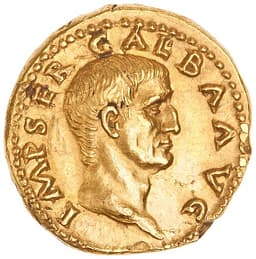
Galba
Emperor · Ancient
33.8Total

Yujiulu Shelun
Emperor · Ancient
52.7Total
Basic Information
Born
-3
391
Died
69
410
Era
Ancient
Ancient
Nationality
Roman Empire
Rouran Khaganate
Occupation
Emperor
Emperor
Civilization
Western
Eastern
Score Comparison
Military (10%)
22.6
70.0
Political (20%)
27.9
45.1
Influence (20%)
42.4
51.0
Legacy (20%)
35.0
44.2
Leadership (15%)
36.9
64.0
Strategy (15%)
25.0
55.0
TOTAL
33.8
52.7
Galba — Complete Timeline
68 AD
Proclamation as EmperorPolitical Action◆ Major
Galba was proclaimed emperor by the Roman Senate after the suicide of Nero. He was governor of Hispania Tarraconensis and had rebelled against Nero. His accession ended the Julio-Claudian dynasty and began the Year of the Four Emperors.
Year of the Four EmperorsNeroProclamation
Impact: national
69 AD
Assassination of GalbaPolitical Action◆ Major
Galba was murdered by Praetorian Guards in the Roman Forum after adopting Lucius Calpurnius Piso as his successor. His unpopularity and failure to pay the Praetorians led to his overthrow by Otho. This event triggered a series of civil wars.
AssassinationPraetorian GuardOtho
Impact: nationaltragic
Yujiulu Shelun — Complete Timeline
402 AD
Foundation of the Rouran KhaganatePolitical Action◆ Major
Yujiulu Shelun united the Rouran tribes and declared himself Khagan, founding the Rouran Khaganate. He established a nomadic empire on the Mongolian steppe, adopting the title 'Khagan' and organizing a powerful cavalry force that threatened Northern Wei.
Dynasty FoundationRouran Khaganate
Impact: regionalconstructive
404 AD
Raid on Northern Wei (404 AD)War
Shelun led a major raid into Northern Wei territory, penetrating deep into the frontier. The Rouran cavalry looted settlements and captured prisoners, but were eventually repelled by Northern Wei forces. This raid established the Rouran as a persistent threat.
RaidRouran-Northern Wei War
Impact: regionaldestructive
410 AD
Defeat by Northern Wei at the Battle of the DesertWar◆ Major
Yujiulu Shelun was defeated by a Northern Wei army under Emperor Daowu (Tuoba Gui) in a battle in the Gobi Desert. The Rouran suffered heavy losses, and Shelun was forced to flee. This defeat temporarily weakened the Rouran Khaganate.
BattleRouran-Northern Wei War
Impact: regionaldestructive
Death of Yujiulu ShelunOther
After his defeat by Northern Wei, Yujiulu Shelun died under uncertain circumstances, possibly killed by his own followers or in battle. His death led to a succession struggle among the Rouran, but the khaganate survived under his successors.
DeathSuccession
Impact: regionaltragic
Expert Analysis
Origins
Galba (born 3 BC, Near Terracina, Italy) came from an ancient patrician family. He was raised by his mother's family after his father's death, receiving a traditional Roman education. He held various magistracies under Tiberius and Caligula, and served as governor of Aquitania and later of Hispania Tarraconensis. His noble lineage and administrative experience positioned him as a respected senator.
Yujiulu Shelun (born c. 360 AD, Mongolian steppes) emerged from the Rouran tribe, a confederation of nomadic peoples under the influence of the Xianbei-led Northern Wei. Little is known of his early life, but he likely grew up in a warrior culture, learning horsemanship and tribal politics. He united the Rouran clans after the death of his father, Yujiulu Yuwen, and claimed descent from the Xiongnu.
Rise to Power
Galba rose to prominence through a series of imperial appointments. In 68 AD, he was governor of Hispania Tarraconensis when Nero's rule collapsed. Following Nero's suicide, the Senate proclaimed Galba emperor, largely due to his reputation for severity and integrity. He marched to Rome, but his popularity quickly waned due to his harsh policies and refusal to pay the Praetorian Guard a promised donative.
Yujiulu Shelun's rise was a direct result of his military prowess. Around 402 AD, he united the Rouran tribes and declared himself Khagan, founding the Rouran Khaganate. He established a nomadic empire on the Mongolian steppe, challenging the dominance of the Northern Wei dynasty. His early raids into Northern Wei territory brought him wealth and prestige, solidifying his leadership.
Leadership & Governance
Galba's leadership style was rigid and conservative. He attempted to restore fiscal discipline by cancelling Nero's lavish gifts and refusing to pay the Praetorians, which earned him their enmity. He also executed several senators without trial, alienating the aristocracy. His governance score of 36.9 reflects his inability to secure loyalty or manage Rome's fragile political balance.
Yujiulu Shelun ruled as a nomadic warlord. He organized the Rouran into a centralized khaganate with a military hierarchy, using cavalry tactics to dominate the steppe. His political score of 45.1 indicates moderate success in state-building, but his governance was undermined by constant warfare and internal tribal rivalries. He lacked the administrative infrastructure of settled empires.
Triumph & Tragedy
Galba's greatest triumph was becoming emperor, ending the Julio-Claudian dynasty. However, his reign lasted only seven months. His failure to secure the loyalty of the Praetorian Guard led to his assassination in the Roman Forum on January 15, 69 AD, after adopting Lucius Calpurnius Piso as his successor. His military score of 22.6 highlights his lack of military achievement.
Yujiulu Shelun's triumph was founding the Rouran Khaganate, which would dominate the Mongolian steppe for over a century. His military score of 70.0 reflects his successful raids and creation of a formidable cavalry force. His tragedy came in 406 AD when he was defeated by Northern Wei at the Battle of the Desert, suffering heavy losses. He died soon after, possibly killed by his own followers. His leadership score of 64.0 indicates strong command, but the defeat ended his expansion.
Character & Destiny
Galba was known for his austerity and discipline, but also for cruelty and indecision. He failed to adapt to the political realities of imperial Rome, relying on Senate support while ignoring the military. His character sealed his fate: he could not compromise or inspire loyalty. Historians like Tacitus note his "obstinacy" as a fatal flaw.
Yujiulu Shelun was a charismatic and ruthless leader, able to unite fractious tribes through force and diplomacy. He was a skilled strategist, as shown by his raids, but his ambition exceeded his resources. His death in obscurity reflects the volatility of steppe politics, where success depended on constant victory.
Legacy
Galba's legacy is minimal: he is remembered as the first emperor of the Year of the Four Emperors, a brief reign that highlighted the Praetorian Guard's power. His influence score of 42.4 is modest, as his rule had little lasting impact on Roman institutions.
Yujiulu Shelun's legacy is more substantial. He founded a khaganate that lasted until 552 AD, shaping the balance of power in East Asia. The Rouran established a pattern for later steppe empires like the Göktürks. His influence score of 51.0 and legacy score of 44.2 reflect his role in creating a lasting nomadic state.
Conclusion
Yujiulu Shelun had greater impact. While Galba's total score is 33.8, Shelun's is 52.7, a gap of 18.9 points. Shelun founded a dynasty that endured for generations and influenced the development of nomadic empires. Galba's seven-month reign was a footnote in Roman history. Shelun's military and leadership scores (70.0 and 64.0) dwarf Galba's (22.6 and 36.9). Even in political and influence metrics, Shelun leads. Thus, Yujiulu Shelun is the more consequential figure.
Rankings
🥇
Yujiulu ShelunLeader
Mil: 70.0Pol: 45.1Inf: 51.0
52.7
🥈
Galba
Mil: 22.6Pol: 27.9Inf: 42.4
33.8
+18.9 behind
How This Comparison Works
Algorithm
Each figure is scored on 6 dimensions (0—100 scale) based on structured historical data: Military (10%), Political (20%), Influence (20%), Legacy (20%), Leadership (15%), Strategy (15%). The weighted total produces the final ranking.
Data Sources
Scores are computed from structured sub-indicators in the database. Scale factors adjust for era (Ancient ×0.85, Modern ×1.0) and civilization size (Eastern ×1.05, Other ×0.80) to account for differences in population and military scale.
Maximum 3 Figures
Comparisons are limited to 2—3 figures to ensure readability and statistical meaningfulness.
Error Margins
±5 points per dimension — Sub-scores are derived from historical records with inherent uncertainty. Two figures within 5 points on a dimension should be considered roughly equivalent in that area.
Total Score Accuracy
±3 points overall — The weighted combination of 6 dimensions produces a total score with approximately ±3 points of uncertainty. Differences of less than 3 points are not statistically significant— the figures are effectively tied.
Known Limitations
- Historical records are incomplete and uneven across civilizations
- Figures from oral-tradition societies may be underrepresented
- Occupation labels can misclassify multi-role figures
- Scores measure capability and impact, not moral character
- Quantitative scoring is a comparison tool, not absolute truth
Capability Radar
Military (10%) — Battles & Warfare
Battles
10
55
Win Rate
10
60
Expansion
5
60
Political (20%) — Governance & Reform
Reform
5
40
Diplomacy
10
50
Economy
5
35
Influence (20%) — Cultural & Global Reach
Cultural
5
30
Global
5
35
Legacy (20%) — Historical Impact
Historical
15
45
Longevity
5
40
Leadership (15%) — Power & Stability
Tenure
5
55
Stability
5
40
Strategy (15%) — Tactics & Innovation
Strategy
15
55
Tactics
15
50
Reform
5
45
Similar Comparisons
Comments & Discussion
No comments yet. Be the first to share your thoughts!