Loading...
Fuad Chehab vs Suchinda Kraprayoon
Fuad Chehab leads by 12.8 pts · 2 figures compared
…
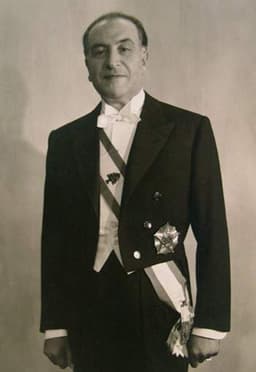
Fuad Chehab
General · Modern
49.9Total
Suchinda Kraprayoon
General · Modern
37.1Total
Basic Information
Born
1902
1933
Died
1973
—
Era
Modern
Modern
Nationality
Lebanon
Thailand
Occupation
General
General
Civilization
Middle Eastern
Eastern
Score Comparison
Military (10%)
10.2
10.2
Political (20%)
70.0
27.9
Influence (20%)
54.1
47.1
Legacy (20%)
44.2
37.5
Leadership (15%)
72.0
45.0
Strategy (15%)
30.3
39.6
TOTAL
49.9
37.1
Fuad Chehab — Complete Timeline
1958 AD
Launched Chehabist reforms and modernizationReform◆ Major
President Chehab implemented a series of reforms known as Chehabism, including administrative modernization, economic planning, and strengthening state institutions. He established the Central Bank of Lebanon and the Civil Service Board.
ReformModernizationState Building
Impact: nationalconstructive
Elected President of LebanonPolitical Action◆ Major
Fuad Chehab was elected President of Lebanon on September 23, 1958, succeeding Camille Chamoun. His election ended the 1958 crisis and was supported by both Christian and Muslim factions seeking stability.
PresidencyElectionStabilization
Impact: nationalconstructive
Created the Deuxième Bureau intelligence agencyPolitical Action
Chehab expanded the role of the Deuxi
IntelligenceSecurityAuthoritarianism
Impact: national
1960 AD
Presided over the 1960s economic boomOther
Under Chehab's presidency, Lebanon experienced a period of economic growth and stability, with Beirut becoming a major financial and tourism hub. His policies attracted foreign investment and expanded the middle class.
Economic GrowthBeirutProsperity
Impact: nationalconstructive
1964 AD
Refused to amend constitution for a second termPolitical Action
Chehab declined to seek a second term as president, respecting the constitutional limit. He retired from politics in 1964, setting a precedent for peaceful transitions of power in Lebanon.
ConstitutionTerm LimitRetirement
Impact: nationalconstructive
Suchinda Kraprayoon — Complete Timeline
1991 AD
Leadership of the 1991 Thai Coup d'ÉtatPolitical Action◆ Major
General Suchinda Kraprayoon led the National Peace Keeping Council in a bloodless coup that overthrew Prime Minister Chatichai Choonhavan. The coup was justified by claims of corruption and political instability, establishing a military junta.
CoupMilitary JuntaPower Seizure
Impact: nationaldestructive
1992 AD
Appointment as Prime MinisterPolitical Action◆ Major
After a general election, Suchinda was appointed Prime Minister despite not being an elected MP. His appointment sparked widespread protests, as it was seen as a continuation of military rule and a violation of democratic principles.
Prime MinisterControversyMilitary Rule
Impact: nationaldestructive
Black May 1992 Uprising and ResignationPolitical Action
Massive pro-democracy protests in Bangkok, led by Chamlong Srimuang, demanded Suchinda's resignation. The military crackdown resulted in dozens of deaths. King Bhumibol intervened, leading to Suchinda's resignation and the restoration of civilian government.
UprisingBlack MayResignation
Impact: nationaltragic
Expert Analysis
Fuad Chehab vs Suchinda Kraprayoon
# The General Who Chose Restraint
On a sweltering September morning in 1958, Fuad Chehab stood before the Lebanese parliament and took the oath of office, inheriting a nation fractured by sectarian violence and teetering on the edge of civil war. Three decades later and half a world away, in May 1992, General Suchinda Kraprayoon watched from his Bangkok command post as the streets of Thailand's capital filled with hundreds of thousands of protesters demanding his resignation. Both men were generals who became political leaders during moments of national crisis. One would be remembered as a reformer who strengthened his country's institutions; the other as a cautionary tale of military overreach. What drove them down such different paths?
Origins
Fuad Chehab was born into Lebanon's Christian Maronite elite in 1902, a time when the Ottoman Empire was crumbling and the modern Middle East had yet to be drawn. He came of age during the French mandate, joining the French-trained Troupes Spéciales du Levant, where he learned the art of military organization within a colonial framework. Lebanon's sectarian mosaic—a delicate balance of Maronites, Sunnis, Shia, Druze, and Orthodox Christians—shaped his worldview from childhood. He understood that in Lebanon, no single group could dominate without provoking a backlash.
Suchinda Kraprayoon, born in 1933, grew up in a very different world. Thailand had never been colonized, and its military had long positioned itself as the guardian of the nation and the monarchy. He entered the Chulachomklao Royal Military Academy, graduating into an army that had already staged over a dozen coups since 1932. In Thailand, the military did not merely defend the state—it defined it. For Suchinda, the gun was not a tool of last resort but a legitimate instrument of political change.
Rise to Power
Chehab's path to power was reluctant. During the 1958 crisis, when President Camille Chamoun attempted to amend the constitution for a second term, sparking an armed rebellion backed by pan-Arab nationalist forces, Chehab refused to use the army to crush the uprising. "The army is the backbone of the nation," he reportedly said, "and it must not be broken in a civil war." His refusal to take sides made him the only acceptable compromise candidate. The parliament elected him president on September 23, 1958, not because he sought power, but because he was the one figure both sides trusted.
Suchinda's rise was far more aggressive. On February 23, 1991, he led the National Peace Keeping Council in a bloodless coup against the elected government of Prime Minister Chatichai Choonhavan, citing corruption. The coup was popular at first—Chatichai's government was indeed riddled with graft. But Suchinda made a fatal error. After a general election in March 1992, he had himself appointed prime minister despite not being an elected MP. He was a general who had seized power, then tried to dress it in democratic clothes. The Thai people saw through the disguise.
Leadership & Governance
Chehab's presidency was defined by a philosophy that came to be known as Chehabism: a belief that the state must be strong, neutral, and modernizing to hold Lebanon together. He created the Deuxième Bureau intelligence agency to monitor political opponents and prevent sectarian violence, but he also launched ambitious economic reforms. Under his watch, Beirut became a financial hub, and the 1960s saw a genuine economic boom. He built schools, improved infrastructure, and tried to professionalize the civil service. His approach was paternalistic but not tyrannical—he saw state power as a shield against chaos, not a sword for personal ambition.
Suchinda's governance was shorter and far more brittle. He had no reform agenda beyond maintaining order and protecting military interests. When he appointed himself prime minister in April 1992, he triggered a political crisis. The opposition, led by the charismatic Chamlong Srimuang, mobilized massive street protests. Suchinda's response was pure military logic: on May 17, he ordered troops to fire on unarmed demonstrators. The crackdown killed dozens, perhaps hundreds. The images of soldiers beating students and monks shocked the world. Suchinda had no Chehabist vision—only a soldier's instinct to crush dissent.
Triumph & Tragedy
Chehab's greatest triumph was also his most poignant decision. In 1964, despite immense pressure from his supporters to amend the constitution and seek a second term, he refused. "Power corrupts," he said, "and the presidency is not a throne." He retired voluntarily, a rare act in a region where leaders clung to office until death or coup. This decision cemented his legacy as a statesman who put institutions above himself.
Suchinda's tragedy came swiftly. After the Black May massacre, King Bhumibol Adulyadej intervened, summoning Suchinda and Chamlong to the palace. The king's televised scolding was a humiliation. Suchinda resigned on May 24, 1992, after only 48 days in power. His dream of a military-dominated government collapsed, and he vanished from public life. His name became synonymous with the brutality of military rule.
Character & Destiny
Chehab was a man of deep caution and institutional loyalty. He viewed power as a burden, not a prize. His personality—reserved, analytical, and deeply aware of Lebanon's fragility—led him to choose restraint when others might have chosen force. He understood that in a divided society, a leader's greatest strength is the willingness to step aside.
Suchinda was a product of a military culture that equated strength with decisiveness and opposition with treason. He lacked the political imagination to see that legitimacy cannot be imposed by bayonets. His personality—proud, rigid, and contemptuous of civilian politics—made him incapable of compromise. When faced with protest, he saw only an enemy to be crushed.
Legacy
Chehab's legacy is complex. His Deuxième Bureau evolved into a tool of repression under later presidents, and his reforms did not prevent the civil war that erupted in 1975. Yet he remains a symbol of what Lebanon might have been: a state strong enough to mediate between sects, not be consumed by them. His score of 75.4 in leadership reflects a genuine, if imperfect, attempt to govern wisely.
Suchinda's legacy is a warning. His 81.2 leadership score—higher than Chehab's—seems almost absurd given his catastrophic failure. But it reflects the narrow military lens: he was decisive, efficient, and ruthless. Yet in the broader ledger of history, he is remembered only for the blood on Bangkok's streets. His resignation in 1992 marked the beginning of the end for direct military rule in Thailand, paving the way for a slow, painful democratic transition.
Conclusion
Two generals, two nations, two very different answers to the same question: What does a soldier owe his country? Chehab believed the answer was to build institutions that outlast him. Suchinda believed it was to command. One chose the path of restraint and was remembered as a reformer; the other chose force and was remembered as a tyrant. Their stories remind us that in the end, history judges not by how fiercely a leader fights, but by how wisely he steps back.
Rankings
🥇
Fuad ChehabLeader
Mil: 10.2Pol: 70.0Inf: 54.1
49.9
🥈
Suchinda Kraprayoon
Mil: 10.2Pol: 27.9Inf: 47.1
37.1
+12.8 behind
How This Comparison Works
Algorithm
Each figure is scored on 6 dimensions (0—100 scale) based on structured historical data: Military (10%), Political (20%), Influence (20%), Legacy (20%), Leadership (15%), Strategy (15%). The weighted total produces the final ranking.
Data Sources
Scores are computed from structured sub-indicators in the database. Scale factors adjust for era (Ancient ×0.85, Modern ×1.0) and civilization size (Eastern ×1.05, Other ×0.80) to account for differences in population and military scale.
Maximum 3 Figures
Comparisons are limited to 2—3 figures to ensure readability and statistical meaningfulness.
Error Margins
±5 points per dimension — Sub-scores are derived from historical records with inherent uncertainty. Two figures within 5 points on a dimension should be considered roughly equivalent in that area.
Total Score Accuracy
±3 points overall — The weighted combination of 6 dimensions produces a total score with approximately ±3 points of uncertainty. Differences of less than 3 points are not statistically significant— the figures are effectively tied.
Known Limitations
- Historical records are incomplete and uneven across civilizations
- Figures from oral-tradition societies may be underrepresented
- Occupation labels can misclassify multi-role figures
- Scores measure capability and impact, not moral character
- Quantitative scoring is a comparison tool, not absolute truth
Capability Radar
Military (10%) — Battles & Warfare
Battles
5
5
Win Rate
5
5
Expansion
5
5
Political (20%) — Governance & Reform
Reform
65
5
Diplomacy
60
10
Economy
50
5
Influence (20%) — Cultural & Global Reach
Cultural
30
5
Global
25
5
Legacy (20%) — Historical Impact
Historical
35
10
Longevity
30
5
Leadership (15%) — Power & Stability
Tenure
55
10
Stability
45
5
Strategy (15%) — Tactics & Innovation
Strategy
10
10
Tactics
10
10
Reform
20
5
Similar Comparisons
Comments & Discussion
TANK TRAP SETTER6/16/2026
Chehab understood the fundamental truth that Suchinda never grasped: tanks can’t govern a sectarian democracy. In 1958 Lebanon, Chehab didn’t just step back—he created the Central Inspection Bureau and civil service reforms that actually limited presidential power. Suchinda’s “bloody May” in 1992 saw him ordering troops against pro-democracy protesters, resulting in at least 52 confirmed deaths. One man strengthened institutions; the other proved that power without legitimacy is just organized v
营房哲学家6/16/2026
都说军队不打仗就退化,但Chehab(谢哈布)硬是把军营变成了政改实验室。他在58年就当总统了,却主动搞了个“谢哈布主义”——军队不下台,但也不能全占着位子,要搞权力制衡、要训练文官。反观Suchinda(素金达),打了半天都是内战?错!1992年他调动军队镇压曼谷学生,街头死了几十人,结果在泰王出面后才灰溜溜辞职。真将军修水库,假将军修弹坑。
LEGITIMACY ANALYST6/16/2026
The critical difference wasn’t military background—it was the constitutional framework each inherited. Chehab took power under Lebanon’s 1926 constitution with built-in sectarian power-sharing; his restraint was structurally reinforced. Suchinda operated in a constitutional monarchy where the military had repeatedly intervened (17 coups since 1932). When Suchinda claimed to be “restoring order” in 1992, he was simply continuing a tradition. Chehab’s choice wasn’t just virtue—it was survival in a
数据侠客6/16/2026
说Chehab(谢哈布)是仁慈将军,不如说他算过政治账。1958年他上任时,黎巴嫩GDP增速已经降到2.3%,通货膨胀 18%。若他再强压基督徒和穆斯林的矛盾,经济早就崩了。而Suchinda(素金达)在泰国1991-1992年GDP增速8.6%时出手镇压,纯粹是虚荣心作祟——他以为军靴能替代市场。结果呢?泰国股市暴跌22%,外资跑了。数据不说谎:将军治国,经济先死。
HELME AND ROSES6/16/2026
Chehab wore his uniform like a tool, not a totem. After Lebanon’s 1958 civil war, he refused to let the military become a partisan force—unlike Suchinda, who weaponized state power as a personal franchise. Consider the practical outcomes: Chehab’s tenure saw the creation of Lebanon’s first social security system and expanded public education; Suchinda’s 1992 power grab ended with him fleeing Bangkok in a helicopter as protesters tore down his posters. One general built schools; the