Loading...
Fuad Chehab vs Shi Dakai
Shi Dakai leads by 9.7 pts · 2 figures compared
…
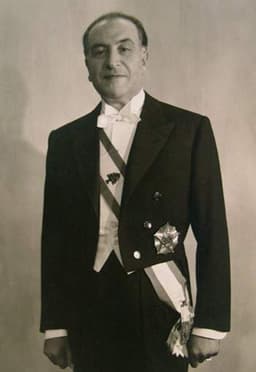
Fuad Chehab
General · Modern
49.9Total
Shi Dakai
General · Modern
59.6Total
Basic Information
Born
1902
1831
Died
1973
1863
Era
Modern
Modern
Nationality
Lebanon
China
Occupation
General
General
Civilization
Middle Eastern
Eastern
Score Comparison
Military (10%)
10.2
76.0
Political (20%)
70.0
45.0
Influence (20%)
54.1
56.7
Legacy (20%)
44.2
54.0
Leadership (15%)
72.0
72.0
Strategy (15%)
30.3
68.1
TOTAL
49.9
59.6
Fuad Chehab — Complete Timeline
1958 AD
Launched Chehabist reforms and modernizationReform◆ Major
President Chehab implemented a series of reforms known as Chehabism, including administrative modernization, economic planning, and strengthening state institutions. He established the Central Bank of Lebanon and the Civil Service Board.
ReformModernizationState Building
Impact: nationalconstructive
Elected President of LebanonPolitical Action◆ Major
Fuad Chehab was elected President of Lebanon on September 23, 1958, succeeding Camille Chamoun. His election ended the 1958 crisis and was supported by both Christian and Muslim factions seeking stability.
PresidencyElectionStabilization
Impact: nationalconstructive
Created the Deuxième Bureau intelligence agencyPolitical Action
Chehab expanded the role of the Deuxi
IntelligenceSecurityAuthoritarianism
Impact: national
1960 AD
Presided over the 1960s economic boomOther
Under Chehab's presidency, Lebanon experienced a period of economic growth and stability, with Beirut becoming a major financial and tourism hub. His policies attracted foreign investment and expanded the middle class.
Economic GrowthBeirutProsperity
Impact: nationalconstructive
1964 AD
Refused to amend constitution for a second termPolitical Action
Chehab declined to seek a second term as president, respecting the constitutional limit. He retired from politics in 1964, setting a precedent for peaceful transitions of power in Lebanon.
ConstitutionTerm LimitRetirement
Impact: nationalconstructive
Shi Dakai — Complete Timeline
1851 AD
Jintian UprisingWar◆ Major
Shi Dakai joined the Taiping Rebellion at its inception in Jintian, Guangxi. As a core leader, he helped organize the rebel forces and was appointed Wing King, becoming one of the key military commanders of the Taiping Heavenly Kingdom.
Taiping RebellionUprisingMilitary Command
Impact: national
1854 AD
Battle of XiangtanWar◆ Major
Shi Dakai led Taiping forces to a major victory at Xiangtan, Hunan, defeating Qing imperial troops. This battle secured Taiping control over key territories in the Yangtze River valley and demonstrated his military skill.
Taiping RebellionBattleVictory
Impact: regional
1856 AD
Tianjing IncidentPolitical Action
Shi Dakai returned to Tianjing (Nanjing) after the internal purge of the Eastern King Yang Xiuqing and the murder of the Northern King Wei Changhui. He condemned the violence and was forced to flee, leading to a split in Taiping leadership.
Taiping RebellionInternal ConflictPurge
Impact: nationaltragic
1858 AD
Campaign in Zhejiang and FujianWar
Shi Dakai led a separate Taiping army into Zhejiang and Fujian provinces, capturing several cities. This campaign expanded Taiping influence into southeastern China but also isolated his forces from the main Taiping base.
Taiping RebellionCampaignExpansion
Impact: regional
1863 AD
Battle of Baishui RiverWar◆ Major
Shi Dakai's army was trapped and defeated by Qing forces at the Baishui River in Sichuan. He was captured and executed shortly after, marking the end of his military career and a significant loss for the Taiping cause.
Taiping RebellionBattleDefeatDeath
Impact: nationaltragic
Expert Analysis
Shi Dakai vs Fuad Chehab
# The General Who Could Not Stop Fighting, and the General Who Would Not Start
In the spring of 1863, on the banks of the Baishui River in Sichuan, a 32-year-old rebel commander stripped off his armor, knelt in the mud, and offered his own neck to the executioner in exchange for the lives of his remaining troops. The Qing officials who had hunted him for years hesitated—then beheaded him anyway, along with every last man in his army. Half a world away and a century later, in the autumn of 1958, a 56-year-old Lebanese general stood in the presidential palace in Beirut, contemplating a very different kind of surrender: the surrender of absolute power. He had just been elected to lead a country on the verge of civil war, and his first instinct was not to crush his enemies but to build institutions that would make crushing enemies unnecessary. Shi Dakai and Fuad Chehab never met, never corresponded, and lived in worlds that had almost nothing in common. Yet both were soldiers who became statesmen, both faced moments when the sword seemed the only answer, and both discovered that the hardest battles are not fought with armies.
Origins
Shi Dakai was born in 1831 into a wealthy Hakka family in Guangxi, southern China. The Qing Dynasty was rotting from within—corrupt officials, opium addiction, foreign humiliation, and a population exploding beyond the land's capacity to feed it. Young Shi was educated in the Confucian classics but also trained in martial arts; he was a scholar who could fight, a combination that would define his life. When a charismatic visionary named Hong Xiuquan declared himself the younger brother of Jesus Christ and launched the Taiping Rebellion in 1851, Shi Dakai joined immediately. He was 20 years old, and the cause felt righteous: overthrow the Manchu oppressors, redistribute land, create a Heavenly Kingdom of Great Peace.
Fuad Chehab was born in 1902 into a Maronite Christian family in Lebanon, then part of the Ottoman Empire. His lineage was aristocratic—the Chehabs had ruled Mount Lebanon for centuries—but his childhood was marked by war and massacre. The Ottoman collapse, the French mandate, and the endless sectarian violence between Christians, Muslims, and Druze taught him early that power without legitimacy is a death sentence. He entered the French military academy and rose through the ranks of the Troupes Spéciales du Levant, learning to command men who hated each other. Where Shi Dakai was forged in the fire of revolution, Chehab was tempered in the ice of occupation.
Rise to Power
Shi Dakai rose with astonishing speed. At the Jintian Uprising in 1851, he was already a core leader, organizing the ragged rebel army into something resembling a fighting force. By 1854, at the Battle of Xiangtan, he crushed Qing imperial troops and secured Hunan province for the Taiping cause. His military score of 84.6 reflects what contemporaries observed: he was a master of maneuver, able to move armies through treacherous terrain and strike where the enemy least expected. He was called the "Wing King" for his ability to fly to any front and save it.
But the Taiping rebellion was also a cult of personality, and personalities clashed. In 1856, the Tianjing Incident tore the Heavenly Kingdom apart: the Eastern King Yang Xiuqing attempted a coup, and the Northern King Wei Changhui responded by massacring Yang's entire family and thousands of followers. Shi Dakai rushed back to the capital to stop the bloodshed. He failed. Wei Changhui then tried to murder Shi as well, forcing him to flee for his life. The movement he had given everything to serve was now trying to kill him.
Fuad Chehab's path was slower and more deliberate. He became commander of the Lebanese army in 1945, inheriting a force that was less a national army than a collection of sectarian militias in uniform. He spent the next thirteen years quietly professionalizing it, keeping it out of politics, building a reputation for integrity in a country where integrity was rare. When the 1958 crisis erupted—Muslim rebels demanding union with Nasser's Egypt, Christians defending the pro-Western government—Chehab refused to deploy the army against either side. He let the crisis burn itself out, and when it did, both factions turned to him as the only man who could hold the country together. He was elected president on September 23, 1958, not because he wanted power, but because no one else could be trusted with it.
Leadership & Governance
Shi Dakai governed like he fought: decisively, personally, and at the head of his troops. After the Tianjing Incident, he abandoned the central Taiping government and led his own army on a six-year campaign through Zhejiang, Fujian, and finally Sichuan. He was a brilliant strategist—his score of 81.6 in strategy reflects his ability to outmaneuver larger Qing forces—but he was also a political naif. He believed that military victory alone could create the Heavenly Kingdom. He never built institutions, never cultivated a bureaucracy, never thought beyond the next battle. When he entered Sichuan in 1863, he was leading an army of 30,000 men through hostile territory with no supply lines, no local support, and no plan except to keep marching until he found a place to fight.
Chehab governed like he had been trained: by building systems. His "Chehabism" was not a ideology but a method: modernize the administration, invest in infrastructure, create a secret police (the Deuxième Bureau) to monitor sectarian extremists, and use economic growth to buy social peace. Under his presidency, Lebanon experienced a boom—Beirut became the banking capital of the Middle East, tourism flourished, and the state actually functioned. He scored 68.8 in politics and 75.4 in leadership, and those numbers make sense: he was not a charismatic visionary, but he was a competent manager who understood that in a country of 17 sects, the only way to govern is to give everyone just enough to keep them from killing each other.
Triumph & Tragedy
Shi Dakai's greatest moment was also his last. At the Battle of Baishui River in 1863, his army was trapped against a flooding river by Qing forces. He had a choice: fight to the death or surrender. He chose surrender—but only after negotiating for the lives of his men. The Qing agreed, then executed them all. Shi was executed slowly, by a thousand cuts, a death reserved for the worst traitors. He did not scream. Witnesses said he remained silent, his eyes fixed on the mountains he had tried to conquer.
Chehab's greatest moment was his refusal to seek a second term in 1964. He could have amended the constitution—everyone expected him to. He had the army, the intelligence service, and the support of both Christians and Muslims. Instead, he walked away. He retired to his village and lived quietly until his death in 1973. He understood what Shi Dakai never did: that the purpose of power is not to hold it, but to build something that can survive without you.
Character & Destiny
Shi Dakai was a romantic. He believed in loyalty, honor, and the righteousness of his cause. He could not imagine that his own comrades would betray him, nor that the Qing would break their word. His personality—brave, idealistic, trusting—was his strength as a warrior and his death sentence as a leader. He scored 76.6 in leadership, but that leadership was tactical, not strategic. He could inspire men to die for him, but he could not build a system that would keep them alive.
Chehab was a cynic, or perhaps a realist. He had seen what sectarian hatred does to a country. He knew that every faction would betray him the moment it served their interest. So he built institutions that could survive betrayal: a professional army, an intelligence service, a civil service. He scored only 19.9 in military, but that low score is misleading—he understood that the best general is the one who never has to fight.
Legacy
Shi Dakai is remembered in China as a tragic hero, a brilliant general who served a doomed cause. The Taiping Rebellion killed 20 million people, and Shi Dakai was part of that catastrophe. But his personal honor, his refusal to abandon his men, his silent death—these have made him a figure of romance and regret. His legacy score of 65.9 is modest, but it is the legacy of a man who tried to change the world and failed beautifully.
Fuad Chehab is remembered in Lebanon as the president who could have been a dictator but chose not to be. His reforms held for a decade after his departure, then collapsed into the civil war of 1975–1990. The Deuxième Bureau became a tool of repression. The economic boom turned to bust. But Chehab himself remains a symbol of what Lebanon might have been: a state that works, a leader who serves, a general who puts down his sword.
Conclusion
The difference between these two generals is not a difference of talent or courage. Shi Dakai was the better soldier; Chehab was the better statesman. But the deeper difference is in how they understood power. Shi Dakai saw power as a weapon to be wielded. Chehab saw power as a trust to be administered. One died in agony at 32, the other in peace at 71. One left behind a legend, the other left behind a question: what if the general who could not stop fighting had learned, just once, to lay down his arms? And what if the general who would not start had picked them up, just once, to save his country? The answer, perhaps, is that history does not reward the pure of heart or the clear of mind. It rewards those who know when to fight and when to build—and no one, not even the Wing King or the Silent President, ever gets that choice exactly right.
Rankings
🥇
Shi DakaiLeader
Mil: 76.0Pol: 45.0Inf: 56.7
59.6
🥈
Fuad Chehab
Mil: 10.2Pol: 70.0Inf: 54.1
49.9
+9.7 behind
How This Comparison Works
Algorithm
Each figure is scored on 6 dimensions (0—100 scale) based on structured historical data: Military (10%), Political (20%), Influence (20%), Legacy (20%), Leadership (15%), Strategy (15%). The weighted total produces the final ranking.
Data Sources
Scores are computed from structured sub-indicators in the database. Scale factors adjust for era (Ancient ×0.85, Modern ×1.0) and civilization size (Eastern ×1.05, Other ×0.80) to account for differences in population and military scale.
Maximum 3 Figures
Comparisons are limited to 2—3 figures to ensure readability and statistical meaningfulness.
Error Margins
±5 points per dimension — Sub-scores are derived from historical records with inherent uncertainty. Two figures within 5 points on a dimension should be considered roughly equivalent in that area.
Total Score Accuracy
±3 points overall — The weighted combination of 6 dimensions produces a total score with approximately ±3 points of uncertainty. Differences of less than 3 points are not statistically significant— the figures are effectively tied.
Known Limitations
- Historical records are incomplete and uneven across civilizations
- Figures from oral-tradition societies may be underrepresented
- Occupation labels can misclassify multi-role figures
- Scores measure capability and impact, not moral character
- Quantitative scoring is a comparison tool, not absolute truth
Capability Radar
Military (10%) — Battles & Warfare
Battles
5
75
Win Rate
5
70
Expansion
5
75
Political (20%) — Governance & Reform
Reform
65
50
Diplomacy
60
45
Economy
50
40
Influence (20%) — Cultural & Global Reach
Cultural
30
55
Global
25
40
Legacy (20%) — Historical Impact
Historical
35
60
Longevity
30
45
Leadership (15%) — Power & Stability
Tenure
55
55
Stability
45
35
Strategy (15%) — Tactics & Innovation
Strategy
10
80
Tactics
10
85
Reform
20
60
Similar Comparisons
Comments & Discussion
SwordAndOlive6/16/2026
Shi Dakai's surrender is the most overrated tragedy in military history. He wasn't some saint—he was a commander who lost a disastrous river crossing and got trapped. The "heroic sacrifice" narrative ignores that his army was already doomed by incompetence. Compare that to Chehab, who actually understood that winning wars means building peace, not just dying prettily. Give me the institutionalist over the romantic any day. Action without strategy is just suicide with a fancier name.