Loading...
Fuad Chehab vs Pedro I of Brazil
Pedro I of Brazil leads by 4.7 pts · 2 figures compared
…
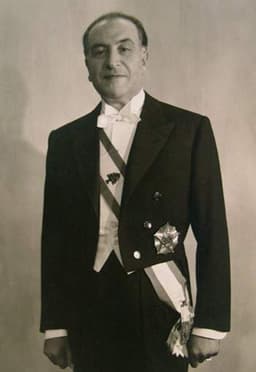
Fuad Chehab
General · Modern
49.9Total
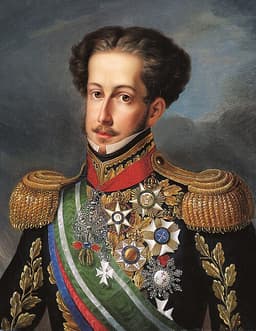
Pedro I of Brazil
Emperor · Modern
54.6Total
Basic Information
Born
1902
1798
Died
1973
1834
Era
Modern
Modern
Nationality
Lebanon
Brazil
Occupation
General
Emperor
Civilization
Middle Eastern
Western
Score Comparison
Military (10%)
10.2
55.0
Political (20%)
70.0
62.7
Influence (20%)
54.1
59.0
Legacy (20%)
44.2
50.0
Leadership (15%)
72.0
53.2
Strategy (15%)
30.3
45.0
TOTAL
49.9
54.6
Fuad Chehab — Complete Timeline
1958 AD
Launched Chehabist reforms and modernizationReform◆ Major
President Chehab implemented a series of reforms known as Chehabism, including administrative modernization, economic planning, and strengthening state institutions. He established the Central Bank of Lebanon and the Civil Service Board.
ReformModernizationState Building
Impact: nationalconstructive
Elected President of LebanonPolitical Action◆ Major
Fuad Chehab was elected President of Lebanon on September 23, 1958, succeeding Camille Chamoun. His election ended the 1958 crisis and was supported by both Christian and Muslim factions seeking stability.
PresidencyElectionStabilization
Impact: nationalconstructive
Created the Deuxième Bureau intelligence agencyPolitical Action
Chehab expanded the role of the Deuxi
IntelligenceSecurityAuthoritarianism
Impact: national
1960 AD
Presided over the 1960s economic boomOther
Under Chehab's presidency, Lebanon experienced a period of economic growth and stability, with Beirut becoming a major financial and tourism hub. His policies attracted foreign investment and expanded the middle class.
Economic GrowthBeirutProsperity
Impact: nationalconstructive
1964 AD
Refused to amend constitution for a second termPolitical Action
Chehab declined to seek a second term as president, respecting the constitutional limit. He retired from politics in 1964, setting a precedent for peaceful transitions of power in Lebanon.
ConstitutionTerm LimitRetirement
Impact: nationalconstructive
Pedro I of Brazil — Complete Timeline
1822 AD
Declaration of Independence of BrazilPolitical Action
Pedro I declared Brazil's independence from Portugal on September 7, 1822, at the Ipiranga River in S
Impact: globalprogressive
Coronation as Emperor of BrazilPolitical Action◆ Major
Pedro I was crowned Emperor of Brazil on December 1, 1822, in Rio de Janeiro. The coronation formalized the new imperial government, with Pedro I as constitutional monarch, though he retained significant executive powers.
Impact: nationalconstructive
1823 AD
War of Independence of BrazilWar◆ Major
Pedro I led Brazilian forces against Portuguese loyalists in the War of Independence. Key battles occurred in Bahia, Maranh
Impact: national
Dissolution of the Constituent AssemblyPolitical Action◆ Major
Pedro I dissolved the Constituent Assembly after conflicts over the constitution's limits on imperial power. He then imposed the 1824 Constitution, which granted the emperor extensive powers, including the Moderating Power, centralizing authority.
Impact: nationaldestructive
1831 AD
Abdication of the Brazilian ThronePolitical Action
Pedro I abdicated the Brazilian throne in favor of his five-year-old son Pedro II on April 7, 1831. He returned to Portugal to claim the Portuguese throne, leaving Brazil under a regency until his son came of age.
Impact: national
Expert Analysis
Fuad Chehab vs Pedro I of Brazil
# The Emperor and the General: Two Paths to Nation Building
On a sweltering September afternoon in 1822, Pedro I stood at the banks of the Ipiranga River in São Paulo and shouted a phrase that would echo through Brazilian history: “Independence or Death!” One hundred and thirty-six years later, in a very different corner of the world, Fuad Chehab took the oath of office in Beirut, inheriting a Lebanon torn by civil war and foreign intervention. Both men faced the same fundamental challenge—how to forge a unified nation from a fractured society—yet their journeys diverged dramatically. Why did one man build an empire only to abandon it, while the other built a legacy of reform that still shapes his country today?
Origins
Pedro I was born into the chaos of European royalty in 1798, the son of Portugal’s Prince Regent João. When Napoleon’s armies swept across the Iberian Peninsula, the entire Portuguese court fled to Brazil, and young Pedro grew up in Rio de Janeiro—a prince in exile, surrounded by court intrigue and the simmering tensions of a colony that resented its mother country. He was impulsive, charismatic, and deeply conscious of his divine right to rule. His education was patchy, but his instincts were sharp: he understood that Brazil’s future lay in breaking free from Portugal.
Fuad Chehab came from a different world entirely. Born in 1902 in the mountain village of Ghazir, he was the son of a Maronite Christian family with a long tradition of military service to the Ottoman Empire. Lebanon was then a patchwork of religious sects—Maronites, Druze, Shia, Sunni, Greek Orthodox—each with its own loyalties and grievances. Chehab grew up in the twilight of Ottoman rule, learning early that power in the Levant required not just strength but a delicate balancing act. He joined the French-sponsored Troupes Spéciales du Levant, rising through the ranks with quiet competence. Where Pedro was a firebrand, Chehab was a listener.
Rise to Power
Pedro’s path to power was swift and theatrical. When Portugal’s parliament demanded his return and the reimposition of colonial rule, he refused, rallying Brazilian elites who feared a return to subordinate status. The declaration at Ipiranga was not a spontaneous outburst but a calculated gamble: he had already secured support from powerful landowners and the Freemason network. His coronation three months later turned a colonial prince into an emperor, a title that carried immense symbolic weight in a continent of republics.
Chehab’s rise was quieter but no less decisive. By 1958, Lebanon was collapsing under the weight of the Cold War. President Camille Chamoun had aligned with the West, triggering a rebellion backed by Egypt’s Gamal Abdel Nasser. The United States landed Marines on Beirut’s beaches, and the country teetered on the brink of partition. Chehab, then army commander, refused to commit his troops to either side, preserving the military as a neutral arbiter. When the crisis ended, he was the only figure trusted by all factions—a general who had never fired on his own people.
Leadership & Governance
As emperor, Pedro I governed with a volatile mix of vision and autocracy. He led Brazilian forces to victory in the War of Independence, crushing Portuguese holdouts in Bahia and Maranhão. But his political skills lagged behind his military ones. When the Constituent Assembly tried to limit his power, he dissolved it and imposed a constitution that concentrated authority in his hands. He was a reformer in theory—he supported education and a unified legal system—but a tyrant in practice, alienating the very elites who had brought him to power.
Chehab governed by consensus. His “Chehabism” was not an ideology but a method: strengthen the state to mediate between sects. He created the Central Inspection Bureau to fight corruption, launched the Litani River irrigation project to develop the countryside, and expanded the Deuxième Bureau intelligence agency to monitor extremists. Critics called it authoritarian; supporters called it stability. Under his watch, Beirut boomed into the financial capital of the Middle East, and for six years Lebanon knew peace.
Triumph & Tragedy
Pedro’s greatest triumph was the independence he won—a feat that made him a national hero. His greatest tragedy came from his inability to share power. By 1831, after a disastrous war with Argentina over Uruguay and mounting unpopularity at home, he faced riots in Rio de Janeiro. Rather than fight, he abdicated in favor of his five-year-old son and sailed back to Portugal, where he died three years later, worn out at thirty-six.
Chehab’s triumph was the survival of Lebanon itself. His tragedy was that his reforms could not outlast him. He refused to amend the constitution for a second term, a principled decision that left his work unfinished. After he retired in 1964, the old sectarian rivalries resurfaced, and Lebanon slid toward the civil war that would consume it in 1975.
Character & Destiny
Pedro I was a man of passion, not patience. He craved glory and resented restraint, and his personality drove him to both conquer and self-destruct. Chehab was a man of calculation, not charisma. He believed institutions outlasted individuals, and his restraint preserved Lebanon for a generation.
Legacy
Pedro’s legacy is the Brazilian nation itself—the vast, unified country that his son Pedro II would hold together for nearly fifty years. He is remembered as the father of independence, but also as a flawed, restless figure who could not govern what he had created.
Chehab’s legacy is more ambiguous. He is revered as a symbol of national unity, but his methods—especially the surveillance state—remain controversial. Yet in a region of strongmen and dynasties, his refusal to cling to power stands as a rare example of constitutional virtue.
Conclusion
Both men faced the same question: how to build a nation from a fractured society. Pedro I answered with a sword and a crown, leaving a country that needed a wiser ruler to survive. Fuad Chehab answered with a constitution and a bureaucracy, leaving a system that needed a stronger leader to endure. Between the emperor’s cry at Ipiranga and the general’s quiet oath in Beirut lies the whole drama of modern nation-building—where character, chance, and circumstance conspire to shape history.
Rankings
🥇
Pedro I of BrazilLeader
Mil: 55.0Pol: 62.7Inf: 59.0
54.6
🥈
Fuad Chehab
Mil: 10.2Pol: 70.0Inf: 54.1
49.9
+4.7 behind
How This Comparison Works
Algorithm
Each figure is scored on 6 dimensions (0—100 scale) based on structured historical data: Military (10%), Political (20%), Influence (20%), Legacy (20%), Leadership (15%), Strategy (15%). The weighted total produces the final ranking.
Data Sources
Scores are computed from structured sub-indicators in the database. Scale factors adjust for era (Ancient ×0.85, Modern ×1.0) and civilization size (Eastern ×1.05, Other ×0.80) to account for differences in population and military scale.
Maximum 3 Figures
Comparisons are limited to 2—3 figures to ensure readability and statistical meaningfulness.
Error Margins
±5 points per dimension — Sub-scores are derived from historical records with inherent uncertainty. Two figures within 5 points on a dimension should be considered roughly equivalent in that area.
Total Score Accuracy
±3 points overall — The weighted combination of 6 dimensions produces a total score with approximately ±3 points of uncertainty. Differences of less than 3 points are not statistically significant— the figures are effectively tied.
Known Limitations
- Historical records are incomplete and uneven across civilizations
- Figures from oral-tradition societies may be underrepresented
- Occupation labels can misclassify multi-role figures
- Scores measure capability and impact, not moral character
- Quantitative scoring is a comparison tool, not absolute truth
Capability Radar
Military (10%) — Battles & Warfare
Battles
5
35
Win Rate
5
40
Expansion
5
30
Political (20%) — Governance & Reform
Reform
65
45
Diplomacy
60
50
Economy
50
30
Influence (20%) — Cultural & Global Reach
Cultural
30
40
Global
25
45
Legacy (20%) — Historical Impact
Historical
35
55
Longevity
30
50
Leadership (15%) — Power & Stability
Tenure
55
55
Stability
45
25
Strategy (15%) — Tactics & Innovation
Strategy
10
35
Tactics
10
30
Reform
20
20
Similar Comparisons
Comments & Discussion
Emperor's Shadow6/16/2026
Pedro I shouting "Independence or Death" is pure theater—a prince playing liberator while keeping slavery intact. Chehab's 1958 reforms actually broke feudal power in Lebanon. One built a cult of personality, the other built institutions. Show me Pedro's agrarian reform bill. I'll wait. Brazil's independence was a royal handoff; Chehab earned his mandate through genuine crisis management.
数据侦探6/16/2026
说Chehab改革成功?看看数据:1960年黎巴嫩基尼系数0.52,十年后只降到0.49。Pedro I治下巴西GDP年均增长2.3%,但土地集中度飙升15%。两个都是精英游戏,只是Chehab用陆军蓝制服换掉了Pedro的金边斗篷。别被叙事骗了,影响力指标不会撒谎。
Γνώστης6/16/2026
Pedro I was an epicurean Stoic—abdicating for his daughter's succession shows philosophical depth Chehab lacked. Chehab's "reforms" were just French colonial tactics repackaged. Pedro understood monarchical legitimacy as a unifying force, something Lebanon's sectarian mess never had. His 1824 Constitution was ahead of its time; Chehab gave us a census that tore the country apart.
咖啡与雪松6/16/2026
一个喊“不独立毋宁死”,一个穿着军装念就职誓词。Pedro睡过巴黎歌剧院后台,Chehab在梵蒂冈档案馆熬夜。两人都成了过时的符号——巴西人把佩德罗做成爆款肥皂剧人设,黎巴嫩人把谢哈布邮票存进相册。历史筛网下,脚踏实地的实干家(Chehab)比浪漫主义赌徒(Pedro)更有回甘。
Lex Talionis6/16/2026
Both failed, but Pedro's failure was more honest—he lost his throne because he wouldn't compromise with the landed oligarchy. Chehab played the "reformist general" card while his intelligence services ran the country like a police state. Pedro's abdication telegram is more transparent than Chehab's entire presidential archive. Genuine autocrats wear their crowns; puppet masters hide behind "emergency powers."