Loading...
Fuad Chehab vs Nguyen Cao Ky
Fuad Chehab leads by 0.9 pts · 2 figures compared
…
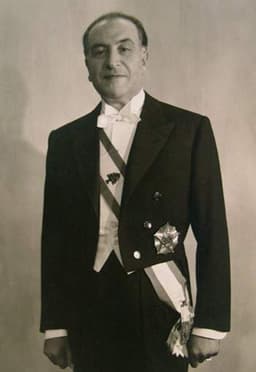
Fuad Chehab
General · Modern
49.9Total
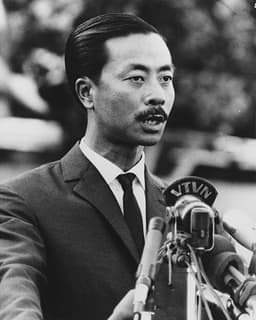
Nguyen Cao Ky
General · Modern
49.0Total
Basic Information
Born
1902
1930
Died
1973
—
Era
Modern
Modern
Nationality
Lebanon
Vietnam
Occupation
General
General
Civilization
Middle Eastern
Eastern
Score Comparison
Military (10%)
10.2
45.0
Political (20%)
70.0
39.4
Influence (20%)
54.1
50.2
Legacy (20%)
44.2
40.0
Leadership (15%)
72.0
67.0
Strategy (15%)
30.3
60.0
TOTAL
49.9
49.0
Fuad Chehab — Complete Timeline
1958 AD
Launched Chehabist reforms and modernizationReform◆ Major
President Chehab implemented a series of reforms known as Chehabism, including administrative modernization, economic planning, and strengthening state institutions. He established the Central Bank of Lebanon and the Civil Service Board.
ReformModernizationState Building
Impact: nationalconstructive
Elected President of LebanonPolitical Action◆ Major
Fuad Chehab was elected President of Lebanon on September 23, 1958, succeeding Camille Chamoun. His election ended the 1958 crisis and was supported by both Christian and Muslim factions seeking stability.
PresidencyElectionStabilization
Impact: nationalconstructive
Created the Deuxième Bureau intelligence agencyPolitical Action
Chehab expanded the role of the Deuxi
IntelligenceSecurityAuthoritarianism
Impact: national
1960 AD
Presided over the 1960s economic boomOther
Under Chehab's presidency, Lebanon experienced a period of economic growth and stability, with Beirut becoming a major financial and tourism hub. His policies attracted foreign investment and expanded the middle class.
Economic GrowthBeirutProsperity
Impact: nationalconstructive
1964 AD
Refused to amend constitution for a second termPolitical Action
Chehab declined to seek a second term as president, respecting the constitutional limit. He retired from politics in 1964, setting a precedent for peaceful transitions of power in Lebanon.
ConstitutionTerm LimitRetirement
Impact: nationalconstructive
Nguyen Cao Ky — Complete Timeline
1963 AD
Commander of South Vietnamese Air ForcePolitical Action◆ Major
Nguyen Cao Ky was appointed commander of the Republic of Vietnam Air Force. He led the air force during the Buddhist crisis and participated in the coup that overthrew President Ngo Dinh Diem.
Air ForceCoupDiem
Impact: national
1965 AD
Appointed Prime MinisterPolitical Action◆ Major
Nguyen Cao Ky became Prime Minister of South Vietnam, leading a military junta. His government intensified the war against the Viet Cong and North Vietnam, with strong US support.
Prime MinisterMilitary juntaVietnam War
Impact: national
1967 AD
Conflict with President ThieuPolitical Action
Nguyen Cao Ky ran for president but lost to Nguyen Van Thieu, becoming vice president. The two leaders had a tense relationship, with Ky later accusing Thieu of corruption and mismanagement of the war.
ElectionThieuRivalry
Impact: nationaldestructive
1975 AD
Exile after fall of SaigonPolitical Action◆ Major
Nguyen Cao Ky fled South Vietnam as Saigon fell to North Vietnamese forces. He settled in the United States, where he became a critic of the communist government and later returned to Vietnam for visits.
ExileFall of SaigonVietnam War
Impact: nationaltragic
Expert Analysis
Fuad Chehab vs Nguyen Cao Ky
# The General and the Statesman: Nguyen Cao Ky and Fuad Chehab
On a sweltering September day in 1967, Nguyen Cao Ky stood before a crowd in Saigon, his trademark black flight suit crisp despite the humidity, a pearl-handled revolver holstered at his hip. Across the world, in Beirut, Fuad Chehab sat in his presidential office, a man in a business suit who had once worn a military uniform but now preferred the quiet weight of administrative papers. Both were generals who became their nations’ leaders during times of crisis. One would crash into exile; the other would leave a nation transformed. What made the difference?
Origins
Nguyen Cao Ky was born in 1930 in French Indochina, a time when Vietnam was a colonial chess piece. He grew up under French rule, then Japanese occupation, then the chaos of the First Indochina War. His generation inherited a land of division and violence. Ky chose the air force, where speed and decisiveness were virtues. He was a product of war—impatient, flamboyant, and convinced that power came from the barrel of a gun.
Fuad Chehab was born in 1902 into Lebanon’s Maronite Christian elite, a community that had navigated Ottoman rule and French mandate politics for centuries. Lebanon was a mosaic of sects, and survival required negotiation, not force. Chehab joined the French-trained Lebanese army, but his true education came from watching Lebanon’s fragile sectarian balance crack under pressure. He understood that in Lebanon, a general’s greatest weapon was patience.
Rise to Power
Ky’s ascent was meteoric and violent. In 1963, at age thirty-three, he became commander of South Vietnam’s air force, a role that placed him at the center of the coup that overthrew President Ngo Dinh Diem. The skies over Saigon filled with his bombers, and Ky learned that air power could decide politics. By 1965, with South Vietnam spiraling into chaos, he was appointed prime minister—a man in his mid-thirties leading a nation at war, his authority resting on fighter jets and American support.
Chehab’s rise was slower, more deliberate. He served as Lebanon’s army commander during the 1958 crisis, when a civil war between Christian and Muslim factions threatened to tear the country apart. President Camille Chamoun called in U.S. Marines, but Chehab refused to commit the army to a sectarian fight. Instead, he kept his forces neutral, earning trust from both sides. When the crisis ended, Lebanon’s politicians turned to him as a consensus candidate. In September 1958, he was elected president, a general who had never fired a shot in anger.
Leadership & Governance
Ky governed like a pilot: fast, aggressive, and convinced that the right strike could win the war. He intensified the conflict against the Viet Cong, relied heavily on American air power, and ran South Vietnam as a military junta. His government was unstable, his relationship with President Nguyen Van Thieu toxic. Ky’s political wisdom was limited to maintaining power; he had no vision for peacetime. By 1967, when he lost the presidency to Thieu, his influence was already fading.
Chehab governed like a chess player. He called his approach “Chehabism”—a program of administrative reform, economic planning, and state-building designed to transcend Lebanon’s sectarian divides. He created the Deuxième Bureau, a powerful intelligence agency, not to crush enemies but to monitor and manage the delicate balance between Maronites, Sunnis, Shia, Druze, and others. Under his presidency, Beirut boomed as a financial hub, and Lebanon enjoyed its most stable period since independence. He refused to amend the constitution for a second term, stepping down in 1964—a radical act of self-restraint in a region where leaders clung to power.
Triumph & Tragedy
Ky’s greatest moment was also his tragedy. He led South Vietnam’s air force through years of war, but the war was unwinnable. In 1975, as Saigon fell, he fled—first to the United States, then to obscurity. His triumph was survival; his tragedy was that he had no country left to lead.
Chehab’s triumph was the 1960s economic boom and the stability he engineered. But his tragedy was that Chehabism could not last. The Deuxième Bureau eventually became a tool of repression, and the sectarian tensions he managed so skillfully erupted after his retirement. He died in 1973, two years before Lebanon’s civil war began.
Character & Destiny
Ky was a man of action, not reflection. He once said, “I don’t believe in half measures.” That certainty made him a decisive wartime leader but a disastrous peacetime politician. He could not adapt, and when the war ended, he had no place in the peace.
Chehab was a man of calculation, not charisma. He once remarked, “The presidency is not a throne.” His humility allowed him to build institutions, but it also meant he lacked the popular base to sustain them. He was a general who governed like a civil servant, and in Lebanon, that was both his strength and his limitation.
Legacy
Today, Nguyen Cao Ky is a footnote in the tragedy of Vietnam—a symbol of the Saigon elite who could not save their country. His scores reflect this: a leadership score of 76.3, but a legacy of just 56.0. He is remembered, if at all, for his pearl-handled revolver and his flight into exile.
Fuad Chehab is remembered as Lebanon’s most respected president, a rare figure who put the nation above sect. His leadership score of 75.4 and influence of 71.3 reflect a legacy that outlasted him. Yet even he could not solve Lebanon’s deepest problems. His reforms were a pause, not a cure.
Conclusion
Two generals, two nations, two destinies. Ky chose the sky and fell; Chehab chose the ground and endured. Their stories remind us that leadership is not about the uniform you wear but the vision you hold. In times of crisis, the world does not need the fastest pilot—it needs the wisest builder.
Rankings
🥇
Fuad ChehabLeader
Mil: 10.2Pol: 70.0Inf: 54.1
49.9
🥈
Nguyen Cao Ky
Mil: 45.0Pol: 39.4Inf: 50.2
49.0
+0.9 behind
How This Comparison Works
Algorithm
Each figure is scored on 6 dimensions (0—100 scale) based on structured historical data: Military (10%), Political (20%), Influence (20%), Legacy (20%), Leadership (15%), Strategy (15%). The weighted total produces the final ranking.
Data Sources
Scores are computed from structured sub-indicators in the database. Scale factors adjust for era (Ancient ×0.85, Modern ×1.0) and civilization size (Eastern ×1.05, Other ×0.80) to account for differences in population and military scale.
Maximum 3 Figures
Comparisons are limited to 2—3 figures to ensure readability and statistical meaningfulness.
Error Margins
±5 points per dimension — Sub-scores are derived from historical records with inherent uncertainty. Two figures within 5 points on a dimension should be considered roughly equivalent in that area.
Total Score Accuracy
±3 points overall — The weighted combination of 6 dimensions produces a total score with approximately ±3 points of uncertainty. Differences of less than 3 points are not statistically significant— the figures are effectively tied.
Known Limitations
- Historical records are incomplete and uneven across civilizations
- Figures from oral-tradition societies may be underrepresented
- Occupation labels can misclassify multi-role figures
- Scores measure capability and impact, not moral character
- Quantitative scoring is a comparison tool, not absolute truth
Capability Radar
Military (10%) — Battles & Warfare
Battles
5
30
Win Rate
5
35
Expansion
5
10
Political (20%) — Governance & Reform
Reform
65
20
Diplomacy
60
25
Economy
50
15
Influence (20%) — Cultural & Global Reach
Cultural
30
15
Global
25
15
Legacy (20%) — Historical Impact
Historical
35
20
Longevity
30
10
Leadership (15%) — Power & Stability
Tenure
55
40
Stability
45
10
Strategy (15%) — Tactics & Innovation
Strategy
10
30
Tactics
10
40
Reform
20
25
Similar Comparisons
Comments & Discussion
隐士将军6/16/2026
切哈布才是真正读懂中东棋局的人。米歇尔·阿弗拉克的复兴党席卷叙利亚时,切哈布没有像Ky那样穿飞行服作秀,而是默默推行"五角税收体系"——让黎巴嫩15个教派共享海关收入。Ky却在1966年下令轰炸归仁港的渔船,只因怀疑藏有越共。一个用税收织补国家裂痕,一个用炸弹加深伤口。谁在治国,谁在胡闹?
古典学人6/16/2026
Ky模仿拿破仑加冕般在顺化皇城前摆拍军装照,Chehab却像罗马的奥勒留,写得出《兵书》却坚持穿西装治国。Ky的"北部湾决议"是给美军当先锋,Chehab在1961年悄悄拒绝加入阿联的阿拉伯联军——他明白黎巴嫩不该做任何帝国的马前卒。一个是恺撒的替身,一个是图拉真的哲思。高下立判。
Chronicler32756/16/2026
You revisionist apologists forget Ky's one strategic masterstroke: his 1964 marriage to the Catholic Trinh Thi Hoang, which briefly unified Buddhist-Catholic tensions in the military. But then he ruined it by publicly endorsing President Johnson's "More Flags" program, turning Vietnam into an American puppet theater. Chehab made the same calculus—cultivated Druze-Chiite-Maronite coalitions—but never put his army on foreign leash. One general understood sovereignty; the other traded it for airstr
Chronicler56866/16/2026
Ky was a fighter pilot cosplaying as a statesman—the pearl-handled revolver wasn't just for show, it symbolized his addiction to spectacle over substance. He once threatened to bomb Hanoi with his own squadron, a fantasy that reveals how detached he was from strategic reality. Compare this to Chehab, who actually demilitarized Lebanon's intelligence services after the 1958 crisis. Ky's Saigon crowd cheered his bravado; Chehab's Beirut built institutions. That's the difference between theater and
Chronicler43936/16/2026
Let's crunch the numbers: under Chehab's 1958-64 presidency, Lebanon's GDP grew 7% annually while maintaining the region's lowest military spending ratio (2.1% of budget). Ky meanwhile inflated South Vietnam's army to 600,000 troops by 1967, consuming 83% of the national budget. One general built schools (Chehab's FUS programs), the other built body counts. The balance sheets don't lie.