Loading...
Franklin D. Roosevelt vs Yuan Shikai
Franklin D. Roosevelt leads by 11.0 pts · 2 figures compared
…
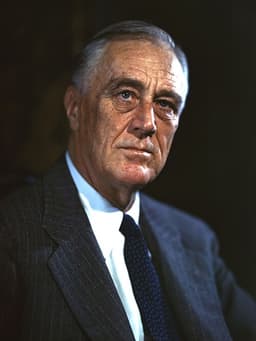
Franklin D. Roosevelt
Politician · Modern
71.0Total
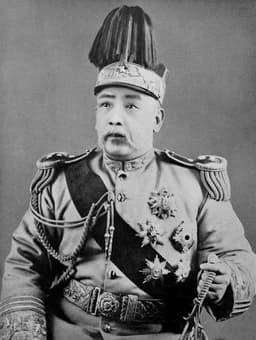
Yuan Shikai
Politician · Modern
60.0Total
Basic Information
Born
1882
1859
Died
1945
1916
Era
Modern
Modern
Nationality
United States
China
Occupation
Politician
Politician
Civilization
Western
Eastern
Score Comparison
Military (10%)
45.0
45.0
Political (20%)
85.0
72.0
Influence (20%)
75.0
57.2
Legacy (20%)
65.0
54.0
Leadership (15%)
85.0
72.0
Strategy (15%)
60.0
61.2
TOTAL
71.0
60.0
Franklin D. Roosevelt — Complete Timeline
1933 AD
Inaugurated as 32nd PresidentOther◆ Major
Franklin D. Roosevelt was inaugurated as President of the United States on March 4, 1933, during the Great Depression. His inaugural address declared 'the only thing we have to fear is fear itself,' and he immediately called Congress into special session to address the banking crisis.
Great DepressionPresidencyInauguration
Impact: national
Enacted the New DealOther◆ Major
Roosevelt launched the New Deal in 1933, a series of federal programs including the Civilian Conservation Corps, the Agricultural Adjustment Act, and the Tennessee Valley Authority. These measures aimed to provide relief, recovery, and reform during the Great Depression, fundamentally expanding the role of the federal government.
Great DepressionEconomic PolicySocial Reform
Impact: nationalconstructive
1935 AD
Signed the Social Security ActOther◆ Major
Roosevelt signed the Social Security Act into law on August 14, 1935, establishing a federal system of old-age pensions, unemployment insurance, and aid for dependent children. This created the modern American welfare state and provided a safety net for millions of citizens.
Social WelfareLegislationNew Deal
Impact: nationalconstructive
1941 AD
Lend-Lease ActOther◆ Major
Roosevelt signed the Lend-Lease Act on March 11, 1941, authorizing the transfer of military equipment and supplies to Allied nations, particularly Britain and the Soviet Union. This program provided critical material support to countries fighting the Axis powers before U.S. entry into World War II.
World War IIForeign PolicyMilitary Aid
Impact: globalconstructive
Declaration of War on JapanPolitical Action◆ Major
Following the Japanese attack on Pearl Harbor on December 7, 1941, Roosevelt delivered his 'Day of Infamy' speech to Congress the next day, requesting a declaration of war. Congress approved the declaration, bringing the United States into World War II.
World War IIPearl HarborDeclaration of War
Impact: globaldestructive
1942 AD
Executive Order 9066Other◆ Major
Roosevelt signed Executive Order 9066 on February 19, 1942, authorizing the forced relocation and internment of Japanese Americans living on the West Coast. Over 110,000 people, mostly U.S. citizens, were incarcerated in camps for the duration of the war, a decision later widely condemned as a violation of civil rights.
World War IICivil RightsInternment
Impact: nationaldestructive
1944 AD
Elected to Fourth TermOther◆ Major
Roosevelt was elected to an unprecedented fourth term as president in November 1944, defeating Republican Thomas E. Dewey. This election occurred during the final stages of World War II, and Roosevelt's continued leadership ensured stability in the war effort and post-war planning.
PresidencyElectionWorld War II
Impact: national
1945 AD
Yalta ConferenceOther◆ Major
Roosevelt met with Winston Churchill and Joseph Stalin at the Yalta Conference in February 1945 to discuss post-war Europe. Agreements included the division of Germany, Soviet entry into the war against Japan, and the creation of the United Nations, shaping the post-war world order.
World War IIDiplomacyPost-War Planning
Impact: global
Yuan Shikai — Complete Timeline
1901 AD
Command of the Beiyang ArmyReform◆ Major
Yuan Shikai took command of the Beiyang Army, the most modern military force in late Qing China. He expanded and trained the army, which became the basis for his political power and later dominated Chinese politics.
Military reformBeiyang Army
Impact: national
1912 AD
Appointed First President of the Republic of ChinaPolitical Action
Yuan Shikai became the first president of the Republic of China after negotiating the abdication of the Qing emperor. He used his control of the Beiyang Army to pressure the revolutionary government into accepting his leadership.
PresidencyRepublic of China
Impact: national
1915 AD
Declaration of the Empire of ChinaPolitical Action◆ Major
Yuan Shikai declared himself emperor of the Empire of China, attempting to restore the monarchy. This move sparked widespread opposition from provincial leaders and foreign powers, leading to the collapse of his regime.
Monarchy restorationPolitical crisis
Impact: nationaldestructive
Signing of the Twenty-One DemandsPolitical Action◆ Major
Yuan Shikai accepted most of Japan's Twenty-One Demands, which expanded Japanese influence in China. The agreement granted Japan economic rights in Manchuria and Shandong, and was seen as a national humiliation.
DiplomacyJapanese imperialism
Impact: globaltragic
1916 AD
Death and Collapse of the Beiyang GovernmentPolitical Action◆ Major
Yuan Shikai died of uremia, leaving no clear successor. His death led to the fragmentation of the Beiyang Army into warlord factions, plunging China into a period of civil war and political instability.
Warlord eraPolitical fragmentation
Impact: nationaltragic
Expert Analysis
Franklin D. Roosevelt vs Yuan Shikai
The Two Faces of Modern Power
In the winter of 1915, as the guns of the Great War fell silent in Europe for a moment, two men on opposite sides of the Pacific faced decisions that would define their nations for generations. In Washington, Franklin Delano Roosevelt, then Assistant Secretary of the Navy, was preparing for a future he could not yet see. In Beijing, Yuan Shikai, the first president of the Republic of China, was preparing to crown himself emperor. One man would become the architect of American resilience; the other, the gravedigger of Chinese democracy. What separated them was not merely geography, but the very nature of how power is earned, held, and surrendered.
Origins
Franklin D. Roosevelt was born into privilege in 1882, the only child of a wealthy New York family. His upbringing was one of patrician confidence—Hyde Park estates, Groton School, Harvard College. He absorbed the genteel progressivism of Theodore Roosevelt, his distant cousin, and learned that leadership was a duty of the fortunate. Polio struck him in 1921, at age 39, and the disease remade him. The man who could no longer walk learned to listen, to calculate, to inspire through voice alone. His disability forced a humility that wealth never could.
Yuan Shikai, born in 1859, came from a military family in Henan province. The Qing Empire was crumbling around him—the Opium Wars, the Taiping Rebellion, the humiliation of foreign concessions. Yuan’s education was not in elite schools but in the brutal school of Chinese military bureaucracy. He failed the civil service exams twice, a humiliation that taught him that merit mattered less than connections. He bought his first official post. Where Roosevelt’s path was paved with noblesse oblige, Yuan’s was paved with survival.
Rise to Power
Roosevelt’s ascent was a slow, deliberate climb through the Democratic Party. He won a state senate seat in 1910, served as Assistant Secretary of the Navy during World War I, and was nominated for vice president in 1920—a losing ticket. Then polio. For seven years, he retreated, rebuilt, and returned to win the governorship of New York in 1928. The Depression arrived in 1929, and by 1932, his message of a "New Deal" resonated with a nation in despair. He won in a landslide, taking 42 of 48 states.
Yuan Shikai’s rise was faster, more ruthless, and more dependent on the sword. In 1901, he took command of the Beiyang Army, the most modern force in China. He did not build it from scratch; he inherited it from Li Hongzhang and then expanded it, filling its officer corps with loyalists. When the Qing dynasty collapsed in 1911, Yuan was the only man who could negotiate between the imperial court and the revolutionaries. In 1912, he became the first president of the Republic of China—not through election, but through backroom deals. He had the army; Sun Yat-sen had the ideas. In politics, the army usually wins.
Leadership & Governance
Roosevelt governed through persuasion and institutional creativity. His New Deal created Social Security, the Securities and Exchange Commission, and the Tennessee Valley Authority. He gave "fireside chats" on the radio, speaking directly to millions of frightened Americans. His political wisdom lay in understanding that a democracy must act boldly or die. During World War II, he managed a global alliance—Churchill, Stalin, Chiang Kai-shek—while mobilizing the American economy. His leadership score of 85 reflects this: he was a master of coalition, of timing, of hope.
Yuan Shikai governed through fear and patronage. His political score of 74 is respectable, but his methods were brittle. He tolerated no dissent, suppressed the Kuomintang, and ruled through military governors. His military score of 60.7 is slightly above Roosevelt’s 60, but it was a hollow strength—the Beiyang Army was loyal to Yuan personally, not to the republic. When he signed the Twenty-One Demands with Japan in 1915, accepting expanded Japanese influence in Manchuria and Shandong, he bought short-term peace at the cost of national humiliation. He did not understand that legitimacy cannot be purchased.
Triumph & Tragedy
Roosevelt’s greatest moment came in the depths of the Depression: the 100 days of 1933, when he pushed through fifteen major bills, restarting the banking system and putting millions to work. His greatest failure was arguably the internment of Japanese Americans during World War II—a decision driven by wartime panic that stained his legacy. Yet even here, he acted within a democratic framework, however flawed.
Yuan Shikai’s triumph was the peaceful abdication of the Qing emperor in 1912—a rare moment in Chinese history where bloodshed was avoided. His tragedy was the Empire of China. In 1915, he declared himself emperor, attempting to restore the monarchy with himself as the Hongxian Emperor. It was a catastrophic miscalculation. Provincial governors rebelled; foreign powers withdrew support; even his own Beiyang generals turned away. He was forced to cancel the monarchy in March 1916, and died of uremia three months later, broken and reviled. The republic he had led fragmented into warlord chaos.
Character & Destiny
Roosevelt’s character was defined by resilience and optimism. Polio taught him patience; privilege taught him responsibility. He could charm opponents, outmaneuver rivals, and wait for the right moment. His famous line—"The only thing we have to fear is fear itself"—was not rhetoric. It was autobiography.
Yuan Shikai’s character was defined by ambition and suspicion. He trusted no one, and no one trusted him. He believed power was a zero-sum game. When Sun Yat-sen offered him the presidency, Yuan reportedly said, "The presidency is not something to be offered; it is something to be taken." He could not imagine a system where power was shared. His strategy score of 65.4 reflects this: he was tactically brilliant but strategically blind. He won every battle and lost the war.
Legacy
Roosevelt is remembered as one of America’s greatest presidents. His Social Security system still supports the elderly; his New Deal philosophy still shapes American governance. His four terms led to the Twenty-Second Amendment, limiting future presidents. His legacy score of 75 is high but not perfect—historians debate his economic policies and his handling of the Holocaust.
Yuan Shikai’s legacy is almost entirely negative in mainland China. He is remembered as a traitor who sold out to Japan, a dictator who crushed democracy, and a fool who tried to become emperor in the twentieth century. His legacy score of 65.9 is generous. The warlord era he unleashed killed millions. Even his military achievement—the Beiyang Army—became the instrument of China’s disunity.
Conclusion
Two men, two paths, two outcomes. Roosevelt inherited a crisis and built institutions. Yuan Shikai inherited a crisis and built a throne. The difference was not intelligence or ambition—both had plenty. The difference was vision. Roosevelt understood that power, in a modern state, must be grounded in consent, in law, in shared sacrifice. Yuan Shikai understood only that power must be held, personally, until death. In the end, Roosevelt’s America became the world’s leading democracy. Yuan Shikai’s China descended into a chaos from which it would not emerge for decades. The lesson is as old as politics itself: the leader who builds for himself builds only a tomb. The leader who builds for the people builds a nation.
Rankings
🥇
Franklin D. RooseveltLeader
Mil: 45.0Pol: 85.0Inf: 75.0
71.0
🥈
Yuan Shikai
Mil: 45.0Pol: 72.0Inf: 57.2
60.0
+11.0 behind
How This Comparison Works
Algorithm
Each figure is scored on 6 dimensions (0—100 scale) based on structured historical data: Military (10%), Political (20%), Influence (20%), Legacy (20%), Leadership (15%), Strategy (15%). The weighted total produces the final ranking.
Data Sources
Scores are computed from structured sub-indicators in the database. Scale factors adjust for era (Ancient ×0.85, Modern ×1.0) and civilization size (Eastern ×1.05, Other ×0.80) to account for differences in population and military scale.
Maximum 3 Figures
Comparisons are limited to 2—3 figures to ensure readability and statistical meaningfulness.
Error Margins
±5 points per dimension — Sub-scores are derived from historical records with inherent uncertainty. Two figures within 5 points on a dimension should be considered roughly equivalent in that area.
Total Score Accuracy
±3 points overall — The weighted combination of 6 dimensions produces a total score with approximately ±3 points of uncertainty. Differences of less than 3 points are not statistically significant— the figures are effectively tied.
Known Limitations
- Historical records are incomplete and uneven across civilizations
- Figures from oral-tradition societies may be underrepresented
- Occupation labels can misclassify multi-role figures
- Scores measure capability and impact, not moral character
- Quantitative scoring is a comparison tool, not absolute truth
Capability Radar
Military (10%) — Battles & Warfare
Battles
10
45
Win Rate
10
55
Expansion
10
50
Political (20%) — Governance & Reform
Reform
95
55
Diplomacy
90
70
Economy
95
50
Influence (20%) — Cultural & Global Reach
Cultural
80
40
Global
90
35
Legacy (20%) — Historical Impact
Historical
90
65
Longevity
85
40
Leadership (15%) — Power & Stability
Tenure
90
60
Stability
75
30
Strategy (15%) — Tactics & Innovation
Strategy
65
65
Tactics
10
60
Reform
70
80
Similar Comparisons
Comments & Discussion
JadeDragonBooks6/16/2026
This comparison overlooks the critical role of timing and personality. FDR inherited a broken economy in 1933; he used radio to connect directly with Americans, crafting a democratic mandate that saved capitalism from itself. Yuan, by contrast, faced a post-imperial vacuum—he had no established institutions to work with. But here’s the kicker: FDR trusted his people with power; Yuan trusted only himself. That’s the difference between nation-building and personal empire-building. A classic case o
历史真相捕手6/16/2026
把罗斯福与袁世凯并列,真是在侮辱美国。罗斯福是渐进改革的大师,他用公权力约束了华尔街的贪婪,签下《社会保障法》养活数千万老人孤儿。而袁世凯呢? 1915年他签署“二十一条”时,用主权换个人野心,这不是“混乱时代的悲剧”——这是赤裸裸的卖国。民国民主被埋葬在他的皇袍下,别给叛徒找借口——历史判决已下。
笑谈风云6/16/2026
罗斯福和袁世凯最根本的差别不在出身或时代,而在对“公共信任”的理解。罗斯福连任四次,是因为他在炉边谈话里对失业者说“你们不孤单”,并真正推行了新政。袁世凯呢?他用军队和暗杀控制议会,连立宪都怕——他1920年下令解散国会时,连自己的顾问都没通知。这不是“复杂历史人物”,这是掌握绝对权力后自我膨胀的典型——历史总是重复这个模式。
Historian9306/16/2026
As a military history nut, I have to flag Yuan’s one genuine success: the Beiyang Fleet reform. He inherited a nearly annihilated navy after 1895 and got six new warships built by 1910, keeping China’s coastal defenses alive for a decade. FDR’s expansion of the U.S. Navy by 70% from 1933–40 was strategically critical for WWII, but let’s not pretend he was the only guy who built a fleet from scratch. Yuan’s shipbuilding was a tactical necessity; FDR’s was a global gamble. Both understood the powe
Chronicler52056/16/2026
I need to push back on the claim that Yuan was “the gravedigger of Chinese democracy.” That’s too neat. China’s first republic had no democratic tradition—the elite were patriarchic, the masses illiterate, the economy feudal. Yuan’s imperial regression was a disaster, sure, but the democracy that FDR nurtured had 150 years of constitutionalism behind it. The comparison should note the lack of democratic soil in Yuan’s context, not just his personal malice. Both leaders were products of their env