Loading...
Franklin D. Roosevelt vs George Washington
George Washington leads by 5.8 pts · 2 figures compared
…
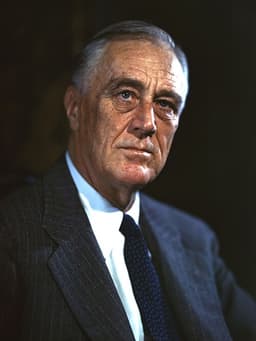
Franklin D. Roosevelt
Politician · Modern
71.0Total
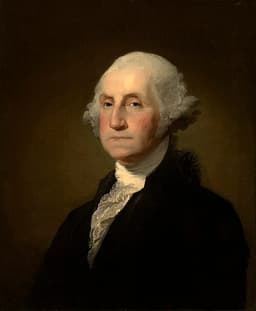
George Washington
Politician · Modern
76.8Total
Basic Information
Born
1882
1732
Died
1945
1799
Era
Modern
Modern
Nationality
United States
United States
Occupation
Politician
Politician
Civilization
Western
Western
Score Comparison
Military (10%)
45.0
75.0
Political (20%)
85.0
82.0
Influence (20%)
75.0
75.0
Legacy (20%)
65.0
80.0
Leadership (15%)
85.0
85.0
Strategy (15%)
60.0
55.0
TOTAL
71.0
76.8
Franklin D. Roosevelt — Complete Timeline
1933 AD
Inaugurated as 32nd PresidentOther◆ Major
Franklin D. Roosevelt was inaugurated as President of the United States on March 4, 1933, during the Great Depression. His inaugural address declared 'the only thing we have to fear is fear itself,' and he immediately called Congress into special session to address the banking crisis.
Great DepressionPresidencyInauguration
Impact: national
Enacted the New DealOther◆ Major
Roosevelt launched the New Deal in 1933, a series of federal programs including the Civilian Conservation Corps, the Agricultural Adjustment Act, and the Tennessee Valley Authority. These measures aimed to provide relief, recovery, and reform during the Great Depression, fundamentally expanding the role of the federal government.
Great DepressionEconomic PolicySocial Reform
Impact: nationalconstructive
1935 AD
Signed the Social Security ActOther◆ Major
Roosevelt signed the Social Security Act into law on August 14, 1935, establishing a federal system of old-age pensions, unemployment insurance, and aid for dependent children. This created the modern American welfare state and provided a safety net for millions of citizens.
Social WelfareLegislationNew Deal
Impact: nationalconstructive
1941 AD
Lend-Lease ActOther◆ Major
Roosevelt signed the Lend-Lease Act on March 11, 1941, authorizing the transfer of military equipment and supplies to Allied nations, particularly Britain and the Soviet Union. This program provided critical material support to countries fighting the Axis powers before U.S. entry into World War II.
World War IIForeign PolicyMilitary Aid
Impact: globalconstructive
Declaration of War on JapanPolitical Action◆ Major
Following the Japanese attack on Pearl Harbor on December 7, 1941, Roosevelt delivered his 'Day of Infamy' speech to Congress the next day, requesting a declaration of war. Congress approved the declaration, bringing the United States into World War II.
World War IIPearl HarborDeclaration of War
Impact: globaldestructive
1942 AD
Executive Order 9066Other◆ Major
Roosevelt signed Executive Order 9066 on February 19, 1942, authorizing the forced relocation and internment of Japanese Americans living on the West Coast. Over 110,000 people, mostly U.S. citizens, were incarcerated in camps for the duration of the war, a decision later widely condemned as a violation of civil rights.
World War IICivil RightsInternment
Impact: nationaldestructive
1944 AD
Elected to Fourth TermOther◆ Major
Roosevelt was elected to an unprecedented fourth term as president in November 1944, defeating Republican Thomas E. Dewey. This election occurred during the final stages of World War II, and Roosevelt's continued leadership ensured stability in the war effort and post-war planning.
PresidencyElectionWorld War II
Impact: national
1945 AD
Yalta ConferenceOther◆ Major
Roosevelt met with Winston Churchill and Joseph Stalin at the Yalta Conference in February 1945 to discuss post-war Europe. Agreements included the division of Germany, Soviet entry into the war against Japan, and the creation of the United Nations, shaping the post-war world order.
World War IIDiplomacyPost-War Planning
Impact: global
George Washington — Complete Timeline
1775 AD
Appointed Commander-in-Chief of the Continental ArmyOther◆ Major
The Second Continental Congress appointed Washington as commander-in-chief of the Continental Army on June 15, 1775. He accepted the position without pay, taking command of the forces besieging Boston at the start of the American Revolutionary War.
American RevolutionMilitary Leadership
Impact: national
1776 AD
Crossed the Delaware RiverOther◆ Major
On the night of December 25-26, 1776, Washington led 2,400 troops across the ice-choked Delaware River. The surprise attack on Hessian forces at Trenton resulted in a decisive American victory, capturing nearly 1,000 prisoners and reviving Patriot morale after a series of defeats.
American RevolutionBattleTurning Point
Impact: nationalconstructive
1787 AD
Presided over the Constitutional ConventionPolitical Action◆ Major
Washington served as president of the Constitutional Convention in Philadelphia from May to September 1787. His presence lent legitimacy to the proceedings, and he formally signed the final draft of the U.S. Constitution, though he contributed little to the debates.
ConstitutionFounding Father
Impact: national
1789 AD
Inaugurated as First President of the United StatesPolitical Action◆ Major
Washington was unanimously elected by the Electoral College and inaugurated on April 30, 1789, at Federal Hall in New York City. He established numerous executive branch precedents, including the cabinet system, the inaugural address, and the title 'Mr. President'.
PresidencyFounding Father
Impact: national
1793 AD
Issued the Proclamation of NeutralityOther◆ Major
Washington issued the Proclamation of Neutrality on April 22, 1793, declaring the United States neutral in the conflict between France and Great Britain. This decision established the precedent of American isolationism and avoided entanglement in European wars.
Foreign PolicyNeutrality
Impact: national
1796 AD
Delivered the Farewell AddressOther◆ Major
Washington published his Farewell Address on September 19, 1796, announcing his decision not to seek a third term. The address warned against political factionalism, permanent foreign alliances, and the influence of the military in government, shaping American political culture.
PresidencyLegacy
Impact: national
Expert Analysis
George Washington vs Franklin D. Roosevelt
# The Two Foundings: Washington and Roosevelt and the Reinvention of America
On a raw December night in 1799, George Washington lay dying at Mount Vernon, his physicians bleeding him with leeches even as he gasped for air. A continent away, 117 years later, a different kind of American leader would be wheeled into a White House study, his legs paralyzed by polio, his voice the only weapon he had left. Between these two men—the stoic planter who refused a crown and the patrician patrician who bent the Constitution to save a nation—lies the entire arc of the American experiment. How did the same office, the same flag, produce such radically different leaders? The answer is not in their bloodlines but in the crises that defined them.
Origins
Washington was born into a Virginia gentry that still remembered the sting of British rule. His father died when he was eleven, leaving him a modest inheritance and a hunger for status that would never fully leave him. He learned surveying not from books but from tramping through the Ohio wilderness, measuring land for speculators. The frontier shaped him: he learned to endure, to command, to keep his emotions locked behind a mask of marble. His world was one of deference and duty, where a gentleman’s word was his bond and honor was a currency more precious than gold.
Franklin Delano Roosevelt emerged from a different America entirely. Born at Hyde Park in 1882, he was the only child of a wealthy Hudson River family, coddled by governesses and tutored by private masters. His world was one of privilege so complete that it seemed immune to history’s rougher edges. Yet something restless stirred in him. He worshipped his distant cousin Theodore, the Rough Rider who had stormed San Juan Hill and broken trusts. FDR learned early that power was not inherited but performed—that a smile could be a weapon, and a patrician’s charm could disarm a crowd of farmers.
Rise to Power
Washington’s ascent was a slow burn of competence and presence. At twenty-two, he led a disastrous skirmish in the Ohio Valley that sparked the French and Indian War. He survived, learned, and returned to Virginia a hero. His real breakthrough came in 1775, when the Continental Congress chose him to command the ragtag army besieging Boston. He was not the most brilliant soldier—his military score of 70 reflects a solid but unspectacular talent—but he was the only man who could hold the army together. He lost more battles than he won, yet he never lost the army itself.
Roosevelt’s rise was swifter and more theatrical. He entered politics as a state senator in 1910, then served as Assistant Secretary of the Navy under Woodrow Wilson. In 1920, he ran for vice president and lost. Then came the polio, the paralysis, the years of painful rehabilitation at Warm Springs. The disease remade him. It stripped away the last traces of arrogance and replaced them with a steel resolve. When he accepted the Democratic nomination in 1932, he flew to Chicago—the first major candidate to do so—and promised a “New Deal” for a nation in despair. The contrast with Washington could not be starker: one man rose through endurance, the other through transformation.
Leadership & Governance
Washington governed by presence. At the Constitutional Convention in 1787, he sat silently for months, his mere attendance lending legitimacy to the proceedings. As president, he understood that every action would set a precedent. He insisted on being called “Mr. President” rather than “His Highness,” and he walked through the streets of New York without guards, establishing that the office was accessible, not monarchical. His cabinet was a battlefield of rivalries—Hamilton versus Jefferson—and Washington stood above it, adjudicating, refusing to take sides. His political score of 80 reflects a man who governed by restraint, not by force.
Roosevelt governed by motion. He entered the White House in March 1933, with banks failing across the country and unemployment at 25 percent. In his first hundred days, he pushed through a blizzard of legislation: the Emergency Banking Act, the Civilian Conservation Corps, the Agricultural Adjustment Act. He spoke to the nation by radio in “fireside chats,” his voice a calm presence in millions of living rooms. His leadership score of 85 is a testament to his ability to mobilize a nation through sheer force of personality. Where Washington held the line, Roosevelt moved it.
Triumph & Tragedy
Washington’s greatest triumph was not a battle but a surrender. In December 1783, he resigned his commission before the Continental Congress, handing back the power that a grateful nation would have given him for life. King George III called him “the greatest character of the age.” His tragedy was quieter: he died childless, the father of a nation but not of a family, his legacy frozen in the amber of his own myth.
Roosevelt’s triumph was the New Deal and the defeat of Nazi Germany. He built Social Security, the minimum wage, and the framework of the modern welfare state. He led the Grand Alliance that crushed Hitler, and he died in April 1945, just weeks before victory. His tragedy was that he did not live to see the peace. He also broke the two-term tradition—a precedent Washington had established—and his enemies accused him of becoming a dictator. The tension between his achievements and his methods remains unresolved.
Character & Destiny
Washington was a man of immense self-control. He burned his correspondence, guarded his emotions, and presented a face of stoic calm. His personality was a fortress, and history has respected its walls. Roosevelt was a man of immense self-confidence. He lied to the public about his polio, smiled through pain, and managed a sprawling government through charm and indirection. His personality was a labyrinth, and historians still argue about what lay at its center.
Both men understood that leadership is performance. But Washington performed for posterity, while Roosevelt performed for the moment. One built a stage that would last for centuries; the other filled that stage with a drama that saved millions.
Legacy
Washington’s legacy is the office itself. He defined what a president should be: above faction, above ambition, above party. Every president since has measured himself against the Washington myth. Roosevelt’s legacy is the expanded state. He redefined what a president could do: intervene in the economy, command a global war, speak directly to the people. The modern presidency is his creation.
Their scores tell the story: Washington’s total of 74.5 and Roosevelt’s 75.7 are almost identical, yet they represent opposite poles of leadership. Washington built the vessel; Roosevelt sailed it into the storm.
Conclusion
Standing at the Lincoln Memorial, visitors see two inscriptions: one from the Gettysburg Address, one from the Second Inaugural. But if you look further back, to the Washington Monument rising across the Reflecting Pool, you see the first American president—a man who refused to be a king. And if you look forward, to the legacy of the New Deal, you see the second—a man who became something like a king to save the republic. Between them, they defined what America could be: a nation of laws, and a nation of action. The question they leave us is whether those two visions can ever be reconciled.
Rankings
🥇
George WashingtonLeader
Mil: 75.0Pol: 82.0Inf: 75.0
76.8
🥈
Franklin D. Roosevelt
Mil: 45.0Pol: 85.0Inf: 75.0
71.0
+5.8 behind
How This Comparison Works
Algorithm
Each figure is scored on 6 dimensions (0—100 scale) based on structured historical data: Military (10%), Political (20%), Influence (20%), Legacy (20%), Leadership (15%), Strategy (15%). The weighted total produces the final ranking.
Data Sources
Scores are computed from structured sub-indicators in the database. Scale factors adjust for era (Ancient ×0.85, Modern ×1.0) and civilization size (Eastern ×1.05, Other ×0.80) to account for differences in population and military scale.
Maximum 3 Figures
Comparisons are limited to 2—3 figures to ensure readability and statistical meaningfulness.
Error Margins
±5 points per dimension — Sub-scores are derived from historical records with inherent uncertainty. Two figures within 5 points on a dimension should be considered roughly equivalent in that area.
Total Score Accuracy
±3 points overall — The weighted combination of 6 dimensions produces a total score with approximately ±3 points of uncertainty. Differences of less than 3 points are not statistically significant— the figures are effectively tied.
Known Limitations
- Historical records are incomplete and uneven across civilizations
- Figures from oral-tradition societies may be underrepresented
- Occupation labels can misclassify multi-role figures
- Scores measure capability and impact, not moral character
- Quantitative scoring is a comparison tool, not absolute truth
Capability Radar
Military (10%) — Battles & Warfare
Battles
10
75
Win Rate
10
70
Expansion
10
60
Political (20%) — Governance & Reform
Reform
95
90
Diplomacy
90
85
Economy
95
65
Influence (20%) — Cultural & Global Reach
Cultural
80
85
Global
90
85
Legacy (20%) — Historical Impact
Historical
90
95
Longevity
85
90
Leadership (15%) — Power & Stability
Tenure
90
70
Stability
75
85
Strategy (15%) — Tactics & Innovation
Strategy
65
80
Tactics
10
65
Reform
70
85
Similar Comparisons
Comments & Discussion
No comments yet. Be the first to share your thoughts!