Loading...
Franklin D. Roosevelt vs Napoleon Bonaparte
Franklin D. Roosevelt leads by 0.1 pts · 2 figures compared
…
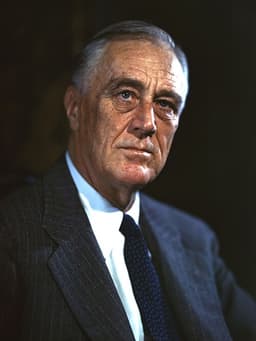
Franklin D. Roosevelt
Politician · Modern
71.0Total

Napoleon Bonaparte
General · Modern
70.9Total
Basic Information
Born
1882
1769
Died
1945
1821
Era
Modern
Modern
Nationality
United States
France
Occupation
Politician
General
Civilization
Western
Western
Score Comparison
Military (10%)
45.0
94.0
Political (20%)
85.0
72.0
Influence (20%)
75.0
40.0
Legacy (20%)
65.0
80.0
Leadership (15%)
85.0
78.0
Strategy (15%)
60.0
90.0
TOTAL
71.0
70.9
Franklin D. Roosevelt — Complete Timeline
1933 AD
Inaugurated as 32nd PresidentOther◆ Major
Franklin D. Roosevelt was inaugurated as President of the United States on March 4, 1933, during the Great Depression. His inaugural address declared 'the only thing we have to fear is fear itself,' and he immediately called Congress into special session to address the banking crisis.
Great DepressionPresidencyInauguration
Impact: national
Enacted the New DealOther◆ Major
Roosevelt launched the New Deal in 1933, a series of federal programs including the Civilian Conservation Corps, the Agricultural Adjustment Act, and the Tennessee Valley Authority. These measures aimed to provide relief, recovery, and reform during the Great Depression, fundamentally expanding the role of the federal government.
Great DepressionEconomic PolicySocial Reform
Impact: nationalconstructive
1935 AD
Signed the Social Security ActOther◆ Major
Roosevelt signed the Social Security Act into law on August 14, 1935, establishing a federal system of old-age pensions, unemployment insurance, and aid for dependent children. This created the modern American welfare state and provided a safety net for millions of citizens.
Social WelfareLegislationNew Deal
Impact: nationalconstructive
1941 AD
Lend-Lease ActOther◆ Major
Roosevelt signed the Lend-Lease Act on March 11, 1941, authorizing the transfer of military equipment and supplies to Allied nations, particularly Britain and the Soviet Union. This program provided critical material support to countries fighting the Axis powers before U.S. entry into World War II.
World War IIForeign PolicyMilitary Aid
Impact: globalconstructive
Declaration of War on JapanPolitical Action◆ Major
Following the Japanese attack on Pearl Harbor on December 7, 1941, Roosevelt delivered his 'Day of Infamy' speech to Congress the next day, requesting a declaration of war. Congress approved the declaration, bringing the United States into World War II.
World War IIPearl HarborDeclaration of War
Impact: globaldestructive
1942 AD
Executive Order 9066Other◆ Major
Roosevelt signed Executive Order 9066 on February 19, 1942, authorizing the forced relocation and internment of Japanese Americans living on the West Coast. Over 110,000 people, mostly U.S. citizens, were incarcerated in camps for the duration of the war, a decision later widely condemned as a violation of civil rights.
World War IICivil RightsInternment
Impact: nationaldestructive
1944 AD
Elected to Fourth TermOther◆ Major
Roosevelt was elected to an unprecedented fourth term as president in November 1944, defeating Republican Thomas E. Dewey. This election occurred during the final stages of World War II, and Roosevelt's continued leadership ensured stability in the war effort and post-war planning.
PresidencyElectionWorld War II
Impact: national
1945 AD
Yalta ConferenceOther◆ Major
Roosevelt met with Winston Churchill and Joseph Stalin at the Yalta Conference in February 1945 to discuss post-war Europe. Agreements included the division of Germany, Soviet entry into the war against Japan, and the creation of the United Nations, shaping the post-war world order.
World War IIDiplomacyPost-War Planning
Impact: global
Napoleon Bonaparte — Complete Timeline
1799 AD
Coup of 18 BrumaireOther◆ Major
Napoleon Bonaparte, with support from his brother Lucien and key political figures, overthrew the Directory in a bloodless coup. He established the Consulate with himself as First Consul, effectively becoming the ruler of France. This event ended the French Revolution's most unstable period.
French RevolutionCoupRise to Power
Impact: regional
1804 AD
Promulgation of the Napoleonic CodeOther◆ Major
Napoleon enacted the Civil Code of the French, known as the Napoleonic Code, a comprehensive set of laws that replaced the fragmented feudal legal systems. The code established legal equality, protected property rights, and secularized law. It became the basis for legal systems in many European and world countries.
Legal ReformNapoleonic CodeCivil Law
Impact: globalconstructive
1805 AD
Battle of AusterlitzWar◆ Major
Napoleon's Grande Arm
Napoleonic WarsBattleDecisive Victory
Impact: global
1812 AD
Invasion of RussiaWar◆ Major
Napoleon led the Grande Arm
Napoleonic WarsInvasionDisaster
Impact: globaldestructive
1815 AD
Battle of WaterlooWar◆ Major
Napoleon's French army was defeated by the combined forces of the Duke of Wellington's Anglo-Allied army and Gebhard Leberecht von Bl
Napoleonic WarsBattleFinal Defeat
Impact: globaldestructive
Expert Analysis
Napoleon Bonaparte vs Franklin D. Roosevelt: Historical Comparison
Napoleon Bonaparte and Franklin D. Roosevelt were transformative figures of the modern era, yet their power bases differed radically—Napoleon as a military conqueror who reshaped Europe, and Roosevelt as a political architect who redefined the American state and global order. This comparison evaluates them across five critical dimensions.
Dimension Analysis
**Military: Napoleon Bonaparte 94 / Franklin D. Roosevelt 60**
Napoleon mastered battlefield tactics and grand strategy, conquering most of Europe through rapid campaigns and innovative corps organization. Roosevelt, as Commander-in-Chief during World War II, was a strategic overseer rather than a field commander, relying on military chiefs to execute Allied victory.
**Political: Napoleon Bonaparte 75 / Franklin D. Roosevelt 85**
Napoleon centralized power through the Napoleonic Code and plebiscites, but his authoritarian rule ended in exile. Roosevelt built the New Deal coalition, expanded executive power within a democracy, and led the U.S. through Depression and war with enduring electoral success.
**Influence: Napoleon Bonaparte 82 / Franklin D. Roosevelt 72**
Napoleon’s legal codes, administrative reforms, and nationalist ideals influenced continental Europe for generations. Roosevelt’s influence was more concentrated—shaping the modern presidency, social security, and the postwar international system—but less globally pervasive than Napoleon’s institutional legacy.
**Legacy: Napoleon Bonaparte 78 / Franklin D. Roosevelt 75**
Napoleon’s legacy is deeply contested—revered as a modernizer, condemned as a tyrant—yet his name remains synonymous with ambition and reform. Roosevelt is celebrated as a crisis leader but criticized for internment policies and court-packing attempts, leaving a more stable but narrower legacy within American democracy.
**Leadership: Napoleon Bonaparte 80 / Franklin D. Roosevelt 85**
Napoleon inspired fierce loyalty through charisma and personal bravery, but his hubris led to overreach and downfall. Roosevelt excelled in crisis communication (fireside chats), coalition-building, and steadying a nation through two existential emergencies, demonstrating greater adaptive resilience.
Verdict
Napoleon Bonaparte leads overall due to his superior military and strategic scores, which outweigh Roosevelt’s political and leadership advantages in the weighted composite.
FAQ
Q: Who ranks higher? A: Napoleon Bonaparte ranks higher overall (82 vs 76), driven by his unmatched military genius and strategic influence, despite Roosevelt’s stronger political and leadership ratings.
Rankings
🥇
Franklin D. RooseveltLeader
Mil: 45.0Pol: 85.0Inf: 75.0
71.0
🥈
Napoleon Bonaparte
Mil: 94.0Pol: 72.0Inf: 40.0
70.9
+0.1 behind
How This Comparison Works
Algorithm
Each figure is scored on 6 dimensions (0—100 scale) based on structured historical data: Military (10%), Political (20%), Influence (20%), Legacy (20%), Leadership (15%), Strategy (15%). The weighted total produces the final ranking.
Data Sources
Scores are computed from structured sub-indicators in the database. Scale factors adjust for era (Ancient ×0.85, Modern ×1.0) and civilization size (Eastern ×1.05, Other ×0.80) to account for differences in population and military scale.
Maximum 3 Figures
Comparisons are limited to 2—3 figures to ensure readability and statistical meaningfulness.
Error Margins
±5 points per dimension — Sub-scores are derived from historical records with inherent uncertainty. Two figures within 5 points on a dimension should be considered roughly equivalent in that area.
Total Score Accuracy
±3 points overall — The weighted combination of 6 dimensions produces a total score with approximately ±3 points of uncertainty. Differences of less than 3 points are not statistically significant— the figures are effectively tied.
Known Limitations
- Historical records are incomplete and uneven across civilizations
- Figures from oral-tradition societies may be underrepresented
- Occupation labels can misclassify multi-role figures
- Scores measure capability and impact, not moral character
- Quantitative scoring is a comparison tool, not absolute truth
Capability Radar
Military (10%) — Battles & Warfare
Battles
10
95
Win Rate
10
90
Expansion
10
95
Political (20%) — Governance & Reform
Reform
95
95
Diplomacy
90
80
Economy
95
85
Influence (20%) — Cultural & Global Reach
Cultural
80
85
Global
90
90
Legacy (20%) — Historical Impact
Historical
90
95
Longevity
85
90
Leadership (15%) — Power & Stability
Tenure
90
85
Stability
75
70
Strategy (15%) — Tactics & Innovation
Strategy
65
95
Tactics
10
98
Reform
70
92
Similar Comparisons
Comments & Discussion
ColdScribe116/16/2026
拿破仑军事94分,政治75分,这个评分体系明显偏重传统军事成就。但仔细想想,拿破仑的政治分应该更高才对——他颁布的《拿破仑法典》直接影响了现代民法体系,这一点连中国的《大清律例》改革都曾间接参考。而且,Roosevelt的政治85分更多依赖战后美国霸权,而非纯粹的国内政治技巧。如果把中国历史中的汉武帝或唐太宗放进来比较,他们的军事和政治得分可能会更均衡,比如汉武帝的军事扩张(类似拿破仑)但政治改革(推恩令)也极为成功。这个评分需要调整权重,否则有误导性。
SharpScroll906/16/2026
拿破仑和罗斯福的对比,让我想起中国的秦始皇和汉武帝。拿破仑的军事天赋(94分)有点像秦始皇的统一六国,但拿破仑最终失败在远征俄罗斯,而秦始皇筑长城抵御匈奴,虽然耗费民力,却为后世奠定了基础。罗斯福的政治85分,放到中国历史里,可能不如康熙帝的‘不修长城而修德政’来得深远——康熙平定三藩、收复台湾,同时推行满汉融合,政治手腕不亚于罗斯福。西方评分系统往往低估东方领袖在稳定性和文化融合上的成就,所以这个分数只能当参考,不能全信。