Loading...
Francisco Morazan vs Oscar Mejia Victores
Francisco Morazan leads by 6.1 pts · 2 figures compared
…
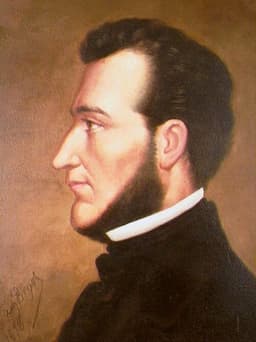
Francisco Morazan
General · Modern
58.0Total

Oscar Mejia Victores
General · Modern
51.9Total
Basic Information
Born
1792
1930
Died
1842
—
Era
Modern
Modern
Nationality
Honduras
Guatemala
Occupation
General
General
Civilization
Western
Western
Score Comparison
Military (10%)
52.5
22.6
Political (20%)
60.0
68.0
Influence (20%)
62.0
50.2
Legacy (20%)
50.0
43.3
Leadership (15%)
68.0
80.0
Strategy (15%)
55.0
41.0
TOTAL
58.0
51.9
Francisco Morazan — Complete Timeline
1824 AD
Abolition of slavery in Central AmericaReform◆ Major
As a key leader in the liberal movement, Moraz
AbolitionSlaveryLiberal Reform
Impact: regionalprogressive
1827 AD
Battle of La TrinidadWar◆ Major
Morazán led a liberal army to victory against conservative forces at La Trinidad, Honduras. This battle was a key turning point in the Central American civil war, allowing Morazán to consolidate power and eventually become president of the federation.
BattleLiberal VictoryCivil War
Impact: regional
1830 AD
Presidency of the Federal Republic of Central AmericaPolitical Action
Morazán was elected president of the Federal Republic of Central America, a union of Guatemala, El Salvador, Honduras, Nicaragua, and Costa Rica. He pursued liberal reforms including separation of church and state, free trade, and land reform, facing opposition from conservatives.
Federal RepublicLiberal ReformsCentral America
Impact: regionalconstructive
1842 AD
Execution by firing squadPolitical Action
After a failed attempt to restore the Federal Republic, Moraz
ExecutionEnd of FederationLiberal Defeat
Impact: regionaltragic
Oscar Mejia Victores — Complete Timeline
1983 AD
1983 Guatemalan coup d'étatPolitical Action◆ Major
Mejia Victores, then Defense Minister, led a coup that ousted President Efrain Rios Montt. He assumed the presidency, becoming the last military ruler of Guatemala.
CoupMilitary RuleGuatemala
Impact: nationaldestructive
1984 AD
Human rights abuses during his ruleOther◆ Major
During his presidency, Mejia Victores' government continued counterinsurgency operations that resulted in forced disappearances and massacres of indigenous Maya communities, as documented by truth commissions.
Human RightsCivil WarAtrocities
Impact: nationaltragic
1985 AD
Transition to civilian rulePolitical Action
Under pressure, Mejia Victores oversaw the drafting of a new constitution and called for democratic elections. He transferred power to civilian President Vinicio Cerezo in 1986, ending decades of military rule.
DemocratizationConstitutionElection
Impact: nationalconstructive
Expert Analysis
Francisco Morazan vs Oscar Mejia Victores
### The General’s Two Paths
On a dusty morning in 1842, a man in a tattered uniform stood before a firing squad in San José, Costa Rica. His name was Francisco Morazán, and he had once commanded the dream of a united Central America. Half a continent and a century away, in 1985, another general—Oscar Mejía Víctores—handed over power to a civilian president in Guatemala City. One died fighting for a failed union; the other lived to oversee a fragile transition to democracy. Both were soldiers who ruled, but their fates diverged like rivers splitting from the same mountain. What drove them to such different ends?
### Origins
Francisco Morazán was born in 1792 in Tegucigalpa, Honduras, into a world of colonial decay and revolutionary ferment. The Spanish Empire was crumbling, and the air was thick with Enlightenment ideas. Morazán absorbed them eagerly—liberty, equality, the rights of man—and by his twenties, he was a liberal firebrand. His Central America was a patchwork of provinces, each fiercely local, but Morazán believed in a grand federal republic. He was a creature of the nineteenth century, when men still thought they could remake the world with constitutions and cavalry charges.
Oscar Mejía Víctores was born in 1930 in Guatemala City, into a different kind of chaos. The Cold War was the backdrop of his youth, and his country was a battleground for ideologies. He chose the military as a career, rising through the ranks of an institution that had become the real power in Guatemala. Where Morazán was shaped by books and battlefields, Mejía was shaped by barracks and counterinsurgency manuals. The world had grown older, and its dreams had grown smaller.
### Rise to Power
Morazán entered history on a horse, sword drawn. In 1827, he led a liberal army to victory at the Battle of La Trinidad in Honduras. It was a turning point: a young general, barely thirty-five, crushing the conservative forces that opposed his vision. From there, his ascent was swift. In 1830, he was elected president of the Federal Republic of Central America—a union of Guatemala, El Salvador, Honduras, Nicaragua, and Costa Rica. He was the champion of reform, the face of a new order.
Mejía’s path was quieter, but no less decisive. In 1983, as Defense Minister, he led a coup that ousted President Efraín Ríos Montt, a man whose brutal rule had horrified the world. Mejía did not seize power for a grand cause; he did it to stabilize a regime. He became president not by election, but by the logic of the barracks. His rise was a matter of timing and ambition, not ideology.
### Leadership & Governance
Morazán ruled with the zeal of a reformer. In 1824, he helped abolish slavery in Central America—a radical act that made him a hero to the poor and a target for the powerful. He believed in education, land reform, and the separation of church and state. But his military mind was tactical, not strategic. His score of 55.6 in strategy suggests a man who could win battles but not wars. He governed with a sword in one hand and a constitution in the other, never quite mastering the art of compromise.
Mejía governed in the shadow of a genocide. His regime continued counterinsurgency operations that resulted in forced disappearances and massacres—human rights abuses that stain his legacy. Yet, under pressure from the United States and a weary populace, he did something unexpected. In 1985, he oversaw the drafting of a new constitution and called for democratic elections. He transferred power to a civilian president, ending decades of military rule. His political score of 72.0 matches Morazán’s, but it was a different kind of politics—pragmatic, survivalist, and tied to the Cold War’s end.
### Triumph & Tragedy
Morazán’s greatest moment was his presidency—a brief, shining era when Central America seemed possible. His greatest failure was its collapse. The federal union frayed under regional rivalries, and by 1840, he was in exile. He returned in 1842 for one last desperate gamble to restore the republic, but he was captured in Costa Rica and executed by firing squad. His triumph was the dream; his tragedy was that he could not make it real.
Mejía’s triumph was his exit. In 1985, he handed power to a civilian, a move that allowed Guatemala to begin a long, painful transition to democracy. His tragedy was what he left behind: a country scarred by violence, a military that had learned to rule through fear. He did not die for his cause; he faded into obscurity, a footnote in a history he helped write.
### Character & Destiny
Morazán was a man of conviction, almost to a fault. He believed that the world could be remade by will and reason, and he paid for that belief with his life. His personality was magnetic, his vision grand—but he lacked the patience for politics. He was a romantic in a cynical age.
Mejía was a survivor. He did not dream of unions or utopias; he saw power as a tool, not a calling. His personality was opaque, his decisions cautious. He gave up power because the cost of holding it had become too high. He was a pragmatist in a brutal age.
### Legacy
Morazán is remembered as a martyr of Central American unity, a hero to liberals, a cautionary tale to federalists. His face adorns currency and statues; his name is invoked by those who still dream of a united isthmus. His legacy score of 68.9 reflects a man whose influence outlived his failures.
Mejía is remembered, if at all, as the last military ruler of Guatemala—a transition figure who did what was necessary but not what was good. His legacy score of 59.5 is lower, but it is also more complex: he is a reminder that democracy sometimes comes from the hands of those who once crushed it.
### Conclusion
Two generals, two centuries, two Central Americas. Morazán died with his boots on, fighting for a union that never was. Mejía walked away from power, leaving behind a democracy that barely survived. One was a dreamer, the other a realist. Both were soldiers who ruled, but their differences run deeper than rank or era. Morazán shows us the cost of vision; Mejía shows us the cost of survival. In the end, history judges them not by their intentions, but by what they left behind: one a legend, the other a lesson.
Rankings
🥇
Francisco MorazanLeader
Mil: 52.5Pol: 60.0Inf: 62.0
58.0
🥈
Oscar Mejia Victores
Mil: 22.6Pol: 68.0Inf: 50.2
51.9
+6.1 behind
How This Comparison Works
Algorithm
Each figure is scored on 6 dimensions (0—100 scale) based on structured historical data: Military (10%), Political (20%), Influence (20%), Legacy (20%), Leadership (15%), Strategy (15%). The weighted total produces the final ranking.
Data Sources
Scores are computed from structured sub-indicators in the database. Scale factors adjust for era (Ancient ×0.85, Modern ×1.0) and civilization size (Eastern ×1.05, Other ×0.80) to account for differences in population and military scale.
Maximum 3 Figures
Comparisons are limited to 2—3 figures to ensure readability and statistical meaningfulness.
Error Margins
±5 points per dimension — Sub-scores are derived from historical records with inherent uncertainty. Two figures within 5 points on a dimension should be considered roughly equivalent in that area.
Total Score Accuracy
±3 points overall — The weighted combination of 6 dimensions produces a total score with approximately ±3 points of uncertainty. Differences of less than 3 points are not statistically significant— the figures are effectively tied.
Known Limitations
- Historical records are incomplete and uneven across civilizations
- Figures from oral-tradition societies may be underrepresented
- Occupation labels can misclassify multi-role figures
- Scores measure capability and impact, not moral character
- Quantitative scoring is a comparison tool, not absolute truth
Capability Radar
Military (10%) — Battles & Warfare
Battles
55
10
Win Rate
60
10
Expansion
40
5
Political (20%) — Governance & Reform
Reform
70
55
Diplomacy
45
50
Economy
50
30
Influence (20%) — Cultural & Global Reach
Cultural
45
15
Global
35
15
Legacy (20%) — Historical Impact
Historical
50
30
Longevity
40
20
Leadership (15%) — Power & Stability
Tenure
55
40
Stability
30
35
Strategy (15%) — Tactics & Innovation
Strategy
55
15
Tactics
50
15
Reform
45
20
Similar Comparisons
Comments & Discussion
战国学者6/16/2026
莫拉桑读太多卢梭,没读懂马基雅维利。中美洲联邦不是靠理想主义能维系的,1820年代各省精英要的是关税自主,不是抽象的自由平等。他若能像俾斯麦那样用铁血手段,先吞并危地马拉的保守派大庄园,再以中央军压服地方武装,联邦或许还有活路。可他倒好,带着几百个学生兵去打内战,不败才怪。
幸存者视角6/16/2026
说句不好听的,历史只记住了活下来的人。莫拉桑在哥斯达黎加被枪决时,他的联邦梦跟着碎了一地。梅希亚却聪明,1985年主动交权给塞雷索,转身当商人去了。危地马拉那些死在军政府手里的几十万人,谁还记得梅希亚的名字?但莫拉桑呢,五大共和国都有他的雕像。死得壮烈,比活得好更有用,这就是中美洲的宿命。
Historian3856/16/2026
Morazan failed because he tried to build a nation with 19th-century romanticism instead of bayonets. One unified command, a single treasury, a ruthless secret police—that's what holds a federation together. He let provincial caudillos talk him into constitutions while they sharpened their knives. Compare Mejia Victores: he didn't try to conquer hearts, just controlled the airports and the banks. Morazan died quoting Rousseau; Mejia died rich. Case closed.
ArchScroll446/16/2026
Let me put it bluntly: Morazan's "union" was a statistical disaster. By 1840, the Federal Republic had a population of maybe 1.5 million spread across five provinces with zero integrated infrastructure. Roads didn't connect capitals, currencies were different, and internal tariffs averaged 15%. Mejia Victores inherited a country where 60% of GDP came from coffee exports alone—a unified economic base. Morazan was fighting geography and economics; Mejia was just managing a monopoly. Not even compa