Loading...
Ferdinand VII of Spain vs Nurhaci
Nurhaci leads by 26.1 pts · 2 figures compared
…
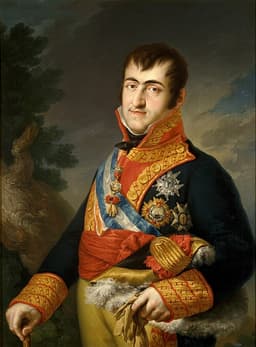
Ferdinand VII of Spain
Emperor · Modern
45.1Total
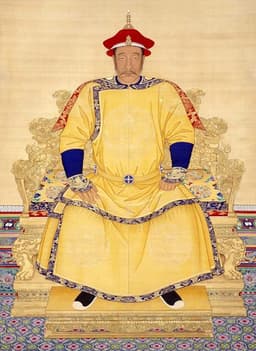
Nurhaci
Emperor · Modern
71.2Total
Basic Information
Born
1784
1559
Died
1833
1626
Era
Modern
Modern
Nationality
Spain
China
Occupation
Emperor
Emperor
Civilization
Western
Eastern
Score Comparison
Military (10%)
14.9
79.9
Political (20%)
32.2
85.0
Influence (20%)
51.0
40.0
Legacy (20%)
41.7
84.0
Leadership (15%)
74.0
79.0
Strategy (15%)
45.0
76.0
TOTAL
45.1
71.2
Ferdinand VII of Spain — Complete Timeline
1808 AD
Accession to the thronePolitical Action◆ Major
Ferdinand VII became King of Spain after the abdication of his father Charles IV. His reign was interrupted by Napoleon's intervention and the Peninsular War, but he was restored in 1814.
SuccessionMonarchy
Impact: national
1814 AD
Abolition of the Constitution of 1812Political Action
Upon returning to Spain, Ferdinand VII abolished the liberal Constitution of 1812 and restored absolute monarchy. He persecuted liberals and reinstated the Inquisition, reversing the reforms of the Cortes of C
ConstitutionAbsolutismReaction
Impact: nationaldestructive
1820 AD
Trienio LiberalPolitical Action◆ Major
A military revolt led by Rafael del Riego forced Ferdinand VII to reinstate the Constitution of 1812, beginning the Trienio Liberal. Ferdinand was effectively a constitutional monarch for three years.
Liberal RevolutionConstitutionRevolt
Impact: national
1823 AD
French intervention and restoration of absolutismWar◆ Major
A French army, the Hundred Thousand Sons of Saint Louis, invaded Spain to restore Ferdinand VII's absolute power. The liberal government fell, and Ferdinand resumed repressive rule.
InterventionAbsolutismCongress of Vienna
Impact: regionaldestructive
1830 AD
Pragmatic Sanction of 1830Political Action◆ Major
Ferdinand VII issued the Pragmatic Sanction, abolishing Salic Law and allowing his daughter Isabella to inherit the throne. This led to the Carlist Wars after his death.
SuccessionLawCarlist Wars
Impact: national
Nurhaci — Complete Timeline
1616 AD
Unified the Jurchen TribesWar
Nurhaci completed the unification of the fragmented Jurchen tribes of Manchuria. He organized them into the Eight Banners system, a military and social structure that became the foundation of his power. He then proclaimed the Later Jin dynasty.
JurchenUnificationEight Banners
Impact: regionalconstructive
Proclaimed the Later Jin DynastyPolitical Action◆ Major
Nurhaci proclaimed the establishment of the Later Jin dynasty in Manchuria, claiming legitimacy as a successor to the Jin dynasty. This act formally declared his independence from the Ming dynasty and established a rival state.
Later JinDynastyFoundation
Impact: regionalconstructive
1618 AD
Issued the Seven GrievancesPolitical Action◆ Major
Nurhaci issued the Seven Grievances, a formal declaration of war against the Ming dynasty. The grievances listed alleged Ming injustices against the Jurchens, including interference in tribal affairs and killing of Jurchen leaders. This justified his invasion of Ming territory.
Ming-Qing TransitionDeclaration of WarPropaganda
Impact: regionaldestructive
1619 AD
Battle of SarhuWar
Nurhaci's forces decisively defeated a large Ming army at the Battle of Sarhu. The Ming sent four separate armies into Manchuria, but Nurhaci used interior lines to defeat them in detail. This victory secured his control over Manchuria.
Ming-Qing TransitionBattleManchuria
Impact: regionalconstructive
1626 AD
Defeated by Yuan Chonghuan at NingyuanWar◆ Major
Nurhaci led an invasion of Ming territory but was defeated at the Battle of Ningyuan by Ming general Yuan Chonghuan. The Ming used European-style cannons to repel the Later Jin forces. Nurhaci was wounded during the battle and died shortly after.
Ming-Qing TransitionBattleDefeat
Impact: regionaltragic
Expert Analysis
Ferdinand VII of Spain vs Nurhaci
# The Emperor and the King: Two Paths of Absolute Power
On a frozen battlefield in Manchuria in 1626, a 67-year-old warrior lay dying from wounds sustained against a fortress he could not take. Nurhaci, the unifier of the Manchu tribes and founder of what would become China’s last imperial dynasty, had tasted defeat for the first time in decades. Two centuries later and half a world away, another monarch—Ferdinand VII of Spain—sat on a throne he had regained through foreign bayonets, having spent six years abolishing every reform his own people had fought to establish. Both men sought absolute power. One built an empire that would rule for nearly three centuries. The other dismantled a kingdom’s future in less than two decades. The difference between them was not merely in their scores—Nurhaci’s composite of 83.8 against Ferdinand’s 54.3—but in the very substance of their ambition.
Origins
Nurhaci was born in 1559 into a world of violent fragmentation. The Jurchen tribes of Manchuria were a patchwork of feuding clans, loosely tributary to the Ming dynasty but effectively masterless. His father and grandfather were killed in a Ming raid when he was young—a wound that would fester for decades. Nurhaci grew up as a borderland pragmatist, learning Chinese, reading the Romance of the Three Kingdoms, and absorbing the military traditions of both steppe and settled civilizations. He was forged in hardship, not palace luxury.
Ferdinand VII, born in 1784, was the product of a decaying absolutism. His father Charles IV was weak; his mother and her favorite, Manuel Godoy, effectively ruled Spain. Ferdinand grew up in the shadow of the French Revolution, watching thrones topple across Europe. He learned to scheme, to conspire, to hate reform—but never to build. Where Nurhaci’s early life taught him how to unite, Ferdinand’s taught him how to divide.
Rise to Power
Nurhaci’s path to power was a slow, grinding ascent. He began as a minor chieftain, trading sable pelts to the Ming for recognition. By 1616, he had unified the Jurchen tribes through a combination of marriage alliances, military conquest, and the revolutionary Eight Banner system—a social and military organization that turned every Manchu into a soldier. That year, he proclaimed the Later Jin dynasty, positioning himself as the avenger of the fallen Jin empire of the 12th century. His rise was built on patience and institutional genius.
Ferdinand VII became king in 1808 through a coup against his own father—a palace intrigue that Napoleon immediately exploited. The French emperor lured both Charles and Ferdinand to Bayonne, forced both to abdicate, and placed his brother Joseph on the Spanish throne. Ferdinand spent the next six years as a prisoner in France, a martyr to Spanish nationalism without ever fighting a battle. His “rise” was an abdication and a captivity.
Leadership & Governance
Nurhaci governed through the Eight Banners, an innovation that transformed tribal loyalty into imperial discipline. Each banner was a self-contained army, administration, and community. He issued laws, standardized the Manchu script, and built a state that could absorb conquered peoples—Chinese, Mongols, Koreans—into its structure. In 1618, he issued the Seven Grievances against the Ming, a masterful propaganda document that framed his war as righteous revenge. At the Battle of Sarhu in 1619, he destroyed a Ming army four times his size by using interior lines, mobility, and the disunity of his enemies. His political wisdom matched his military skill: he knew when to fight and when to wait.
Ferdinand VII’s governance was the mirror opposite. Upon returning to Spain in 1814, he immediately abolished the liberal Constitution of 1812—a document written by the Cortes during his captivity that limited royal power and established civil rights. He purged reformers, restored the Inquisition, and ruled through a camarilla of reactionary favorites. When a military revolt in 1820 forced him to reinstate the constitution, he spent three years of the Trienio Liberal secretly plotting with foreign powers to destroy it. In 1823, a French army—the Hundred Thousand Sons of Saint Louis—invaded Spain and restored his absolute power. Ferdinand’s leadership was a cycle of betrayal: he promised reform, then crushed it; he swore oaths, then broke them.
Triumph & Tragedy
Nurhaci’s greatest triumph was the Battle of Sarhu, where he proved that a unified Manchu force could defeat the Ming empire in open battle. His tragedy came at Ningyuan in 1626, where Ming general Yuan Chonghuan used European-style cannons to stop his army cold. Nurhaci was wounded and died days later—a rare defeat that could not undo his life’s work. His son Hong Taiji and grandson the Shunzhi Emperor would complete the conquest of China.
Ferdinand VII’s triumph was his restoration in 1823—but it was a triumph purchased by French intervention, not Spanish strength. His tragedy was the Pragmatic Sanction of 1830, which abolished Salic Law to allow his daughter Isabella to inherit the throne. This act triggered decades of civil war between Carlists and Liberals, a conflict that bled Spain dry. Ferdinand’s “triumph” was the seed of his nation’s tragedy.
Character & Destiny
Nurhaci was ruthless but strategic. He killed rivals, absorbed their followers, and built systems that outlasted him. His personality was that of a founder—someone who sees the future in fragments and assembles them into a whole. Ferdinand VII was suspicious, vengeful, and short-sighted. He was called “the Desired” when he returned to Spain in 1814; by his death in 1833, he was widely despised. One man’s character built an empire; the other’s destroyed a kingdom.
Legacy
Nurhaci is remembered as the founding father of the Qing dynasty, which ruled China from 1644 to 1912. His Eight Banner system, his unification of the Manchu people, and his military campaigns laid the groundwork for one of history’s great empires. His legacy score of 87.6 reflects this: a man who created a state that shaped the modern world.
Ferdinand VII’s legacy is a cautionary tale. His abolition of the Constitution of 1812 set back Spanish liberalism by decades. His reign sowed the seeds of the Carlist Wars, the loss of most of Spain’s American colonies, and a pattern of military intervention in politics that haunted Spain into the 20th century. His legacy score of 57.1 is generous.
Conclusion
Standing at the gates of Ningyuan, wounded and dying, Nurhaci might have wondered what his life had built. He could not have known that his grandson would sit on the Dragon Throne in Beijing. Ferdinand VII, dying in the Royal Palace of Madrid, left behind a daughter too young to rule and a nation too divided to heal. Both men sought absolute power. One knew that power required institutions, loyalty, and vision. The other believed it required only a throne and an army of foreign allies. History answered them both.
Rankings
🥇
NurhaciLeader
Mil: 79.9Pol: 85.0Inf: 40.0
71.2
🥈
Ferdinand VII of Spain
Mil: 14.9Pol: 32.2Inf: 51.0
45.1
+26.1 behind
How This Comparison Works
Algorithm
Each figure is scored on 6 dimensions (0—100 scale) based on structured historical data: Military (10%), Political (20%), Influence (20%), Legacy (20%), Leadership (15%), Strategy (15%). The weighted total produces the final ranking.
Data Sources
Scores are computed from structured sub-indicators in the database. Scale factors adjust for era (Ancient ×0.85, Modern ×1.0) and civilization size (Eastern ×1.05, Other ×0.80) to account for differences in population and military scale.
Maximum 3 Figures
Comparisons are limited to 2—3 figures to ensure readability and statistical meaningfulness.
Error Margins
±5 points per dimension — Sub-scores are derived from historical records with inherent uncertainty. Two figures within 5 points on a dimension should be considered roughly equivalent in that area.
Total Score Accuracy
±3 points overall — The weighted combination of 6 dimensions produces a total score with approximately ±3 points of uncertainty. Differences of less than 3 points are not statistically significant— the figures are effectively tied.
Known Limitations
- Historical records are incomplete and uneven across civilizations
- Figures from oral-tradition societies may be underrepresented
- Occupation labels can misclassify multi-role figures
- Scores measure capability and impact, not moral character
- Quantitative scoring is a comparison tool, not absolute truth
Capability Radar
Military (10%) — Battles & Warfare
Battles
10
85
Win Rate
5
90
Expansion
5
88
Political (20%) — Governance & Reform
Reform
5
85
Diplomacy
20
80
Economy
10
70
Influence (20%) — Cultural & Global Reach
Cultural
15
85
Global
20
80
Legacy (20%) — Historical Impact
Historical
30
90
Longevity
20
88
Leadership (15%) — Power & Stability
Tenure
60
75
Stability
10
78
Strategy (15%) — Tactics & Innovation
Strategy
5
85
Tactics
5
88
Reform
5
92
Similar Comparisons
Comments & Discussion
MANCHU_EAGLE6/16/2026
Nurhaci's 83.8 vs. Ferdinand's 54.3—that's not just numbers, that's the difference between building an empire and burning one down. Nurhaci unified fractured tribes, created the Eight Banners system, and laid the groundwork for the Qing dynasty that would rule 267 years. Ferdinand? He reinstated the Inquisition, bankrupted Spain, and triggered the Latin American wars of independence. Nurhaci died in battle from a cannon wound, probably thinking about his next conquest. Ferdinand died in his bed,
历史猎人6/16/2026
比较这俩人就像拿火药桶比棉花糖。努尔哈赤83.8分?低了。他从13副铠甲起家,面对的是明军火器优势,硬是用骑射和游击战术撕开辽东防线,萨尔浒之战以少胜多直接定鼎大局。费迪南七世54.3分?高了。这家伙1814年回国第一件事就是废除1812年宪法,把西班牙拖回绝对君主制,导致海外殖民地全跑了——比如墨西哥独立战争。努尔哈赤活着的时候统一女真、建立八旗,死时有清国雏形。费迪南死了,西班牙帝国也基本死了。这分差太小了,在我看来至少差40分。