Loading...
Ferdinand VII of Spain vs Napoleon Bonaparte
Napoleon Bonaparte leads by 25.8 pts · 2 figures compared
…
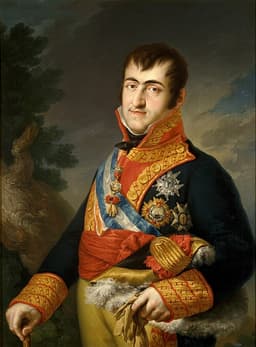
Ferdinand VII of Spain
Emperor · Modern
45.1Total

Napoleon Bonaparte
General · Modern
70.9Total
Basic Information
Born
1784
1769
Died
1833
1821
Era
Modern
Modern
Nationality
Spain
France
Occupation
Emperor
General
Civilization
Western
Western
Score Comparison
Military (10%)
14.9
94.0
Political (20%)
32.2
72.0
Influence (20%)
51.0
40.0
Legacy (20%)
41.7
80.0
Leadership (15%)
74.0
78.0
Strategy (15%)
45.0
90.0
TOTAL
45.1
70.9
Ferdinand VII of Spain — Complete Timeline
1808 AD
Accession to the thronePolitical Action◆ Major
Ferdinand VII became King of Spain after the abdication of his father Charles IV. His reign was interrupted by Napoleon's intervention and the Peninsular War, but he was restored in 1814.
SuccessionMonarchy
Impact: national
1814 AD
Abolition of the Constitution of 1812Political Action
Upon returning to Spain, Ferdinand VII abolished the liberal Constitution of 1812 and restored absolute monarchy. He persecuted liberals and reinstated the Inquisition, reversing the reforms of the Cortes of C
ConstitutionAbsolutismReaction
Impact: nationaldestructive
1820 AD
Trienio LiberalPolitical Action◆ Major
A military revolt led by Rafael del Riego forced Ferdinand VII to reinstate the Constitution of 1812, beginning the Trienio Liberal. Ferdinand was effectively a constitutional monarch for three years.
Liberal RevolutionConstitutionRevolt
Impact: national
1823 AD
French intervention and restoration of absolutismWar◆ Major
A French army, the Hundred Thousand Sons of Saint Louis, invaded Spain to restore Ferdinand VII's absolute power. The liberal government fell, and Ferdinand resumed repressive rule.
InterventionAbsolutismCongress of Vienna
Impact: regionaldestructive
1830 AD
Pragmatic Sanction of 1830Political Action◆ Major
Ferdinand VII issued the Pragmatic Sanction, abolishing Salic Law and allowing his daughter Isabella to inherit the throne. This led to the Carlist Wars after his death.
SuccessionLawCarlist Wars
Impact: national
Napoleon Bonaparte — Complete Timeline
1799 AD
Coup of 18 BrumaireOther◆ Major
Napoleon Bonaparte, with support from his brother Lucien and key political figures, overthrew the Directory in a bloodless coup. He established the Consulate with himself as First Consul, effectively becoming the ruler of France. This event ended the French Revolution's most unstable period.
French RevolutionCoupRise to Power
Impact: regional
1804 AD
Promulgation of the Napoleonic CodeOther◆ Major
Napoleon enacted the Civil Code of the French, known as the Napoleonic Code, a comprehensive set of laws that replaced the fragmented feudal legal systems. The code established legal equality, protected property rights, and secularized law. It became the basis for legal systems in many European and world countries.
Legal ReformNapoleonic CodeCivil Law
Impact: globalconstructive
1805 AD
Battle of AusterlitzWar◆ Major
Napoleon's Grande Arm
Napoleonic WarsBattleDecisive Victory
Impact: global
1812 AD
Invasion of RussiaWar◆ Major
Napoleon led the Grande Arm
Napoleonic WarsInvasionDisaster
Impact: globaldestructive
1815 AD
Battle of WaterlooWar◆ Major
Napoleon's French army was defeated by the combined forces of the Duke of Wellington's Anglo-Allied army and Gebhard Leberecht von Bl
Napoleonic WarsBattleFinal Defeat
Impact: globaldestructive
Expert Analysis
ferdinand-vii-of-spain-vs-napoleon-bonaparte
# The Emperor and the King
In the spring of 1808, two men stood at the crossroads of European history, their fates about to intertwine in a drama that would reshape a continent. One was a short, intense Corsican who had already conquered Italy and Egypt and now sat on the throne of France as Emperor Napoleon Bonaparte. The other was a Spanish prince, Ferdinand VII, who had just orchestrated a coup against his own father and was about to walk into Napoleon’s trap at Bayonne. When they met, Napoleon was thirty-eight, at the height of his power; Ferdinand was twenty-three, naive and desperate to rule. The encounter would set in motion a chain of events that revealed not only the vast gulf between two rulers but also the deeper forces that separate greatness from mediocrity in the theater of history.
Origins
Napoleon Bonaparte was born in 1769 on the island of Corsica, a year after France had purchased the island from Genoa. His family was minor nobility, but their status meant little in a land where the French were still seen as occupiers. Young Napoleon spoke Italian before he learned French, and his accent would mark him as an outsider for life. Yet it was precisely this marginality that forged him. At the military academy of Brienne, he was mocked by wealthy aristocrats, so he buried himself in books—history, geography, military tactics—and emerged with a burning ambition to prove himself.
Ferdinand VII, born in 1784, came from the opposite pole of privilege. He was the son of Charles IV of Spain, a weak king dominated by his wife and her lover, the court favorite Manuel Godoy. Ferdinand grew up in the gilded cage of the Spanish court, surrounded by intrigue and flattery. He learned to hate his parents and to scheme in shadows. Unlike Napoleon, who read Caesar and studied artillery, Ferdinand’s education was a training in resentment. He was taught that kings ruled by divine right, that the people were subjects, not citizens, and that the only real virtue was loyalty to the throne—his throne.
Rise to Power
Napoleon’s ascent was a masterpiece of opportunity seized. The French Revolution destroyed the old order and created a vacuum for talent. In 1793, at the Siege of Toulon, the twenty-four-year-old artillery captain devised a plan that drove the British from the port. By 1795, he was a general, saving the revolutionary government from a royalist uprising with a “whiff of grapeshot.” In 1796, he led a ragged army into Italy and emerged as a legend, winning battles against the Austrians with speed and audacity that stunned Europe. By 1799, he was First Consul; by 1804, Emperor. Each step was a gamble, each victory a building block.
Ferdinand’s rise was a tragedy of incompetence. In 1808, Spain was in chaos. King Charles IV was despised, and the people looked to Ferdinand as a savior. He engineered a revolt at Aranjuez, forcing his father to abdicate. But instead of consolidating power, he made a fatal error: he asked Napoleon to recognize his kingship. Napoleon invited him to Bayonne, and there, in a series of humiliating interviews, forced Ferdinand to return the crown to his father, who then gave it to Napoleon, who gave it to his brother Joseph. Ferdinand became a prisoner in France for six years. His “rise” was a fall.
Leadership & Governance
Napoleon governed with a clarity that still shapes Europe. The Napoleonic Code, established in 1804, replaced feudal laws with a rational system based on merit and equality before the law. He centralized the state, created the Bank of France, and built schools that trained engineers and officers. On the battlefield, his scores of 94 in military and 93 in strategy reflect a genius who could read terrain and men like a chessboard. At Austerlitz in 1805, he destroyed the combined armies of Russia and Austria, a victory so complete that it ended the Holy Roman Empire. He understood that war was politics by other means, and he wielded both with ruthless precision.
Ferdinand’s governance was a study in reaction. When he returned to Spain in 1814, after Napoleon’s fall, he abolished the liberal Constitution of 1812, which had been drafted by reformers during his captivity. He restored the Inquisition, purged liberals, and ruled by decree. His political score of 51.5 reflects a leader who saw governance not as a duty to a nation but as a privilege to be hoarded. When a military revolt in 1820 forced him to reinstate the constitution, he accepted it only to wait for foreign help. In 1823, a French army—the Hundred Thousand Sons of Saint Louis—invaded Spain to restore his absolutism. Ferdinand then repaid his saviors by executing the very liberals who had tried to reform his kingdom.
Triumph & Tragedy
Napoleon’s greatest moment was Austerlitz, where he crushed the Third Coalition and crowned himself master of Europe. His greatest tragedy was the invasion of Russia in 1812. He marched with 600,000 men and returned with fewer than 100,000. The Russian winter, the scorched earth, and his own hubris destroyed the Grand Army. He was exiled to Elba in 1814, returned for a Hundred Days, and met final defeat at Waterloo in 1815. His score of 82.4 total reflects a man who rose higher than any since Caesar but fell because he could not stop.
Ferdinand’s triumph was survival. He outlasted Napoleon, outlasted the liberals, and died in his bed in 1833. But his tragedy was the destruction of Spain. His abolition of the constitution, his reliance on French bayonets, and his Pragmatic Sanction of 1830—which changed the succession to favor his daughter Isabella—plunged Spain into a century of civil wars. His total score of 54.3 tells the story of a king who ruled but never led.
Character & Destiny
Napoleon was driven by an insatiable hunger for glory. “Impossible is a word to be found only in the dictionary of fools,” he said. He trusted his own genius above all, and that faith made him unstoppable—until it made him blind. He could not delegate, could not compromise, could not retreat. His character was his destiny: a man of iron will who broke himself on the anvil of his own ambition.
Ferdinand was driven by fear. He trusted no one, not even his own brothers. He was called “the Desired” when he returned to Spain, but he became “the Felon” for his betrayals. He ruled through spies and secret police, and his only consistent policy was to preserve his own power. His character was a cage: a man who could not see beyond his own throne, and so lost his kingdom to decay.
Legacy
Napoleon’s legacy is a paradox. He was a tyrant who enslaved Europe, but he also spread the ideals of the French Revolution—meritocracy, legal equality, secular governance—across the continent. The Napoleonic Code remains the basis of law in dozens of countries. His military innovations are studied in every war college. He is remembered as both a liberator and a conqueror, a man who changed the world whether it wanted to change or not.
Ferdinand’s legacy is a warning. He is remembered in Spain as the king who killed the Enlightenment. His reign set the country back a century, creating a pattern of military coups and civil strife that would haunt Spain until the late twentieth century. His score of 57.1 in legacy reflects a ruler who left nothing but ruins.
Conclusion
Standing at Bayonne in 1808, Napoleon and Ferdinand represented two visions of power. Napoleon believed that power was earned through talent and action; Ferdinand believed it was inherited through blood and divine right. One conquered Europe, the other lost Spain. One forged a code that still governs millions; the other signed decrees that ignited civil wars. Their lives remind us that history is not a lottery. It is a judgment—on character, on ambition, on the willingness to see beyond oneself. Napoleon, for all his flaws, saw a world to be remade. Ferdinand saw only a throne to be kept. In the end, that difference decided everything.
Rankings
🥇
Napoleon BonaparteLeader
Mil: 94.0Pol: 72.0Inf: 40.0
70.9
🥈
Ferdinand VII of Spain
Mil: 14.9Pol: 32.2Inf: 51.0
45.1
+25.8 behind
How This Comparison Works
Algorithm
Each figure is scored on 6 dimensions (0—100 scale) based on structured historical data: Military (10%), Political (20%), Influence (20%), Legacy (20%), Leadership (15%), Strategy (15%). The weighted total produces the final ranking.
Data Sources
Scores are computed from structured sub-indicators in the database. Scale factors adjust for era (Ancient ×0.85, Modern ×1.0) and civilization size (Eastern ×1.05, Other ×0.80) to account for differences in population and military scale.
Maximum 3 Figures
Comparisons are limited to 2—3 figures to ensure readability and statistical meaningfulness.
Error Margins
±5 points per dimension — Sub-scores are derived from historical records with inherent uncertainty. Two figures within 5 points on a dimension should be considered roughly equivalent in that area.
Total Score Accuracy
±3 points overall — The weighted combination of 6 dimensions produces a total score with approximately ±3 points of uncertainty. Differences of less than 3 points are not statistically significant— the figures are effectively tied.
Known Limitations
- Historical records are incomplete and uneven across civilizations
- Figures from oral-tradition societies may be underrepresented
- Occupation labels can misclassify multi-role figures
- Scores measure capability and impact, not moral character
- Quantitative scoring is a comparison tool, not absolute truth
Capability Radar
Military (10%) — Battles & Warfare
Battles
10
95
Win Rate
5
90
Expansion
5
95
Political (20%) — Governance & Reform
Reform
5
95
Diplomacy
20
80
Economy
10
85
Influence (20%) — Cultural & Global Reach
Cultural
15
85
Global
20
90
Legacy (20%) — Historical Impact
Historical
30
95
Longevity
20
90
Leadership (15%) — Power & Stability
Tenure
60
85
Stability
10
70
Strategy (15%) — Tactics & Innovation
Strategy
5
95
Tactics
5
98
Reform
5
92
Similar Comparisons
Comments & Discussion
BRIENNE'S REVENGE6/17/2026
Let's be real: comparing Napoleon to Ferdinand VII is like comparing a tactical nuke to a soggy firecracker. Napoleon didn't just win battles—he rewrote the rules of warfare. The 1805 Ulm Campaign alone, where he encircled an entire Austrian army in under two weeks, shows a genius Ferdinand couldn't fathom. While Ferdinand hid behind the skirts of the Inquisition and blamed others for his failures, Napoleon was personally leading charges at Austerlitz. One man built an empire through blood and b
历史沙漏6/17/2026
你们都在歌颂拿破仑的军事天才,却忘了历史书是胜利者写的。拿破仑在1808年诱捕费迪南七世的手段,本质上和黑帮老大设鸿门宴有什么区别?费迪南确实是个懦弱的君主,但别忘了法国入侵西班牙后,民众自发组织游击战拖垮了法军——这恰恰证明了一个民族的血性可以对抗所谓的天才。拿破仑的军事机器最终在西班牙泥潭里生锈,而费迪南至少活着回到了王位。没骨气的国王有时比瞎折腾的征服者更会熬时间。
DATA DETECTIVE6/17/2026
The analysis romanticizes Napoleon but glosses over the numbers. France under Napoleon lost nearly 1 million military deaths from 1803-1815, a catastrophic demographic cost. Meanwhile, Ferdinand's Spain, despite being politically chaotic, kept a colonial empire intact until the 1820s. Napoleon's "genius" gave France a smaller territory than Louis XIV left, while Ferdinand bumbled along but Spain survived as a geopolitical entity. You can argue which leader was smarter, but by the metric of natio
古典主义之眼6/17/2026
从古典政治哲学角度,拿破仑代表的是僭主政治的极致——用个人野心篡改国家命运。他自称继承了查理曼,却在1804年加冕时自己戴上皇冠,这是对罗马传统的公开亵渎。反观费迪南七世,即便再无能,他秉持的是正统王权的伦理框架,这是自奥古斯都以来西方政治秩序的基石。拿破仑的莱比锡之战溃败后,欧洲各国重新拾起的就是这个正统原则。历史告诉我们:投机取巧的野心家始终干不过体系的力量。
REVISIONIST'S SPADE6/17/2026
Let's stop pretending Napoleon was some tragic hero. He invaded Spain under false pretenses, forced Ferdinand VII to abdicate via blackmail at Bayonne in 1808, and installed his brother on the throne. That's not genius—that's thuggery dressed up as diplomacy. And for all his military chops, Napoleon never understood guerrilla warfare. The Spanish "ulcer" bl