Loading...
Ferdinand VII of Spain vs Gojong of Korea
Gojong of Korea leads by 10.4 pts · 2 figures compared
…
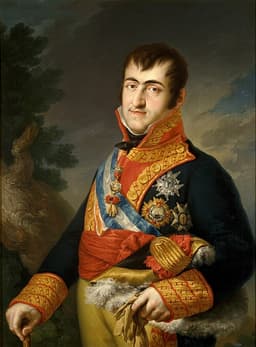
Ferdinand VII of Spain
Emperor · Modern
45.1Total
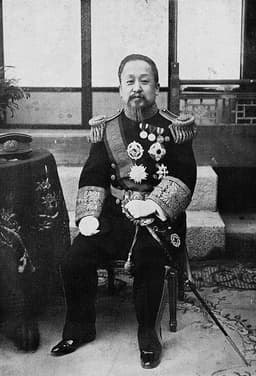
Gojong of Korea
Emperor · Modern
55.5Total
Basic Information
Born
1784
1852
Died
1833
1919
Era
Modern
Modern
Nationality
Spain
Korea
Occupation
Emperor
Emperor
Civilization
Western
Eastern
Score Comparison
Military (10%)
14.9
43.3
Political (20%)
32.2
68.0
Influence (20%)
51.0
60.0
Legacy (20%)
41.7
50.0
Leadership (15%)
74.0
53.2
Strategy (15%)
45.0
54.6
TOTAL
45.1
55.5
Ferdinand VII of Spain — Complete Timeline
1808 AD
Accession to the thronePolitical Action◆ Major
Ferdinand VII became King of Spain after the abdication of his father Charles IV. His reign was interrupted by Napoleon's intervention and the Peninsular War, but he was restored in 1814.
SuccessionMonarchy
Impact: national
1814 AD
Abolition of the Constitution of 1812Political Action
Upon returning to Spain, Ferdinand VII abolished the liberal Constitution of 1812 and restored absolute monarchy. He persecuted liberals and reinstated the Inquisition, reversing the reforms of the Cortes of C
ConstitutionAbsolutismReaction
Impact: nationaldestructive
1820 AD
Trienio LiberalPolitical Action◆ Major
A military revolt led by Rafael del Riego forced Ferdinand VII to reinstate the Constitution of 1812, beginning the Trienio Liberal. Ferdinand was effectively a constitutional monarch for three years.
Liberal RevolutionConstitutionRevolt
Impact: national
1823 AD
French intervention and restoration of absolutismWar◆ Major
A French army, the Hundred Thousand Sons of Saint Louis, invaded Spain to restore Ferdinand VII's absolute power. The liberal government fell, and Ferdinand resumed repressive rule.
InterventionAbsolutismCongress of Vienna
Impact: regionaldestructive
1830 AD
Pragmatic Sanction of 1830Political Action◆ Major
Ferdinand VII issued the Pragmatic Sanction, abolishing Salic Law and allowing his daughter Isabella to inherit the throne. This led to the Carlist Wars after his death.
SuccessionLawCarlist Wars
Impact: national
Gojong of Korea — Complete Timeline
1897 AD
Proclamation of the Korean EmpirePolitical Action
Gojong declared Korea an empire, assuming the title of Emperor. This was an attempt to assert Korea's sovereignty and equal status with China and Japan, and to modernize the state. The move was partly a response to the assassination of his wife, Empress Myeongseong.
Korean EmpireSovereigntyModernization
Impact: nationalconstructive
1905 AD
Signing of the Japan-Korea Treaty of 1905Political Action
Under Japanese pressure, Gojong's government signed the Eulsa Treaty, making Korea a Japanese protectorate. Gojong did not sign the treaty himself and later attempted to appeal to international powers, but the treaty stripped Korea of its diplomatic sovereignty.
TreatyJapanese ProtectorateLoss of Sovereignty
Impact: nationaltragic
1907 AD
Forced Abdication by JapanPolitical Action◆ Major
Japanese authorities forced Gojong to abdicate in favor of his son, Sunjong, after Gojong sent a secret envoy to the Hague Peace Conference to protest Japanese control. The abdication was part of Japan's consolidation of power over Korea.
AbdicationJapanese ImperialismHague Secret Envoy Affair
Impact: nationaltragic
1919 AD
Death and Funeral of GojongOther
Gojong died suddenly, with rumors of poisoning by Japanese agents. His funeral on March 1, 1919, became a catalyst for the March First Movement, a massive nationwide protest against Japanese rule. The movement was brutally suppressed but galvanized Korean independence efforts.
DeathMarch First MovementKorean Independence
Impact: nationaltragic
Expert Analysis
Gojong of Korea vs Ferdinand VII of Spain
# The Iron Cage and the Silk Trap
In the spring of 1814, Ferdinand VII of Spain rode through a delirious crowd in Valencia, hailed as “the Desired One” for restoring absolute monarchy after six years of Napoleonic occupation. Just over ninety years later, in the winter of 1907, Gojong of Korea sat in his palace in Seoul, a prisoner in his own throne room, forced by Japanese soldiers to sign an abdication document he had already refused to touch. Both were emperors in an age of revolution. One chose to strangle reform and was celebrated for it. The other tried to embrace it and was destroyed. Their stories are mirrors held up to the same question: what does a monarch do when the world changes?
Origins
Ferdinand VII was born into the rotting grandeur of the Bourbon dynasty. His father, Charles IV, was a weak king dominated by his queen and her favorite, Manuel Godoy. Ferdinand grew up in a court of intrigue, learning to hate his father’s ministers and to distrust the Enlightenment ideas that had already convulsed France. He was not educated for statecraft but for survival—his first political act, as a teenager, was plotting a coup against his own parents. The Spain he inherited was a shell of its former empire, but its elites still believed in divine right.
Gojong, by contrast, came to the throne at age eleven in 1864, in a Korea ruled by the Joseon dynasty that had endured for five centuries. His father, the regent Heungseon Daewongun, raised him in a world of Confucian ritual and isolationism. But Gojong grew up watching Western gunboats appear off Korean shores, and his queen, Empress Myeongseong, was a fierce pragmatist who pushed him toward modernization. Where Ferdinand inherited a crumbling absolutism, Gojong inherited a kingdom that had not yet been broken—but was surrounded by powers that intended to do so.
Rise to Power
Ferdinand’s path to the throne was a farce of betrayal. In 1808, Napoleon lured both Charles IV and Ferdinand to Bayonne, France, and forced them both to abdicate. Ferdinand spent the next six years imprisoned at Valençay, a gilded cage where Napoleon tried to teach him French manners. When the Peninsular War ended and the French withdrew, Ferdinand returned not as a reformer but as a man who had learned one lesson: power is taken, not given. He was greeted by a Spain that had written the liberal Constitution of 1812 in his absence, a document that limited royal authority. He tore it up within weeks.
Gojong’s rise was slower and more deliberate. He was declared king in 1864, but real power rested with his father until 1873. When Gojong finally took control, he began opening Korea to the outside world—signing treaties with the United States, Britain, and Japan, sending students abroad, and building a modern army. His defining moment came in 1897, when he proclaimed the Korean Empire, declaring himself emperor to assert equality with China and Japan. It was a bold move, but it was also a desperate one: Korea was already being squeezed between Russian, Chinese, and Japanese ambitions.
Leadership & Governance
Ferdinand VII governed by instinct, and his instinct was repression. After abolishing the 1812 Constitution, he restored the Inquisition, purged liberals, and ruled through a network of loyalists. His military score of 32.2 reflects a king who never led an army and avoided war when possible. His political score of 51.5 shows a man who understood power but not governance. The Trienio Liberal of 1820–1823, when a revolt forced him to reinstate the constitution, was a humiliation he never forgot. He spent those three years sabotaging his own ministers until a French army—the Hundred Thousand Sons of Saint Louis—invaded to restore him. He returned to power and executed his enemies.
Gojong was a different kind of ruler. His political score of 85.0 reflects a man who understood that survival required adaptation. He built an electric tram in Seoul, established a postal service, and sent Korean diplomats to the Hague Peace Conference in 1907. But his strategy score of 30.0 reveals a fatal weakness: he could not outmaneuver the Japanese. The Japan-Korea Treaty of 1905, signed under duress, turned Korea into a protectorate. Gojong tried to resist by sending secret envoys to the Hague, but Japan intercepted them. His last act of defiance was refusing to sign the abdication document—Japanese soldiers held his hand and forced the seal onto the paper.
Triumph & Tragedy
Ferdinand’s greatest triumph was his return in 1814—the moment he crushed the liberal experiment and restored the old order. It was also his greatest tragedy. By refusing to compromise, he turned Spain into a battlefield for the next century, where liberals and absolutists would fight in a cycle of coups and counter-coups that left the country weak and divided. His legacy score of 57.1 reflects a king who preserved his throne but destroyed his kingdom.
Gojong’s greatest triumph was the proclamation of the Korean Empire in 1897. For a few years, Korea stood as a sovereign equal among nations. His tragedy came in 1919, when he died suddenly, rumored to have been poisoned by Japanese agents. His funeral on March 1 became the spark for the March First Movement, a nationwide protest for Korean independence. Gojong died a prisoner, but his death ignited a dream that would outlive him.
Character & Destiny
Ferdinand VII was a man of narrow vision. He saw reform as betrayal and compromise as weakness. His leadership score of 72.0 reflects a king who was decisive but destructive—he knew how to hold power, but not how to use it for anything beyond himself. His personality shaped his decisions: he could not share authority because he had never learned to trust anyone.
Gojong was a man of broader vision but weaker resolve. He wanted to modernize, but he was caught between domestic conservatives and foreign predators. His leadership score of 78.3 reflects a king who tried to steer his nation through impossible currents. But his personality—cautious, sometimes indecisive, too trusting of foreign promises—doomed his efforts. Where Ferdinand destroyed his nation by fighting change, Gojong saw his nation destroyed because he could not change fast enough.
Legacy
Ferdinand VII is remembered in Spain as a reactionary king who set the country back a century. His abolition of the Salic Law in 1830, the Pragmatic Sanction that allowed his daughter Isabella to inherit the throne, triggered the Carlist Wars that tore Spain apart for decades. His legacy is one of missed chances and unnecessary suffering.
Gojong is remembered in Korea as a tragic figure, the last emperor who tried to save his country. His name is spoken with sorrow and respect. The Korean Empire he proclaimed lasted only thirteen years, but it planted the seed of a national identity that would bloom in the independence movement and, eventually, in the Republic of Korea. His legacy score of 69.5 reflects a king who failed in his lifetime but succeeded in history.
Conclusion
One king clung to the past and was destroyed by the future. Another reached for the future and was crushed by the present. Ferdinand VII and Gojong of Korea both faced the same choice—adapt or resist—and both chose wrong, but for opposite reasons. Ferdinand’s tragedy was that he could have saved his dynasty by sharing power; Gojong’s tragedy was that he could have saved his nation by seizing it faster. In the end, they remind us that a monarch’s greatest enemy is not the crowd outside the palace walls, but the limits of his own imagination.
Rankings
🥇
Gojong of KoreaLeader
Mil: 43.3Pol: 68.0Inf: 60.0
55.5
🥈
Ferdinand VII of Spain
Mil: 14.9Pol: 32.2Inf: 51.0
45.1
+10.4 behind
How This Comparison Works
Algorithm
Each figure is scored on 6 dimensions (0—100 scale) based on structured historical data: Military (10%), Political (20%), Influence (20%), Legacy (20%), Leadership (15%), Strategy (15%). The weighted total produces the final ranking.
Data Sources
Scores are computed from structured sub-indicators in the database. Scale factors adjust for era (Ancient ×0.85, Modern ×1.0) and civilization size (Eastern ×1.05, Other ×0.80) to account for differences in population and military scale.
Maximum 3 Figures
Comparisons are limited to 2—3 figures to ensure readability and statistical meaningfulness.
Error Margins
±5 points per dimension — Sub-scores are derived from historical records with inherent uncertainty. Two figures within 5 points on a dimension should be considered roughly equivalent in that area.
Total Score Accuracy
±3 points overall — The weighted combination of 6 dimensions produces a total score with approximately ±3 points of uncertainty. Differences of less than 3 points are not statistically significant— the figures are effectively tied.
Known Limitations
- Historical records are incomplete and uneven across civilizations
- Figures from oral-tradition societies may be underrepresented
- Occupation labels can misclassify multi-role figures
- Scores measure capability and impact, not moral character
- Quantitative scoring is a comparison tool, not absolute truth
Capability Radar
Military (10%) — Battles & Warfare
Battles
10
5
Win Rate
5
5
Expansion
5
5
Political (20%) — Governance & Reform
Reform
5
40
Diplomacy
20
30
Economy
10
30
Influence (20%) — Cultural & Global Reach
Cultural
15
50
Global
20
40
Legacy (20%) — Historical Impact
Historical
30
60
Longevity
20
40
Leadership (15%) — Power & Stability
Tenure
60
60
Stability
10
20
Strategy (15%) — Tactics & Innovation
Strategy
5
5
Tactics
5
5
Reform
5
10
Similar Comparisons
Comments & Discussion
EmperorFallacy6/16/2026
Ferdinand VII is a cautionary tale for democracy advocates—he crushed the 1820 Liberal Triennium with French bayonets, proving monarchs only "desire" power. Gojong's real sin wasn't trying reform but trusting Russia and Japan equally, leading to the 1905 protectorate. History applauds the rebel, not the reactionary.
铁笼王爷6/16/2026
说两人都失败太客气了——费迪南七世把西班牙拖进"十年灾难",流放三万自由派;高宗连自己的军队都保不住,1907年解散时日本只用了三天。一个蠢得拒绝时代,一个笨得不会利用时代。选哪个?都是输家。
DataSkeptic_Reborn6/16/2026
The analysis romanticizes "choice" like monarchs podcast in cafes. Comparison ignores base realities: Spain in 1814 had 12 million people, Korea in 1905 had 13 million—but one sat near French revolutionaries, the other next to Meiji imperialists. Ferdinand's "restoration" lasted 19 years; Gojong's "forced abdication" sparked 1919 protests killing 7,500. Different cages, different locks.
忠武公再世6/16/2026
拿高宗比费迪南七世是侮辱朝鲜半岛。前者至少搞了甲申政变后暗中支持独立协会,后者直接废除1812年宪法。最讽刺是:西班牙国王靠拿破仑复位(1814),朝鲜皇帝被日本废黜(1907)。一个背叛人民,一个被人民背叛——结局天差地别。
ClassicsAnonymous6/16/2026
Both epitomize what Erasmus warned: "In the kingdom of the blind, the one-eyed man is king." Ferdinand's 1715-style Bourbon restoration ignored the 1812 Cadiz Constitution's seed of liberalism. Gojong's Gwangmu Reform (1897-1904) built telegraphs and railways but not an army that could fight Japan. They saw the mirror of history—neither knew how to break it.
逆流译史6/16/2026
别被"改革派"标签骗了——高宗1895年下令剪短发,民众暴动;费迪南七世拒绝剪发,人民却爱他。说明什么?君主制合法性不在进步或倒退,在地缘博弈的胜负。西班牙离巴黎近,改革方案多元;朝鲜离东京近,选项只有附庸或灭亡。命运不是他们选的,是地图定的。