Loading...
Ferdinand VII of Spain vs King Gojong of Korea
King Gojong of Korea leads by 7.7 pts · 2 figures compared
…
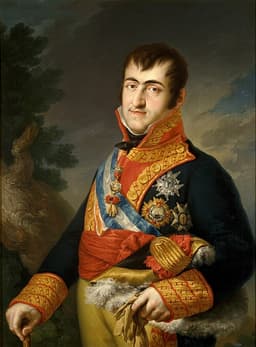
Ferdinand VII of Spain
Emperor · Modern
45.1Total
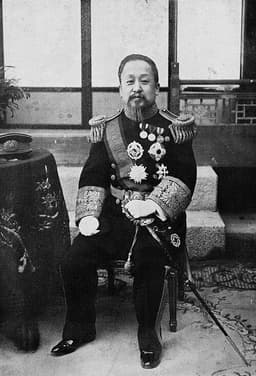
King Gojong of Korea
Emperor · Modern
52.8Total
Basic Information
Born
1784
1852
Died
1833
1919
Era
Modern
Modern
Nationality
Spain
Korea
Occupation
Emperor
Emperor
Civilization
Western
Eastern
Score Comparison
Military (10%)
14.9
50.0
Political (20%)
32.2
68.0
Influence (20%)
51.0
56.4
Legacy (20%)
41.7
48.3
Leadership (15%)
74.0
40.0
Strategy (15%)
45.0
54.6
TOTAL
45.1
52.8
Ferdinand VII of Spain — Complete Timeline
1808 AD
Accession to the thronePolitical Action◆ Major
Ferdinand VII became King of Spain after the abdication of his father Charles IV. His reign was interrupted by Napoleon's intervention and the Peninsular War, but he was restored in 1814.
SuccessionMonarchy
Impact: national
1814 AD
Abolition of the Constitution of 1812Political Action
Upon returning to Spain, Ferdinand VII abolished the liberal Constitution of 1812 and restored absolute monarchy. He persecuted liberals and reinstated the Inquisition, reversing the reforms of the Cortes of C
ConstitutionAbsolutismReaction
Impact: nationaldestructive
1820 AD
Trienio LiberalPolitical Action◆ Major
A military revolt led by Rafael del Riego forced Ferdinand VII to reinstate the Constitution of 1812, beginning the Trienio Liberal. Ferdinand was effectively a constitutional monarch for three years.
Liberal RevolutionConstitutionRevolt
Impact: national
1823 AD
French intervention and restoration of absolutismWar◆ Major
A French army, the Hundred Thousand Sons of Saint Louis, invaded Spain to restore Ferdinand VII's absolute power. The liberal government fell, and Ferdinand resumed repressive rule.
InterventionAbsolutismCongress of Vienna
Impact: regionaldestructive
1830 AD
Pragmatic Sanction of 1830Political Action◆ Major
Ferdinand VII issued the Pragmatic Sanction, abolishing Salic Law and allowing his daughter Isabella to inherit the throne. This led to the Carlist Wars after his death.
SuccessionLawCarlist Wars
Impact: national
King Gojong of Korea — Complete Timeline
1894 AD
Gabo ReformsReform◆ Major
Gojong's government implemented the Gabo Reforms, a series of modernization measures including the abolition of slavery, reform of the civil service exam, and adoption of a solar calendar. These reforms aimed to strengthen Korea against foreign encroachment.
ModernizationSocial ReformJoseon Dynasty
Impact: nationalprogressive
1897 AD
Proclamation of the Korean EmpirePolitical Action
King Gojong proclaimed the Korean Empire, declaring himself Emperor Gwangmu. This was an attempt to assert Korea's sovereignty and independence from foreign influence, particularly China and Japan, and to modernize the state.
Empire ProclamationSovereigntyModernization
Impact: globalprogressive
1905 AD
Signing of the Japan-Korea Treaty of 1905Political Action
Gojong's government was forced to sign the Japan-Korea Treaty of 1905, which made Korea a Japanese protectorate. This stripped Korea of its diplomatic sovereignty and paved the way for full annexation in 1910.
ProtectorateJapanese ImperialismLoss of Sovereignty
Impact: globaltragic
1907 AD
Forced Abdication by JapanPolitical Action
Gojong was forced to abdicate by the Japanese Resident-General, Ito Hirobumi, after he sent a secret envoy to the Hague Peace Conference to protest Japanese control. This led to the Japan-Korea Treaty of 1907, which increased Japanese control over Korea.
Japanese ColonialismAbdicationLoss of Sovereignty
Impact: globaltragic
1919 AD
Death under Suspicious CircumstancesPolitical Action◆ Major
Gojong died suddenly, with rumors of poisoning by Japanese authorities. His death sparked the March 1st Movement, a nationwide protest against Japanese rule, which became a pivotal event in the Korean independence movement.
DeathIndependence MovementJapanese Colonialism
Impact: nationaltragic
Expert Analysis
King Gojong of Korea vs Ferdinand VII of Spain
# The Prisoner and the Puppet: Ferdinand VII and Gojong, Two Monarchs Trapped by History
In the summer of 1808, a young Spanish king stood before Napoleon Bonaparte in Bayonne, France, trembling as the Emperor demanded his crown. Forty years later, on the other side of the world, a Korean boy of twelve was placed on a throne he never sought, surrounded by scheming nobles and foreign powers circling like sharks. Both men became monarchs at moments of national crisis. Both tried to preserve their thrones against overwhelming forces. And both ended their reigns in tragedy—Ferdinand VII as the man who destroyed his nation’s liberal hopes, Gojong as the last emperor of a Korea that vanished into Japan’s empire. But their paths diverged in ways that reveal the deepest questions of leadership, character, and historical destiny.
Origins
Ferdinand VII was born in 1784 into the decaying Spanish Bourbon dynasty. His father Charles IV was weak, his mother Maria Luisa was domineering, and the court was dominated by the favorite Manuel Godoy, a man widely rumored to be the queen’s lover. Ferdinand grew up in a palace of whispers and conspiracies. He learned early that power was a game of deception, not principle. When Napoleon invaded Spain in 1808, Ferdinand saw his chance: he orchestrated the Mutiny of Aranjuez, forced his father to abdicate, and became king—only to be immediately arrested by Napoleon and replaced with Joseph Bonaparte. For six years, Ferdinand was a prisoner in France, while Spanish guerrillas fought the French in his name, making him a symbol he had done nothing to earn.
Gojong’s origins were no less turbulent. Born in 1852, he was not meant to be king. The Joseon dynasty was in crisis, with the regent Heungseon Daewongun seeking a malleable child to control. Gojong was chosen at age twelve, his father ruling as regent. The boy grew up inside the walls of Changdeokgung Palace, isolated from the world, taught Confucian classics and court ritual. But unlike Ferdinand, Gojong had a father who modernized Korea’s military and resisted foreign interference—until the regent’s own arrogance provoked a French naval attack in 1866. Gojong watched his father’s failures, and learned that isolation was no longer possible.
Rise to Power
Ferdinand returned to Spain in 1814 after Napoleon’s defeat. The liberal Cortes had written a constitution in 1812, limiting royal power and establishing a parliamentary system. Ferdinand faced a choice: accept the constitution and become a constitutional monarch, or reject it and restore absolutism. He chose the latter. With the support of conservative generals and the Church, he abolished the Constitution of 1812, declared the liberals traitors, and launched a purge. His political score of 51.5 reflects this—he was neither visionary nor incompetent, but a man who chose the easiest path: the path of repression.
Gojong’s rise was slower and more deliberate. He took full power in 1873, after his father’s regency ended. By then, Korea was facing the same question as Spain: could a traditional monarchy survive in a world of empires? Gojong attempted a middle path. He opened ports to Japan and the West, sent students abroad, and in 1894 implemented the Gabo Reforms, which abolished slavery, ended the civil service examination system, and modernized the military. His political score of 84.8 is among the highest of any monarch of his era—not because he was a democrat, but because he understood that reform was necessary for survival.
Leadership & Governance
Ferdinand VII’s governance was a study in self-destruction. He ruled through fear and favoritism, appointing incompetent ministers who served his whims. He abolished the Inquisition not out of enlightenment but to seize its wealth. He persecuted liberals, executed Freemasons, and drove the best minds of Spain into exile. When a military revolt in 1820 forced him to reinstate the Constitution of 1812, he spent three years—the Trienio Liberal—sabotaging his own government, secretly plotting with France to invade his own country. In 1823, the Hundred Thousand Sons of Saint Louis marched into Spain, restored Ferdinand’s absolute power, and he immediately began hanging liberals again. His strategy score of 30.0 is damning: he had no long-term vision, only the desperate need to stay in power.
Gojong’s leadership was more complex. He embraced modernization but never fully controlled it. He proclaimed the Korean Empire in 1897, declaring himself Emperor Gwangmu, in a desperate attempt to assert sovereignty against Japan, Russia, and China. He built a railway, established a postal service, and sent a diplomatic mission to the Hague. But he was outmaneuvered at every turn. The Gabo Reforms were co-opted by pro-Japanese factions. His secret envoy to the Hague Peace Conference in 1907 was exposed by Japan, leading to his forced abdication. His military score of 43.0 reflects the reality: he built a modern army, but it was never strong enough to fight off Japan.
Triumph & Tragedy
Ferdinand’s greatest triumph was surviving. He outlasted Napoleon, outlasted the liberals, outlasted his own incompetence. But his greatest tragedy was that he left Spain a hollowed-out nation. When he died in 1833, the Carlist Wars erupted over his decision to abolish Salic Law and allow his daughter Isabella to inherit the throne. The Pragmatic Sanction of 1830 was his final act of political manipulation, and it plunged Spain into decades of civil war. His legacy score of 57.1 is a verdict: remembered, but not admired.
Gojong’s triumph was symbolic. By declaring the Korean Empire, he gave his people a brief moment of national pride. But his tragedy was total. Forced to abdicate in 1907, he lived under Japanese surveillance until his death in 1919, under suspicious circumstances—rumored to have been poisoned. His death sparked the March 1st Movement, a nationwide protest that became the founding moment of Korean nationalism. His legacy score of 68.0 reflects this: he failed as a king, but became a martyr for a nation he could not save.
Character & Destiny
Ferdinand VII was a man of small virtues and large vices. He was cunning but not wise, stubborn but not brave. He never forgave an enemy and never trusted a friend. His character was shaped by the Bourbon court—a world of intrigue where sincerity was weakness. He could have chosen to lead Spain toward constitutional monarchy, as many of his contemporaries did. Instead, he chose the path of reaction, and Spain paid for it for generations.
Gojong was a man caught between two worlds. He was raised in Confucian tradition but saw the power of Western technology. He wanted to reform but feared losing control. He was not a great strategist—his strategy score is also 30.0—but he was a man of genuine conviction. He believed in Korean sovereignty, and he tried everything to preserve it. His failure was not cowardice but circumstance: Korea was too small, too weak, and too isolated to resist Japan alone.
Legacy
Ferdinand VII is remembered in Spain as “the Desired” and “the Felon”—a king who was loved before he returned and hated after he ruled. His name is synonymous with absolutism, betrayal, and the lost opportunity of Spanish liberalism. He left no enduring institutions, only wounds.
Gojong is remembered in Korea as a tragic figure, the last emperor who tried to save his nation. His mausoleum in Namyangju is a site of pilgrimage. The Korean Empire he proclaimed lasted only thirteen years, but it gave Korea a claim to sovereignty that Japan tried to erase. His death sparked a movement that eventually led to Korean independence.
Conclusion
Both men were prisoners of their time. Ferdinand VII chose to be a jailer, locking Spain into a past that could not last. Gojong tried to be a bridge, but the bridge collapsed under him. Their scores tell the story: Ferdinand, the higher leadership score but lower political wisdom, chose reaction and left destruction. Gojong, the higher political wisdom but lower military power, chose reform and left a dream. In the end, the difference between them is not talent or intelligence, but the willingness to see the future and the courage to meet it—or the fear that turns a king into a tyrant, and a nation into a tomb.
Rankings
🥇
King Gojong of KoreaLeader
Mil: 50.0Pol: 68.0Inf: 56.4
52.8
🥈
Ferdinand VII of Spain
Mil: 14.9Pol: 32.2Inf: 51.0
45.1
+7.7 behind
How This Comparison Works
Algorithm
Each figure is scored on 6 dimensions (0—100 scale) based on structured historical data: Military (10%), Political (20%), Influence (20%), Legacy (20%), Leadership (15%), Strategy (15%). The weighted total produces the final ranking.
Data Sources
Scores are computed from structured sub-indicators in the database. Scale factors adjust for era (Ancient ×0.85, Modern ×1.0) and civilization size (Eastern ×1.05, Other ×0.80) to account for differences in population and military scale.
Maximum 3 Figures
Comparisons are limited to 2—3 figures to ensure readability and statistical meaningfulness.
Error Margins
±5 points per dimension — Sub-scores are derived from historical records with inherent uncertainty. Two figures within 5 points on a dimension should be considered roughly equivalent in that area.
Total Score Accuracy
±3 points overall — The weighted combination of 6 dimensions produces a total score with approximately ±3 points of uncertainty. Differences of less than 3 points are not statistically significant— the figures are effectively tied.
Known Limitations
- Historical records are incomplete and uneven across civilizations
- Figures from oral-tradition societies may be underrepresented
- Occupation labels can misclassify multi-role figures
- Scores measure capability and impact, not moral character
- Quantitative scoring is a comparison tool, not absolute truth
Capability Radar
Military (10%) — Battles & Warfare
Battles
10
5
Win Rate
5
5
Expansion
5
0
Political (20%) — Governance & Reform
Reform
5
40
Diplomacy
20
30
Economy
10
20
Influence (20%) — Cultural & Global Reach
Cultural
15
40
Global
20
30
Legacy (20%) — Historical Impact
Historical
30
50
Longevity
20
40
Leadership (15%) — Power & Stability
Tenure
60
60
Stability
10
15
Strategy (15%) — Tactics & Innovation
Strategy
5
5
Tactics
5
5
Reform
5
10
Similar Comparisons
Comments & Discussion
KingCagliostro6/16/2026
Calling Gojong a "prisoner" is an insult to actual prisoners. Ferdinand VII literally spent six years in French captivity while Gojong sat on his throne surrounded by eunuchs and concubines. The real parallel is that both were spectacularly ineffective at reading geopolitical realities. Ferdinand thought he could play Napoleon; Gojong thought Russia, Japan, and China would let Korea exist. Both were wrong, but only one had the excuse of bayonets at his throat.
半岛之狐6/16/2026
把高宗和费迪南七世类比是对韩国历史的侮辱。费迪南是主动向拿破仑投降的叛徒,而高宗至少尝试了亲俄外交、海牙密使等各种手段抵抗日本。虽然结果都是亡国,但一个是为了保住王冠出卖国家,另一个是明知不可为而为之的绝望挣扎。费迪南在法国城堡里喝红酒时,高宗在景福宫面对的是真正的刀俎。
LaManchaVigilante6/16/2026
The real tragedy isn't their imprisonment but their liberation. Ferdinand returned in 1814 and immediately tore up the liberal constitution, executing reformers and restoring the Inquisition. Gojong, for all his failures, never actively destroyed his people's hopes the way Ferdinand did. One was a victim of circumstance, the other a willing architect of tyranny. Spain's liberal dream died because Ferdinand chose absolutism over his own people. Korea died because Japan was stronger. There's a mor
大韩遗民6/16/2026
说什么性格决定命运完全是西方中心论的历史观。费迪南七世面对的是拿破仑体系崩溃后的欧洲重建,他还能选择回归专制。高宗面对的却是19世纪末赤裸裸的帝国主义吞并浪潮,连慈禧太后都逃不出北京,一个小国王能怎样?关键区别不是个人品格,而是地缘政治的绝境。把两人并列本身就是忽视东亚被殖民历史特殊性的傲慢。