Loading...
Ferdinand VII of Spain vs Julius Caesar
Julius Caesar leads by 37.7 pts · 2 figures compared
…
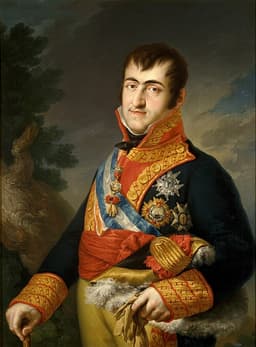
Ferdinand VII of Spain
Emperor · Modern
45.1Total

Julius Caesar
General · Ancient
82.8Total
Basic Information
Born
1784
-100
Died
1833
-44
Era
Modern
Ancient
Nationality
Spain
Roman Republic
Occupation
Emperor
General
Civilization
Western
Western
Score Comparison
Military (10%)
14.9
88.0
Political (20%)
32.2
78.0
Influence (20%)
51.0
85.0
Legacy (20%)
41.7
82.0
Leadership (15%)
74.0
80.0
Strategy (15%)
45.0
85.0
TOTAL
45.1
82.8
Ferdinand VII of Spain — Complete Timeline
1808 AD
Accession to the thronePolitical Action◆ Major
Ferdinand VII became King of Spain after the abdication of his father Charles IV. His reign was interrupted by Napoleon's intervention and the Peninsular War, but he was restored in 1814.
SuccessionMonarchy
Impact: national
1814 AD
Abolition of the Constitution of 1812Political Action
Upon returning to Spain, Ferdinand VII abolished the liberal Constitution of 1812 and restored absolute monarchy. He persecuted liberals and reinstated the Inquisition, reversing the reforms of the Cortes of C
ConstitutionAbsolutismReaction
Impact: nationaldestructive
1820 AD
Trienio LiberalPolitical Action◆ Major
A military revolt led by Rafael del Riego forced Ferdinand VII to reinstate the Constitution of 1812, beginning the Trienio Liberal. Ferdinand was effectively a constitutional monarch for three years.
Liberal RevolutionConstitutionRevolt
Impact: national
1823 AD
French intervention and restoration of absolutismWar◆ Major
A French army, the Hundred Thousand Sons of Saint Louis, invaded Spain to restore Ferdinand VII's absolute power. The liberal government fell, and Ferdinand resumed repressive rule.
InterventionAbsolutismCongress of Vienna
Impact: regionaldestructive
1830 AD
Pragmatic Sanction of 1830Political Action◆ Major
Ferdinand VII issued the Pragmatic Sanction, abolishing Salic Law and allowing his daughter Isabella to inherit the throne. This led to the Carlist Wars after his death.
SuccessionLawCarlist Wars
Impact: national
Julius Caesar — Complete Timeline
58 BC
Gallic WarsWar◆ Major
Caesar, as proconsul of Gaul, launched a series of campaigns that conquered all of Gaul (modern France, Belgium, and parts of Switzerland). He fought numerous battles, including against the Helvetii, the Belgae, and the Gallic chieftain Vercingetorix. The wars brought immense wealth and a loyal army to Caesar.
Gallic WarsConquestRoman Expansion
Impact: regional
49 BC
Crossing the RubiconPolitical Action◆ Major
Caesar led Legio XIII across the Rubicon River into Italy, defying the Roman Senate's order to disband his army. This act triggered a civil war against Pompey and the Optimates, ultimately leading to Caesar's dictatorship and the end of the Roman Republic.
Roman Civil WarEnd of RepublicPower Struggle
Impact: global
48 BC
Battle of PharsalusWar◆ Major
Caesar's outnumbered army defeated the larger forces of Pompey the Great at Pharsalus in Greece. Caesar's tactical use of a reserve line to counter Pompey's cavalry charge proved decisive. Pompey fled to Egypt, where he was assassinated, leaving Caesar as the undisputed master of the Roman world.
Roman Civil WarBattleDecisive Victory
Impact: regional
44 BC
Appointment as Dictator for LifePolitical Action◆ Major
The Roman Senate appointed Caesar dictator perpetuo (dictator for life), granting him unprecedented personal power. This move concentrated military, legislative, and judicial authority in one person, effectively ending the Roman Republic's traditional system of checks and balances and alarming many senators.
DictatorshipEnd of RepublicPower Consolidation
Impact: regionaldestructive
Assassination on the Ides of MarchPolitical Action◆ Major
A group of Roman senators, led by Marcus Junius Brutus and Gaius Cassius Longinus, stabbed Caesar to death at a meeting of the Senate in the Theatre of Pompey. The assassination was intended to restore the Republic, but instead triggered another civil war that led to the rise of the Roman Empire.
AssassinationRoman PoliticsEnd of Republic
Impact: globaldestructive
Expert Analysis
ferdinand-vii-of-spain-vs-julius-caesar
# The Dictator and the Despot: Caesar and Ferdinand VII, Two Faces of Absolute Power
On a March morning in 44 BCE, Julius Caesar fell beneath sixty dagger strokes at the foot of Pompey’s theater, his blood pooling on the marble floor where his rival’s statue once stood. Eighteen centuries later, in 1823, Ferdinand VII of Spain watched from a gilded carriage as French soldiers marched through Madrid to restore his crown, his enemies scattering into exile. Both men died kings in all but name—Caesar in a toga stained by betrayal, Ferdinand in a bed worn by tyranny. Yet one transformed the world; the other merely clung to it. What separates a revolutionary from a reactionary? The answer lies not in the power they seized, but in what they did with it.
Origins
Caesar was born into the chaos of a dying Republic, a patrician family fallen on hard times, his youth spent dodging Sulla’s proscription lists. The Rome of his childhood was a city of civil wars, where ambition was a survival instinct. Ferdinand, by contrast, entered the world as the heir to a crumbling empire, coddled in the Escorial palace, schooled in the divine right of kings. The Spanish monarchy in 1784 was a machine of ritual and inertia, its power already hollowed by Enlightenment ideas and colonial revolt. Caesar learned to read men in the Forum’s shouting matches; Ferdinand learned to distrust them in his father’s shadow. Their eras shaped them like clay: the first forged in the furnace of competition, the second molded in the amber of entitlement.
Rise to Power
Caesar’s ascent was a masterpiece of calculated risk. He climbed the Roman ladder—quaestor, aedile, pontifex maximus—not by birthright but by borrowing fortunes and forging alliances. His conquest of Gaul was a decade-long gamble that made him the richest man in the Republic, his legions loyal to him alone. When the Senate ordered him to disband, he crossed the Rubicon in 49 BCE, a river that became the hinge of history. Ferdinand’s rise was a puppet’s dance. He became king in 1808 only after his father abdicated under Napoleon’s pressure, then spent six years as a prisoner in France, a monarch without a throne. Where Caesar seized his moment, Ferdinand had his handed to him—and dropped it.
Leadership & Governance
Caesar governed as a reformer who understood that power needed a foundation. He reorganized the calendar, granted citizenship to provincials, launched public works, and curbed the corruption of grain dole. His military genius was inseparable from his political vision: every legionary knew his general’s name, and every Gaulish chieftain knew his iron. Ferdinand governed as a destroyer. Upon returning to Spain in 1814, he abolished the liberal Constitution of 1812, purged reformers, and restored the Inquisition. His rule was a war against the future. The *Trienio Liberal* of 1820–1823 forced him to accept the constitution again, but he called in French bayonets to crush it. Caesar built aqueducts; Ferdinand built prisons.
Triumph & Tragedy
Caesar’s greatest triumph was his conquest of Gaul—a feat of strategy, logistics, and ruthlessness that added a province larger than Italy to Roman dominion. His tragedy was his success: the dictatorship he created to save Rome from chaos made him a tyrant in the eyes of his peers. The Ides of March was the price of his ambition. Ferdinand’s triumph was survival itself—he outlasted Napoleon, outmaneuvered liberals, and died on his throne in 1833. His tragedy was that he ruled over a Spain he had hollowed out: bankrupt, divided, and stripped of its American empire. His greatest act, the Pragmatic Sanction of 1830, allowed his daughter Isabella to inherit the throne, but it also ignited a century of civil war. Caesar’s death began an empire; Ferdinand’s death began a curse.
Character & Destiny
Caesar was restless, brilliant, and dangerously charismatic. He forgave his enemies—until he didn’t. He wrote his own commentaries, controlled his own narrative, and believed in his own star. His flaw was not arrogance but a kind of fatalistic courage: he knew the conspirators’ knives waited, and he walked into the Senate anyway. Ferdinand was sullen, vindictive, and small. He betrayed his father, his allies, and his people. His flaw was fear: he could not share power because he could not trust anyone. Caesar’s destiny was to break the old world; Ferdinand’s was to break the new one that tried to replace him.
Legacy
Caesar’s legacy is the Roman Empire—the legal system, the Latin language, the idea of a European civilization that lasted a millennium. His name became a title: *Kaiser*, *Tsar*. Ferdinand’s legacy is the failure of Spanish liberalism, the loss of the Americas, and the Carlist Wars that tore his country apart. Historians score Caesar at 83.3 overall, a titan of strategy and influence. Ferdinand scores 54.3, a middling monarch saved from obscurity only by the wreckage he left. One gave the world an empire; the other gave it a cautionary tale.
Conclusion
Two men who held absolute power, separated by centuries and circumstance. Caesar used his to build; Ferdinand used his to preserve. The difference is not in ambition—both wanted everything—but in vision. Caesar saw the future and tried to shape it; Ferdinand saw the past and tried to chain it. The lesson for the ages is this: power without purpose is not tyranny—it is decay. And decay, unlike ambition, leaves nothing behind but ruins.
Rankings
🥇
Julius CaesarLeader
Mil: 88.0Pol: 78.0Inf: 85.0
82.8
🥈
Ferdinand VII of Spain
Mil: 14.9Pol: 32.2Inf: 51.0
45.1
+37.7 behind
How This Comparison Works
Algorithm
Each figure is scored on 6 dimensions (0—100 scale) based on structured historical data: Military (10%), Political (20%), Influence (20%), Legacy (20%), Leadership (15%), Strategy (15%). The weighted total produces the final ranking.
Data Sources
Scores are computed from structured sub-indicators in the database. Scale factors adjust for era (Ancient ×0.85, Modern ×1.0) and civilization size (Eastern ×1.05, Other ×0.80) to account for differences in population and military scale.
Maximum 3 Figures
Comparisons are limited to 2—3 figures to ensure readability and statistical meaningfulness.
Error Margins
±5 points per dimension — Sub-scores are derived from historical records with inherent uncertainty. Two figures within 5 points on a dimension should be considered roughly equivalent in that area.
Total Score Accuracy
±3 points overall — The weighted combination of 6 dimensions produces a total score with approximately ±3 points of uncertainty. Differences of less than 3 points are not statistically significant— the figures are effectively tied.
Known Limitations
- Historical records are incomplete and uneven across civilizations
- Figures from oral-tradition societies may be underrepresented
- Occupation labels can misclassify multi-role figures
- Scores measure capability and impact, not moral character
- Quantitative scoring is a comparison tool, not absolute truth
Capability Radar
Military (10%) — Battles & Warfare
Battles
10
95
Win Rate
5
92
Expansion
5
97
Political (20%) — Governance & Reform
Reform
5
90
Diplomacy
20
85
Economy
10
82
Influence (20%) — Cultural & Global Reach
Cultural
15
88
Global
20
94
Legacy (20%) — Historical Impact
Historical
30
95
Longevity
20
96
Leadership (15%) — Power & Stability
Tenure
60
75
Stability
10
60
Strategy (15%) — Tactics & Innovation
Strategy
5
94
Tactics
5
96
Reform
5
88
Similar Comparisons
Comments & Discussion
历史量化控6/17/2026
这种人物对比最怕“关公战秦琼”。凯撒在58-50 BCE的高卢战争里整合了超过40个部落,直接改变了欧陆政治格局;费迪南七世1814-1833年间统治的西班牙,GDP增长率不到0.3%。凯撒死后罗马进入帝国时代;费迪南死后西班牙陷入卡洛斯战争。数据不撒谎:一个是从A点到B点的引擎,另一个是原地打滑的轮胎。历史爱好者该放下浪漫滤镜了。
GallicGrumble6/17/2026
Caesar conquered Gaul with legions he raised himself; Ferdinand VII couldn't even hold Spain together with the entire French army backing him. The comparison is almost insulting. Caesar was a military genius who rewrote the rules of warfare at Alesia and Pharsalus. Ferdinand's biggest achievement was abolishing the 1812 Constitution, which made him the textbook definition of a reactionary. One expanded civilization's borders; the other choked his kingdom's progress. History buffs romanticize mon
ClassicistCato6/17/2026
Ferdinand VII and Caesar are only comparable if you ignore everything about Roman political norms. Caesar's dictatorship was framed as a temporary necessity to end civil wars; Ferdinand's was an embrace of absolutism disguised as tradition. Caesar reformed the calendar, granted citizenship to Gauls, and built infrastructure. Ferdinand restored the Inquisition, crushed liberals, and lost most of the American empire. One expanded citizenship; the other narrowed it. That's not two faces of power—th
反权威历史粉6/17/2026
拿凯撒和费迪南七世并列,本身就是对历史的庸俗化。凯撒跨过卢比孔河时,起码带着“解放平民对抗元老院压迫”的叙事;费迪南废除1812年宪法时,直接说“我是一切法律的源头”。差别在于:前者利用制度漏洞改革,后者废掉制度独裁。更可笑的是,费迪南最后靠法国刺刀复位,凯撒却是自己砍出来的江山。一个是赌徒,一个是妈宝。别把专制混为一谈。
BattlefieldBard6/17/2026
My issue is tactical. Caesar personally led from the front at Munda, his cavalry charges decisive in dozens of engagements. Ferdinand VII never once led troops in battle—his generals fought the Peninsular War while he sulked in exile. Caesar’s Commentaries demonstrate operational genius; Ferdinand’s decrees show petulant vanity. One wrote the manual on command presence; the other couldn't command a stable succession. Comparing their legacies is generous to Ferdinand—bluntly, it's like comparing