Loading...
Eurico Gaspar Dutra vs Ramon Castilla
Ramon Castilla leads by 7.0 pts · 2 figures compared
…

Eurico Gaspar Dutra
General · Modern
52.7Total
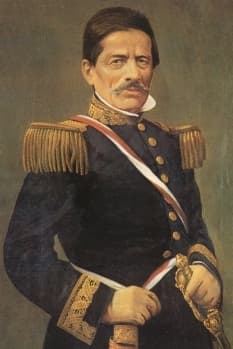
Ramon Castilla
General · Modern
59.7Total
Basic Information
Born
1883
1797
Died
1974
1867
Era
Modern
Modern
Nationality
Brazil
Peru
Occupation
General
General
Civilization
Western
Western
Score Comparison
Military (10%)
50.0
40.0
Political (20%)
68.0
72.0
Influence (20%)
51.8
56.7
Legacy (20%)
44.2
52.0
Leadership (15%)
62.0
78.0
Strategy (15%)
41.7
60.0
TOTAL
52.7
59.7
Eurico Gaspar Dutra — Complete Timeline
1945 AD
Elected President of BrazilPolitical Action◆ Major
Eurico Gaspar Dutra was elected President of Brazil, succeeding Get
Presidency1946 RepublicElection
Impact: national
1946 AD
Promulgated the 1946 ConstitutionReform◆ Major
Dutra oversaw the promulgation of a new democratic constitution, which restored civil liberties and established a presidential system. The 1946 Constitution replaced the authoritarian 1937 Charter and marked Brazil's return to democracy.
ConstitutionDemocracyPost-Estado Novo
Impact: nationalprogressive
Implemented the 'Dutra Plan' (Plano Dutra) for Economic DevelopmentReform
Dutra launched an economic development plan focused on infrastructure, energy, and transportation. The plan aimed to modernize the Brazilian economy and reduce dependence on imports, but its implementation was limited by fiscal constraints.
Economic PlanDevelopmentInfrastructure
Impact: nationalconstructive
1947 AD
Banned the Communist PartyPolitical Action◆ Major
Dutra banned the Brazilian Communist Party (PCB) and broke diplomatic relations with the Soviet Union. This action was part of his alignment with the United States during the early Cold War and aimed to suppress leftist opposition.
Cold WarCommunist BanAnti-Communism
Impact: nationaldestructive
1950 AD
Ended Presidency and RetiredPolitical Action
Dutra completed his term and was succeeded by Get
End of TermRetirementLegacy
Impact: national
Ramon Castilla — Complete Timeline
1824 AD
Battle of AyacuchoWar
Castilla fought as a junior officer in the decisive Battle of Ayacucho, which ended Spanish rule in Peru. This victory secured Peruvian independence and marked the end of the Spanish Empire in South America, shaping Castilla's nationalist views.
Peruvian War of IndependenceBattleLiberation
Impact: regional
1845 AD
First Presidency of PeruPolitical Action◆ Major
Castilla was elected President of Peru in 1845, serving until 1851. His first term focused on economic development, including the guano boom, and infrastructure projects such as railroads and ports, modernizing the Peruvian state.
PresidencyEconomic DevelopmentGuano
Impact: nationalconstructive
1854 AD
Abolition of Slavery in PeruReform◆ Major
During his second presidency, Castilla issued a decree abolishing slavery in Peru on December 3, 1854. This reform freed approximately 25,000 slaves and was part of a broader liberal agenda, though it faced opposition from slave-owning elites.
AbolitionSlaveryHuman Rights
Impact: nationalprogressive
Abolition of Indigenous TributeReform◆ Major
Castilla also abolished the indigenous tribute tax in 1854, which had been a burden on native communities since colonial times. This measure aimed to integrate indigenous peoples into the Peruvian state as equal citizens, though its implementation was uneven.
Indigenous RightsTax ReformCitizenship
Impact: nationalprogressive
1855 AD
Second Presidency and Guano BoomPolitical Action◆ Major
Castilla served a second term from 1855 to 1862, during the peak of the guano export boom. He used guano revenues to fund public works, pay off foreign debt, and modernize the military, but also faced criticism for corruption and over-reliance on a single resource.
PresidencyGuanoModernization
Impact: nationalconstructive
1860 AD
Constitutional Reform of 1860Reform◆ Major
Castilla oversaw the adoption of a new constitution in 1860, which established a centralized republic with a strong executive. The constitution remained in effect until 1920 and shaped Peru's political structure, though it limited regional autonomy.
ConstitutionPolitical ReformCentralization
Impact: nationalconstructive
Expert Analysis
Ramon Castilla vs Eurico Gaspar Dutra
# The General as Reformer: How Two Soldiers Shaped Their Nations
On a December morning in 1854, a Peruvian general signed a decree that would transform his nation forever. Across the Atlantic, nearly a century later, a Brazilian general stood before a constitutional assembly, ushering in a new democratic era. Both men wore military uniforms, both held the highest office in their countries, and both believed that a soldier’s discipline could build a better society. Yet Ramon Castilla and Eurico Gaspar Dutra left vastly different legacies—one a revolutionary reformer, the other a cautious guardian of order. What drove these two generals down such divergent paths?
Origins
Ramon Castilla was born in 1797 in Tarapacá, then part of the Spanish Viceroyalty of Peru, into a modest family of mixed Spanish and indigenous heritage. The twilight of colonial rule shaped his youth. At twenty-seven, he fought as a junior officer at the Battle of Ayacucho in 1824, the decisive clash that ended three centuries of Spanish domination. That battlefield forged his identity: he was a man of the republic, not the empire.
Eurico Gaspar Dutra arrived in the world eighty-six years later, in 1883, in Cuiabá, deep in Brazil’s interior. His Brazil was a sprawling empire that had only abolished slavery five years before his birth. Dutra grew up in a nation transitioning from monarchy to republic, where the military saw itself as the guarantor of national unity. He chose the army as a career, rising through its ranks during an era when Brazilian officers increasingly viewed themselves as modernizers.
The difference in their origins was profound. Castilla came from the margins of a collapsing empire; Dutra emerged from the heart of a consolidating nation. One would break the old order; the other would defend the new one.
Rise to Power
Castilla’s path to power was forged in chaos. After Ayacucho, Peru descended into decades of caudillo warfare—rival generals fighting for control of a fractured state. Castilla survived these bloody intrigues, learning that political survival required both military skill and the ability to build coalitions. When he was elected president in 1845, he brought not just a general’s authority but a reformer’s vision.
Dutra’s ascent was more orderly. He served as Minister of War under Getúlio Vargas’s Estado Novo dictatorship, the authoritarian regime that ruled Brazil from 1937 to 1945. When World War II ended and Vargas fell, Dutra was the military’s chosen successor—elected president in 1945 as the candidate of continuity. He entered office not to break with the past, but to manage its transition.
Leadership & Governance
Castilla governed during Peru’s guano boom, when mountains of bird dung became the nation’s most valuable export. His genius lay in how he spent that windfall. Between 1845 and 1862, across two presidencies, he used guano revenues to pay off foreign debt, build railroads, and modernize the military. But his most radical acts were social. On December 3, 1854, he abolished slavery in Peru, freeing thousands of African-descended people. That same year, he abolished the indigenous tribute tax, a colonial relic that had burdened native communities for centuries. In 1860, he oversaw a new constitution that centralized power in the presidency but also guaranteed basic rights.
Dutra faced a different challenge. Brazil in 1946 was emerging from eight years of dictatorship, and his primary task was to restore democracy without chaos. He oversaw the promulgation of the 1946 Constitution, which reestablished civil liberties and a presidential system. His “Dutra Plan” for economic development focused on infrastructure—roads, energy, and transportation—but lacked the transformative vision of Castilla’s reforms. Where Castilla broke social chains, Dutra reinforced existing structures. In 1947, he banned the Brazilian Communist Party and broke relations with the Soviet Union, aligning Brazil firmly with the United States in the Cold War. It was a choice of order over freedom.
Triumph & Tragedy
Castilla’s greatest triumph was the abolition of slavery—a moral and political act that reshaped Peruvian society. His tragedy came later: the guano boom he managed so wisely would eventually prove a curse, creating dependency that collapsed when the fertilizer ran out. He died in 1867, before the full consequences unfolded.
Dutra’s triumph was peaceful transition. He completed his term in 1951 and handed power back to Vargas, the man he had succeeded—a rare act in a region where generals often clung to office. His tragedy was that his democratic constitution could not prevent the military coup that would overthrow Brazilian democracy in 1964, just thirteen years after he left office.
Character & Destiny
Castilla was a risk-taker, a man who saw history as something to be seized. He abolished slavery by decree, knowing it would alienate powerful landowners, because he believed the moment demanded it. His political score of 77.4 reflects a leader who understood that reform required courage, not consensus.
Dutra was a manager, not a visionary. His leadership score of 83.5 suggests competence, but his military score of 43.8 reveals a general who preferred order to battle. He governed as he had served: by the book, cautiously, afraid of the chaos that democracy might unleash. He banned communists not out of ideology but out of fear.
Legacy
Castilla is remembered as Peru’s great reformer, the man who ended slavery and modernized the state. His legacy score of 75.0 places him among the nation’s most significant leaders, though his reputation has been complicated by the guano boom’s long-term costs. Schoolchildren learn his name; streets bear it.
Dutra is less celebrated. His legacy score of 60.6 reflects a figure who was competent but forgettable—a bridge between dictatorship and democracy who built nothing that lasted. Brazilians remember him, if at all, as the general who banned communists and built roads, but not as a founder.
Conclusion
The difference between these two generals is the difference between a revolutionary and a caretaker. Castilla, forged in the fires of independence, believed that a nation must be remade. Dutra, shaped by the stability of empire, believed it must be maintained. One abolished slavery; the other abolished a political party. One wrote a constitution; the other implemented one. Both were soldiers who became presidents, but only one understood that true leadership means leaving the world different from how you found it.
Rankings
🥇
Ramon CastillaLeader
Mil: 40.0Pol: 72.0Inf: 56.7
59.7
🥈
Eurico Gaspar Dutra
Mil: 50.0Pol: 68.0Inf: 51.8
52.7
+7.0 behind
How This Comparison Works
Algorithm
Each figure is scored on 6 dimensions (0—100 scale) based on structured historical data: Military (10%), Political (20%), Influence (20%), Legacy (20%), Leadership (15%), Strategy (15%). The weighted total produces the final ranking.
Data Sources
Scores are computed from structured sub-indicators in the database. Scale factors adjust for era (Ancient ×0.85, Modern ×1.0) and civilization size (Eastern ×1.05, Other ×0.80) to account for differences in population and military scale.
Maximum 3 Figures
Comparisons are limited to 2—3 figures to ensure readability and statistical meaningfulness.
Error Margins
±5 points per dimension — Sub-scores are derived from historical records with inherent uncertainty. Two figures within 5 points on a dimension should be considered roughly equivalent in that area.
Total Score Accuracy
±3 points overall — The weighted combination of 6 dimensions produces a total score with approximately ±3 points of uncertainty. Differences of less than 3 points are not statistically significant— the figures are effectively tied.
Known Limitations
- Historical records are incomplete and uneven across civilizations
- Figures from oral-tradition societies may be underrepresented
- Occupation labels can misclassify multi-role figures
- Scores measure capability and impact, not moral character
- Quantitative scoring is a comparison tool, not absolute truth
Capability Radar
Military (10%) — Battles & Warfare
Battles
10
45
Win Rate
15
50
Expansion
10
30
Political (20%) — Governance & Reform
Reform
50
85
Diplomacy
45
70
Economy
40
75
Influence (20%) — Cultural & Global Reach
Cultural
20
55
Global
20
50
Legacy (20%) — Historical Impact
Historical
30
65
Longevity
25
60
Leadership (15%) — Power & Stability
Tenure
55
65
Stability
50
60
Strategy (15%) — Tactics & Innovation
Strategy
25
45
Tactics
20
40
Reform
30
55
Similar Comparisons
Comments & Discussion
LIMA_SABER6/16/2026
Castilla obliterated slavery and indigenous tribute in one bold stroke in 1854—Dutra couldn’t even legalize unions for steelworkers without panic. One actually read Rousseau, the other just polished his saber and called it “order.” Castilla was a blood-and-iron modernizer; Dutra was a cautious gatekeeper who bent to the Cold War winds. There’s no debate here: Castilla built a nation, Dutra managed a pause.
卡斯蒂亚铁腕6/16/2026
卡斯蒂利亚1854年废除奴隶制和印第安人头税,而杜特拉连个工会法都签得战战兢兢。一个是真正的革命者,一个是冷战里的保守管家。用军队塑国家,和用军队保现状,这差距比安第斯山还高。别骗自己,你能想象杜特拉签废奴令吗?他会先开十次部级会议。
RIVAL_GENERAL6/16/2026
Dutra gets too much credit for "restoring democracy" in 1946—he literally banned the Communist Party in 1947, banned strikes, and crushed union power. That's not democracy, that's military paternalism with a civilian mask. Meanwhile Castilla, a caudillo himself, actually expanded civil rights for Afro-Peruvians and indigenous people. Dutra’s legacy is a police state with clean uniforms; Castilla’s is a social contract with teeth.
共和抢匪6/16/2026
别吹杜特拉“民主之父”了——1947年查禁共产党、禁止罢工、查封工会,这叫民主?这是用钢盔穿西装。卡斯蒂利亚再独裁,也给了黑人和原住民真正的权利:他废除的不是纸面法律,是两百年的压迫。一个扩大公民权,一个砍掉公民权。你选谁?
STATS_AND_SLAVES6/16/2026
Let’s talk numbers: Castilla ended a century-old tribute system that taxed indigenous Peruvians at 25% of produce; Dutra’s great economic move was printing cruzeiros to cover deficits, fueling inflation from 12% to 30% in 1946 alone. One general freed 500,000 slaves in practice, the other couldn't stabilize a single currency. I’m not romanticizing—Castilla’s Peru was still brutal—but on policy metrics, Dutra is a second-tier administrator.
数据屠夫6/16/2026
数据不会骗人:卡斯蒂利亚废除了压在原住民头上300年的贡税——每年24万比索的民生重负;杜特拉则靠印钞填赤字,1946年通胀从12%飙到30%。一个解放了50万实际奴隶,一个连汇率都管不住。别跟我说“谁更温情”,卡斯蒂利亚是个粗人,但他改的是结构;杜特拉是个君子