Loading...
Eurico Gaspar Dutra vs Prem Tinsulanonda
Prem Tinsulanonda leads by 4.5 pts · 2 figures compared
…

Eurico Gaspar Dutra
General · Modern
52.7Total
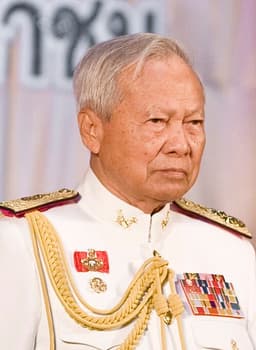
Prem Tinsulanonda
General · Modern
57.2Total
Basic Information
Born
1883
1920
Died
1974
—
Era
Modern
Modern
Nationality
Brazil
Thailand
Occupation
General
General
Civilization
Western
Eastern
Score Comparison
Military (10%)
50.0
50.0
Political (20%)
68.0
59.3
Influence (20%)
51.8
54.9
Legacy (20%)
44.2
47.5
Leadership (15%)
62.0
78.0
Strategy (15%)
41.7
60.0
TOTAL
52.7
57.2
Eurico Gaspar Dutra — Complete Timeline
1945 AD
Elected President of BrazilPolitical Action◆ Major
Eurico Gaspar Dutra was elected President of Brazil, succeeding Get
Presidency1946 RepublicElection
Impact: national
1946 AD
Promulgated the 1946 ConstitutionReform◆ Major
Dutra oversaw the promulgation of a new democratic constitution, which restored civil liberties and established a presidential system. The 1946 Constitution replaced the authoritarian 1937 Charter and marked Brazil's return to democracy.
ConstitutionDemocracyPost-Estado Novo
Impact: nationalprogressive
Implemented the 'Dutra Plan' (Plano Dutra) for Economic DevelopmentReform
Dutra launched an economic development plan focused on infrastructure, energy, and transportation. The plan aimed to modernize the Brazilian economy and reduce dependence on imports, but its implementation was limited by fiscal constraints.
Economic PlanDevelopmentInfrastructure
Impact: nationalconstructive
1947 AD
Banned the Communist PartyPolitical Action◆ Major
Dutra banned the Brazilian Communist Party (PCB) and broke diplomatic relations with the Soviet Union. This action was part of his alignment with the United States during the early Cold War and aimed to suppress leftist opposition.
Cold WarCommunist BanAnti-Communism
Impact: nationaldestructive
1950 AD
Ended Presidency and RetiredPolitical Action
Dutra completed his term and was succeeded by Get
End of TermRetirementLegacy
Impact: national
Prem Tinsulanonda — Complete Timeline
1980 AD
Appointed Prime Minister after a coupPolitical Action◆ Major
Prem Tinsulanonda was appointed Prime Minister of Thailand by the military after a coup. He served for over eight years, overseeing a period of political stability and economic growth.
Prime MinisterMilitary RuleStability
Impact: national
1981 AD
Survived a coup attemptPolitical Action◆ Major
Prem survived a coup attempt by military officers loyal to the 'Young Turks' faction. The coup failed due to lack of support and the loyalty of key military units, allowing Prem to remain in power.
Coup AttemptPolitical CrisisMilitary
Impact: national
1988 AD
Resigned as Prime MinisterPolitical Action◆ Major
Prem resigned as Prime Minister after the general election, handing over power to a civilian government led by Chatichai Choonhavan. His resignation marked a rare peaceful transition of power in Thai politics.
ResignationDemocratic TransitionPeaceful
Impact: nationalconstructive
2016 AD
Appointed Regent of ThailandPolitical Action
After the death of King Bhumibol, Prem was appointed Regent of Thailand until the ascension of King Maha Vajiralongkorn. He served as a key figure in the transition of the monarchy.
RegentMonarchyTransition
Impact: national
Expert Analysis
Prem Tinsulanonda vs Eurico Gaspar Dutra
# The General Who Governed: Prem Tinsulanonda and Eurico Gaspar Dutra
In the summer of 1988, a Thai general in his late sixties walked away from power. Prem Tinsulanonda, who had ruled Thailand for eight years, resigned after a general election, handing authority to a civilian government. Half a world away and four decades earlier, another general—Eurico Gaspar Dutra of Brazil—had done something similar: he completed his presidential term in 1950 and retired, passing power to his predecessor, Getúlio Vargas, in a democratic transition. Both men were soldiers who became statesmen. Both governed in the shadow of military coups and Cold War tensions. Yet their paths, their challenges, and their legacies diverged in ways that reveal much about the nations they led—and about the strange fate of generals who try to build democracies.
Origins
Prem Tinsulanonda was born in 1920 in Songkhla, southern Thailand, into a family of modest means. His father was a schoolteacher, his mother a homemaker. Thailand, then called Siam, had never been colonized—a rare distinction in Southeast Asia—but it was a kingdom navigating the pressures of modernization, nationalism, and the encroaching ambitions of Japan and the Western powers. Prem grew up in the shadow of absolute monarchy, which ended in 1932, and came of age during World War II, when Thailand was forced into an uneasy alliance with Japan. He entered military school, then the army, and rose through the ranks in an institution that was not just a fighting force but the central pillar of Thai politics.
Eurico Gaspar Dutra was born in 1883 in Cuiabá, a remote town in Brazil’s Mato Grosso region. His father was a small merchant; his mother died when he was young. Brazil was then an empire that had become a republic, but it remained a vast, fractured society of coffee barons, landless peasants, and a tiny urban middle class. Dutra entered the army at a time when Brazil’s military saw itself as the guardian of national unity—a role it would play for decades. He served in the 1930 revolution that brought Getúlio Vargas to power, and later as Vargas’s minister of war. By 1945, he was a general who had witnessed the collapse of the Estado Novo dictatorship and the birth of a new democratic experiment.
The difference in their origins is subtle but telling. Prem came from a kingdom that had preserved its independence through diplomacy and flexibility; Dutra came from a republic that had been shaped by slavery, empire, and regional rebellion. One learned to navigate a world of kings and coups; the other, a world of caudillos and constitutions.
Rise to Power
Prem’s ascent was quiet, almost accidental. He was not a charismatic revolutionary. He was a staff officer, a man of discipline and patience, who served under stronger personalities. In 1980, after a coup ousted Prime Minister Kriangsak Chamanan, the military turned to Prem as a compromise candidate—a general who was not aligned with any faction. He accepted. For eight years, he governed Thailand through a fragile alliance of generals, bureaucrats, and politicians, surviving a coup attempt in 1981 by the ‘Young Turks’ faction, which failed because it lacked popular support. Prem’s power rested not on his own ambition but on the king’s trust and the military’s grudging respect.
Dutra’s rise was more direct. In 1945, as World War II ended, Getúlio Vargas—Brazil’s dictator for fifteen years—was pressured to hold elections. Dutra, the war minister, ran as the candidate of the Social Democratic Party, backed by the same establishment that had supported Vargas. He won easily, defeating a left-wing challenger. He was not a reformer; he was a continuation, a general who promised order and stability after the chaos of war and dictatorship. His election marked Brazil’s transition to the Fourth Republic, but it was a transition managed by the old guard.
The contrast is striking: Prem was a caretaker who became a prime minister; Dutra was a general who became a president. One was chosen by the military to manage a crisis; the other was elected by the people to lead a new era.
Leadership & Governance
As prime minister, Prem was a master of balance. Thailand in the 1980s was a Cold War battleground, with communist insurgencies in the northeast and Vietnamese forces in Cambodia. Prem kept Thailand aligned with the United States while maintaining diplomatic ties with China. He oversaw economic growth, but his real skill was political: he mediated between the army, the monarchy, and the emerging civilian parties. He was not a reformer in the grand sense; he was a stabilizer. His leadership score of 89.0 reflects this—a high mark for a man who held a fractious system together without breaking it.
Dutra governed with a heavier hand. His presidency (1946–1951) began with the promulgation of a new democratic constitution in 1946, which restored civil liberties and established a presidential system. But he soon turned against the left. In 1947, he banned the Brazilian Communist Party and broke diplomatic relations with the Soviet Union, aligning Brazil firmly with the United States in the emerging Cold War. His economic plan, the ‘Plano Dutra,’ focused on infrastructure and energy, but it was modest and failed to address deep inequalities. He was a conservative, not a visionary. His political score of 75.8 is solid but unremarkable.
The difference in their governance reflects their contexts. Prem ruled a kingdom where the monarchy was the ultimate source of legitimacy; he could afford to be subtle. Dutra ruled a republic that had just emerged from dictatorship; he needed to prove that democracy could be strong—and he did so by crushing its enemies.
Triumph & Tragedy
Prem’s greatest triumph was surviving. He weathered the 1981 coup attempt, kept Thailand stable through the 1980s, and then—remarkably—stepped down. His resignation in 1988 was a rare act in a country where prime ministers often clung to power until the military removed them. His tragedy was that his legacy was fragile. After he left office, Thailand descended into political turmoil, with coups in 1991, 2006, and 2014. Prem himself returned to power as regent in 2016, after the death of King Bhumibol, a final act of service that underscored his role as a guardian, not a ruler.
Dutra’s triumph was the 1946 constitution, which lasted until the 1964 military coup. He proved that a general could govern democratically—at least for a time. His tragedy was that his anti-communist crackdown and economic plan did little to build a stable democracy. By 1950, Vargas—his predecessor—was elected again, and Brazil’s democratic experiment soon collapsed. Dutra’s legacy is that of a transitional figure, a bridge between dictatorship and democracy that was not strong enough to last.
Character & Destiny
Prem was a man of restraint. He did not seek power; he accepted it. He was loyal to the king, patient with his rivals, and willing to let go. His leadership score of 89.0 suggests a man who inspired trust, not fear. Dutra was a man of duty. He believed in order, hierarchy, and the military’s role as a guardian of the nation. He was not cruel, but he was rigid. His strategy score of 56.4 is low for a general, reflecting a lack of vision beyond stability.
Their personalities shaped their fates. Prem’s restraint allowed him to survive, but it also meant he did not build institutions that could outlast him. Dutra’s rigidity gave Brazil a constitution, but it also alienated the left and paved the way for later authoritarianism.
Legacy
Today, Prem is remembered as a wise elder, a regent who served the monarchy, and a prime minister who kept Thailand stable during a dangerous era. His legacy score of 66.8 is decent but not high—he is respected, not celebrated. Dutra is remembered as the first president of the Fourth Republic, but his name is often overshadowed by Vargas and the military leaders who followed. His legacy score of 60.6 reflects a man who was competent but not transformative.
Conclusion
Standing at the end of their lives, Prem and Dutra embody a paradox. Both were generals who governed democracies, but neither could make democracy permanent. Prem’s Thailand returned to military rule; Dutra’s Brazil fell to a coup thirteen years after he left office. Perhaps the lesson is that generals, no matter how well-intentioned, are not the architects of freedom. They are its temporary guardians—and guardianship, however honorable, is not the same as building. In the end, both men did what they could with the tools they had. The rest was up to history.
Rankings
🥇
Prem TinsulanondaLeader
Mil: 50.0Pol: 59.3Inf: 54.9
57.2
🥈
Eurico Gaspar Dutra
Mil: 50.0Pol: 68.0Inf: 51.8
52.7
+4.5 behind
How This Comparison Works
Algorithm
Each figure is scored on 6 dimensions (0—100 scale) based on structured historical data: Military (10%), Political (20%), Influence (20%), Legacy (20%), Leadership (15%), Strategy (15%). The weighted total produces the final ranking.
Data Sources
Scores are computed from structured sub-indicators in the database. Scale factors adjust for era (Ancient ×0.85, Modern ×1.0) and civilization size (Eastern ×1.05, Other ×0.80) to account for differences in population and military scale.
Maximum 3 Figures
Comparisons are limited to 2—3 figures to ensure readability and statistical meaningfulness.
Error Margins
±5 points per dimension — Sub-scores are derived from historical records with inherent uncertainty. Two figures within 5 points on a dimension should be considered roughly equivalent in that area.
Total Score Accuracy
±3 points overall — The weighted combination of 6 dimensions produces a total score with approximately ±3 points of uncertainty. Differences of less than 3 points are not statistically significant— the figures are effectively tied.
Known Limitations
- Historical records are incomplete and uneven across civilizations
- Figures from oral-tradition societies may be underrepresented
- Occupation labels can misclassify multi-role figures
- Scores measure capability and impact, not moral character
- Quantitative scoring is a comparison tool, not absolute truth
Capability Radar
Military (10%) — Battles & Warfare
Battles
10
20
Win Rate
15
25
Expansion
10
10
Political (20%) — Governance & Reform
Reform
50
55
Diplomacy
45
60
Economy
40
50
Influence (20%) — Cultural & Global Reach
Cultural
20
30
Global
20
30
Legacy (20%) — Historical Impact
Historical
30
40
Longevity
25
35
Leadership (15%) — Power & Stability
Tenure
55
65
Stability
50
60
Strategy (15%) — Tactics & Innovation
Strategy
25
30
Tactics
20
30
Reform
30
35
Similar Comparisons
Comments & Discussion
Generalissimo's Ghost6/16/2026
Calling Prem a "democracy builder" is laughable. He was a supreme commander who ruled through Article 17 of the interim constitution, granting him absolute power to suppress dissent. In 1981, he crushed a coup attempt by Young Turks—not democratic processes. Dutra at least faced a real opposition and lost to Vargas fairly. Prem's "resignation" was theater, since his military loyalists still controlled parliament. These were autocrats in uniform, not statesmen.
老蒋的干儿子6/16/2026
别吹什么“民主先驱”了,普雷姆1980年授予自己绝对权力,禁止政党活动,达特拉1946年关闭工会、查禁共产党,两个都是冷战走狗。达特拉更狠,直接对示威者开枪。所谓退位不过是遮掩独裁的遮羞布,一个让泰国军队继续把持权力30年,一个让巴西军政府后来变本加厉。军阀哪有好人?
Data Skeptic6/16/2026
The summary omits crucial facts: Prem's GDP growth averaged 7.2% annually, but Thailand's wealth gap exploded. The bottom 40% saw incomes drop 8% during his tenure. Dutra's inflation hit 20% in 1949 alone. Both "democratic transitions" were top-down military bargains, not grassroots movements. Without inflation-adjusted wage data or land reform metrics, this comparison is just nostalgic idolatry of strongman rulers. The real story is economic repression masked as stability.
民国遗少6/16/2026
讲个笑话:一个靠政变上台的将军,一个打压工会的独裁者,被包装成“民主典范”。普雷姆1985年镇压学生运动时,放话“民主是西方的腐朽玩意”。达特拉1947年颁布的《国家安全法》至今仍是巴西镇压左派的利器。两人最大的共同点是:都确保军队永远不受惩处。民主转型?呸,这是军政府的可持续发展模式。
Colonial Hangover6/16/2026
The core difference is institutional context. Prem inherited Thailand's uncolonized military tradition—the army as nation-builder, not just tool. Dutra inherited Vargas's state machinery from a colonized past obsessed with "order and progress." Prem's 1980s economic boom was built on Japanese investment and US bases; Dutra's 1940s reconstruction leaned on Marshall Plan steel mills. One managed decline gracefully (Thailand's 1997 crash), the other built authoritarian infrastructure for 1964 coup.