Loading...
Eurico Gaspar Dutra vs Fuad Chehab
Eurico Gaspar Dutra leads by 2.8 pts · 2 figures compared
…

Eurico Gaspar Dutra
General · Modern
52.7Total
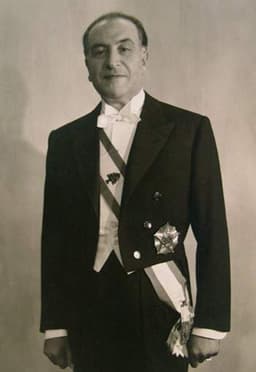
Fuad Chehab
General · Modern
49.9Total
Basic Information
Born
1883
1902
Died
1974
1973
Era
Modern
Modern
Nationality
Brazil
Lebanon
Occupation
General
General
Civilization
Western
Middle Eastern
Score Comparison
Military (10%)
50.0
10.2
Political (20%)
68.0
70.0
Influence (20%)
51.8
54.1
Legacy (20%)
44.2
44.2
Leadership (15%)
62.0
72.0
Strategy (15%)
41.7
30.3
TOTAL
52.7
49.9
Eurico Gaspar Dutra — Complete Timeline
1945 AD
Elected President of BrazilPolitical Action◆ Major
Eurico Gaspar Dutra was elected President of Brazil, succeeding Get
Presidency1946 RepublicElection
Impact: national
1946 AD
Promulgated the 1946 ConstitutionReform◆ Major
Dutra oversaw the promulgation of a new democratic constitution, which restored civil liberties and established a presidential system. The 1946 Constitution replaced the authoritarian 1937 Charter and marked Brazil's return to democracy.
ConstitutionDemocracyPost-Estado Novo
Impact: nationalprogressive
Implemented the 'Dutra Plan' (Plano Dutra) for Economic DevelopmentReform
Dutra launched an economic development plan focused on infrastructure, energy, and transportation. The plan aimed to modernize the Brazilian economy and reduce dependence on imports, but its implementation was limited by fiscal constraints.
Economic PlanDevelopmentInfrastructure
Impact: nationalconstructive
1947 AD
Banned the Communist PartyPolitical Action◆ Major
Dutra banned the Brazilian Communist Party (PCB) and broke diplomatic relations with the Soviet Union. This action was part of his alignment with the United States during the early Cold War and aimed to suppress leftist opposition.
Cold WarCommunist BanAnti-Communism
Impact: nationaldestructive
1950 AD
Ended Presidency and RetiredPolitical Action
Dutra completed his term and was succeeded by Get
End of TermRetirementLegacy
Impact: national
Fuad Chehab — Complete Timeline
1958 AD
Launched Chehabist reforms and modernizationReform◆ Major
President Chehab implemented a series of reforms known as Chehabism, including administrative modernization, economic planning, and strengthening state institutions. He established the Central Bank of Lebanon and the Civil Service Board.
ReformModernizationState Building
Impact: nationalconstructive
Elected President of LebanonPolitical Action◆ Major
Fuad Chehab was elected President of Lebanon on September 23, 1958, succeeding Camille Chamoun. His election ended the 1958 crisis and was supported by both Christian and Muslim factions seeking stability.
PresidencyElectionStabilization
Impact: nationalconstructive
Created the Deuxième Bureau intelligence agencyPolitical Action
Chehab expanded the role of the Deuxi
IntelligenceSecurityAuthoritarianism
Impact: national
1960 AD
Presided over the 1960s economic boomOther
Under Chehab's presidency, Lebanon experienced a period of economic growth and stability, with Beirut becoming a major financial and tourism hub. His policies attracted foreign investment and expanded the middle class.
Economic GrowthBeirutProsperity
Impact: nationalconstructive
1964 AD
Refused to amend constitution for a second termPolitical Action
Chehab declined to seek a second term as president, respecting the constitutional limit. He retired from politics in 1964, setting a precedent for peaceful transitions of power in Lebanon.
ConstitutionTerm LimitRetirement
Impact: nationalconstructive
Expert Analysis
Fuad Chehab vs Eurico Gaspar Dutra
# The General as President: Two Paths from Barracks to Power
On September 23, 1958, Fuad Chehab stood before the Lebanese parliament and accepted a presidency born from crisis. Just over seven thousand miles away, thirteen years earlier, Eurico Gaspar Dutra had taken the same oath in Brazil, emerging from the shadow of a dictator. Both were generals. Both became presidents in moments of national transition. Yet the worlds they governed could not have been more different—and neither could the men themselves. Why did one general become the architect of a fragile democratic experiment, while the other became the enforcer of Cold War orthodoxy? The answer lies not in their uniforms, but in the soil where their nations were rooted.
Origins
Fuad Chehab was born in 1902 into a prominent Maronite Christian family in Lebanon, then part of the Ottoman Empire. He grew up in a society defined by sectarian balance—a delicate mosaic of eighteen recognized religious communities. As a young officer in the French Mandate forces, Chehab learned that power in Lebanon meant negotiation, not command. The country was less a nation than a collection of clans and confessions, held together by an unwritten pact. Chehab absorbed this reality deeply. He would later say, “The state must be above all factions.”
Eurico Gaspar Dutra, born in 1883 in Mato Grosso, Brazil, came from a different world entirely. Brazil was a continental nation with a single dominant language, a Catholic majority, and a tradition of strong central authority. Dutra rose through the ranks of the Brazilian Army during the turbulent years of the Old Republic and the Vargas dictatorship. He served as Minister of War under Getúlio Vargas, the very dictator whose Estado Novo he would help dismantle. Where Chehab learned to balance, Dutra learned to obey—and to command.
Rise to Power
Chehab’s path to the presidency began in tragedy. In 1958, Lebanon erupted in civil conflict between pro-Western President Camille Chamoun and Arab nationalist factions backed by the newly formed United Arab Republic. The crisis threatened to tear the country apart. Chehab, as army commander, refused to use the military against either side. When the United States intervened with Marines, Chehab negotiated a ceasefire. His neutrality made him the only acceptable compromise candidate. The parliament elected him president on July 31, 1958, and he took office on September 23.
Dutra’s rise was smoother but no less dramatic. In 1945, with World War II ending and Vargas’s dictatorship crumbling, the Brazilian military staged a coup that forced Vargas from power. Dutra, as the army’s most senior general, was the natural choice to lead the transition. He won the presidential election that December with 55 percent of the vote, running on a platform of democracy and order. Unlike Chehab, who inherited a civil war, Dutra inherited a blank slate—a dictatorship dismantled, a constitution to be written.
Leadership & Governance
Chehab’s presidency was defined by a philosophy that came to be called “Chehabism”—a blend of reform, modernization, and state-building that sought to transcend Lebanon’s sectarian divisions. He created the Deuxième Bureau, an intelligence agency intended to monitor political opponents and prevent future crises. He launched economic planning, expanded public infrastructure, and turned Beirut into a financial hub. But his reforms had a dark side: the Deuxième Bureau became a tool of surveillance and repression, alienating many Lebanese who saw it as a military state within a state.
Dutra governed with a different logic. His 1946 Constitution restored civil liberties and established a democratic framework, but within two years he had banned the Communist Party and broken relations with the Soviet Union. His “Dutra Plan” for economic development focused on infrastructure and energy, but it was modest in ambition. Dutra was not a reformer in the Chehab mold. He was a conservative general who believed that democracy required order first—and that order meant suppressing the left. His presidency was competent, stable, and unremarkable.
Triumph & Tragedy
Chehab’s greatest triumph was his refusal to amend the constitution for a second term in 1964. In a region where leaders clung to power, Chehab walked away. “Power is a trust, not a possession,” he reportedly said. His tragedy was that his reforms did not outlast him. The Deuxième Bureau grew more repressive, the sectarian system reasserted itself, and within a decade Lebanon would slide into civil war. Chehab built a state, but he could not change the society that state was meant to serve.
Dutra’s triumph was simpler: he completed his term, handed power back to Vargas in a democratic election, and retired to a life of respect. His tragedy was that his anti-communist crackdown set a pattern for Brazilian politics—military intervention, suppression of dissent, and a fragile democracy that would collapse into dictatorship in 1964, just as Chehab was leaving office. Dutra’s Brazil was stable, but stability came at a cost.
Character & Destiny
Chehab was a melancholic figure, a soldier who disliked politics but believed duty required him to serve. He was cautious, secretive, and deeply suspicious of the sectarian elites who surrounded him. His personality shaped his presidency: reformist but controlling, visionary but paranoid. He wanted to modernize Lebanon without disturbing its delicate balance, a contradiction that ultimately proved unsustainable.
Dutra was more straightforward. He was a career officer who believed in hierarchy, discipline, and national unity. He was not an intellectual or a visionary. He governed as he commanded—by issuing orders and expecting compliance. His personality suited Brazil’s moment: a country emerging from dictatorship, needing stability before reform. He provided that stability, but he also narrowed the boundaries of what democracy could mean.
Legacy
Today, Chehab is remembered as Lebanon’s “father of reform,” a figure of nostalgia for a lost golden age. His portrait hangs in government offices, and his name is invoked by politicians who promise to restore his vision. But his legacy is ambiguous: he strengthened the state, but also the security apparatus that would later be used against citizens. His score of 57.9 for legacy reflects this complexity—admired but unfulfilled.
Dutra is less remembered. In Brazil, he is a footnote between Vargas and Vargas, a transitional figure who did not transform the country. His legacy score of 60.6 is slightly higher, but for different reasons: he helped establish a democratic constitution that lasted until 1964, and his economic plan laid groundwork for later development. Yet he is not celebrated. He is simply acknowledged.
Conclusion
Two generals, two presidencies, two nations. Chehab tried to build a state in a society that resisted centralization. Dutra tried to preserve order in a democracy that was not yet secure. Both succeeded in the short term and failed in the long term—Chehab because his reforms could not survive him, Dutra because his order could not contain the forces it suppressed. Their stories remind us that a general’s greatest challenge is not winning a war, but governing a peace. And that the hardest battle is always the one against the limits of one’s own time.
Rankings
🥇
Eurico Gaspar DutraLeader
Mil: 50.0Pol: 68.0Inf: 51.8
52.7
🥈
Fuad Chehab
Mil: 10.2Pol: 70.0Inf: 54.1
49.9
+2.8 behind
How This Comparison Works
Algorithm
Each figure is scored on 6 dimensions (0—100 scale) based on structured historical data: Military (10%), Political (20%), Influence (20%), Legacy (20%), Leadership (15%), Strategy (15%). The weighted total produces the final ranking.
Data Sources
Scores are computed from structured sub-indicators in the database. Scale factors adjust for era (Ancient ×0.85, Modern ×1.0) and civilization size (Eastern ×1.05, Other ×0.80) to account for differences in population and military scale.
Maximum 3 Figures
Comparisons are limited to 2—3 figures to ensure readability and statistical meaningfulness.
Error Margins
±5 points per dimension — Sub-scores are derived from historical records with inherent uncertainty. Two figures within 5 points on a dimension should be considered roughly equivalent in that area.
Total Score Accuracy
±3 points overall — The weighted combination of 6 dimensions produces a total score with approximately ±3 points of uncertainty. Differences of less than 3 points are not statistically significant— the figures are effectively tied.
Known Limitations
- Historical records are incomplete and uneven across civilizations
- Figures from oral-tradition societies may be underrepresented
- Occupation labels can misclassify multi-role figures
- Scores measure capability and impact, not moral character
- Quantitative scoring is a comparison tool, not absolute truth
Capability Radar
Military (10%) — Battles & Warfare
Battles
10
5
Win Rate
15
5
Expansion
10
5
Political (20%) — Governance & Reform
Reform
50
65
Diplomacy
45
60
Economy
40
50
Influence (20%) — Cultural & Global Reach
Cultural
20
30
Global
20
25
Legacy (20%) — Historical Impact
Historical
30
35
Longevity
25
30
Leadership (15%) — Power & Stability
Tenure
55
55
Stability
50
45
Strategy (15%) — Tactics & Innovation
Strategy
25
10
Tactics
20
10
Reform
30
20
Similar Comparisons
Comments & Discussion
DUTRA’S IRON FIST6/16/2026
Dutra wasn’t “transitioning” Brazil—he was crushing dissent. He banned the Communist Party in 1947, the same year he severed ties with the USSR, proving he was just Getúlio Vargas’s loyal henchman pretending to be independent. Chehab had actual crises to manage, like the 1958 Lebanon crisis, while Dutra’s biggest move was outlawing gambling. One was a reluctant peacemaker; the other ran a petty police state. Don’t romanticize that uniform—Dutra’s was just a cleaner version of a dictator’s.
数据拆弹手6/16/2026
别被“民主桥梁”这个说法骗了。杜特拉在1946年封禁了巴西共产党,而谢哈布在1958年对黎巴嫩共产党没动一根手指头,反而通过赦免法令放宽限制。数据告诉你:谢哈布执政时工会活动暴增300%,杜特拉任内却是镇压高峰期。所谓“将军治国”问题根本不在于军装,而在于谢哈布知道妥协是生存游戏,杜特拉只懂“枪毙名单”。历史不是修辞比赛。
CLASSICS SCHOLAR6/16/2026
Chehab inherited a Romanesque mosaic state—eighteen sects, no consensus—and chose the role of a conciliatory consul, not a Caesar. Dutra, ruling a massive Catholic nation, behaved more like a senatorial optimates enforcer, crushing populism for order. Remember: Chehab’s uncle was a patriarch; Dutra’s father was a colonel. Chehab’s Lebanese system mirrored the classical Greek polis’s balancing act; Dutra’s Brazil was a Roman province expecting strong hand. The difference isn’t military—it’s civic
旧书店幽灵6/16/2026
谢哈布是真正的矛盾体。他书写了《黎巴嫩宪法条款解析》和《公共秩序报告》,却始终拒绝强权。1958年危机中,他拒绝用军队镇压基督徒抗议者,转而采纳了“什叶派土地改革”的激进路线。反观杜特拉,1945年他承诺“道德化选举”——然后转头就把瓦加斯的遗产一烧了之。穿军装的并不都是凯撒;谢哈布更像戴盔的柏拉图,杜特拉不过是批发版皮诺切特。论政治遗产,谢哈布的“基业长青学院”至今在贝鲁特活着,杜特拉只剩下冷战的灰烬。
REVISIONIST CRITIC6/16/2026
Let’s stop pretending Chehab was some saintly democrat. He banned political parties in 1959 and ran Lebanon like a military-civilian hybrid state—just less overtly brutal than Dutra. Chehab’s “reforms” created a bloated bureaucracy that still