Loading...
Empress Dowager Cixi vs Yuan Shikai
Yuan Shikai leads by 5.0 pts · 2 figures compared
…
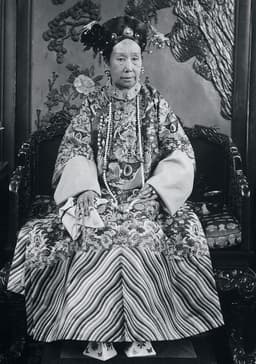
Empress Dowager Cixi
Politician · Modern
55.0Total
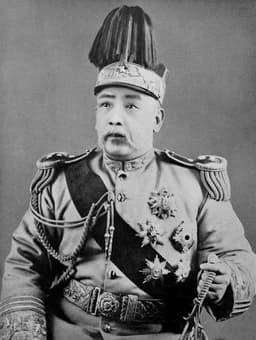
Yuan Shikai
Politician · Modern
60.0Total
Basic Information
Born
1835
1859
Died
1908
1916
Era
Modern
Modern
Nationality
China
China
Occupation
Politician
Politician
Civilization
Eastern
Eastern
Score Comparison
Military (10%)
25.9
45.0
Political (20%)
53.8
72.0
Influence (20%)
58.3
57.2
Legacy (20%)
52.0
54.0
Leadership (15%)
72.0
72.0
Strategy (15%)
60.0
61.2
TOTAL
55.0
60.0
Empress Dowager Cixi — Complete Timeline
1861 AD
Self-Strengthening MovementReform◆ Major
Cixi supported the Self-Strengthening Movement, which modernized China's military and infrastructure. Arsenals, shipyards, and railways were built, and the Tongwen Guan language school was established. However, the movement avoided political reform, limiting its effectiveness.
Qing dynastyModernizationReform
Impact: nationalconstructive
Xinyou CoupPolitical Action
Cixi, with Prince Gong, staged a coup against the eight regents appointed by the dying Xianfeng Emperor. She had the regents arrested and executed, establishing herself as co-regent for the young Tongzhi Emperor. This began her effective control over the Qing government.
Qing dynastyCoupRegency
Impact: national
1898 AD
Hundred Days' Reform CoupPolitical Action◆ Major
Cixi staged a coup to end the Hundred Days' Reform, a series of modernization edicts by the Guangxu Emperor. She imprisoned the emperor, executed six reform leaders, and rescinded most reforms. This reversed political liberalization and strengthened conservative forces.
Qing dynastyReform suppressionCoup
Impact: nationaldestructive
1900 AD
Boxer RebellionWar◆ Major
Cixi declared war on eight foreign powers after the Boxers besieged foreign legations in Beijing. The Eight-Nation Alliance invaded, defeated Qing forces, and occupied Beijing. Cixi fled to Xi'an. The resulting Boxer Protocol imposed heavy reparations and further weakened the Qing.
Qing dynastyForeign interventionWar
Impact: globaldestructive
1901 AD
Late Qing ReformsReform◆ Major
After the Boxer Rebellion, Cixi initiated the Late Qing Reforms, including abolition of the civil service examination, establishment of modern schools, and military modernization. These reforms aimed to strengthen the dynasty but came too late to prevent its collapse.
Qing dynastyModernizationReform
Impact: nationalconstructive
Yuan Shikai — Complete Timeline
1901 AD
Command of the Beiyang ArmyReform◆ Major
Yuan Shikai took command of the Beiyang Army, the most modern military force in late Qing China. He expanded and trained the army, which became the basis for his political power and later dominated Chinese politics.
Military reformBeiyang Army
Impact: national
1912 AD
Appointed First President of the Republic of ChinaPolitical Action
Yuan Shikai became the first president of the Republic of China after negotiating the abdication of the Qing emperor. He used his control of the Beiyang Army to pressure the revolutionary government into accepting his leadership.
PresidencyRepublic of China
Impact: national
1915 AD
Declaration of the Empire of ChinaPolitical Action◆ Major
Yuan Shikai declared himself emperor of the Empire of China, attempting to restore the monarchy. This move sparked widespread opposition from provincial leaders and foreign powers, leading to the collapse of his regime.
Monarchy restorationPolitical crisis
Impact: nationaldestructive
Signing of the Twenty-One DemandsPolitical Action◆ Major
Yuan Shikai accepted most of Japan's Twenty-One Demands, which expanded Japanese influence in China. The agreement granted Japan economic rights in Manchuria and Shandong, and was seen as a national humiliation.
DiplomacyJapanese imperialism
Impact: globaltragic
1916 AD
Death and Collapse of the Beiyang GovernmentPolitical Action◆ Major
Yuan Shikai died of uremia, leaving no clear successor. His death led to the fragmentation of the Beiyang Army into warlord factions, plunging China into a period of civil war and political instability.
Warlord eraPolitical fragmentation
Impact: nationaltragic
Expert Analysis
Yuan Shikai vs Empress Dowager Cixi
# The Dragon and the Warlord: Two Visions of China's Destiny
In the winter of 1908, as the Qing dynasty gasped its last breaths, two figures stood at opposite ends of China's crumbling imperial stage. One was a woman who had ruled from behind a silk screen for nearly half a century, her face never seen by foreign diplomats, her will iron-hard beneath layers of brocade. The other was a man who would, within a decade, become the first president of a republic that he would try to turn back into an empire. They never met as equals—Cixi was the empress dowager, Yuan Shikai her most powerful general—but their fates were twisted together like the dragons embroidered on imperial robes. Both sought to save China. Both left it bleeding.
Origins
Cixi was born in 1835 into a Manchu family of modest rank, entering the Forbidden City at seventeen as a concubine of the fifth grade—barely above a servant. Her rise was improbable, driven by a combination of intelligence, ruthlessness, and the singular luck of bearing the Xianfeng Emperor his only son. She learned statecraft in the shadows, watching men who underestimated her make fatal mistakes.
Yuan Shikai, born twenty-four years later in 1859, came from a military family with a tradition of service. His path was more conventional: failure in the civil service examinations, then purchase of a minor military post. Where Cixi learned patience, Yuan learned the mechanics of power—how to train soldiers, how to build networks, how to make himself indispensable.
The difference in their origins shaped everything that followed. Cixi had clawed her way up from near-invisibility; she saw power as something to be hoarded and defended. Yuan had inherited connections; he saw power as something to be built and expanded.
Rise to Power
Cixi's first great act came in 1861, when the Xianfeng Emperor died and left eight regents to govern for his young son. With Prince Gong, she staged the Xinyou Coup, arresting the regents and installing herself as co-regent. She was twenty-six years old, and she had just seized control of the largest empire on earth.
Yuan's rise was slower but more systematic. In 1901, he took command of the Beiyang Army, the most modern military force in China. He staffed it with his own men, trained it with German methods, and armed it with Western weapons. By the time Cixi died in 1908, Yuan controlled the only army that mattered. When the revolution came in 1911, both sides—the Qing court and the republican revolutionaries—needed him.
Leadership & Governance
Cixi governed through manipulation and balance. She supported the Self-Strengthening Movement in the 1860s and 1870s, building arsenals and shipyards, sending students abroad. But she drew a firm line: modernization of technology, not of institutions. When her adopted son, the Guangxu Emperor, attempted genuine political reform in 1898, she staged a coup, imprisoned him, and reversed his edicts. She would accept steamships and telegraphs, but not parliaments or constitutions.
This half-hearted reform proved catastrophic. In 1900, she declared war on eight foreign powers during the Boxer Rebellion, believing the Boxers' magic could defeat Western guns. The Eight-Nation Alliance marched to Beijing, and Cixi fled the Forbidden City disguised as a peasant woman. The humiliation was absolute.
Yuan Shikai was a different kind of leader—more pragmatic, more modern, but equally self-interested. As president of the Republic of China in 1912, he centralized power ruthlessly, assassinating rivals and suppressing dissent. His political score of 74.2 reflects genuine skill: he negotiated the Qing abdication, secured foreign recognition, and maintained order. But his leadership score of 81.3 also reveals his fatal flaw: he believed only he could save China.
Triumph & Tragedy
Cixi's greatest triumph was survival itself. She outlasted the Taiping Rebellion, the Opium Wars, and countless court intrigues. Her greatest tragedy was the Hundred Days' Reform—by crushing it, she crushed China's best chance at peaceful modernization. The 1898 coup set the country on a path toward revolution.
Yuan's triumph was the Beiyang Army, a modern force that could have unified China. His tragedy was the 1915 declaration of the Empire of China, when he crowned himself emperor. The move was absurd—a republic barely three years old, and its president tried to become a new dynast. Provincial governors rebelled; Japan, which had extracted the Twenty-One Demands from Yuan in 1915, withdrew support. He died in 1916 of uremia, his empire crumbling around him.
Character & Destiny
Cixi's personality was shaped by insecurity. She had risen from nothing and trusted no one. Her strategic score of 49.6 is surprisingly low for someone who ruled forty-seven years, but it reflects a crucial truth: she was a tactician, not a strategist. She could win battles but not wars, hold power but not build institutions.
Yuan was more capable but less wise. His military score of 60.7 and strategy of 65.4 show competence, but his political score of 74.2 reveals his core drive: personal ambition masked as patriotism. He could have been China's George Washington. He chose to be its Napoleon—and failed.
Legacy
Cixi is remembered as the woman who destroyed the Qing dynasty by refusing to let it change. Her legacy score of 78.5 reflects her lasting impact: she modernized China's infrastructure but fossilized its politics. The Late Qing Reforms she finally launched after 1901—abolishing the civil service examination, creating a constitutional framework—came too late.
Yuan's legacy is more ambiguous. His total score of 70.6 edges Cixi's 64.2, but his failure was more dramatic. The Beiyang Army fragmented into warlord factions after his death, plunging China into a decade of civil war. He is remembered as the man who sold China's interests to Japan and tried to become emperor.
Conclusion
Both Cixi and Yuan Shikai faced the same question: how to save an ancient civilization in a modern world. Both answered with the same word: control. Cixi controlled from the shadows, preserving forms while reality crumbled. Yuan controlled from the center, building power while legitimacy evaporated. They were not villains—they were Chinese patriots who could not imagine a China that did not revolve around them. In the end, they prepared the ground for a different kind of leader, one who would finally break the pattern: not a dowager empress or a warlord-president, but a revolutionary who would remake China entirely. Their failure was not personal. It was civilizational. And it had to happen before China could finally change.
Rankings
🥇
Yuan ShikaiLeader
Mil: 45.0Pol: 72.0Inf: 57.2
60.0
🥈
Empress Dowager Cixi
Mil: 25.9Pol: 53.8Inf: 58.3
55.0
+5.0 behind
How This Comparison Works
Algorithm
Each figure is scored on 6 dimensions (0—100 scale) based on structured historical data: Military (10%), Political (20%), Influence (20%), Legacy (20%), Leadership (15%), Strategy (15%). The weighted total produces the final ranking.
Data Sources
Scores are computed from structured sub-indicators in the database. Scale factors adjust for era (Ancient ×0.85, Modern ×1.0) and civilization size (Eastern ×1.05, Other ×0.80) to account for differences in population and military scale.
Maximum 3 Figures
Comparisons are limited to 2—3 figures to ensure readability and statistical meaningfulness.
Error Margins
±5 points per dimension — Sub-scores are derived from historical records with inherent uncertainty. Two figures within 5 points on a dimension should be considered roughly equivalent in that area.
Total Score Accuracy
±3 points overall — The weighted combination of 6 dimensions produces a total score with approximately ±3 points of uncertainty. Differences of less than 3 points are not statistically significant— the figures are effectively tied.
Known Limitations
- Historical records are incomplete and uneven across civilizations
- Figures from oral-tradition societies may be underrepresented
- Occupation labels can misclassify multi-role figures
- Scores measure capability and impact, not moral character
- Quantitative scoring is a comparison tool, not absolute truth
Capability Radar
Military (10%) — Battles & Warfare
Battles
30
45
Win Rate
25
55
Expansion
15
50
Political (20%) — Governance & Reform
Reform
65
55
Diplomacy
60
70
Economy
50
50
Influence (20%) — Cultural & Global Reach
Cultural
60
40
Global
60
35
Legacy (20%) — Historical Impact
Historical
75
65
Longevity
55
40
Leadership (15%) — Power & Stability
Tenure
85
60
Stability
40
30
Strategy (15%) — Tactics & Innovation
Strategy
55
65
Tactics
40
60
Reform
70
80
Similar Comparisons
Comments & Discussion
紫禁城幽影6/16/2026
我偏站慈禧。别跟我扯军事现代化,那是袁世凯给北洋军烙的西方铁印,但他骨子里就是旧式官僚。慈禧虽守旧,可她在戊戌政变后硬生生拖住清朝二十年,全靠手腕和平衡术拉扯各方。八国联军打进北京那会儿,她逃了,但回銮后搞“清末新政”——废科举、练新军、派留学生,这些措施比袁世凯的独裁跳梁靠谱。别忘了,甲午海战前光绪才是名义主战者,慈禧至少知道打不赢就猥琐发育,别拿海军银子说事。
Historian6626/16/2026
As a military historian, I'll take Yuan Shikai any day. He modernized China's army with German discipline, creating the Beiyang Army—the first truly effective force since the Eight Banners rotted. Cixi? She gutted naval funding for her Summer Palace rebuild, crippling the Beiyang Fleet at the Battle of Yalu in 1894. Yuan understood power flows from guns, not eunuchs. His New Army paved the way for Sun Yat-sen's revolution, even if his imperial ambitions were a pathetic farce. Thirty years of Cix