Loading...
Ehud Barak vs Shi Dakai
Ehud Barak leads by 0.3 pts · 2 figures compared
…
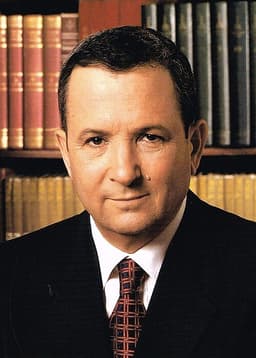
Ehud Barak
General · Modern
59.9Total
Shi Dakai
General · Modern
59.6Total
Basic Information
Born
1942
1831
Died
—
1863
Era
Modern
Modern
Nationality
Israel
China
Occupation
General
General
Civilization
Middle Eastern
Eastern
Score Comparison
Military (10%)
63.3
76.0
Political (20%)
72.0
45.0
Influence (20%)
55.0
56.7
Legacy (20%)
52.0
54.0
Leadership (15%)
66.0
72.0
Strategy (15%)
61.2
68.1
TOTAL
59.9
59.6
Ehud Barak — Complete Timeline
1973 AD
Awarded Medal of Distinguished ServiceOther
Barak received the Medal of Distinguished Service, Israel's highest military decoration, for his actions during the Yom Kippur War. He led a commando raid deep into Egyptian territory, destroying radar installations. This was part of a broader operation to open a supply route.
Military DecorationYom Kippur War
Impact: nationalconstructive
1976 AD
Led Operation Thunderbolt (Entebbe Raid)War◆ Major
As Chief of Staff, Barak planned and oversaw the Entebbe raid, a rescue of hostages hijacked by Palestinian and German militants in Uganda. Israeli commandos rescued 102 hostages. The operation was a major military success and boosted Israeli morale and international standing.
EntebbeHostage RescueCounterterrorism
Impact: globalconstructive
1991 AD
Appointed Chief of Staff of the IDFPolitical Action◆ Major
Barak was appointed the 14th Chief of Staff of the Israel Defense Forces. He served until 1995, overseeing military operations during the First Intifada and the Oslo Accords period. His tenure included the 1993 Operation Accountability in Lebanon.
Military CommandIDF
Impact: national
1999 AD
Elected Prime Minister of IsraelPolitical Action◆ Major
Barak was elected Prime Minister of Israel, defeating incumbent Benjamin Netanyahu. He campaigned on a platform of peace negotiations and domestic reform. His government pursued the Camp David Summit with Palestinians and withdrew from southern Lebanon.
ElectionPeace Process
Impact: regionalconstructive
2000 AD
Camp David Summit with ArafatPolitical Action
Barak participated in the Camp David Summit with Palestinian leader Yasser Arafat and U.S. President Bill Clinton. The summit aimed to reach a final status agreement but failed. Barak offered territorial concessions that were rejected. The failure contributed to the Second Intifada.
Peace NegotiationsCamp DavidIsraeli-Palestinian Conflict
Impact: global
Withdrew from Southern LebanonPolitical Action◆ Major
Barak ordered the unilateral withdrawal of Israeli forces from the security zone in southern Lebanon, ending 18 years of occupation. The withdrawal was completed in May 2000. Hezbollah claimed victory, and the move was criticized by some as a retreat under fire.
WithdrawalLebanonHezbollah
Impact: regional
Shi Dakai — Complete Timeline
1851 AD
Jintian UprisingWar◆ Major
Shi Dakai joined the Taiping Rebellion at its inception in Jintian, Guangxi. As a core leader, he helped organize the rebel forces and was appointed Wing King, becoming one of the key military commanders of the Taiping Heavenly Kingdom.
Taiping RebellionUprisingMilitary Command
Impact: national
1854 AD
Battle of XiangtanWar◆ Major
Shi Dakai led Taiping forces to a major victory at Xiangtan, Hunan, defeating Qing imperial troops. This battle secured Taiping control over key territories in the Yangtze River valley and demonstrated his military skill.
Taiping RebellionBattleVictory
Impact: regional
1856 AD
Tianjing IncidentPolitical Action
Shi Dakai returned to Tianjing (Nanjing) after the internal purge of the Eastern King Yang Xiuqing and the murder of the Northern King Wei Changhui. He condemned the violence and was forced to flee, leading to a split in Taiping leadership.
Taiping RebellionInternal ConflictPurge
Impact: nationaltragic
1858 AD
Campaign in Zhejiang and FujianWar
Shi Dakai led a separate Taiping army into Zhejiang and Fujian provinces, capturing several cities. This campaign expanded Taiping influence into southeastern China but also isolated his forces from the main Taiping base.
Taiping RebellionCampaignExpansion
Impact: regional
1863 AD
Battle of Baishui RiverWar◆ Major
Shi Dakai's army was trapped and defeated by Qing forces at the Baishui River in Sichuan. He was captured and executed shortly after, marking the end of his military career and a significant loss for the Taiping cause.
Taiping RebellionBattleDefeatDeath
Impact: nationaltragic
Expert Analysis
Shi Dakai vs Ehud Barak
# The General Who Could Not Rest
On a June morning in 1863, Shi Dakai knelt in a marketplace in Chengdu, his scholar’s robes stained with river mud. The executioner’s blade would end the life of the man who had once commanded armies that terrified an empire. Across the world and a century later, another soldier stood in the Knesset in Jerusalem, taking the oath of office as prime minister of Israel. Ehud Barak, the most decorated warrior in his nation’s history, was about to trade his general’s stars for a politician’s burden. Both men had mastered the art of war. Only one would learn that victory on the battlefield does not guarantee wisdom in the council chamber.
Origins
Shi Dakai was born in 1831 into a Hakka family in Guangxi, southern China. His father was a prosperous landowner who gave him a classical Confucian education. But the world of Shi’s youth was crumbling. The Qing dynasty, weakened by opium wars with the West and plagued by corruption, had allowed taxes to crush the peasantry. Famine stalked the countryside. Shi was a bright, earnest young man, deeply influenced by the strange new Christian teachings of Hong Xiuquan, a failed civil service candidate who claimed to be the younger brother of Jesus Christ. When Hong launched the Taiping Rebellion in 1851, Shi Dakai joined him. He was barely twenty years old.
Ehud Barak was born in 1942 on a kibbutz in British Palestine, a child of socialist Zionism. His parents were European Jews who had fled persecution. Barak grew up in a world where survival was not an abstraction but a daily struggle. The state of Israel was founded when he was six, and its wars would define his life. He studied physics and mathematics, but his true education came in the army. Barak was a prodigy of violence: by his thirties, he had led commando raids, infiltrated enemy territory, and once disguised himself as a woman to assassinate a Palestinian militant. Where Shi Dakai was shaped by the collapse of an ancient order, Barak was forged in the furnace of a new nation’s desperate fight to exist.
Rise to Power
Shi Dakai’s ascent was swift and bloody. In 1851, he was present at the Jintian Uprising, the spark that ignited the Taiping Rebellion. Within months, he was named the Wing King, one of the movement’s core leaders. His military brilliance emerged in 1854 at the Battle of Xiangtan, where he crushed Qing imperial forces and secured Hunan for the Taiping cause. Shi was not just a fighter; he was a strategist. He understood supply lines, troop morale, and the psychological impact of victory. By 1856, he was arguably the most capable general in a kingdom that had conquered much of central China.
Barak’s rise was more methodical, though no less spectacular. In 1973, he received the Medal of Distinguished Service, Israel’s highest military honor, for his role in the Yom Kippur War. But his defining moment came in 1976, when he planned and oversaw Operation Thunderbolt—the Entebbe Raid. Israeli commandos flew 4,000 kilometers to Uganda, rescued over a hundred hostages, and killed the hijackers. Barak did not pull the trigger, but his mind had drawn the map. In 1991, he became Chief of Staff of the IDF, the top soldier in a nation of soldiers.
Leadership & Governance
Shi Dakai governed as he fought: with energy and a sense of justice. In the territories he controlled, he tried to implement the Taiping vision—land reform, communal property, and a strict moral code. He was a better administrator than most of his peers, but he was trapped in a movement that was tearing itself apart. The Taiping leadership, especially Hong Xiuquan and the Eastern King Yang Xiuqing, were paranoid and power-hungry. In 1856, the Tianjing Incident shattered the kingdom. Yang Xiuqing was purged and murdered; the Western King, Wei Changhui, was also killed. Shi Dakai returned to the capital only to find chaos. He was nearly murdered himself. He fled, taking his army south, effectively becoming a warlord within a failed state.
Barak’s leadership was more systematic. As prime minister from 1999, he pursued peace with the same intensity he had once reserved for war. He withdrew Israeli forces from southern Lebanon in 2000, ending an 18-year occupation. That same year, he went to Camp David with Yasser Arafat and President Bill Clinton. The summit failed. Barak offered a Palestinian state on most of the West Bank and Gaza, but Arafat walked away. Barak’s political skill was real, but he could not overcome the fundamental distrust between the two sides.
Triumph & Tragedy
Shi Dakai’s greatest triumph was also the seed of his tragedy. After the Tianjing Incident, he led a brilliant campaign into Zhejiang and Fujian, capturing cities and expanding Taiping influence. But he was now isolated, cut off from the main Taiping forces. In 1863, his army was trapped at the Baishui River in Sichuan. Qing forces, led by the ruthless general Luo Bingzhang, surrounded him. Shi Dakai surrendered, hoping to spare his men. He was executed by slow slicing. His death marked the beginning of the end for the Taiping Heavenly Kingdom.
Barak’s tragedy was different. He had won every war, but he could not win the peace. The Camp David summit’s failure was followed by the Second Intifada, a wave of suicide bombings that killed hundreds of Israelis. Barak lost the 2001 election to Ariel Sharon. He had been Israel’s most decorated soldier, but his political career ended in defeat. He would later serve as defense minister, but the prime minister’s office was gone forever.
Character & Destiny
Shi Dakai was a man of principle in a movement that had abandoned them. He was loyal to the Taiping cause even when its leaders were corrupt. He was courageous in battle but naive in politics. He believed that if he fought well enough, the kingdom would survive. It did not. His character was his fate: he could not betray his comrades, so he died with them.
Barak was more pragmatic. He understood that war was a tool, not a religion. He could negotiate with enemies one day and plan their destruction the next. But he was also a perfectionist, a man who expected others to see the world as clearly as he did. When they did not—when Arafat refused his offer, when the Israeli public turned against him—he was baffled. His genius was for the clear, decisive moment. Politics is a fog.
Legacy
Shi Dakai is remembered in China as a tragic hero, a brilliant general who served a doomed cause. His name appears in textbooks, but the Taiping Rebellion itself remains controversial—a rebellion that killed millions but also challenged the old order. Barak is remembered as a warrior-statesman who came close to peace but could not close the deal. His legacy is the Entebbe Raid, the withdrawal from Lebanon, and the painful lesson that military victory does not guarantee political success.
Conclusion
Two generals, two destinies. Shi Dakai died by the sword, Barak by the ballot box. One fought for a heavenly kingdom that crumbled into dust; the other fought for a nation that still stands. But both learned the same hard truth: the skills that win wars are not the skills that build peace. The battlefield rewards certainty; the council chamber rewards patience. Shi Dakai had courage; Ehud Barak had strategy. Neither had enough of what they truly needed—the wisdom to know when to stop fighting.
Rankings
🥇
Ehud BarakLeader
Mil: 63.3Pol: 72.0Inf: 55.0
59.9
🥈
Shi Dakai
Mil: 76.0Pol: 45.0Inf: 56.7
59.6
+0.3 behind
How This Comparison Works
Algorithm
Each figure is scored on 6 dimensions (0—100 scale) based on structured historical data: Military (10%), Political (20%), Influence (20%), Legacy (20%), Leadership (15%), Strategy (15%). The weighted total produces the final ranking.
Data Sources
Scores are computed from structured sub-indicators in the database. Scale factors adjust for era (Ancient ×0.85, Modern ×1.0) and civilization size (Eastern ×1.05, Other ×0.80) to account for differences in population and military scale.
Maximum 3 Figures
Comparisons are limited to 2—3 figures to ensure readability and statistical meaningfulness.
Error Margins
±5 points per dimension — Sub-scores are derived from historical records with inherent uncertainty. Two figures within 5 points on a dimension should be considered roughly equivalent in that area.
Total Score Accuracy
±3 points overall — The weighted combination of 6 dimensions produces a total score with approximately ±3 points of uncertainty. Differences of less than 3 points are not statistically significant— the figures are effectively tied.
Known Limitations
- Historical records are incomplete and uneven across civilizations
- Figures from oral-tradition societies may be underrepresented
- Occupation labels can misclassify multi-role figures
- Scores measure capability and impact, not moral character
- Quantitative scoring is a comparison tool, not absolute truth
Capability Radar
Military (10%) — Battles & Warfare
Battles
65
75
Win Rate
70
70
Expansion
55
75
Political (20%) — Governance & Reform
Reform
50
50
Diplomacy
60
45
Economy
45
40
Influence (20%) — Cultural & Global Reach
Cultural
50
55
Global
55
40
Legacy (20%) — Historical Impact
Historical
55
60
Longevity
45
45
Leadership (15%) — Power & Stability
Tenure
55
55
Stability
40
35
Strategy (15%) — Tactics & Innovation
Strategy
70
80
Tactics
75
85
Reform
60
60
Similar Comparisons
Comments & Discussion
SwordSlayer6/16/2026
Shi Dakai was no tragic hero—he was a brilliant tactician who threw it all away for loyalty to a madman. Hong Xiuquan was clearly unhinged, yet Shi fought for years to prop up a regime that executed its own. Compare that to Barak, who knew when to break ranks and pursue civilian power. Generals should be judged by their exits, not their battles.
兵败笔谈6/16/2026
石达开败在读书太多,仁义压过了狠辣。大渡河畔他本可硬冲清军,却选择投降保士卒。这跟Barak根本没法比——人家在黎巴嫩打过硬仗,回家就当总理。石达开要是有Barak那种政治手腕,太平天国多撑几年没问题。
TroopTheory6/16/2026
The military historian in me sees one critical difference: Barak understood that war is an extension of politics, while Shi Dakai treated war as a moral crusade. Barak planned Operation Litani and Entebbe with cold precision, but Shi let ideals dictate strategy. The Taiping Rebellion burned because it fought for heaven on earth instead of achievable goals.
儒将算账6/16/2026
数据没骗人——石达开手下十几万兵,大渡河一役几乎全灭;Barak当总理时以色列GDP涨了快两成。打仗不是请客吃饭,但治国更不是带兵冲锋。石达开是个好将军,但跟Barak比治国?别逗了,连朝堂都玩不明白的人,怎么跟懂经济懂外交的现代领袖比。
ClassicistEye6/16/2026
Compare their education: Shi mastered the Four Books and Five Classics, steeped in Confucian ideals of loyalty and righteous war. Barak studied physics and engineering at Hebrew University. One legacy of the scholar-general failed because he couldn't adapt; the other succeeded because he built a modern state on rational planning. The old world lost to the new.
书生剑6/16/2026
石达开被抓时穿的是书生衣裳,Barak穿的是军装。这个细节比什么都说明问题——一个想做圣人,一个只想做赢家。石达开的儒家仁义让他在战场上犹豫不决,最后被凌迟处死还面带微笑。Barak呢?直接撕了和平协议打黎巴嫩。别跟我谈道德,这是战争史,不是道德经。