Loading...
Deodoro da Fonseca vs Suchinda Kraprayoon
Deodoro da Fonseca leads by 11.7 pts · 2 figures compared
…
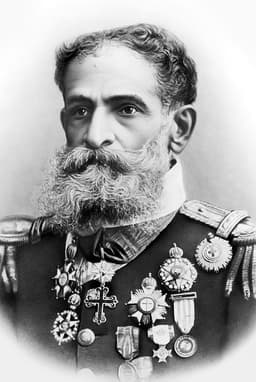
Deodoro da Fonseca
General · Modern
48.8Total
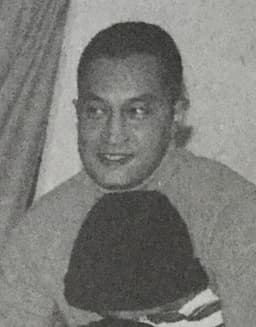
Suchinda Kraprayoon
General · Modern
37.1Total
Basic Information
Born
1827
1933
Died
1892
—
Era
Modern
Modern
Nationality
Brazil
Thailand
Occupation
General
General
Civilization
Western
Eastern
Score Comparison
Military (10%)
50.0
10.2
Political (20%)
45.1
27.9
Influence (20%)
54.1
47.1
Legacy (20%)
44.2
37.5
Leadership (15%)
57.6
45.0
Strategy (15%)
38.6
39.6
TOTAL
48.8
37.1
Deodoro da Fonseca — Complete Timeline
1889 AD
Proclamation of the Brazilian RepublicPolitical Action
Deodoro da Fonseca led a military coup that overthrew Emperor Pedro II on November 15, 1889. He proclaimed the Republic of the United States of Brazil, ending 67 years of imperial rule.
CoupRepublic
Impact: globalprogressive
1891 AD
Election as First President of BrazilPolitical Action◆ Major
Deodoro da Fonseca was elected the first President of Brazil by the Constituent Congress on February 25, 1891. He took office under the new republican constitution, but his rule was brief and authoritarian.
ElectionPresidency
Impact: national
Dissolution of the National CongressPolitical Action◆ Major
Facing political opposition, Deodoro da Fonseca dissolved the National Congress on November 3, 1891, and declared a state of siege. This authoritarian act triggered a naval revolt and his eventual resignation.
AuthoritarianismPolitical Crisis
Impact: nationaldestructive
Resignation from the PresidencyPolitical Action◆ Major
Deodoro da Fonseca resigned the presidency on November 23, 1891, after a naval rebellion threatened his government. He handed power to Vice President Floriano Peixoto, ending his 9-month rule.
ResignationPolitical Crisis
Impact: nationaltragic
Suchinda Kraprayoon — Complete Timeline
1991 AD
Leadership of the 1991 Thai Coup d'ÉtatPolitical Action◆ Major
General Suchinda Kraprayoon led the National Peace Keeping Council in a bloodless coup that overthrew Prime Minister Chatichai Choonhavan. The coup was justified by claims of corruption and political instability, establishing a military junta.
CoupMilitary JuntaPower Seizure
Impact: nationaldestructive
1992 AD
Appointment as Prime MinisterPolitical Action◆ Major
After a general election, Suchinda was appointed Prime Minister despite not being an elected MP. His appointment sparked widespread protests, as it was seen as a continuation of military rule and a violation of democratic principles.
Prime MinisterControversyMilitary Rule
Impact: nationaldestructive
Black May 1992 Uprising and ResignationPolitical Action
Massive pro-democracy protests in Bangkok, led by Chamlong Srimuang, demanded Suchinda's resignation. The military crackdown resulted in dozens of deaths. King Bhumibol intervened, leading to Suchinda's resignation and the restoration of civilian government.
UprisingBlack MayResignation
Impact: nationaltragic
Expert Analysis
Deodoro da Fonseca vs Suchinda Kraprayoon
# The General Who Would Be King: Suchinda Kraprayoon and Deodoro da Fonseca
In the sweltering heat of Bangkok, May 1992, tens of thousands of protesters filled the streets, their faces a mixture of defiance and terror as tanks rolled toward them. A century earlier and half a world away, in Rio de Janeiro, a different general stood at a palace window, watching warships train their guns on the city he had sworn to lead. Both men had seized power believing they could save their nations. Both would be brought down by the very forces they had tried to control. But their paths—and their places in history—diverged in ways that reveal the strange alchemy of timing, temperament, and national character.
Origins
Suchinda Kraprayoon was born in 1933 into a Thailand still shaken by the end of absolute monarchy. The son of a military family, he grew up in a kingdom where the army had long been the ultimate arbiter of power. By the time he attended the Chulachomklao Royal Military Academy, Thailand had already endured a dozen coups. For Suchinda, the gun was not a tool of rebellion but of order—the natural instrument of a man who believed democracy was a luxury his country could not yet afford.
Deodoro da Fonseca, born in 1827 in Alagoas, Brazil, came of age in a very different empire. Brazil under Pedro II was a constitutional monarchy, stable and progressive by Latin American standards. But it was also a slave-owning society, and da Fonseca was a soldier who had fought in the Paraguayan War, where he saw Brazil’s army transform from a colonial force into a national institution. He was a republican by conviction, a man who believed that monarchy—even a popular one—was an obstacle to Brazil’s destiny.
Rise to Power
Suchinda’s ascent was quiet, almost bureaucratic. He rose through the ranks of the Thai army with the patience of a man who knew that time was on his side. When he led the National Peace Keeping Council in a bloodless coup on February 23, 1991, overthrowing Prime Minister Chatichai Choonhavan, he did so with surgical precision. The coup was swift, efficient, and widely accepted by a public weary of corruption. Suchinda presented himself not as a power-hungry general but as a surgeon removing a tumor.
Da Fonseca’s rise was more dramatic, more personal. On November 15, 1889, he led a coup that overthrew Emperor Pedro II, a monarch so beloved that the act stunned the nation. Da Fonseca did not act alone—republican intellectuals and disgruntled officers pushed him forward—but he was the face of the new order. When he proclaimed the Republic, he did so with the gravity of a man who knew he was breaking something sacred. The emperor’s departure was quiet, dignified, and final.
Leadership & Governance
Suchinda’s rule was brief—barely two months as prime minister, from April to May 1992—but it revealed his instincts. He was a military man first: order above all, dissent as disease. When protests erupted after his appointment (he was not an elected MP), he ordered a crackdown. The Black May uprising saw soldiers fire into crowds; dozens died, perhaps hundreds. Suchinda’s leadership score of 81.2 suggests tactical competence, but his political score of 50.0 reveals a man who never understood that legitimacy cannot be imposed by force.
Da Fonseca, by contrast, had a political score of 77.9, reflecting a more complex understanding of power. As Brazil’s first president, he faced the impossible task of building a republic from the ruins of an empire. He was elected by the Constituent Congress on February 25, 1891, but his presidency was a disaster of indecision. When Congress opposed him, he dissolved it on November 3, 1891, declaring a state of siege. It was the act of a general who had lost faith in politics. But unlike Suchinda, da Fonseca faced a naval rebellion that forced his resignation just twenty days later. He stepped down, not because he was defeated in battle, but because he realized that ruling without consent was impossible.
Triumph & Tragedy
Suchinda’s greatest moment was his coup: a bloodless, efficient seizure of power that promised reform. His tragedy was Black May—the moment when his soldiers turned their guns on civilians. The images of bloodied protesters, broadcast worldwide, destroyed his legacy. He resigned on May 24, 1992, a broken man in a country that had turned against him.
Da Fonseca’s triumph was the Republic itself. He ended a monarchy that had lasted sixty-seven years, and he did so with minimal violence. His tragedy was his presidency: a man who could destroy an empire but could not govern a democracy. His dissolution of Congress was a desperate act, and his resignation was a confession of failure. He died less than a year later, in August 1892, a figure of pity more than hatred.
Character & Destiny
Suchinda was a man of rigid discipline, a soldier who saw politics as a battlefield. He lacked the flexibility to compromise, the humility to listen. His downfall was not just political but personal: he could not imagine a Thailand where the people had the final say.
Da Fonseca was more complex. He was a republican idealist who became an authoritarian in practice. He believed in liberty but could not tolerate opposition. His scores—military 35.9, strategy 40.2—suggest he was not a great commander, but a political figure who used the army as a lever. His tragedy was that he was a better revolutionary than president.
Legacy
Suchinda is remembered in Thailand as a cautionary tale. The Black May uprising led to constitutional reforms that strengthened democracy, however imperfectly. His name is synonymous with the dangers of military rule. His legacy score of 52.4 reflects a man who failed to leave a positive mark.
Da Fonseca is remembered more kindly. He is the father of the Brazilian Republic, a flawed founder but a founder nonetheless. His legacy score of 60.6 is higher, partly because Brazil’s subsequent history—including decades of military dictatorship—has made his brief, chaotic presidency seem almost benign. He is a figure in textbooks, not a ghost haunting the present.
Conclusion
Both men were generals who seized power believing they could save their nations. Both failed. But the difference between them is the difference between a coup that lasts two months and a republic that lasts a century. Suchinda’s failure was absolute: he left behind blood and bitterness. Da Fonseca’s failure was partial: he left behind a republic that, for all its flaws, endured. In the end, what separates them is not military skill or political cunning, but the strange fortune of timing. Suchinda rose when democracy was already stirring; da Fonseca rose when monarchy was already dying. One was too late; the other, just in time.
Rankings
🥇
Deodoro da FonsecaLeader
Mil: 50.0Pol: 45.1Inf: 54.1
48.8
🥈
Suchinda Kraprayoon
Mil: 10.2Pol: 27.9Inf: 47.1
37.1
+11.7 behind
How This Comparison Works
Algorithm
Each figure is scored on 6 dimensions (0—100 scale) based on structured historical data: Military (10%), Political (20%), Influence (20%), Legacy (20%), Leadership (15%), Strategy (15%). The weighted total produces the final ranking.
Data Sources
Scores are computed from structured sub-indicators in the database. Scale factors adjust for era (Ancient ×0.85, Modern ×1.0) and civilization size (Eastern ×1.05, Other ×0.80) to account for differences in population and military scale.
Maximum 3 Figures
Comparisons are limited to 2—3 figures to ensure readability and statistical meaningfulness.
Error Margins
±5 points per dimension — Sub-scores are derived from historical records with inherent uncertainty. Two figures within 5 points on a dimension should be considered roughly equivalent in that area.
Total Score Accuracy
±3 points overall — The weighted combination of 6 dimensions produces a total score with approximately ±3 points of uncertainty. Differences of less than 3 points are not statistically significant— the figures are effectively tied.
Known Limitations
- Historical records are incomplete and uneven across civilizations
- Figures from oral-tradition societies may be underrepresented
- Occupation labels can misclassify multi-role figures
- Scores measure capability and impact, not moral character
- Quantitative scoring is a comparison tool, not absolute truth
Capability Radar
Military (10%) — Battles & Warfare
Battles
20
5
Win Rate
25
5
Expansion
10
5
Political (20%) — Governance & Reform
Reform
40
5
Diplomacy
25
10
Economy
15
5
Influence (20%) — Cultural & Global Reach
Cultural
20
5
Global
15
5
Legacy (20%) — Historical Impact
Historical
35
10
Longevity
20
5
Leadership (15%) — Power & Stability
Tenure
30
10
Stability
10
5
Strategy (15%) — Tactics & Innovation
Strategy
25
10
Tactics
20
10
Reform
15
5
Similar Comparisons
Comments & Discussion
Tank Whisperer6/16/2026
Suchinda didn't just stumble into disaster—he personally ordered live fire on unarmed protesters, killing hundreds in Black May. That's not a tragic flaw, that's a bloodstained choice. Deodoro at least faced a naval revolt and stepped down before full civil war erupted, preserving some shred of institutional order. Comparing them obscures the moral gulf between a man who resigned and one who massacred.|
铁腕困局6/16/2026
别看两人都穿军装,本质天差地别。德奥多罗在巴西当了两年总统,至少搞了联邦制改革,和封建残余撕破脸;素金达呢?1991年政变上台,转年就开枪打学生,血洗曼谷。一个是用权力推进现代国家,一个是用权力保住自己饭碗,这也能相提并论?|
Thucydides' Ghost6/16/2026
Military coups are never about "saving the nation"—they're about saving the officers' pension plans. Deodoro's coup in 1889 ended Brazil's monarchy, but he couldn't manage the resulting inflation or the Encilhamento bubble. Suchinda's 1991 coup in Thailand merely replaced one junta with himself. Both failed because generals make terrible economists and worse democrats. The real comparison is how both nations eventually sidelined these men without civil war—Brazil in 1891, Thailand in 1992.|
语法叛军6/16/2026
史料里德奥多罗被描述成“创建共和的伟人”,可他1889年政变后第一件事是解散国会、自己当总统,这跟素金达1991年搞的有什么区别?区别只在于巴西人后来编了套历史叙事把他洗白,而泰国人至今叫素金达“屠夫”。意识形态包装才是真相的敌人,军事独裁者都是同一枚硬币的正反面。|
Counterfactual Historian6/16/2026
Imagine if U.S. Secretary of State James Baker hadn't warned Suchinda that Washington would suspend military aid after the 1992 crackdown. That external pressure, plus King Bhumibol's intervention, forced him out. Deodoro had no such constraint—Brazil was a republic only two years old, with no superpower patron to check him. Suchinda fell faster because the Cold War had just ended, and dictators lost their geopolitical umbrella. Timing, not temperament, made the difference.|
军靴民主党6/16/2026
最讽刺的是两人下台方式:德奥多罗1891年被海军政变逼退,素金达1992年被街头示威掀翻。一个输给军人同僚,一个输给平民百姓。这说明巴西精英政治在19世纪就烂透了,泰国草根力量在20世纪末却觉醒得快。我不否认两人都是独裁者,但素金达面对的是活生生的民主运动,德奥