Loading...
Deodoro da Fonseca vs Soe Win
Deodoro da Fonseca leads by 7.1 pts · 2 figures compared
…
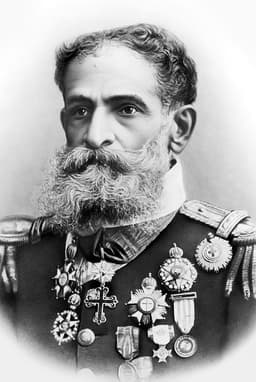
Deodoro da Fonseca
General · Modern
48.8Total
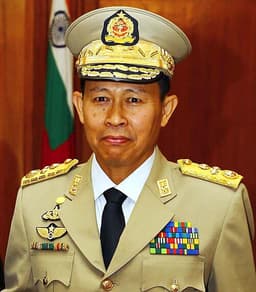
Soe Win
General · Modern
41.7Total
Basic Information
Born
1827
1947
Died
1892
—
Era
Modern
Modern
Nationality
Brazil
Myanmar
Occupation
General
General
Civilization
Western
Eastern
Score Comparison
Military (10%)
50.0
25.9
Political (20%)
45.1
30.8
Influence (20%)
54.1
48.6
Legacy (20%)
44.2
40.0
Leadership (15%)
57.6
57.6
Strategy (15%)
38.6
36.8
TOTAL
48.8
41.7
Deodoro da Fonseca — Complete Timeline
1889 AD
Proclamation of the Brazilian RepublicPolitical Action
Deodoro da Fonseca led a military coup that overthrew Emperor Pedro II on November 15, 1889. He proclaimed the Republic of the United States of Brazil, ending 67 years of imperial rule.
CoupRepublic
Impact: globalprogressive
1891 AD
Election as First President of BrazilPolitical Action◆ Major
Deodoro da Fonseca was elected the first President of Brazil by the Constituent Congress on February 25, 1891. He took office under the new republican constitution, but his rule was brief and authoritarian.
ElectionPresidency
Impact: national
Dissolution of the National CongressPolitical Action◆ Major
Facing political opposition, Deodoro da Fonseca dissolved the National Congress on November 3, 1891, and declared a state of siege. This authoritarian act triggered a naval revolt and his eventual resignation.
AuthoritarianismPolitical Crisis
Impact: nationaldestructive
Resignation from the PresidencyPolitical Action◆ Major
Deodoro da Fonseca resigned the presidency on November 23, 1891, after a naval rebellion threatened his government. He handed power to Vice President Floriano Peixoto, ending his 9-month rule.
ResignationPolitical Crisis
Impact: nationaltragic
Soe Win — Complete Timeline
2004 AD
Appointed Prime Minister of MyanmarPolitical Action◆ Major
Soe Win was appointed Prime Minister of Myanmar by the State Peace and Development Council, succeeding Khin Nyunt. He served as a key figure in the military junta's government.
Military JuntaGovernment Appointment
Impact: national
2007 AD
Saffron Revolution CrackdownPolitical Action
As Prime Minister, Soe Win oversaw the military's violent suppression of the Saffron Revolution, a series of anti-government protests led by Buddhist monks. The crackdown resulted in numerous deaths, arrests, and international condemnation.
Saffron RevolutionHuman RightsRepression
Impact: nationaldestructive
Death in OfficeOther
Soe Win died in office on October 12, 2007, from leukemia. His death occurred shortly after the Saffron Revolution crackdown, and he was succeeded by Thein Sein.
DeathSuccession
Impact: national
Expert Analysis
Deodoro da Fonseca vs Soe Win
# The General as President: Two Paths to Power, Two Legacies of Failure
On a humid November morning in 1891, Marshal Deodoro da Fonseca stood before a shattered National Congress in Rio de Janeiro, his hand trembling as he signed the decree that dissolved Brazil’s fledgling democracy. Half a world away and more than a century later, another general—Soe Win of Myanmar—sat in his office in Naypyidaw, watching reports of Buddhist monks marching through the streets of Yangon, knowing that his own grip on power would soon be tested by blood. Both men were soldiers who became heads of state. Both seized power through force and left behind nations scarred by their ambition. But their stories could not be more different—one a reluctant revolutionary who stumbled into the presidency, the other a calculating enforcer who rose through the ranks of a brutal junta. What drove them, and why did their paths diverge so sharply?
Origins
Deodoro da Fonseca was born in 1827 in Alagoas, a poor province in northeastern Brazil, into a family of modest military tradition. His father was a minor officer, and young Deodoro grew up surrounded by the strict hierarchies of the army, where loyalty to the emperor was drilled into every cadet. The Brazil of his youth was a monarchy—the only one in the Americas—ruled by the aging Emperor Pedro II, a figure revered for his stability but increasingly criticized for his aloofness. Deodoro’s education was practical, not intellectual; he learned command, not philosophy. He fought in the Paraguayan War (1864–1870), where he earned a reputation for bravery and bluntness, but also for a volatile temper that would later prove his undoing.
Soe Win was born in 1947 in Burma—then newly independent from British rule—into a country already convulsed by civil war. His father was a minor civil servant, but the young Soe Win chose the military as his path to status. He joined the Burmese Army in the 1960s, just as General Ne Win’s coup had installed a socialist military dictatorship that would isolate the country for decades. Soe Win’s world was one of paranoia, censorship, and absolute obedience. He learned to survive by aligning himself with stronger men, and by the 1990s, he had become a key figure in the State Peace and Development Council, the junta that ruled Myanmar with an iron fist. Where Deodoro was shaped by a fading monarchy, Soe Win was forged in the fire of a military state that had no tolerance for dissent.
Rise to Power
Deodoro’s ascent was accidental. In 1889, he was a respected but aging marshal, nearing retirement, when a group of young republican officers approached him to lead a coup against Emperor Pedro II. Deodoro was not an ideologue—he had served the monarchy faithfully for decades—but he was persuaded by a mix of personal grievances and a genuine belief that the empire had become corrupt and stagnant. On November 15, 1889, he marched his troops into Rio de Janeiro, arrested the prime minister, and proclaimed the Republic. The emperor abdicated without a fight, and Deodoro found himself, at age 62, the provisional head of state. It was a revolution that happened almost by default, driven more by frustration than vision.
Soe Win’s rise was deliberate and ruthless. He climbed the ranks of the Burmese military during the long twilight of Ne Win’s rule, surviving purges and shifting alliances. In 2004, he was appointed Prime Minister by the junta’s leader, Than Shwe, replacing Khin Nyunt, a rival who had been purged for corruption. Soe Win was chosen precisely because he was loyal, efficient, and willing to do what was necessary. He had no popular support, no electoral mandate—only the backing of the generals who controlled the country’s guns. His power was a product of the system, not a break from it.
Leadership & Governance
As president, Deodoro was a disaster. He had no experience in civilian governance, no patience for political debate, and no understanding of compromise. His military style—command and control—clashed with the messy realities of Brazil’s new republic. The Constituent Congress elected him president in February 1891, but the constitution they wrote deliberately limited his powers, creating a weak executive that infuriated him. For months, he tried to govern by decree, alienating both the old imperial elites and the new republican factions. When Congress refused to approve his budget, he dissolved it on November 3, 1891, and declared a state of siege. It was a desperate act that triggered a naval rebellion, and within weeks, he was forced to resign—the first and only Brazilian president to do so under threat of force.
Soe Win governed Myanmar with the cold efficiency of a military bureaucrat. He oversaw the country’s economy, which remained stagnant under international sanctions, and continued the junta’s brutal suppression of pro-democracy activists, including Aung San Suu Kyi, who was under house arrest. His tenure was marked by no reforms, no development, and no attempt to engage with the outside world. When the Saffron Revolution erupted in August 2007—led by thousands of Buddhist monks demanding an end to military rule—Soe Win ordered a violent crackdown. Soldiers fired on protesters, beat monks, and raided monasteries. The world watched in horror, but Soe Win showed no remorse. For him, the state’s survival was paramount, and dissent was treason.
Triumph & Tragedy
Deodoro’s greatest moment was also his tragedy: the proclamation of the Republic. It was an act that ended a 67-year monarchy and set Brazil on a new path, but it was also the moment that revealed his limitations. He was a general who had overthrown a government but had no idea how to build one. His dissolution of Congress was a fatal miscalculation that turned his own supporters against him. When he resigned on November 23, 1891, he handed power to his vice president, Floriano Peixoto, who would prove even more authoritarian. Deodoro died a few months later, in August 1892, a broken man who had seen his revolution crumble in just two years.
Soe Win’s triumph was purely institutional: he survived in a system that devoured its weak. The Saffron Revolution crackdown was his defining moment, and it was a tragedy for Myanmar. By ordering the violence, he ensured that the junta would remain in power for another four years, but he also sealed his own legacy as a tyrant. He died of leukemia on October 12, 2007, just weeks after the protests were crushed. His death was met with silence—no mourning, no memorials, only the quiet relief of a nation that had endured his rule.
Character & Destiny
Deodoro was a man of impulse, not strategy. His military score of 35.9 and strategy score of 40.2 reflect a commander who relied on courage rather than cunning. He was prone to outbursts of rage, and his political score of 77.9 suggests he had some instinct for power but no discipline to wield it. His leadership score of 70.0 shows he could inspire loyalty, but only among a small circle. His destiny was to be a transitional figure—a bridge between empire and republic, but a bridge that collapsed under its own weight.
Soe Win was the opposite: cold, calculating, and patient. His military score of 44.6 and strategy score of 61.6 indicate a man who understood the mechanics of power, even if he lacked brilliance. His leadership score of 72.6 and political score of 51.8 show he was a survivor, not a visionary. He did not seek to transform Myanmar; he sought to preserve it—as a prison for its people. His destiny was to be a cog in a machine that crushed hope.
Legacy
Deodoro da Fonseca is remembered today as a flawed but necessary figure in Brazilian history. His statue stands in Rio de Janeiro, and his name adorns streets and plazas, but historians debate whether he was a patriot or a opportunist. His legacy score of 60.6 places him in a middle ground—neither hero nor villain, but a man who stumbled into history and left it changed, for better or worse.
Soe Win is remembered as a villain. His name is synonymous with the Saffron Revolution crackdown, and his legacy score of 56.0 reflects the contempt of both his own people and the world. In Myanmar, he is a ghost—mentioned only in whispers, a warning of what the military can do when its power is threatened.
Conclusion
Two generals, two nations, two failures. Deodoro da Fonseca failed because he could not adapt—a soldier who tried to rule as a civilian and found himself outmatched by the complexity of democracy. Soe Win failed because he succeeded too well—a soldier who crushed dissent but left his country in ruins, a testament to the emptiness of power without purpose. Their stories remind us that the difference between a revolutionary and a tyrant is not always clear, but the outcome is always measured in the lives they touch. One died in obscurity, the other in silence, but both left behind a question that still haunts us: what does it mean to lead when you have no vision beyond your own survival?
Rankings
🥇
Deodoro da FonsecaLeader
Mil: 50.0Pol: 45.1Inf: 54.1
48.8
🥈
Soe Win
Mil: 25.9Pol: 30.8Inf: 48.6
41.7
+7.1 behind
How This Comparison Works
Algorithm
Each figure is scored on 6 dimensions (0—100 scale) based on structured historical data: Military (10%), Political (20%), Influence (20%), Legacy (20%), Leadership (15%), Strategy (15%). The weighted total produces the final ranking.
Data Sources
Scores are computed from structured sub-indicators in the database. Scale factors adjust for era (Ancient ×0.85, Modern ×1.0) and civilization size (Eastern ×1.05, Other ×0.80) to account for differences in population and military scale.
Maximum 3 Figures
Comparisons are limited to 2—3 figures to ensure readability and statistical meaningfulness.
Error Margins
±5 points per dimension — Sub-scores are derived from historical records with inherent uncertainty. Two figures within 5 points on a dimension should be considered roughly equivalent in that area.
Total Score Accuracy
±3 points overall — The weighted combination of 6 dimensions produces a total score with approximately ±3 points of uncertainty. Differences of less than 3 points are not statistically significant— the figures are effectively tied.
Known Limitations
- Historical records are incomplete and uneven across civilizations
- Figures from oral-tradition societies may be underrepresented
- Occupation labels can misclassify multi-role figures
- Scores measure capability and impact, not moral character
- Quantitative scoring is a comparison tool, not absolute truth
Capability Radar
Military (10%) — Battles & Warfare
Battles
20
10
Win Rate
25
10
Expansion
10
10
Political (20%) — Governance & Reform
Reform
40
10
Diplomacy
25
10
Economy
15
10
Influence (20%) — Cultural & Global Reach
Cultural
20
10
Global
15
10
Legacy (20%) — Historical Impact
Historical
35
20
Longevity
20
10
Leadership (15%) — Power & Stability
Tenure
30
30
Stability
10
10
Strategy (15%) — Tactics & Innovation
Strategy
25
10
Tactics
20
10
Reform
15
10
Similar Comparisons
Comments & Discussion
数据拆解者6/16/2026
光看数据就知道谁更失败:德奥多罗执政不到两年就下台,巴西到1894年就恢复文官统治;梭温干了整整八年,直到2007年才死——缅甸军政府统治了六十年。列强干预呢?美国没干涉巴西,联合国至今制裁缅甸。这不是什么两种道路,这是一个愚蠢巧合和一场持久灾难的对比。选举也没用,两国的民主都虚伪得很。|
散文笔法6/16/2026
一个是巴西的将军,读着宫廷流言长大,在位时连个像样的政变都镇不住——副总统逼宫,他认输辞职;另一个缅甸的,年轻时就训练童子军,晚年亲自下令镇压抗议,连佛教僧侣都不放过。德奥多罗留下的是1891年宪法,稀里糊涂的民主;梭温留下的是21世纪的万人坑,清清楚楚的恐怖。两半烂橘子,哪个更臭?我选后者。|
保守史家6/16/2026
说梭温是“冷酷执行者”太轻描淡写。他1960年代靠镇压少数民族上位,1988年又参与屠杀学生,2007年暴力镇压僧侣时已病入膏肓,可他还是下令开枪。德奥多罗至少晚年有悔意,拒绝流血——梭温呢?死前还签署紧急状态令。这哪里是两条道路?分明是一个人类尊严的堕落阶梯:一个半途而废的暴君,一个坚持到底的屠夫。|
Historian3406/16/2026
As a military historian, I see these two as opposite poles of the soldier-president archetype. Deodoro was a reluctant despot who dissolved Congress out of genuine rage at corruption, even refusing to restore order when his own vice president staged a counter-coup. Soe Win, by contrast, was the junta’s enforcer—he personally oversaw the 2007 crackdown that killed a hundred monks, never hesitating. One was post-imperial chaos, the other a systematic slide into terror.|
Chronicler70536/16/2026
Classics scholar here: Deodoro’s fall reads like a Roman tragedy—a man who saved the empire only to be consumed by it. He was a hero of the Paraguayan War, a loyalist who turned against the monarchy when it abolished slavery, alienating his base. Soe Win, meanwhile, has no such pathos; his Burma was a neo-Spartan state where loyalty was measured in body counts. One is Livy, the other a police blotter.|