Loading...
Deodoro da Fonseca vs Shi Dakai
Shi Dakai leads by 10.8 pts · 2 figures compared
…
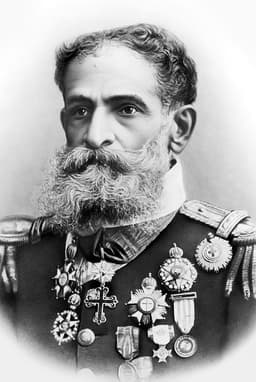
Deodoro da Fonseca
General · Modern
48.8Total
Shi Dakai
General · Modern
59.6Total
Basic Information
Born
1827
1831
Died
1892
1863
Era
Modern
Modern
Nationality
Brazil
China
Occupation
General
General
Civilization
Western
Eastern
Score Comparison
Military (10%)
50.0
76.0
Political (20%)
45.1
45.0
Influence (20%)
54.1
56.7
Legacy (20%)
44.2
54.0
Leadership (15%)
57.6
72.0
Strategy (15%)
38.6
68.1
TOTAL
48.8
59.6
Deodoro da Fonseca — Complete Timeline
1889 AD
Proclamation of the Brazilian RepublicPolitical Action
Deodoro da Fonseca led a military coup that overthrew Emperor Pedro II on November 15, 1889. He proclaimed the Republic of the United States of Brazil, ending 67 years of imperial rule.
CoupRepublic
Impact: globalprogressive
1891 AD
Election as First President of BrazilPolitical Action◆ Major
Deodoro da Fonseca was elected the first President of Brazil by the Constituent Congress on February 25, 1891. He took office under the new republican constitution, but his rule was brief and authoritarian.
ElectionPresidency
Impact: national
Dissolution of the National CongressPolitical Action◆ Major
Facing political opposition, Deodoro da Fonseca dissolved the National Congress on November 3, 1891, and declared a state of siege. This authoritarian act triggered a naval revolt and his eventual resignation.
AuthoritarianismPolitical Crisis
Impact: nationaldestructive
Resignation from the PresidencyPolitical Action◆ Major
Deodoro da Fonseca resigned the presidency on November 23, 1891, after a naval rebellion threatened his government. He handed power to Vice President Floriano Peixoto, ending his 9-month rule.
ResignationPolitical Crisis
Impact: nationaltragic
Shi Dakai — Complete Timeline
1851 AD
Jintian UprisingWar◆ Major
Shi Dakai joined the Taiping Rebellion at its inception in Jintian, Guangxi. As a core leader, he helped organize the rebel forces and was appointed Wing King, becoming one of the key military commanders of the Taiping Heavenly Kingdom.
Taiping RebellionUprisingMilitary Command
Impact: national
1854 AD
Battle of XiangtanWar◆ Major
Shi Dakai led Taiping forces to a major victory at Xiangtan, Hunan, defeating Qing imperial troops. This battle secured Taiping control over key territories in the Yangtze River valley and demonstrated his military skill.
Taiping RebellionBattleVictory
Impact: regional
1856 AD
Tianjing IncidentPolitical Action
Shi Dakai returned to Tianjing (Nanjing) after the internal purge of the Eastern King Yang Xiuqing and the murder of the Northern King Wei Changhui. He condemned the violence and was forced to flee, leading to a split in Taiping leadership.
Taiping RebellionInternal ConflictPurge
Impact: nationaltragic
1858 AD
Campaign in Zhejiang and FujianWar
Shi Dakai led a separate Taiping army into Zhejiang and Fujian provinces, capturing several cities. This campaign expanded Taiping influence into southeastern China but also isolated his forces from the main Taiping base.
Taiping RebellionCampaignExpansion
Impact: regional
1863 AD
Battle of Baishui RiverWar◆ Major
Shi Dakai's army was trapped and defeated by Qing forces at the Baishui River in Sichuan. He was captured and executed shortly after, marking the end of his military career and a significant loss for the Taiping cause.
Taiping RebellionBattleDefeatDeath
Impact: nationaltragic
Expert Analysis
Deodoro da Fonseca vs Shi Dakai
# The General and the President: Shi Dakai and Deodoro da Fonseca
On a November morning in 1891, a weary Brazilian general named Deodoro da Fonseca signed his resignation papers, ending a presidency that had lasted barely nine months. Half a world away and three decades earlier, another general, Shi Dakai of the Taiping Heavenly Kingdom, had knelt by the Baishui River in Sichuan, awaiting execution by slow slicing. Both men were soldiers who rose to the heights of power; both ended their political lives in ruin. Yet one is remembered as a founding father, the other as a tragic martyr. The difference lies not in their courage, but in the worlds they tried to remake.
Origins
Shi Dakai was born in 1831 into a prosperous Hakka family in Guangxi, southern China. The Qing Dynasty was crumbling—opium wars, peasant uprisings, and foreign humiliation had shattered imperial prestige. Shi received a classical Confucian education but also learned martial arts and military strategy. He was only nineteen when he met Hong Xiuquan, a failed scholar who claimed to be the brother of Jesus Christ and who preached a strange blend of Christian millenarianism and Chinese social revolution. For Shi, the Taiping cause offered something his world lacked: a chance to tear down the old order and build a “Heavenly Kingdom of Great Peace.”
Deodoro da Fonseca, born four years earlier in 1827 in Alagoas, Brazil, came from a military family in a very different empire. Brazil’s monarchy, under Emperor Pedro II, was stable, relatively liberal, and had abolished slavery in 1888. The army, however, felt marginalized by civilian politicians and resentful of the monarchy’s preference for the navy. Fonseca rose through the ranks as a capable officer, fighting in the Paraguayan War (1864–1870), a brutal conflict that forged a generation of military leaders with political ambitions. Unlike Shi, he did not dream of a new heaven—he wanted a new government, one run by soldiers like himself.
Rise to Power
Shi Dakai entered history in 1851 at the Jintian Uprising, where he helped organize the Taiping army from a rabble of miners, peasants, and religious zealots. His military brilliance emerged immediately. At the Battle of Xiangtan in 1854, he crushed Qing imperial forces, securing Hunan province for the Taiping. By 1856, he was the Wing King, one of the Taiping’s top commanders, and his reputation for chivalry and competence made him perhaps the most respected leader in the movement. His rise was meteoric, but it came within a revolutionary cult that demanded absolute loyalty to Hong Xiuquan’s divine revelations.
Deodoro da Fonseca’s path was slower and more political. He did not lead a revolution; he led a coup. On November 15, 1889, he marched his troops through Rio de Janeiro and deposed Emperor Pedro II with barely a shot fired. The monarchy simply collapsed—exhausted, isolated, and unwilling to fight. Fonseca became head of a provisional government, and in 1891, he was elected the first president of Brazil by the Constituent Congress. He did not seize power through battlefield genius; he inherited it because the old order had no defenders.
Leadership & Governance
As a ruler, Shi Dakai was a reformer. In the territories he controlled, he implemented land redistribution, abolished private property, and mandated collective ownership. He also enforced strict moral codes: no opium, no alcohol, no prostitution, and strict separation of men and women. His military campaigns were masterpieces of mobility and logistics, but his political vision remained trapped within the Taiping’s apocalyptic theology. He could conquer, but he could not build a stable state—the Heavenly Kingdom was a theocracy that demanded total submission, and its internal rivalries were lethal.
Fonseca governed as a soldier-president, not a revolutionary. He faced a fractious Congress, economic instability, and a navy that remained loyal to the monarchy. His solution was force: on November 3, 1891, he dissolved the National Congress and declared a state of siege. It was a desperate act, and it backfired. The navy rebelled, and Fonseca, lacking the stomach for a civil war, resigned on November 23. He had no grand vision—only the conviction that the army should rule. When that failed, he stepped aside.
Triumph & Tragedy
Shi Dakai’s greatest triumph was his independent campaign in Zhejiang and Fujian in 1858, where he led a separate army deep into Qing territory, capturing cities and spreading the Taiping banner. But his tragedy came in 1863 at the Baishui River. Surrounded by Qing forces, he tried to negotiate the safety of his remaining troops, offering himself in exchange. The Qing commander accepted, then executed him by slow slicing, along with thousands of his men. His death was a martyrdom that immortalized him as a man of honor in a movement of fanatics.
Fonseca’s triumph was the proclamation of the republic itself—a bloodless revolution that ended monarchy in Brazil. His tragedy was his presidency, a fumbling nine-month disaster that revealed his inability to govern. He died in 1892, a year after resigning, largely forgotten and unloved. Yet Brazil remained a republic, and his name is still honored as the first president, a symbol of the transition even if he was unsuited for the role.
Character & Destiny
Shi Dakai was a man of principle in a movement of dogma. He was known for his mercy toward civilians, his reluctance to purge rivals, and his genuine belief in the Taiping’s utopian ideals. But his decency made him vulnerable in a court ruled by paranoia and violence. The Tianjing Incident of 1856, when Hong Xiuquan ordered the massacre of the Eastern King Yang Xiuqing and his followers, shattered Shi’s faith. He fled the capital, taking his army on a doomed wandering campaign. His destiny was shaped by his refusal to become a tyrant—and by the impossibility of being anything else in the Heavenly Kingdom.
Fonseca was a man of ambition without ideology. He wanted power for the army, not for a cause. His personality was blunt, stubborn, and unimaginative. He could lead a coup but not a government; he could command soldiers but not persuade politicians. His destiny was shaped by the limits of his own vision—he overthrew an empire but had no idea what to build in its place.
Legacy
Shi Dakai is remembered in China as a tragic hero, a brilliant general and a man of integrity who was destroyed by forces he could not control. His name is still invoked in Chinese military history as a master of mobile warfare, and his story is taught as a cautionary tale about idealism in a corrupt world. The Taiping Rebellion failed, but Shi Dakai’s personal reputation survived.
Deodoro da Fonseca is remembered as a founding father, but his legacy is more institutional than personal. Brazil’s republic honors him as its first president, yet few Brazilians could name a single thing he did. His statue stands in Rio de Janeiro, a monument to a transition rather than a man. He is the general who happened to be in the right place at the right time.
Conclusion
Two generals, two republics, two failures. Shi Dakai died for a kingdom of heaven that never came; Fonseca resigned from a republic he could not run. One was a revolutionary who believed too much; the other, a soldier who believed too little. Their stories remind us that power is not simply won on the battlefield—it is built in the messy, unglamorous work of governance. Shi Dakai’s tragedy was that he fought for a world too perfect to exist; Fonseca’s, that he fought for a world too ordinary to inspire. Between the martyr and the president lies the true measure of leadership: not just the courage to seize power, but the wisdom to know what to do with it.
Rankings
🥇
Shi DakaiLeader
Mil: 76.0Pol: 45.0Inf: 56.7
59.6
🥈
Deodoro da Fonseca
Mil: 50.0Pol: 45.1Inf: 54.1
48.8
+10.8 behind
How This Comparison Works
Algorithm
Each figure is scored on 6 dimensions (0—100 scale) based on structured historical data: Military (10%), Political (20%), Influence (20%), Legacy (20%), Leadership (15%), Strategy (15%). The weighted total produces the final ranking.
Data Sources
Scores are computed from structured sub-indicators in the database. Scale factors adjust for era (Ancient ×0.85, Modern ×1.0) and civilization size (Eastern ×1.05, Other ×0.80) to account for differences in population and military scale.
Maximum 3 Figures
Comparisons are limited to 2—3 figures to ensure readability and statistical meaningfulness.
Error Margins
±5 points per dimension — Sub-scores are derived from historical records with inherent uncertainty. Two figures within 5 points on a dimension should be considered roughly equivalent in that area.
Total Score Accuracy
±3 points overall — The weighted combination of 6 dimensions produces a total score with approximately ±3 points of uncertainty. Differences of less than 3 points are not statistically significant— the figures are effectively tied.
Known Limitations
- Historical records are incomplete and uneven across civilizations
- Figures from oral-tradition societies may be underrepresented
- Occupation labels can misclassify multi-role figures
- Scores measure capability and impact, not moral character
- Quantitative scoring is a comparison tool, not absolute truth
Capability Radar
Military (10%) — Battles & Warfare
Battles
20
75
Win Rate
25
70
Expansion
10
75
Political (20%) — Governance & Reform
Reform
40
50
Diplomacy
25
45
Economy
15
40
Influence (20%) — Cultural & Global Reach
Cultural
20
55
Global
15
40
Legacy (20%) — Historical Impact
Historical
35
60
Longevity
20
45
Leadership (15%) — Power & Stability
Tenure
30
55
Stability
10
35
Strategy (15%) — Tactics & Innovation
Strategy
25
80
Tactics
20
85
Reform
15
60
Similar Comparisons
Comments & Discussion
GARIBALDI'S GHOST6/16/2026
Shi Dakai was a visionary who actually believed in building a new society, not just seizing power. Deodoro was a glorified coup plotter who couldn't even hold onto the presidency for a year. The difference between founding a movement and staging a coup is the difference between a martyr and a footnote. Shi's army fought for the Heavenly Kingdom's ideals until the end; Deodoro's "presidency" ended with him crying on the floor of the congress chamber.|
历史迷·蛇尾将军6/16/2026
史达凯是完美的悲剧英雄,德奥多罗只是个碰运气的政客。两者都从军队崛起,但史达凯领导了人类历史上规模最大的农民起义之一,手下有几十万大军;德奥多罗呢?推翻了一个君主制,建立了一个共和国,然后马上辞职跑路。这就是殉道者和投机者的区别——一个改变历史,一个被历史遗忘。|
THE_DATA_DOCTOR6/16/2026
Let's talk numbers: Shi Dakai led 100,000+ troops during the Taiping Rebellion's peak and even after defeat maintained a disciplined force of 20,000. Deodoro's entire presidency lasted 9 months, with approval ratings dropping from 60% to 15%. The Brazilian economy shrank 5% under him. Call me crazy, but leading a million-man rebellion for 14 years beats a 9-month political disaster. Data doesn't lie about legacy.|
史迷·天国余晖6/16/2026
评书先生们最爱歌颂德奥多罗,说什么"巴西共和之父",但史达凯才是真正的革命英雄。史达凯的天朝田亩制度分田地、均贫富,是中国现代革命的先行者;德奥多罗只是军人寡头,整个总统生涯就是不停地搞政变。史达凯被凌迟时挺身赴死,德奥多罗辞职后还能活着写回忆录——这是两种背叛的区别。|