Loading...
Deodoro da Fonseca vs Prayut Chan-o-cha
Deodoro da Fonseca leads by 0.7 pts · 2 figures compared
…
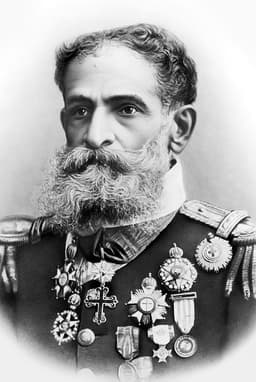
Deodoro da Fonseca
General · Modern
48.8Total
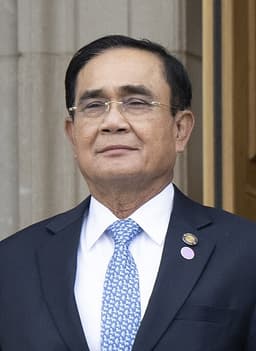
Prayut Chan-o-cha
General · Modern
48.1Total
Basic Information
Born
1827
1954
Died
1892
—
Era
Modern
Modern
Nationality
Brazil
Thailand
Occupation
General
General
Civilization
Western
Eastern
Score Comparison
Military (10%)
50.0
10.2
Political (20%)
45.1
68.0
Influence (20%)
54.1
51.8
Legacy (20%)
44.2
40.8
Leadership (15%)
57.6
68.0
Strategy (15%)
38.6
35.7
TOTAL
48.8
48.1
Deodoro da Fonseca — Complete Timeline
1889 AD
Proclamation of the Brazilian RepublicPolitical Action
Deodoro da Fonseca led a military coup that overthrew Emperor Pedro II on November 15, 1889. He proclaimed the Republic of the United States of Brazil, ending 67 years of imperial rule.
CoupRepublic
Impact: globalprogressive
1891 AD
Election as First President of BrazilPolitical Action◆ Major
Deodoro da Fonseca was elected the first President of Brazil by the Constituent Congress on February 25, 1891. He took office under the new republican constitution, but his rule was brief and authoritarian.
ElectionPresidency
Impact: national
Dissolution of the National CongressPolitical Action◆ Major
Facing political opposition, Deodoro da Fonseca dissolved the National Congress on November 3, 1891, and declared a state of siege. This authoritarian act triggered a naval revolt and his eventual resignation.
AuthoritarianismPolitical Crisis
Impact: nationaldestructive
Resignation from the PresidencyPolitical Action◆ Major
Deodoro da Fonseca resigned the presidency on November 23, 1891, after a naval rebellion threatened his government. He handed power to Vice President Floriano Peixoto, ending his 9-month rule.
ResignationPolitical Crisis
Impact: nationaltragic
Prayut Chan-o-cha — Complete Timeline
2014 AD
Led the 2014 military coupPolitical Action
General Prayut Chan-o-cha, as Army Commander-in-Chief, led a coup d'
CoupMilitaryThailand
Impact: nationaldestructive
Appointed Prime Minister by military legislaturePolitical Action◆ Major
Following the coup, Prayut was appointed Prime Minister by the military-controlled National Legislative Assembly. He assumed executive power, leading a government that promised reforms and national reconciliation.
AppointmentMilitary RuleThailand
Impact: national
2017 AD
Promulgation of the 2017 ConstitutionReform◆ Major
Prayut's government oversaw the drafting and approval of a new constitution that strengthened the military's political role and created a fully appointed Senate. The charter was criticized for entrenching military influence.
ConstitutionMilitaryThailand
Impact: national
2019 AD
Re-elected Prime Minister after 2019 electionPolitical Action◆ Major
Prayut was re-elected Prime Minister following a general election that was criticized for being manipulated to favor pro-military parties. He formed a coalition government, continuing his rule under a civilian facade.
ElectionContinuityThailand
Impact: national
Expert Analysis
Deodoro da Fonseca vs Prayut Chan-o-cha
# The General Who Became President: Prayut Chan-o-cha and Deodoro da Fonseca
In November 2014, a stern-faced Thai general in full military uniform stood before television cameras in Bangkok, announcing that the army had seized control of the country. The coup was the twelfth since Thailand became a constitutional monarchy in 1932. Half a world away and 125 years earlier, another mustachioed general in a crisp Brazilian uniform had similarly proclaimed the end of an empire, declaring a republic from the balcony of Rio de Janeiro's city hall. Both men—Prayut Chan-o-cha and Deodoro da Fonseca—rose from barracks to presidential palaces through the force of arms. But their paths diverged in ways that reveal how personality, circumstance, and national context shape the fate of military rulers.
Origins
Prayut Chan-o-cha was born in 1954 in Nakhon Ratchasima, a provincial city in northeastern Thailand, to a middle-class family with military connections. He entered the Chulachomklao Royal Military Academy at a time when the Thai army was deeply entangled in politics, fighting communist insurgencies and staging regular coups. His rise was methodical, bureaucratic, and loyal—he never commanded troops in battle but mastered the art of internal army politics.
Deodoro da Fonseca, born in 1827 in Alagoas, Brazil, came from a military family steeped in the wars that forged the Brazilian Empire. He fought in the Paraguayan War (1864–1870), South America's bloodiest conflict, where he earned a reputation for bravery and impatience with civilian authority. Unlike Prayut, Fonseca was a combat veteran who had seen men die in trenches and jungles, and that experience gave him a certain swagger—and a contempt for the politicians he believed had mismanaged the war.
Rise to Power
Prayut's path to power was a slow accumulation of institutional authority. He became Army Commander-in-Chief in 2010, a position that gave him control over the military's internal machinery. When political protests paralyzed Bangkok in 2013–2014, with rival factions clashing in the streets, Prayut positioned himself as the arbiter of order. On May 22, 2014, he declared martial law, then led a coup that overthrew the caretaker government. Within months, the military-controlled National Legislative Assembly appointed him Prime Minister, a title he would hold for nearly a decade.
Deodoro da Fonseca's rise was more dramatic and less calculated. By 1889, the Brazilian Empire was fraying—the monarchy had alienated the army, the Church, and the planter class after abolishing slavery without compensation. Republican conspirators approached Fonseca, then a respected but ailing general, to lead a revolt. On November 15, 1889, he marched troops through Rio de Janeiro, deposed Emperor Pedro II, and proclaimed the Republic. Unlike Prayut, Fonseca had no detailed plan for governance; he was a figurehead for a movement he barely controlled.
Leadership & Governance
Prayut governed as a cautious, technocratic authoritarian. His 2017 constitution was a masterpiece of military engineering—it created an appointed Senate, weakened political parties, and ensured the army's veto power over civilian governments. He presented himself as a fatherly figure restoring order, using emergency decrees and censorship to suppress dissent. His economic record was modest: infrastructure spending and tourism promotion, but no transformative reforms. He was reelected in 2019 in an election critics called rigged, yet he maintained a veneer of legality.
Fonseca's presidency was a catastrophe of improvisation. Elected by the Constituent Congress on February 25, 1891, he inherited a fragile republic with no democratic traditions. When Congress resisted his authoritarian impulses, he dissolved it on November 3, 1891, declaring a state of siege. But he lacked the military loyalty to enforce his will—a naval rebellion erupted, and within three weeks, he resigned in disgrace, handing power to his vice president. His entire presidency lasted just nine months.
Triumph & Tragedy
Prayut's triumph was survival. He outlasted protests, economic downturns, and a pandemic, remaining in power until 2023—longer than any elected Thai prime minister. His tragedy was that he solved nothing: the political divisions that caused the 2014 coup remain, and his legacy is a constitution designed to prevent democracy from functioning.
Fonseca's triumph was the Republic itself—he ended 67 years of monarchy and set Brazil on a republican path that endures today. His tragedy was personal: a decorated war hero destroyed by political incompetence, forced to resign in humiliation, dying just a year later in 1892, a broken man.
Character & Destiny
Prayut was cautious, bureaucratic, and patient—a man who played the long game within institutional structures. Fonseca was impulsive, proud, and reckless—a warrior who could not adapt to politics. Their personalities determined their fates: Prayut's slow, methodical style suited a military institution that prized loyalty and procedure; Fonseca's explosive temperament was ill-suited to the compromises of republican governance.
Yet both were products of their eras. Prayut ruled in a Thailand where the military had decades of experience managing coups and constitutions. Fonseca led a Brazil with no republican history, no stable parties, and a military divided between monarchists and republicans. The difference was not just character—it was context.
Legacy
Today, Prayut Chan-o-cha is remembered as the general who turned Thailand into a semi-authoritarian state, his name synonymous with military-backed rule. His 2017 constitution remains in force, a lasting brake on democracy. Deodoro da Fonseca is a footnote in Brazilian history—honored as the first president but largely forgotten, his portrait fading in government buildings. Both men proved that generals make poor democrats, but their failures teach different lessons: one about the persistence of military power, the other about the fragility of republican beginnings.
Conclusion
The contrast between these two generals is a mirror held up to their nations. Prayut's long, grinding rule reflects a Thailand where the military learned to dominate without governing well. Fonseca's brief, chaotic presidency reflects a Brazil that stumbled into republicanism before it was ready. Both stories end with the same truth: when soldiers seize power, they may win the battle, but they rarely win the peace. The gun speaks louder than the ballot—but it cannot write a constitution that lasts.
Rankings
🥇
Deodoro da FonsecaLeader
Mil: 50.0Pol: 45.1Inf: 54.1
48.8
🥈
Prayut Chan-o-cha
Mil: 10.2Pol: 68.0Inf: 51.8
48.1
+0.7 behind
How This Comparison Works
Algorithm
Each figure is scored on 6 dimensions (0—100 scale) based on structured historical data: Military (10%), Political (20%), Influence (20%), Legacy (20%), Leadership (15%), Strategy (15%). The weighted total produces the final ranking.
Data Sources
Scores are computed from structured sub-indicators in the database. Scale factors adjust for era (Ancient ×0.85, Modern ×1.0) and civilization size (Eastern ×1.05, Other ×0.80) to account for differences in population and military scale.
Maximum 3 Figures
Comparisons are limited to 2—3 figures to ensure readability and statistical meaningfulness.
Error Margins
±5 points per dimension — Sub-scores are derived from historical records with inherent uncertainty. Two figures within 5 points on a dimension should be considered roughly equivalent in that area.
Total Score Accuracy
±3 points overall — The weighted combination of 6 dimensions produces a total score with approximately ±3 points of uncertainty. Differences of less than 3 points are not statistically significant— the figures are effectively tied.
Known Limitations
- Historical records are incomplete and uneven across civilizations
- Figures from oral-tradition societies may be underrepresented
- Occupation labels can misclassify multi-role figures
- Scores measure capability and impact, not moral character
- Quantitative scoring is a comparison tool, not absolute truth
Capability Radar
Military (10%) — Battles & Warfare
Battles
20
5
Win Rate
25
5
Expansion
10
5
Political (20%) — Governance & Reform
Reform
40
30
Diplomacy
25
40
Economy
15
35
Influence (20%) — Cultural & Global Reach
Cultural
20
20
Global
15
20
Legacy (20%) — Historical Impact
Historical
35
20
Longevity
20
15
Leadership (15%) — Power & Stability
Tenure
30
60
Stability
10
25
Strategy (15%) — Tactics & Innovation
Strategy
25
15
Tactics
20
10
Reform
15
20
Similar Comparisons
Comments & Discussion
史海沉钩6/16/2026
别被军装骗了,这两位压根不是一个物种。德奥多罗在巴拉圭战争里真刀真枪砍过人,巴西帝国那是他亲手掀翻的。再看巴育,军校毕业就玩办公室政治,政变12次里他算老几?一个开创共和,一个巩固既得利益。说白了,德奥多罗是暴风骤雨里的革命家,巴育充其量是棵不会倒的墙头草。历史会记住前者,后者只会被泰国人骂到下台。
Chronicler84656/16/2026
Prayut and Deodoro both prove that military coups are just the same old song, different key. But here’s the kicker: Deodoro actually fought in the Paraguayan War, while Prayut’s greatest campaign was climbing the army’s bureaucratic ladder. One earned his stripes in blood, the other in paperwork. Deodoro at least had the excuse of building a republic from scratch; Prayut just wanted to keep his seat warm. Give me the Brazilian chaos over Thai order any day—at least Deodoro’s mess was honest.