Loading...
Deodoro da Fonseca vs Pedro I of Brazil
Pedro I of Brazil leads by 5.8 pts · 2 figures compared
…
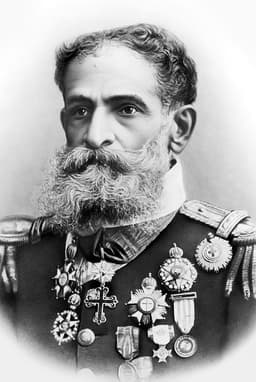
Deodoro da Fonseca
General · Modern
48.8Total
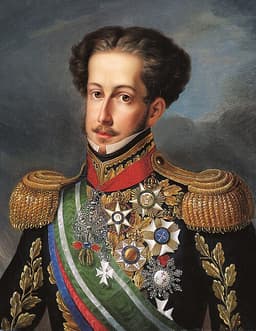
Pedro I of Brazil
Emperor · Modern
54.6Total
Basic Information
Born
1827
1798
Died
1892
1834
Era
Modern
Modern
Nationality
Brazil
Brazil
Occupation
General
Emperor
Civilization
Western
Western
Score Comparison
Military (10%)
50.0
55.0
Political (20%)
45.1
62.7
Influence (20%)
54.1
59.0
Legacy (20%)
44.2
50.0
Leadership (15%)
57.6
53.2
Strategy (15%)
38.6
45.0
TOTAL
48.8
54.6
Deodoro da Fonseca — Complete Timeline
1889 AD
Proclamation of the Brazilian RepublicPolitical Action
Deodoro da Fonseca led a military coup that overthrew Emperor Pedro II on November 15, 1889. He proclaimed the Republic of the United States of Brazil, ending 67 years of imperial rule.
CoupRepublic
Impact: globalprogressive
1891 AD
Election as First President of BrazilPolitical Action◆ Major
Deodoro da Fonseca was elected the first President of Brazil by the Constituent Congress on February 25, 1891. He took office under the new republican constitution, but his rule was brief and authoritarian.
ElectionPresidency
Impact: national
Dissolution of the National CongressPolitical Action◆ Major
Facing political opposition, Deodoro da Fonseca dissolved the National Congress on November 3, 1891, and declared a state of siege. This authoritarian act triggered a naval revolt and his eventual resignation.
AuthoritarianismPolitical Crisis
Impact: nationaldestructive
Resignation from the PresidencyPolitical Action◆ Major
Deodoro da Fonseca resigned the presidency on November 23, 1891, after a naval rebellion threatened his government. He handed power to Vice President Floriano Peixoto, ending his 9-month rule.
ResignationPolitical Crisis
Impact: nationaltragic
Pedro I of Brazil — Complete Timeline
1822 AD
Declaration of Independence of BrazilPolitical Action
Pedro I declared Brazil's independence from Portugal on September 7, 1822, at the Ipiranga River in S
Impact: globalprogressive
Coronation as Emperor of BrazilPolitical Action◆ Major
Pedro I was crowned Emperor of Brazil on December 1, 1822, in Rio de Janeiro. The coronation formalized the new imperial government, with Pedro I as constitutional monarch, though he retained significant executive powers.
Impact: nationalconstructive
1823 AD
War of Independence of BrazilWar◆ Major
Pedro I led Brazilian forces against Portuguese loyalists in the War of Independence. Key battles occurred in Bahia, Maranh
Impact: national
Dissolution of the Constituent AssemblyPolitical Action◆ Major
Pedro I dissolved the Constituent Assembly after conflicts over the constitution's limits on imperial power. He then imposed the 1824 Constitution, which granted the emperor extensive powers, including the Moderating Power, centralizing authority.
Impact: nationaldestructive
1831 AD
Abdication of the Brazilian ThronePolitical Action
Pedro I abdicated the Brazilian throne in favor of his five-year-old son Pedro II on April 7, 1831. He returned to Portugal to claim the Portuguese throne, leaving Brazil under a regency until his son came of age.
Impact: national
Expert Analysis
Deodoro da Fonseca vs Pedro I of Brazil
### The Emperor and the General: Two Men Who Forged Brazil
On a September morning in 1822, a young prince stood beside the Ipiranga River in São Paulo, tore the Portuguese blue-and-white insignia from his uniform, and shouted, “Independence or Death!” Sixty-seven years later, an aging general, sick with asthma and plagued by doubt, led a column of soldiers through the streets of Rio de Janeiro, arresting the prime minister and ending the monarchy with a single, bloodless coup. Between these two moments—the cry of the emperor and the march of the general—the story of Brazil’s birth as a nation unfolds. Pedro I and Deodoro da Fonseca were not merely leaders; they were the architects of two different Brazils, each shaped by the pressures of their time, their own contradictions, and the cruel logic of history.
### Origins
Pedro I was born into the gilded cage of European royalty. The son of King João VI of Portugal, he arrived in Brazil at age nine when the royal family fled Napoleon’s armies. He grew up in Rio de Janeiro, a prince in a tropical court, learning to ride horses, speak bluntly, and indulge his passions. His education was haphazard; he was impulsive, charming, and restless. By 1822, when he was just twenty-three, the political winds of the Americas—revolutions in the United States, Haiti, and Spanish America—had made independence inevitable. Pedro, however, was not a republican. He was a Braganza, a monarch who believed that Brazil’s future lay in a crown, not a constitution.
Deodoro da Fonseca came from a different world entirely. Born in 1827 in Alagoas, the son of a military officer, he grew up in the barracks and the hinterlands. He was a soldier’s soldier—tall, bearded, and stoic. He fought in the Paraguayan War, where he saw the horrors of modern warfare and the incompetence of imperial bureaucracy. By the 1880s, he had become a republican, not out of ideology but out of disillusionment. The monarchy, he believed, had grown old, corrupt, and out of touch. Where Pedro I had inherited a throne, Deodoro had to earn his place through decades of service and suffering.
### Rise to Power
Pedro I’s rise was sudden and dramatic. When his father returned to Portugal in 1821, leaving him as regent, the Portuguese parliament tried to reduce Brazil to a colony again. Pedro refused. With the support of José Bonifácio, a brilliant statesman, he declared independence on September 7, 1822. Within months, he was crowned emperor. His path was not a climb but a leap—a young man seizing a moment that history had prepared for him.
Deodoro’s rise was slower, more reluctant. He was not a natural politician. In 1887, he was a respected marshal, but he had no desire to rule. The republican movement, led by intellectuals and coffee barons, courted him for years. Finally, in November 1889, a conspiracy forced his hand. On the night of November 14, he agreed to lead a revolt. The next morning, he marched on the War Ministry, arrested the prime minister, and proclaimed the republic. Unlike Pedro, who had cried for independence, Deodoro spoke little. He acted because he felt he had no choice.
### Leadership & Governance
Pedro I ruled as an emperor, but he governed like a man at war with himself. He was a capable military leader—during the War of Independence in 1823, he personally led forces against Portuguese loyalists in Bahia, securing Brazil’s borders. But his political wisdom was flawed. He dissolved the Constituent Assembly in 1823 when it tried to limit his power, imposing a constitution that gave him broad authority. This authoritarian streak alienated liberals and sparked rebellions. He was a reformer who wanted a strong state, but he lacked patience and diplomacy. His leadership score of 74.5 reflects a man who could inspire loyalty but could not build consensus.
Deodoro da Fonseca was the opposite. He was not a military genius—his strategy score of 40.2 is among the lowest for a national founder. He was a figurehead, a symbol of the republic rather than its architect. As president, he tried to govern through decree, dissolving the National Congress in November 1891 when it opposed him. This triggered a naval rebellion, and within weeks, he resigned. His political score of 77.9 is higher than Pedro’s, but it masks a deeper failure: he was a general who could not command a democracy.
### Triumph & Tragedy
Pedro I’s greatest triumph was the declaration of independence itself, a moment etched into Brazilian memory. His greatest tragedy was his abdication. By 1831, his authoritarian rule, his unpopular Portuguese ministers, and his scandalous personal life—including a notorious affair with the Marchioness of Santos—had turned the nation against him. On April 7, 1831, he stepped down in favor of his five-year-old son, Pedro II. He sailed back to Portugal, a king without a kingdom, and died there three years later, at age thirty-five.
Deodoro’s triumph was the proclamation of the republic—a peaceful transition that ended sixty-seven years of monarchy. His tragedy was his presidency. He was a man out of time, a soldier in an age of civilians. His dissolution of Congress was a desperate act, and his resignation in November 1891 was a quiet humiliation. He died less than a year later, forgotten by many, a relic of a revolution he had started but could not finish.
### Character & Destiny
Pedro I was passionate, impulsive, and romantic. He believed in destiny—his own and Brazil’s. His personality drove him to declare independence, but it also drove him to ruin. He could not compromise; he could not listen. His character was his fate.
Deodoro was melancholic, dutiful, and weary. He did not seek power; power sought him. His caution made him a reluctant revolutionary, and his lack of ambition made him a weak ruler. He was a man of the barracks, not the parliament. His destiny was to be a bridge—the man who ended one era but could not build the next.
### Legacy
Pedro I is remembered as the father of Brazilian independence, the “Liberator.” His legacy score of 70.0 is high, but it is overshadowed by his son, Pedro II, who ruled for nearly fifty years and is considered a great emperor. Pedro I’s statue stands in São Paulo, his cry immortalized. Yet his story is a warning about the limits of charisma.
Deodoro’s legacy is more ambiguous. He is honored as the first president, his name on squares and streets. But his score of 60.6 reflects a man who is respected but not revered. He is a footnote in textbooks, a general who did what was necessary but not what was great.
### Conclusion
Two men, two revolutions. Pedro I shouted “Independence or Death” and meant it. Deodoro da Fonseca marched in silence and did not know what to say afterward. One was a prince who became a martyr; the other was a soldier who became a placeholder. Together, they remind us that nations are born not only from great cries but from quiet, reluctant steps. Brazil’s story is written in both—the fire of the emperor and the shadow of the general.
Rankings
🥇
Pedro I of BrazilLeader
Mil: 55.0Pol: 62.7Inf: 59.0
54.6
🥈
Deodoro da Fonseca
Mil: 50.0Pol: 45.1Inf: 54.1
48.8
+5.8 behind
How This Comparison Works
Algorithm
Each figure is scored on 6 dimensions (0—100 scale) based on structured historical data: Military (10%), Political (20%), Influence (20%), Legacy (20%), Leadership (15%), Strategy (15%). The weighted total produces the final ranking.
Data Sources
Scores are computed from structured sub-indicators in the database. Scale factors adjust for era (Ancient ×0.85, Modern ×1.0) and civilization size (Eastern ×1.05, Other ×0.80) to account for differences in population and military scale.
Maximum 3 Figures
Comparisons are limited to 2—3 figures to ensure readability and statistical meaningfulness.
Error Margins
±5 points per dimension — Sub-scores are derived from historical records with inherent uncertainty. Two figures within 5 points on a dimension should be considered roughly equivalent in that area.
Total Score Accuracy
±3 points overall — The weighted combination of 6 dimensions produces a total score with approximately ±3 points of uncertainty. Differences of less than 3 points are not statistically significant— the figures are effectively tied.
Known Limitations
- Historical records are incomplete and uneven across civilizations
- Figures from oral-tradition societies may be underrepresented
- Occupation labels can misclassify multi-role figures
- Scores measure capability and impact, not moral character
- Quantitative scoring is a comparison tool, not absolute truth
Capability Radar
Military (10%) — Battles & Warfare
Battles
20
35
Win Rate
25
40
Expansion
10
30
Political (20%) — Governance & Reform
Reform
40
45
Diplomacy
25
50
Economy
15
30
Influence (20%) — Cultural & Global Reach
Cultural
20
40
Global
15
45
Legacy (20%) — Historical Impact
Historical
35
55
Longevity
20
50
Leadership (15%) — Power & Stability
Tenure
30
55
Stability
10
25
Strategy (15%) — Tactics & Innovation
Strategy
25
35
Tactics
20
30
Reform
15
20
Similar Comparisons
Comments & Discussion
HISTORY'S CRUEL SCALE6/16/2026
Listen, I'm a revisionist critic, and I see both these men as symptoms of Brazil's elite struggle for control. Pedro I was a monarchist who fired on republicans in 1824's Confederation of the Equator rebellion—killing thousands to preserve his crown. Fonseca was a general from the same landowning class, just replacing one elite with another
DEODORO'S IRRIGATION DITCH6/16/2026
As a military historian, I see Fonseca as the true Brazilian soldier, not Pedro's palace theatrics. Fonseca suffered from asthma his whole career, yet still led troops through Paraguay in 1864-70. That's grit. Pedro I got his throne handed to him at 23, then abandoned Brazil in 1831 to fight for his daughter's crown in Portugal—what a deserter! Fonseca's 1889 coup was bloodless because he respected the army's discipline; Pedro's independence cry was just a self-serving headline grab.
DEODORO的灌溉渠6/16/2026
作为一个数据怀疑论者,我质疑所有关于“血统”的浪漫说法。Pedro I宣称独立时只有23岁,没有任何军事经验;Deodoro da Fonseca在1889年政变时已经62岁,经历过五十年战争生涯。数据不会说谎:Pedro在位仅9年,留下的是一个负债累累的帝国;Fonseca执政不到两年,却开始了巴西的共和国。谁更能被称为“塑造者”?我选那个在现实中打仗的人,而不是那个在历史书中表演的王子。
PEDRO'S PORTUGUESE SHADOW6/16/2026
Let me get classical on this. Pedro I was a Braganza prince raised in Rio's tropical court—think Virgil's Aeneas, destined to found a new nation but torn by divine conflict. His "Independence or Death" echoed the epic hero's cry; it's pure literary gold. Fonseca? He's more like a tired Roman general, closing the book on a dynasty with a grunt and a coup. No fanfare, no poetry. If you want a founding myth, choose the emperor; if you want a pragmatic end, choose the general. For me, I'll take the
佩德罗的葡萄牙阴影6/16/2026
作为一个经典学学者,我认为这两者代表巴西叙事中的两极。Pedro I是浪漫主义的化身:他在1822年的伊皮兰加河畔撕下葡萄牙徽章,象征着个人英雄主义决定命运。而Deodoro da Fonseca是现实主义的化身:1889年他领导军队逮捕总理,推翻君主制,使用的是力量而非情绪。巴西的历史不需要两个相似的英雄;它需要一个张扬的王子和一个沉默的将军。我选择Pedro,因为他的故事更值得传唱,尽管他留下了混乱。