Loading...
Deodoro da Fonseca vs Nguyen Cao Ky
Nguyen Cao Ky leads by 0.2 pts · 2 figures compared
…
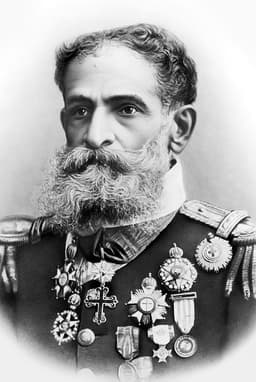
Deodoro da Fonseca
General · Modern
48.8Total
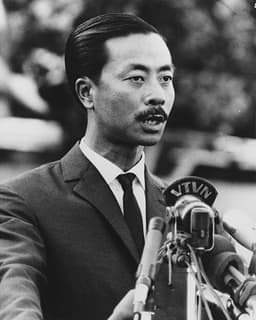
Nguyen Cao Ky
General · Modern
49.0Total
Basic Information
Born
1827
1930
Died
1892
—
Era
Modern
Modern
Nationality
Brazil
Vietnam
Occupation
General
General
Civilization
Western
Eastern
Score Comparison
Military (10%)
50.0
45.0
Political (20%)
45.1
39.4
Influence (20%)
54.1
50.2
Legacy (20%)
44.2
40.0
Leadership (15%)
57.6
67.0
Strategy (15%)
38.6
60.0
TOTAL
48.8
49.0
Deodoro da Fonseca — Complete Timeline
1889 AD
Proclamation of the Brazilian RepublicPolitical Action
Deodoro da Fonseca led a military coup that overthrew Emperor Pedro II on November 15, 1889. He proclaimed the Republic of the United States of Brazil, ending 67 years of imperial rule.
CoupRepublic
Impact: globalprogressive
1891 AD
Election as First President of BrazilPolitical Action◆ Major
Deodoro da Fonseca was elected the first President of Brazil by the Constituent Congress on February 25, 1891. He took office under the new republican constitution, but his rule was brief and authoritarian.
ElectionPresidency
Impact: national
Dissolution of the National CongressPolitical Action◆ Major
Facing political opposition, Deodoro da Fonseca dissolved the National Congress on November 3, 1891, and declared a state of siege. This authoritarian act triggered a naval revolt and his eventual resignation.
AuthoritarianismPolitical Crisis
Impact: nationaldestructive
Resignation from the PresidencyPolitical Action◆ Major
Deodoro da Fonseca resigned the presidency on November 23, 1891, after a naval rebellion threatened his government. He handed power to Vice President Floriano Peixoto, ending his 9-month rule.
ResignationPolitical Crisis
Impact: nationaltragic
Nguyen Cao Ky — Complete Timeline
1963 AD
Commander of South Vietnamese Air ForcePolitical Action◆ Major
Nguyen Cao Ky was appointed commander of the Republic of Vietnam Air Force. He led the air force during the Buddhist crisis and participated in the coup that overthrew President Ngo Dinh Diem.
Air ForceCoupDiem
Impact: national
1965 AD
Appointed Prime MinisterPolitical Action◆ Major
Nguyen Cao Ky became Prime Minister of South Vietnam, leading a military junta. His government intensified the war against the Viet Cong and North Vietnam, with strong US support.
Prime MinisterMilitary juntaVietnam War
Impact: national
1967 AD
Conflict with President ThieuPolitical Action
Nguyen Cao Ky ran for president but lost to Nguyen Van Thieu, becoming vice president. The two leaders had a tense relationship, with Ky later accusing Thieu of corruption and mismanagement of the war.
ElectionThieuRivalry
Impact: nationaldestructive
1975 AD
Exile after fall of SaigonPolitical Action◆ Major
Nguyen Cao Ky fled South Vietnam as Saigon fell to North Vietnamese forces. He settled in the United States, where he became a critic of the communist government and later returned to Vietnam for visits.
ExileFall of SaigonVietnam War
Impact: nationaltragic
Expert Analysis
Deodoro da Fonseca vs Nguyen Cao Ky
# The General Who Could Not Govern
On a humid November morning in 1891, a weary old man in Rio de Janeiro signed his resignation as Brazil’s first president, ending a republic that had lasted barely two years. Half a world away, a decade later, a young Vietnamese airman was learning to fly, unaware that he would one day lead a nation into its own tragic twilight. Deodoro da Fonseca and Nguyen Cao Ky shared a common fate: both were generals who seized power in times of chaos, both believed military discipline could cure political disease, and both saw their dreams collapse under the weight of their own contradictions. Yet their stories diverged in ways that reveal how history shapes—and shatters—those who try to command it.
Origins
Deodoro da Fonseca was born in 1827 into a traditional military family in Alagoas, a poor northeastern province of the Brazilian Empire. His father was a soldier, his uncles were soldiers, and he entered the army at fourteen. The Brazil of his youth was a monarchy, stable but creaking, ruled by the aging Emperor Pedro II. Deodoro absorbed the values of the officer class: honor, order, and a deep suspicion of civilian politicians. He fought in the Paraguayan War, where he earned a reputation for courage and a temper that could flash like gunpowder.
Nguyen Cao Ky was born in 1930 in Hanoi, then part of French Indochina. His father was a minor civil servant, and Ky grew up under colonial rule. He joined the Vietnamese National Army, trained by the French, and later studied aviation in France. Unlike Deodoro, who came of age in a world of empires and monarchies, Ky entered a world of revolutions and cold wars. The Vietnam of his youth was a land torn between communism and nationalism, tradition and modernity. He learned to fly fighter jets, not cavalry charges, and his uniform bore the insignia of a client state, not an independent nation.
Rise to Power
Deodoro’s path to power was slow and reluctant. For decades, he was a loyal officer, rising through ranks, commanding garrisons, and suppressing rebellions. But by the 1880s, the Brazilian Empire was unraveling. Abolition of slavery angered landowners, the Church was alienated by imperial policies, and the army felt humiliated by civilian interference. In November 1889, a conspiracy of republicans and officers persuaded Deodoro—then sixty-two, ill, and hesitant—to lead a coup. He did so almost by accident, ordering troops into the streets, and when Emperor Pedro II refused to resist, the monarchy simply fell. On November 15, 1889, Deodoro proclaimed the Republic of the United States of Brazil.
Nguyen Cao Ky’s rise was faster and more violent. In 1963, at thirty-three, he was appointed commander of the South Vietnamese Air Force, a force built by American aid. He led bombing runs against Viet Cong positions and participated in the coup that overthrew President Ngo Dinh Diem. Two years later, in 1965, with South Vietnam collapsing into factional chaos, Ky was chosen as prime minister by a military junta. He was young, flamboyant, and ruthless—a man who wore a black flying suit and a pearl-handled revolver, who once said, “I have only one enemy—the Communists,” and who dismissed democracy as a luxury his country could not afford.
Leadership & Governance
Deodoro governed as a soldier, not a statesman. As provisional president from 1889 to 1891, he ruled by decree, alienating the very republicans who had brought him to power. He called for elections, but when the Constituent Congress drafted a constitution that limited executive power, he felt betrayed. He was elected president in February 1891, but his government was paralyzed by infighting. In November 1891, facing a hostile Congress, he dissolved it and declared a state of siege. The Brazilian navy, led by Admiral Custódio de Melo, rebelled. After two weeks of standoff, Deodoro resigned, his health broken, his republic in ruins.
Nguyen Cao Ky’s governance was no less authoritarian, but it was shaped by war. As prime minister from 1965 to 1967, he intensified the American bombing campaign, sent troops into battle, and suppressed Buddhist protests with violence. He ran for president in 1967 but lost to General Nguyen Van Thieu, his rival, and became vice president—a position he held for four years in a tense, dysfunctional partnership. Unlike Deodoro, Ky did not dissolve a congress; he simply governed without one, relying on military force and American support. But his power was always borrowed, never rooted.
Triumph & Tragedy
Deodoro’s greatest moment was the proclamation of the republic—a bloodless coup that ended sixty-seven years of monarchy. His greatest tragedy was his failure to build a stable government. He died less than a year after resigning, in 1892, a disgraced figure who had given Brazil a republic but not the peace it deserved.
Ky’s triumph was survival. He led South Vietnam through some of the war’s darkest years, holding together a fractious regime. His tragedy came in 1975, when Saigon fell and he fled into exile, leaving behind a country that ceased to exist. He settled in California, where he ran a liquor store and wrote memoirs, a ghost of a lost war.
Character & Destiny
Deodoro was a man of honor and impulse. He was brave but stubborn, generous but quick to anger. He believed in order but could not create it. His destiny was to be a bridge between eras—a monarchist who became a republican, a soldier who could not govern.
Ky was a man of style and survival. He was vain, audacious, and adaptable. He believed in victory but could not achieve it. His destiny was to be a symbol of a lost cause—a pilot who flew into history and crashed into oblivion.
Legacy
Deodoro da Fonseca is remembered as the founder of the Brazilian Republic, but his name is often overshadowed by later presidents. His portrait hangs in official buildings, but his legacy is ambiguous: he gave Brazil democracy, but he also gave it the habit of military intervention.
Nguyen Cao Ky is remembered, if at all, as a footnote to the Vietnam War. His scores—military 61.8, political 60.2, legacy 56.0—reflect a life of ambition without achievement. He was a general who fought a war he could not win, a leader who governed a country that was never fully his.
Conclusion
What drove these two men to different outcomes? Deodoro was a product of the nineteenth century, when a coup could topple an empire and a general could become a president. Ky was a product of the twentieth century, when a coup could start a war and a general could become a refugee. Deodoro failed because he could not adapt to democracy; Ky failed because he could not escape the war. Both were men of action in an age of upheaval, and both learned that the hardest thing to command is not an army, but a nation. In the end, they left behind not a legacy of peace, but a lesson: that power, when seized by the sword, is often lost by the same blade.
Rankings
🥇
Nguyen Cao KyLeader
Mil: 45.0Pol: 39.4Inf: 50.2
49.0
🥈
Deodoro da Fonseca
Mil: 50.0Pol: 45.1Inf: 54.1
48.8
+0.2 behind
How This Comparison Works
Algorithm
Each figure is scored on 6 dimensions (0—100 scale) based on structured historical data: Military (10%), Political (20%), Influence (20%), Legacy (20%), Leadership (15%), Strategy (15%). The weighted total produces the final ranking.
Data Sources
Scores are computed from structured sub-indicators in the database. Scale factors adjust for era (Ancient ×0.85, Modern ×1.0) and civilization size (Eastern ×1.05, Other ×0.80) to account for differences in population and military scale.
Maximum 3 Figures
Comparisons are limited to 2—3 figures to ensure readability and statistical meaningfulness.
Error Margins
±5 points per dimension — Sub-scores are derived from historical records with inherent uncertainty. Two figures within 5 points on a dimension should be considered roughly equivalent in that area.
Total Score Accuracy
±3 points overall — The weighted combination of 6 dimensions produces a total score with approximately ±3 points of uncertainty. Differences of less than 3 points are not statistically significant— the figures are effectively tied.
Known Limitations
- Historical records are incomplete and uneven across civilizations
- Figures from oral-tradition societies may be underrepresented
- Occupation labels can misclassify multi-role figures
- Scores measure capability and impact, not moral character
- Quantitative scoring is a comparison tool, not absolute truth
Capability Radar
Military (10%) — Battles & Warfare
Battles
20
30
Win Rate
25
35
Expansion
10
10
Political (20%) — Governance & Reform
Reform
40
20
Diplomacy
25
25
Economy
15
15
Influence (20%) — Cultural & Global Reach
Cultural
20
15
Global
15
15
Legacy (20%) — Historical Impact
Historical
35
20
Longevity
20
10
Leadership (15%) — Power & Stability
Tenure
30
40
Stability
10
10
Strategy (15%) — Tactics & Innovation
Strategy
25
30
Tactics
20
40
Reform
15
25
Similar Comparisons
Comments & Discussion
GAUCHO'S GHOST6/16/2026
Deodoro embodied the Latin American caudillo tradition: a military strongman who mistook battlefield command for governance. He dissolved Congress in 1891 like a frustrated colonel dismissing insubordinate troops. But Brazil wasn't a battalion, and his coup lasted only nine months before naval revolt forced him out. Ky at least understood counterinsurgency, flying combat missions himself. Deodoro just sat in the palace, sulking, while the navy bombarded Rio. A general who can't adapt to politics
DIM SUM DICTATOR6/16/2026
阮高祺这个人最讽刺的是,他一边坐着美国人的飞机轰炸同胞,一边又自称民族主义者。他当总理的时候,南越的腐败烂到骨子里了,他却在公开场合夸耀自己紫色的飞行员围巾和左轮手枪,简直是个戏子。更可笑的是,1975年西贡陷落前,他第一个跳上美国直升机逃命。德奥多罗至少还有点军人骨气,辞职后老老实实待在里约热内卢直到老死。阮高祺就是个穿着戏服的投机分子。
CENTURION'S SCRIBE6/16/2026
The real tragedy here isn't their failures but their self-deception. Deodoro genuinely believed Brazil needed a "savior" after overthrowing the monarchy—yet he had no political program beyond order. Ky thought he could defeat the Viet Cong through sheer will and American firepower, ignoring that peasant loyalty mattered more than air raids. Both men were prisoners of their own military training: they saw every problem as an enemy to be crushed, not a compromise to be negotiated. History rewards
历史围观者6/16/2026
有意思的是,这两人都当过"副总统转正":德奥多罗1891年当选总统时,对手正是他的副总统佩绍托,结果他搞独裁被逼下台,副总统反而接任。阮高祺更绝,1965年政变后他当"总理",但真正的实权人物是阮文绍当总统,两人互相猜忌。这证明了一个真理:独裁者连自己的副手都搞不定,还谈什么治国?军事独裁从来就是一场失败的内斗游戏。
BRASS HAT RECRUITER6/16/2026
Both men prove my favorite maxim: never trust a general who wears a costume. Deodoro's elaborate imperial uniforms after the republic was declared. Ky's lavender scarf and pearl-handled revolver. These aren't serious leaders—they're playing dress-up. Meanwhile, real statesmen like Goulart or Thieu (flawed as they were) at least understood civilian politics. Put a general in a suit, and he still thinks like a soldier. Put him in a costume, and he thinks he's history's protagonist. Spoiler: he's n