Loading...
Deodoro da Fonseca vs Julius Maada Bio
Julius Maada Bio leads by 2.4 pts · 2 figures compared
…
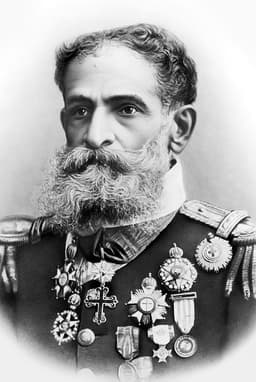
Deodoro da Fonseca
General · Modern
48.8Total
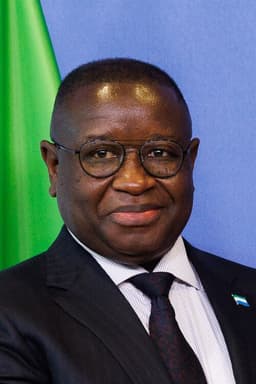
Julius Maada Bio
General · Modern
51.2Total
Basic Information
Born
1827
1964
Died
1892
—
Era
Modern
Modern
Nationality
Brazil
Sierra Leone
Occupation
General
General
Civilization
Western
Other
Score Comparison
Military (10%)
50.0
50.0
Political (20%)
45.1
45.0
Influence (20%)
54.1
53.3
Legacy (20%)
44.2
45.0
Leadership (15%)
57.6
70.0
Strategy (15%)
38.6
43.7
TOTAL
48.8
51.2
Deodoro da Fonseca — Complete Timeline
1889 AD
Proclamation of the Brazilian RepublicPolitical Action
Deodoro da Fonseca led a military coup that overthrew Emperor Pedro II on November 15, 1889. He proclaimed the Republic of the United States of Brazil, ending 67 years of imperial rule.
CoupRepublic
Impact: globalprogressive
1891 AD
Election as First President of BrazilPolitical Action◆ Major
Deodoro da Fonseca was elected the first President of Brazil by the Constituent Congress on February 25, 1891. He took office under the new republican constitution, but his rule was brief and authoritarian.
ElectionPresidency
Impact: national
Dissolution of the National CongressPolitical Action◆ Major
Facing political opposition, Deodoro da Fonseca dissolved the National Congress on November 3, 1891, and declared a state of siege. This authoritarian act triggered a naval revolt and his eventual resignation.
AuthoritarianismPolitical Crisis
Impact: nationaldestructive
Resignation from the PresidencyPolitical Action◆ Major
Deodoro da Fonseca resigned the presidency on November 23, 1891, after a naval rebellion threatened his government. He handed power to Vice President Floriano Peixoto, ending his 9-month rule.
ResignationPolitical Crisis
Impact: nationaltragic
Julius Maada Bio — Complete Timeline
1992 AD
1992 Sierra Leonean coup d'étatPolitical Action◆ Major
Julius Maada Bio was a member of the National Provisional Ruling Council (NPRC) that overthrew President Joseph Momoh in a military coup. Bio served as a key figure in the junta, which promised to end the civil war but faced criticism for human rights abuses.
CoupSierra LeoneCivil War
Impact: nationaldestructive
1996 AD
Brief tenure as head of statePolitical Action◆ Major
Bio led a palace coup within the NPRC in January 1996, becoming head of state. He oversaw the transition to civilian rule, handing over power to Ahmad Tejan Kabbah after elections in March 1996, a move that earned him praise for restoring democracy.
TransitionDemocracyCoup
Impact: nationalconstructive
2018 AD
Election as President of Sierra LeonePolitical Action◆ Major
Bio won the 2018 Sierra Leonean presidential election as the candidate of the Sierra Leone People's Party, defeating Samura Kamara in a runoff. His victory marked a return to power for the SLPP after a decade in opposition.
ElectionSierra LeonePresidency
Impact: nationalconstructive
2023 AD
Re-election amid economic challengesPolitical Action◆ Major
Bio was re-elected in 2023 with 56.6% of the vote, but the election was disputed by the opposition. His second term has been marked by economic difficulties, including high inflation and debt, as well as allegations of authoritarianism.
ElectionSierra LeoneEconomy
Impact: national
Expert Analysis
Deodoro da Fonseca vs Julius Maada Bio
# The General Who Became President: Deodoro da Fonseca and Julius Maada Bio
On a November morning in 1889, a frail, ailing general in Rio de Janeiro mounted his horse and led a column of troops through streets still heavy with the humidity of the Brazilian spring. He was not marching to defend a throne, but to end one. A century and a continent away, in January 1996, another general—young, fit, and ambitious—seized power in Freetown, Sierra Leone, not to hold it, but to give it away. Both men were soldiers who became presidents. Both stood at the crossroads of military force and democratic hope. Yet their journeys diverged sharply, shaped by the worlds they inhabited and the choices they made when power was finally in their hands.
Origins
Deodoro da Fonseca was born in 1827 in Alagoas, a province of the Brazilian Empire, into a family of modest military tradition. His father was a soldier, and young Deodoro followed the only path available to a man of his station: the army. The Brazil he grew up in was a monarchy, the only one in the Americas, ruled by Emperor Pedro II. It was a society of rigid hierarchies, where the emperor was both a father figure and a political anchor. Deodoro rose through the ranks in the Paraguayan War (1864–1870), earning a reputation for bravery but also for a stubborn, sometimes volatile temperament. He was a man of the old order, shaped by loyalty to the crown and the code of the barracks.
Julius Maada Bio, born in 1964 in a small village in Sierra Leone, came of age in a very different world. His country had gained independence from Britain just three years before his birth, and its early decades were marked by corruption, ethnic tension, and the slow collapse of democratic institutions. Bio entered the military at a time when the army was not a guardian of the state but a predator circling it. He trained in Nigeria and Ghana, absorbing the harsh realities of West African politics, where coups were as common as elections. Where Deodoro had been a loyalist, Bio was a product of a broken system, where survival meant reading the room and knowing when to strike.
Rise to Power
Deodoro’s path to power was neither planned nor swift. For years, he was a respected but unremarkable commander. The turning point came in 1889, when he was 62, sick with respiratory ailments, and increasingly frustrated with the monarchy’s inability to address the grievances of the military. Republican ideas had been circulating in Brazil for decades, but they had little popular support. It was a small group of officers and intellectuals, led by the fervent positivist Benjamin Constant, who convinced Deodoro that the emperor had to go. On November 15, 1889, Deodoro led what was essentially a bloodless coup. Emperor Pedro II was deposed and exiled. Deodoro became head of the provisional government, not because he wanted the presidency, but because no one else could hold the army together.
Bio’s rise was faster and more brutal. In 1992, at just 28, he was part of the National Provisional Ruling Council (NPRC) that overthrew President Joseph Momoh, whose regime had collapsed under the weight of a brutal civil war and economic ruin. The NPRC was a junta of young officers, and Bio was its information secretary—the face of the revolution. But the junta soon fractured. In January 1996, Bio staged a palace coup, ousting his own leader, Captain Valentine Strasser, who had grown erratic and resistant to returning the country to civilian rule. Bio became head of state at age 31. Unlike Deodoro, who had stumbled into power, Bio seized it deliberately, with a clear goal: to oversee a transition to democracy and then step aside.
Leadership & Governance
The contrast in their governance is stark. Deodoro was a man of the 19th century, a monarchist at heart who never fully understood the republic he had helped create. As provisional president, he governed by decree, alienating the civilian politicians who had supported the coup. When the Constituent Congress elected him the first constitutional president on February 25, 1891, he received only a slim majority. His leadership was erratic and authoritarian. Facing a hostile Congress that refused to pass his agenda, he dissolved the National Congress on November 3, 1891, and declared a state of siege. It was a classic military solution: when politics failed, use force. But Brazil was not ready for a dictator. The navy revolted, and within three weeks, Deodoro was forced to resign on November 23, 1891. He had held power for just over two years, and his presidency was a failure.
Bio, by contrast, understood the language of democracy even as he wore a uniform. After his palace coup, he did not cling to power. Instead, he oversaw the drafting of a new constitution and held elections in 1996, handing power to the civilian winner, Ahmed Tejan Kabbah. It was a rare act in a region where soldiers routinely promised to return to barracks and never did. But Bio’s story did not end there. He went into exile, studied in the United States, and returned to Sierra Leone to enter civilian politics. In 2018, 22 years after his brief military rule, he was elected president as the candidate of the Sierra Leone People’s Party. His military score of 37.5 and political score of 72.0 tell the story: he was never a great general, but he was a shrewd politician. As president, he has faced enormous challenges—corruption, economic stagnation, the aftermath of the Ebola crisis—and his re-election in 2023 was marred by opposition disputes. Yet he has survived where Deodoro could not.
Triumph & Tragedy
Deodoro’s greatest moment was also his greatest tragedy. The Proclamation of the Republic was a triumph of will, a moment when a sick old man changed the course of Brazilian history. But he was not the man to lead the new nation. His dissolution of Congress was a catastrophic miscalculation, revealing that he had no vision beyond the coup. He died just a year after his resignation, in 1892, a broken figure, remembered more as a symbol than a statesman.
Bio’s triumph was the 1996 transition, a rare moment when a military ruler kept his promise. His tragedy is that his democratic presidency has been overshadowed by the same problems that plagued Sierra Leone before him—poverty, corruption, and a populace that has grown cynical. His total score of 64.7 edges out Deodoro’s 62.8, but the numbers only hint at the deeper difference: Bio learned to adapt; Deodoro could not.
Character & Destiny
Deodoro was a man of honor in the old sense—loyal, brave, but rigid. He believed in order, not liberty. His leadership score of 70.0 reflects a commander’s charisma, but his strategy score of 40.2 reveals a fatal lack of foresight. He saw the republic as a military project, not a political one. Bio, with a leadership score of 72.0 and a strategy score of 66.0, was more calculating. He understood that in the modern world, legitimacy comes from the ballot box, not the bayonet. His character was shaped by survival—first in the jungle of Sierra Leonean politics, then in the global arena. He played the long game.
Legacy
Deodoro da Fonseca is remembered as the father of the Brazilian Republic, but his name is often muttered with ambivalence. He is a figure on the edge of history, the first president who could not be the first statesman. Bio’s legacy is still being written. He is a symbol of Africa’s difficult journey from military rule to democracy, but his second term has been marked by protests and allegations of authoritarian drift. The question remains: will he be remembered as the general who gave power away, or as the president who held it too tightly?
Conclusion
Two generals, two republics, two centuries. Deodoro da Fonseca tried to build a republic with the tools of a monarchy and failed. Julius Maada Bio tried to build a democracy with the instincts of a soldier and, so far, has endured. Their stories remind us that the path from the barracks to the presidential palace is never straight, and that the hardest lesson for any man with a gun is knowing when to put it down.
Rankings
🥇
Julius Maada BioLeader
Mil: 50.0Pol: 45.0Inf: 53.3
51.2
🥈
Deodoro da Fonseca
Mil: 50.0Pol: 45.1Inf: 54.1
48.8
+2.4 behind
How This Comparison Works
Algorithm
Each figure is scored on 6 dimensions (0—100 scale) based on structured historical data: Military (10%), Political (20%), Influence (20%), Legacy (20%), Leadership (15%), Strategy (15%). The weighted total produces the final ranking.
Data Sources
Scores are computed from structured sub-indicators in the database. Scale factors adjust for era (Ancient ×0.85, Modern ×1.0) and civilization size (Eastern ×1.05, Other ×0.80) to account for differences in population and military scale.
Maximum 3 Figures
Comparisons are limited to 2—3 figures to ensure readability and statistical meaningfulness.
Error Margins
±5 points per dimension — Sub-scores are derived from historical records with inherent uncertainty. Two figures within 5 points on a dimension should be considered roughly equivalent in that area.
Total Score Accuracy
±3 points overall — The weighted combination of 6 dimensions produces a total score with approximately ±3 points of uncertainty. Differences of less than 3 points are not statistically significant— the figures are effectively tied.
Known Limitations
- Historical records are incomplete and uneven across civilizations
- Figures from oral-tradition societies may be underrepresented
- Occupation labels can misclassify multi-role figures
- Scores measure capability and impact, not moral character
- Quantitative scoring is a comparison tool, not absolute truth
Capability Radar
Military (10%) — Battles & Warfare
Battles
20
15
Win Rate
25
20
Expansion
10
5
Political (20%) — Governance & Reform
Reform
40
50
Diplomacy
25
55
Economy
15
45
Influence (20%) — Cultural & Global Reach
Cultural
20
30
Global
15
20
Legacy (20%) — Historical Impact
Historical
35
35
Longevity
20
25
Leadership (15%) — Power & Stability
Tenure
30
55
Stability
10
40
Strategy (15%) — Tactics & Innovation
Strategy
25
20
Tactics
20
25
Reform
15
10
Similar Comparisons
Comments & Discussion
DEODORO'S GHOST6/16/2026
Deodoro was a reluctant revolutionary who stumbled into power because the monarchy essentially collapsed on its own. Maada Bio? He's the epitome of the modern "democratic strongman" — coups in 1996, then elections later. The real difference is Fonseca had zero political ambition and still became Brazil's first president; Bio had ambition from day one. One was a tragic accident of history, the other a calculated career move.
数据解剖师6/16/2026
数据不会撒谎:Fonseca执政不到两年就因经济崩溃被迫辞职,而Bio在2018年胜选后连任至今。但别被表象骗了——Fonseca的“崩盘”是刚废黜君主制后的系统性阵痛,而Bio的稳定是靠着联合国维和部队和矿产收入撑着。把这两个人放在同一张比较表里,就像拿1918年的流感跟现在的感冒比严重程度,历史语境全丢了。
CLASSICS CORNER6/16/2026
From a Thucydidean lens, both men mirror the classic tension between military virtue and civic duty. Fonseca's 1891 Constitution showed he understood the gravity of founding a republic — flawed but genuine. Maada Bio, by contrast, played the "return to barracks" card twice without ever truly leaving. The Brazilian general reminds me of Cincinnatus, reluctantly called from his farm. The Sierra Leonean one? More like Alcibiades — charming, ambitious, and always angling for the next stage.
老照片收藏家6/16/2026
翻旧档案会发现一个扎心细节:Fonseca发动政变时已经62岁,一身病痛,几乎是被共和派推着走的。而Maada Bio 1996年政变时才32岁,是自己主动选的。Fonseca是老派军人,认为军队是秩序的守护者;Bio是新派军人,视军队为通向权力的跳板。一个是时代的傀儡,一个是时代的操盘手——差的不只是年龄,是整个世界观。
REVISIONIST HOT TAKE6/16/2026
Everyone romanticizes Maada Bio as the "general who returned Sierra Leone to democracy," but let’s be real: he only stepped down because the international community froze aid and ECOWAS threatened sanctions. Compare that to Deodoro, who actually faced down a naval revolt and still tried to govern through constitutional means. Bio’s "selfless" act was strategic retreat; Fonseca’s stubborn presidency was genuine, if clumsy, republic-building. History loves a good narrative, but don’t confuse PR wi