Loading...
Deodoro da Fonseca vs Giuseppe Garibaldi
Giuseppe Garibaldi leads by 6.2 pts · 2 figures compared
…
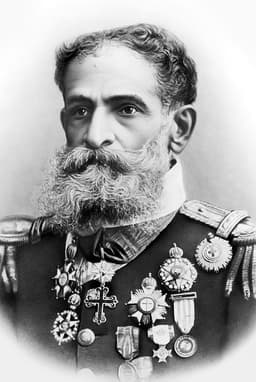
Deodoro da Fonseca
General · Modern
48.8Total
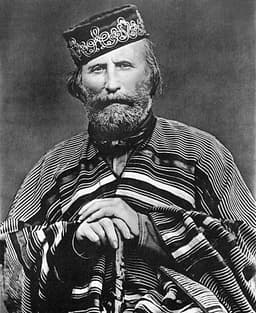
Giuseppe Garibaldi
General · Modern
55.0Total
Basic Information
Born
1827
1807
Died
1892
1882
Era
Modern
Modern
Nationality
Brazil
Italy
Occupation
General
General
Civilization
Western
Western
Score Comparison
Military (10%)
50.0
61.7
Political (20%)
45.1
54.7
Influence (20%)
54.1
40.0
Legacy (20%)
44.2
68.0
Leadership (15%)
57.6
54.2
Strategy (15%)
38.6
55.0
TOTAL
48.8
55.0
Deodoro da Fonseca — Complete Timeline
1889 AD
Proclamation of the Brazilian RepublicPolitical Action
Deodoro da Fonseca led a military coup that overthrew Emperor Pedro II on November 15, 1889. He proclaimed the Republic of the United States of Brazil, ending 67 years of imperial rule.
CoupRepublic
Impact: globalprogressive
1891 AD
Election as First President of BrazilPolitical Action◆ Major
Deodoro da Fonseca was elected the first President of Brazil by the Constituent Congress on February 25, 1891. He took office under the new republican constitution, but his rule was brief and authoritarian.
ElectionPresidency
Impact: national
Dissolution of the National CongressPolitical Action◆ Major
Facing political opposition, Deodoro da Fonseca dissolved the National Congress on November 3, 1891, and declared a state of siege. This authoritarian act triggered a naval revolt and his eventual resignation.
AuthoritarianismPolitical Crisis
Impact: nationaldestructive
Resignation from the PresidencyPolitical Action◆ Major
Deodoro da Fonseca resigned the presidency on November 23, 1891, after a naval rebellion threatened his government. He handed power to Vice President Floriano Peixoto, ending his 9-month rule.
ResignationPolitical Crisis
Impact: nationaltragic
Giuseppe Garibaldi — Complete Timeline
1849 AD
Defense of the Roman RepublicWar◆ Major
Garibaldi commanded the defense of the short-lived Roman Republic against French forces sent to restore papal rule. Despite heroic resistance, the republic fell, and Garibaldi led a retreat through central Italy.
Italian UnificationRoman RepublicDefense
Impact: regionaltragic
1860 AD
Expedition of the ThousandWar
Garibaldi led a volunteer force of about 1,000 men to conquer Sicily and Naples. His campaign overthrew the Bourbon monarchy and unified southern Italy with the Kingdom of Sardinia.
Italian UnificationExpeditionVolunteers
Impact: nationalconstructive
Battle of CalatafimiWar◆ Major
Garibaldi's Redshirts defeated a larger Bourbon army at Calatafimi in Sicily. The victory boosted morale and demonstrated the effectiveness of his volunteers, opening the way to Palermo.
Italian UnificationBattleSicily
Impact: regional
Battle of VolturnusWar◆ Major
Garibaldi's forces defeated the Neapolitan army at the Volturno River. The victory secured his conquest of Naples and forced King Francis II into exile, completing the unification of southern Italy.
Italian UnificationBattleNaples
Impact: regional
Cession of Sicily and Naples to Victor Emmanuel IIPolitical Action
After conquering southern Italy, Garibaldi voluntarily handed over his conquests to King Victor Emmanuel II of Sardinia. This act unified Italy under the monarchy and avoided civil war.
Italian UnificationCessionMonarchy
Impact: nationalconstructive
Expert Analysis
Deodoro da Fonseca vs Giuseppe Garibaldi
### The General Who Gave Away a Kingdom, and the General Who Could Not Keep One
On a dusty road in Sicily, a man with a flowing red shirt and a wild mane of hair accepted the surrender of a kingdom he had just conquered, only to hand it over to a distant king he had never met. Two thousand miles away, in the ornate halls of Rio de Janeiro, a man in a starched uniform stood before a stunned emperor, declared a republic, and then, within two years, watched it crumble around him. Both were generals. Both were revolutionaries. But their paths diverged so sharply that they seem to belong to different centuries, not the same modern era. Giuseppe Garibaldi and Deodoro da Fonseca both rode the wave of nationalism that swept the nineteenth century, yet one became a global symbol of liberation, while the other became a footnote in his own country’s history. Why did the Italian succeed where the Brazilian stumbled? The answer lies not in their courage, but in their character.
**Origins**
Giuseppe Garibaldi was born in 1807 in Nice, a port city then part of the French Empire. His father was a fisherman, his mother a woman of deep piety. From an early age, Garibaldi was drawn to the sea and to stories of adventure. He read about the Roman Republic and dreamed of a unified Italy, a nation that existed only on maps drawn by poets. His world was one of fragmented states, foreign domination, and simmering rebellion. By contrast, Deodoro da Fonseca, born twenty years later in 1827 in Alagoas, Brazil, grew up in a stable empire. Brazil, under Emperor Pedro II, was a vast, peaceful monarchy—the only one in the Americas. Deodoro’s father was a military officer, and his family was part of the rural elite. There was no foreign oppressor to fight, no dream of unification to inspire. For Garibaldi, rebellion was a calling; for Deodoro, it was a career move.
**Rise to Power**
Garibaldi’s path to power was forged in exile and fire. After a failed uprising in Genoa in 1834, he fled to South America, where he fought as a guerrilla leader in Brazil and Uruguay. He learned to win with small, mobile forces, living off the land and the loyalty of his men. His reputation grew not through political maneuvering but through daring feats—like the defense of the Roman Republic in 1849, where he held off French armies for months before escaping through enemy lines with his pregnant wife. Deodoro’s rise was quieter, more institutional. He served in the Paraguayan War, earned a reputation as a capable officer, and climbed the ranks of the Brazilian Army. By 1889, he was a respected general, but not a revolutionary. His political awakening came late, when he was recruited by republican intellectuals who saw him as a figurehead. Where Garibaldi forged his own legend, Deodoro inherited a plot.
**Leadership & Governance**
Garibaldi’s leadership was that of a prophet in uniform. He inspired devotion, not obedience. His men—the famous Redshirts—followed him because they believed in Italy, not because they feared punishment. At the Battle of Calatafimi in 1860, he charged with a few hundred volunteers against a Bourbon army twice their size, shouting, “Here we make Italy or die!” The victory was a miracle of morale. Yet Garibaldi was a poor politician. He despised bureaucracy, refused to compromise, and often acted on instinct. His greatest political act—the cession of Sicily and Naples to King Victor Emmanuel II—was not a calculation but a gesture of faith. He believed the king would finish the work of unification. Deodoro, by contrast, was a politician in uniform. His military score of 35.9 reflects his mediocrity as a commander; his political score of 77.9 shows where his true talents lay. He led the coup that toppled the emperor with almost no bloodshed, then maneuvered himself into the presidency. But governance requires more than maneuvering. When faced with opposition in Congress, he dissolved it—a move that united his enemies and isolated his allies. He had no Garibaldi charisma, no popular movement to fall back on.
**Triumph & Tragedy**
Garibaldi’s greatest triumph was the Expedition of the Thousand, a campaign so audacious it seems like fiction. With a ragtag army of volunteers, he conquered Sicily and Naples, an area larger than his native Piedmont. His greatest tragedy was that he could not hold what he had won. After handing over his conquests, he retired to a small island farm, a hero without a country to rule. Deodoro’s triumph was the Proclamation of the Republic in 1889, a bloodless coup that ended a sixty-seven-year-old monarchy. His tragedy was the presidency itself. Within two years, economic crisis, political infighting, and a naval rebellion forced him to resign. He died in 1892, a broken man, remembered as the man who could not lead the nation he had founded.
**Character & Destiny**
Garibaldi was a romantic. He believed in the goodness of the people, the inevitability of freedom, and the power of personal example. This made him a great revolutionary but a poor ruler. He did not want power; he wanted justice. Deodoro was a pragmatist. He saw the republic as a solution to a problem—the aging emperor’s succession—not as a sacred cause. He lacked Garibaldi’s fire and, more importantly, his faith. When opposition came, Garibaldi would have fought or fled; Deodoro tried to command, then collapsed. Their scores tell the story: Garibaldi’s leadership at 74.9, Deodoro’s at 70.0—close, but with a chasm of difference. Garibaldi led men who would die for him; Deodoro led men who would replace him.
**Legacy**
Today, Garibaldi is a global icon. Streets, squares, and monuments bear his name across Europe and the Americas. He is the “Hero of Two Worlds,” a symbol of liberation. Deodoro is a footnote. His name appears in Brazilian textbooks, but few outside Brazil remember him. His legacy is the republic he founded, but even that is tarnished by his failure to stabilize it. Garibaldi’s legacy score of 75.0 versus Deodoro’s 60.6 reflects this disparity. One man gave away a kingdom and became immortal; the other seized a republic and could not keep it.
**Conclusion**
In the end, the difference between Garibaldi and Deodoro is not one of skill but of soul. Garibaldi fought for an idea so powerful that it outlived his mistakes. Deodoro fought for an office so fragile that it crumbled in his hands. The general who gives away a kingdom is remembered as a saint; the general who cannot hold a presidency is forgotten as a failure. History, it seems, rewards not the men who seize power, but the men who surrender it for a cause greater than themselves.
Rankings
🥇
Giuseppe GaribaldiLeader
Mil: 61.7Pol: 54.7Inf: 40.0
55.0
🥈
Deodoro da Fonseca
Mil: 50.0Pol: 45.1Inf: 54.1
48.8
+6.2 behind
How This Comparison Works
Algorithm
Each figure is scored on 6 dimensions (0—100 scale) based on structured historical data: Military (10%), Political (20%), Influence (20%), Legacy (20%), Leadership (15%), Strategy (15%). The weighted total produces the final ranking.
Data Sources
Scores are computed from structured sub-indicators in the database. Scale factors adjust for era (Ancient ×0.85, Modern ×1.0) and civilization size (Eastern ×1.05, Other ×0.80) to account for differences in population and military scale.
Maximum 3 Figures
Comparisons are limited to 2—3 figures to ensure readability and statistical meaningfulness.
Error Margins
±5 points per dimension — Sub-scores are derived from historical records with inherent uncertainty. Two figures within 5 points on a dimension should be considered roughly equivalent in that area.
Total Score Accuracy
±3 points overall — The weighted combination of 6 dimensions produces a total score with approximately ±3 points of uncertainty. Differences of less than 3 points are not statistically significant— the figures are effectively tied.
Known Limitations
- Historical records are incomplete and uneven across civilizations
- Figures from oral-tradition societies may be underrepresented
- Occupation labels can misclassify multi-role figures
- Scores measure capability and impact, not moral character
- Quantitative scoring is a comparison tool, not absolute truth
Capability Radar
Military (10%) — Battles & Warfare
Battles
20
65
Win Rate
25
70
Expansion
10
60
Political (20%) — Governance & Reform
Reform
40
40
Diplomacy
25
50
Economy
15
20
Influence (20%) — Cultural & Global Reach
Cultural
20
70
Global
15
65
Legacy (20%) — Historical Impact
Historical
35
75
Longevity
20
65
Leadership (15%) — Power & Stability
Tenure
30
30
Stability
10
25
Strategy (15%) — Tactics & Innovation
Strategy
25
60
Tactics
20
75
Reform
15
55
Similar Comparisons
Comments & Discussion
RedShirtSage6/16/2026
Garibaldi actually gave away power when he could have taken it all—how many men in history do that? Fonseca, however, lacked that revolutionary grace; he overthrew an emperor but couldn't even hold onto the fragile republic he built. Garibaldi's Sicily campaign in 1860 shows his true genius: handing over a kingdom proves he was bigger than ambition. Fonseca, by contrast, watched his own coup collapse in two years. That’s not just failure—it’s a character flaw.
数据解剖师6/16/2026
说Fonseca是失败者?那得先看看他当时的政变成本。1889年他推翻佩德罗二世时,几乎没流一滴血,巴西帝国瞬间瓦解,这效率Garibaldi在意大利打了二十年游击都比不上。你夸Garibaldi让出王位很伟大,但别忘了,那更多是政治投机的结果——他把西西里交给萨伏依王朝,是因为知道自己镇不住场面。Fonseca至少真刀真枪建立了一个共和国。数据说话:Garibaldi的胜利靠运气和异国赞助,Fonseca的失败则源于真实本土政治博弈。别光吹浪漫英雄主义!