Loading...
Deodoro da Fonseca vs Francisco Morazan
Francisco Morazan leads by 9.2 pts · 2 figures compared
…
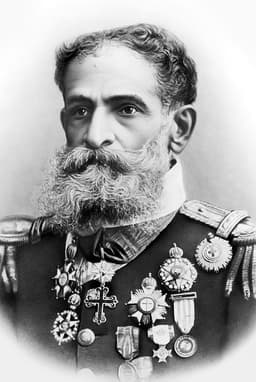
Deodoro da Fonseca
General · Modern
48.8Total
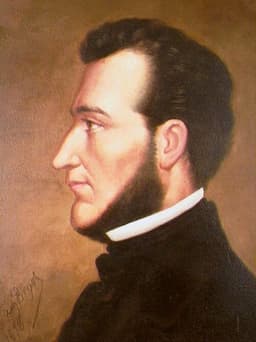
Francisco Morazan
General · Modern
58.0Total
Basic Information
Born
1827
1792
Died
1892
1842
Era
Modern
Modern
Nationality
Brazil
Honduras
Occupation
General
General
Civilization
Western
Western
Score Comparison
Military (10%)
50.0
52.5
Political (20%)
45.1
60.0
Influence (20%)
54.1
62.0
Legacy (20%)
44.2
50.0
Leadership (15%)
57.6
68.0
Strategy (15%)
38.6
55.0
TOTAL
48.8
58.0
Deodoro da Fonseca — Complete Timeline
1889 AD
Proclamation of the Brazilian RepublicPolitical Action
Deodoro da Fonseca led a military coup that overthrew Emperor Pedro II on November 15, 1889. He proclaimed the Republic of the United States of Brazil, ending 67 years of imperial rule.
CoupRepublic
Impact: globalprogressive
1891 AD
Election as First President of BrazilPolitical Action◆ Major
Deodoro da Fonseca was elected the first President of Brazil by the Constituent Congress on February 25, 1891. He took office under the new republican constitution, but his rule was brief and authoritarian.
ElectionPresidency
Impact: national
Dissolution of the National CongressPolitical Action◆ Major
Facing political opposition, Deodoro da Fonseca dissolved the National Congress on November 3, 1891, and declared a state of siege. This authoritarian act triggered a naval revolt and his eventual resignation.
AuthoritarianismPolitical Crisis
Impact: nationaldestructive
Resignation from the PresidencyPolitical Action◆ Major
Deodoro da Fonseca resigned the presidency on November 23, 1891, after a naval rebellion threatened his government. He handed power to Vice President Floriano Peixoto, ending his 9-month rule.
ResignationPolitical Crisis
Impact: nationaltragic
Francisco Morazan — Complete Timeline
1824 AD
Abolition of slavery in Central AmericaReform◆ Major
As a key leader in the liberal movement, Moraz
AbolitionSlaveryLiberal Reform
Impact: regionalprogressive
1827 AD
Battle of La TrinidadWar◆ Major
Morazán led a liberal army to victory against conservative forces at La Trinidad, Honduras. This battle was a key turning point in the Central American civil war, allowing Morazán to consolidate power and eventually become president of the federation.
BattleLiberal VictoryCivil War
Impact: regional
1830 AD
Presidency of the Federal Republic of Central AmericaPolitical Action
Morazán was elected president of the Federal Republic of Central America, a union of Guatemala, El Salvador, Honduras, Nicaragua, and Costa Rica. He pursued liberal reforms including separation of church and state, free trade, and land reform, facing opposition from conservatives.
Federal RepublicLiberal ReformsCentral America
Impact: regionalconstructive
1842 AD
Execution by firing squadPolitical Action
After a failed attempt to restore the Federal Republic, Moraz
ExecutionEnd of FederationLiberal Defeat
Impact: regionaltragic
Expert Analysis
Francisco Morazan vs Deodoro da Fonseca
The Dreamer and the Drifter
In November 1891, a weary old general in Rio de Janeiro signed his resignation and stepped away from the presidency he had held for barely nine months. Deodoro da Fonseca, the man who had toppled an empire with a single proclamation, could not hold a republic together. Half a century earlier, on a June morning in 1830, another general—Francisco Morazán—had taken the oath of office as president of the Federal Republic of Central America, a union he believed would endure for centuries. Both men were soldiers who became founders. Both failed. But their failures were not the same. One died before a firing squad, still dreaming of union. The other died in his bed, having watched his creation crumble in his hands. The difference lay not in their ambition, but in the soil in which they planted their dreams.
Origins
Francisco Morazán was born in 1792 in Tegucigalpa, Honduras, into a world of colonial decay and revolutionary ferment. The Spanish Empire was cracking, and the air of Central America was thick with the scent of coffee, gunpowder, and new ideas. His family was of Creole descent—respectable but not wealthy—and young Francisco soaked up the Enlightenment texts smuggled from Europe. He learned law, philosophy, and the art of war from books and from the streets. He was a child of the liberal age, convinced that reason, freedom, and federalism could remake a continent.
Deodoro da Fonseca, born in 1827 in Alagoas, Brazil, came from a different world entirely. Brazil was an empire, not a collection of fractious provinces. His family was military aristocracy—his father a marshal, his uncles generals. Young Deodoro entered the military academy at fifteen, where he learned obedience, hierarchy, and the art of artillery. He fought in the Paraguayan War, that brutal slaughterhouse that forged a generation of Brazilian officers. He was a creature of the empire he would one day destroy: loyal, conservative, and deeply suspicious of the very liberal ideas that Morazán worshipped.
Rise to Power
Morazán’s path to power ran through blood and smoke. In 1827, at the Battle of La Trinidad in Honduras, he led a ragged liberal army against conservative forces and won a victory that turned the tide of the Central American civil wars. He was thirty-five, charismatic, and ruthless when needed. The liberals made him president in 1830, and he set about remaking society with the zeal of a true believer.
Deodoro da Fonseca stumbled into revolution almost by accident. In 1889, he was a respected but aging marshal, grumbling about the emperor’s neglect of the military. When Republican conspirators approached him, he hesitated. But on November 15, 1889, he finally led his troops into Rio de Janeiro’s central square. There was no battle, no bloodshed. Emperor Pedro II simply bowed to the inevitable. Deodoro proclaimed the republic, and the empire fell like a ripe fruit. He was sixty-two, tired, and unprepared for the work of building a new order.
Leadership & Governance
Morazán governed as he fought: with energy, vision, and a dangerous lack of compromise. He abolished slavery in Central America in 1824, even before the United States and Brazil. He separated church and state, established public education, and tried to build a modern, unified nation out of five quarrelsome provinces. His military score of 65.4 and political score of 72.0 reflect a man who could win battles but could not win lasting peace. He was a reformer of genius and a politician of impatience.
Deodoro da Fonseca, by contrast, was a man who had never wanted to be a politician. His political score of 77.9 is higher than Morazán’s, but it was a passive score—he was chosen, not earned. As president, he governed by instinct and frustration. He faced a Congress that wanted a parliamentary system; he wanted a strong executive. In November 1891, he dissolved the National Congress and declared a state of siege. It was the act of a general who had forgotten he was now a civilian. The navy rebelled, and within weeks, he resigned. His military score of 35.9 is strikingly low for a man who overthrew an empire—but it reflects the truth: Deodoro was a symbol, not a strategist.
Triumph & Tragedy
Morazán’s greatest moment was his presidency itself—the dream of a united Central America, free and modern. But his tragedy was that the dream could not survive the hatreds it unleashed. Conservatives, landowners, and the Church rallied against him. In 1842, after a failed attempt to restore the Federal Republic, he was captured in Costa Rica. He faced his execution with dignity, reportedly telling his guards, “I die with the conviction that I have served my country.” The firing squad ended his life, but his idea did not die.
Deodoro’s triumph was his proclamation of the republic, a bloodless revolution that ended sixty-seven years of monarchy. But his tragedy was that he had no idea what to do with his victory. He was a man who could break an empire but could not build a state. His resignation in 1891 was not a noble sacrifice but a weary collapse. He died the following year, in 1892, a forgotten figure in the regime he had launched.
Character & Destiny
Morazán was a man of conviction. He believed that the world could be remade by will and reason. That belief gave him courage but also blindness—he could not see that Central America’s fractures ran deeper than any constitution could heal. His total score of 69.8 reflects a life of high ambition and tragic limits.
Deodoro was a man of duty, not vision. He became a revolutionary because his colleagues pushed him, a president because the moment demanded it. His total score of 62.8 is lower, but it captures a different kind of life: a soldier who rose to the occasion, then sank beneath it. He was not a dreamer. He was a drifter in history’s current.
Legacy
Morazán is remembered as the father of Central American unity, a martyr to the liberal cause. His face appears on Honduran currency, his name on streets and schools. But the union he died for has never been restored. His legacy is a beautiful failure.
Deodoro da Fonseca is a footnote in Brazilian history, overshadowed by the more successful republic that followed. He is the first president, but not the great one. His legacy is a necessary step, not a destination.
Conclusion
Two generals, two republics, two failures. Morazán died for a dream that could not be realized; Deodoro lived long enough to see his dream dissolve. One was too idealistic for his world; the other was not idealistic enough. Their scores are numbers, but the real measure is in the questions they leave us: Is it better to die for an impossible future, or to live with a broken present? History does not give easy answers. It only gives us these two men, standing at the edge of their own creations, waiting for the end.
Rankings
🥇
Francisco MorazanLeader
Mil: 52.5Pol: 60.0Inf: 62.0
58.0
🥈
Deodoro da Fonseca
Mil: 50.0Pol: 45.1Inf: 54.1
48.8
+9.2 behind
How This Comparison Works
Algorithm
Each figure is scored on 6 dimensions (0—100 scale) based on structured historical data: Military (10%), Political (20%), Influence (20%), Legacy (20%), Leadership (15%), Strategy (15%). The weighted total produces the final ranking.
Data Sources
Scores are computed from structured sub-indicators in the database. Scale factors adjust for era (Ancient ×0.85, Modern ×1.0) and civilization size (Eastern ×1.05, Other ×0.80) to account for differences in population and military scale.
Maximum 3 Figures
Comparisons are limited to 2—3 figures to ensure readability and statistical meaningfulness.
Error Margins
±5 points per dimension — Sub-scores are derived from historical records with inherent uncertainty. Two figures within 5 points on a dimension should be considered roughly equivalent in that area.
Total Score Accuracy
±3 points overall — The weighted combination of 6 dimensions produces a total score with approximately ±3 points of uncertainty. Differences of less than 3 points are not statistically significant— the figures are effectively tied.
Known Limitations
- Historical records are incomplete and uneven across civilizations
- Figures from oral-tradition societies may be underrepresented
- Occupation labels can misclassify multi-role figures
- Scores measure capability and impact, not moral character
- Quantitative scoring is a comparison tool, not absolute truth
Capability Radar
Military (10%) — Battles & Warfare
Battles
20
55
Win Rate
25
60
Expansion
10
40
Political (20%) — Governance & Reform
Reform
40
70
Diplomacy
25
45
Economy
15
50
Influence (20%) — Cultural & Global Reach
Cultural
20
45
Global
15
35
Legacy (20%) — Historical Impact
Historical
35
50
Longevity
20
40
Leadership (15%) — Power & Stability
Tenure
30
55
Stability
10
30
Strategy (15%) — Tactics & Innovation
Strategy
25
55
Tactics
20
50
Reform
15
45
Similar Comparisons
Comments & Discussion
CaptainCannon6/16/2026
Morazán was a visionary who died for his ideals; da Fonseca was a hesitant general who couldn’t lead a republic because he never understood it. Morazán’s execution proved he fought for union against entrenched oligarchs. Da Fonseca’s resignation showed he built nothing—he toppled the monarchy but lacked the spine to govern. One faced the firing squad. The other faced his own bed. That says everything about their mettle.
数据狙击手6/16/2026
别把两人并列。莫拉桑是中美洲统一的真信徒,他写宪法、打内战、流亡后还回来战死。德奥多罗呢?他1889年废了帝国,可1891年就辞职了,手下还差点造反。数据说话:莫拉桑执政9年,联邦垮了;德奥多罗执政9个月,共和国也摇摇欲坠。但莫拉桑至少算个烈士,德奥多罗只是运气好没被枪毙。
LibertyLegion6/16/2026
The key difference is ideology—Morazán fought for a liberal federal republic with Enlightenment ideals; da Fonseca was a conservative military man who stumbled into republicanism. Morazán’s 1830 oath? He believed in education, land reform, and separation of powers. Da Fonseca? He ruled by decree, dissolved congress, and flirted with dictatorship. One dies for principle. The other dies in office with nothing to show.
历史猎犬6/16/2026
你们忽略了一个根本:巴西和洪都拉斯的地基不同。莫拉桑在火山带上建联邦——危地马拉、萨尔瓦多这些地方领主比中央政府还横,他输在对手太强。德奥多罗呢?他接手一个已经统一的帝国,只要不瞎搞就能混下去。但他瞎搞——经济危机、海军政变、政治孤立。一个在破碎中挣扎,一个坐拥家底却败光,高下立判。
ClassicsKnight6/16/2026
Compare their ends: Morazán’s firing squad in 1842 made him a martyr for Central American unity, his dream echoing in every failed union since. Da Fonseca’s peaceful death in 1892 turned him into a historical footnote—a starter pistol for a republic that outgrew him. Morazán’s tragedy is epic; da Fonseca’s is merely pathetic. One shaped a region’s memory; the other shaped only a brief, awkward transition.