Loading...
Deodoro da Fonseca vs Eurico Gaspar Dutra
Eurico Gaspar Dutra leads by 3.9 pts · 2 figures compared
…
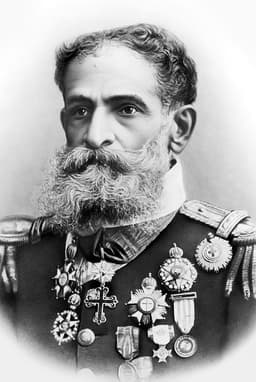
Deodoro da Fonseca
General · Modern
48.8Total

Eurico Gaspar Dutra
General · Modern
52.7Total
Basic Information
Born
1827
1883
Died
1892
1974
Era
Modern
Modern
Nationality
Brazil
Brazil
Occupation
General
General
Civilization
Western
Western
Score Comparison
Military (10%)
50.0
50.0
Political (20%)
45.1
68.0
Influence (20%)
54.1
51.8
Legacy (20%)
44.2
44.2
Leadership (15%)
57.6
62.0
Strategy (15%)
38.6
41.7
TOTAL
48.8
52.7
Deodoro da Fonseca — Complete Timeline
1889 AD
Proclamation of the Brazilian RepublicPolitical Action
Deodoro da Fonseca led a military coup that overthrew Emperor Pedro II on November 15, 1889. He proclaimed the Republic of the United States of Brazil, ending 67 years of imperial rule.
CoupRepublic
Impact: globalprogressive
1891 AD
Election as First President of BrazilPolitical Action◆ Major
Deodoro da Fonseca was elected the first President of Brazil by the Constituent Congress on February 25, 1891. He took office under the new republican constitution, but his rule was brief and authoritarian.
ElectionPresidency
Impact: national
Dissolution of the National CongressPolitical Action◆ Major
Facing political opposition, Deodoro da Fonseca dissolved the National Congress on November 3, 1891, and declared a state of siege. This authoritarian act triggered a naval revolt and his eventual resignation.
AuthoritarianismPolitical Crisis
Impact: nationaldestructive
Resignation from the PresidencyPolitical Action◆ Major
Deodoro da Fonseca resigned the presidency on November 23, 1891, after a naval rebellion threatened his government. He handed power to Vice President Floriano Peixoto, ending his 9-month rule.
ResignationPolitical Crisis
Impact: nationaltragic
Eurico Gaspar Dutra — Complete Timeline
1945 AD
Elected President of BrazilPolitical Action◆ Major
Eurico Gaspar Dutra was elected President of Brazil, succeeding Get
Presidency1946 RepublicElection
Impact: national
1946 AD
Promulgated the 1946 ConstitutionReform◆ Major
Dutra oversaw the promulgation of a new democratic constitution, which restored civil liberties and established a presidential system. The 1946 Constitution replaced the authoritarian 1937 Charter and marked Brazil's return to democracy.
ConstitutionDemocracyPost-Estado Novo
Impact: nationalprogressive
Implemented the 'Dutra Plan' (Plano Dutra) for Economic DevelopmentReform
Dutra launched an economic development plan focused on infrastructure, energy, and transportation. The plan aimed to modernize the Brazilian economy and reduce dependence on imports, but its implementation was limited by fiscal constraints.
Economic PlanDevelopmentInfrastructure
Impact: nationalconstructive
1947 AD
Banned the Communist PartyPolitical Action◆ Major
Dutra banned the Brazilian Communist Party (PCB) and broke diplomatic relations with the Soviet Union. This action was part of his alignment with the United States during the early Cold War and aimed to suppress leftist opposition.
Cold WarCommunist BanAnti-Communism
Impact: nationaldestructive
1950 AD
Ended Presidency and RetiredPolitical Action
Dutra completed his term and was succeeded by Get
End of TermRetirementLegacy
Impact: national
Expert Analysis
Deodoro da Fonseca vs Eurico Gaspar Dutra
# The General and the Republic
On a sweltering November morning in 1889, a seventy-two-year-old marshal with a white beard and a troubled heart led a column of soldiers through the streets of Rio de Janeiro. Deodoro da Fonseca was not a revolutionary by nature. He had served the empire for forty years. Yet on that day, November 15, he would end it. The emperor, Pedro II, was deposed without a single shot. A republic was proclaimed. And a pattern was set—one that would haunt Brazil for generations: the soldier who makes a nation, only to find he cannot rule it.
Fifty-six years later, another general, Eurico Gaspar Dutra, took the presidential oath in the same city. He had served under the dictator Getúlio Vargas for fifteen years. But Dutra would do something no Brazilian general had done before: he would hand power back to a civilian, on schedule, without a crisis. The contrast between these two men—one who stumbled into history and one who walked through its door—illuminates the long, painful education of a republic.
Origins
Deodoro da Fonseca was born in 1827 in Alagoas, a poor northeastern state, into a military family. His father was a colonel; his brothers became officers. The young Deodoro entered the military academy at fourteen and learned to see the army as the only honest institution in a land of slave-owning aristocrats. He fought in the Paraguayan War (1864–1870), where he was wounded and decorated. The war forged his generation: it gave officers a sense of national purpose and a contempt for the civilian politicians who mismanaged the war effort. Deodoro emerged a hero, but also a man of the barracks—gruff, loyal, and suspicious of civilians.
Eurico Gaspar Dutra was born in 1883 in Mato Grosso, a frontier state, into a more modest family. His father was a small merchant. Dutra entered the military academy at seventeen, just as the republic Deodoro had founded was falling into chaos. He served in the same army, fought in no major wars, and rose slowly through the ranks. Where Deodoro was impulsive, Dutra was methodical. Where Deodoro was a figure of drama, Dutra was a figure of process. He became a staff officer, a planner, a man who understood that armies win not by heroism but by logistics.
The difference in their eras was decisive. Deodoro came of age when Brazil was an empire, when the army was a tool of the emperor, and when the idea of a republic was still a dangerous dream. Dutra came of age when the republic already existed, when the army had already seized power twice, and when the question was no longer whether Brazil should be a republic but what kind of republic it should be.
Rise to Power
Deodoro did not seek the presidency. In 1889, he was a respected but aging marshal, suffering from asthma and depression. The republican conspirators—a group of young officers and intellectuals led by Benjamin Constant—needed a figurehead. They chose Deodoro because of his prestige, not his politics. On the morning of November 15, they persuaded him to lead the revolt by telling him the emperor planned to arrest him. It was a lie. Deodoro believed it, acted, and found himself the master of a revolution he had not planned.
He became head of the provisional government, then, in February 1891, the first elected president of Brazil. But he was not a politician. He had no party, no program, no patience for the give-and-take of democracy. When Congress opposed his cabinet choices, he lost his temper. On November 3, 1891, he dissolved the National Congress and declared a state of siege. It was a coup within the republic. The navy revolted. The army wavered. Twenty days later, Deodoro resigned, broken and humiliated. He died the next year, a footnote to his own revolution.
Dutra's rise was the opposite. He did not seize power; he was elected. In 1945, after fifteen years of Vargas's Estado Novo dictatorship, the regime held elections. Dutra, Vargas's own war minister, ran as the candidate of the Social Democratic Party, a centrist coalition. He won with 55 percent of the vote. The military did not put him in power; the ballot box did. He was the first president of the Fourth Republic, and he knew that his legitimacy depended on keeping the military out of politics.
Leadership & Governance
Deodoro governed by instinct and temper. His only major reform was the separation of church and state, which he decreed in 1890. He had no economic plan, no vision for development, no understanding of how to manage a legislature. His military mind saw opposition as insubordination. When he dissolved Congress, he acted like a general silencing a mutinous regiment. But a republic is not an army. His fall was swift and total.
Dutra governed by plan and patience. In 1946, he promulgated a new constitution that restored civil liberties, established a presidential system, and guaranteed elections. It was the most democratic constitution Brazil had ever had. He then launched the "Dutra Plan" (Plano Dutra), a five-year economic development program focused on infrastructure, energy, and transportation. It was modest by later standards, but it was a plan—and Brazil had never had one.
His most controversial act was banning the Brazilian Communist Party in 1947 and breaking diplomatic relations with the Soviet Union. This was the Cold War, and Dutra was a conservative general. But he did it through legal channels, not decree. He left office in 1951, as scheduled, and handed power to his predecessor, Getúlio Vargas—now returned as a democratically elected president. It was an act of political maturity that Deodoro could not have imagined.
Triumph & Tragedy
Deodoro's triumph was the proclamation of the republic. It was a genuine achievement: Brazil became the last monarchy in the Americas to fall, and it fell without bloodshed. His tragedy was that he could not govern the republic he had made. He was a revolutionary who hated revolution, a republican who could not tolerate dissent. His presidency lasted nine months, and his legacy was a lesson in what not to do.
Dutra's triumph was the consolidation of democracy. He oversaw the transition from dictatorship to democracy, wrote a constitution, and left office peacefully. His tragedy was that his achievements were soon forgotten. The Dutra Plan was overshadowed by the later developmentalism of Juscelino Kubitschek. His anti-communism seemed paranoid to later generations. He was remembered as a gray, cautious figure—a caretaker, not a founder.
Character & Destiny
Deodoro was a man of the nineteenth century: honor-bound, impulsive, and tragic. He believed in the republic but could not live with its messiness. His character was his destiny: his pride made him a leader, and his pride destroyed him.
Dutra was a man of the twentieth century: bureaucratic, patient, and professional. He believed in institutions, not heroes. His character was his destiny: his caution made him unremarkable, but it also made him successful. He gave Brazil something Deodoro could not: a peaceful transfer of power.
Legacy
Deodoro is remembered as the founder of the republic. His name is on streets and squares across Brazil. But his legacy is ambiguous: he founded a republic that immediately fell into chaos, oligarchy, and eventually dictatorship. He is a statue in a park, but few Brazilians know his story.
Dutra is almost forgotten. He has no major monuments. His name appears in history books as a transition between Vargas and Vargas. But his legacy is deeper: he proved that a general could govern democratically and leave office willingly. He was the first Brazilian president to do so. In a country where the military would again seize power in 1964, Dutra's example was a road not taken.
Conclusion
Two generals, two republics. Deodoro da Fonseca made the republic but could not rule it. Eurico Gaspar Dutra ruled the republic but could not make it great. Between them lies the central tragedy of Brazilian history: the difficulty of building democracy in a land of inequality, violence, and military ambition. Deodoro's fall taught Brazilians that revolution is easier than governance. Dutra's quiet success taught them that governance is possible—but only if the generals learn to put down their swords and pick up the law. The question Brazil still faces is whether that lesson has been learned.
Rankings
🥇
Eurico Gaspar DutraLeader
Mil: 50.0Pol: 68.0Inf: 51.8
52.7
🥈
Deodoro da Fonseca
Mil: 50.0Pol: 45.1Inf: 54.1
48.8
+3.9 behind
How This Comparison Works
Algorithm
Each figure is scored on 6 dimensions (0—100 scale) based on structured historical data: Military (10%), Political (20%), Influence (20%), Legacy (20%), Leadership (15%), Strategy (15%). The weighted total produces the final ranking.
Data Sources
Scores are computed from structured sub-indicators in the database. Scale factors adjust for era (Ancient ×0.85, Modern ×1.0) and civilization size (Eastern ×1.05, Other ×0.80) to account for differences in population and military scale.
Maximum 3 Figures
Comparisons are limited to 2—3 figures to ensure readability and statistical meaningfulness.
Error Margins
±5 points per dimension — Sub-scores are derived from historical records with inherent uncertainty. Two figures within 5 points on a dimension should be considered roughly equivalent in that area.
Total Score Accuracy
±3 points overall — The weighted combination of 6 dimensions produces a total score with approximately ±3 points of uncertainty. Differences of less than 3 points are not statistically significant— the figures are effectively tied.
Known Limitations
- Historical records are incomplete and uneven across civilizations
- Figures from oral-tradition societies may be underrepresented
- Occupation labels can misclassify multi-role figures
- Scores measure capability and impact, not moral character
- Quantitative scoring is a comparison tool, not absolute truth
Capability Radar
Military (10%) — Battles & Warfare
Battles
20
10
Win Rate
25
15
Expansion
10
10
Political (20%) — Governance & Reform
Reform
40
50
Diplomacy
25
45
Economy
15
40
Influence (20%) — Cultural & Global Reach
Cultural
20
20
Global
15
20
Legacy (20%) — Historical Impact
Historical
35
30
Longevity
20
25
Leadership (15%) — Power & Stability
Tenure
30
55
Stability
10
50
Strategy (15%) — Tactics & Innovation
Strategy
25
25
Tactics
20
20
Reform
15
30
Similar Comparisons
Comments & Discussion
MARSHAL_OF_MESS6/16/2026
Deodoro versus Dutra? That’s like comparing a cannonball to a traffic cone. Deodoro stumbled into power, a reluctant revolutionary who dissolved Congress in 1891 because he couldn’t handle the squabbling—his temperament alone wrecked the First Republic’s infancy. Dutra, by contrast, was a cold, calculating machine; he returned power to civilians in 1951, sure, but only after crafting a development pact with the U.S. that deepened inequality. One was a flailing tragic hero, the other a silent arc
历史破壁者6/16/2026
说德奥多罗是“无意间创造共和国”的将军,简直就是历史软文!他1889年废黜佩德罗二世,表面是政变,背后全是咖啡大佬们甩掉奴隶制帝国、换共和新装的阴谋。德奥多罗只是个旗子,三个月后就因经济失控下台,连宪法都没撑住。杜特拉呢?1946年执政,直接拥抱冷战,把巴西绑在美元战车上,压制工人运动,还通过《国家安全法》搞清洗。这两个将军,一个傀儡,一个工具,巴西人民才是真输家。