Loading...
Deodoro da Fonseca vs Dzhokhar Dudayev
Dzhokhar Dudayev leads by 3.2 pts · 2 figures compared
…
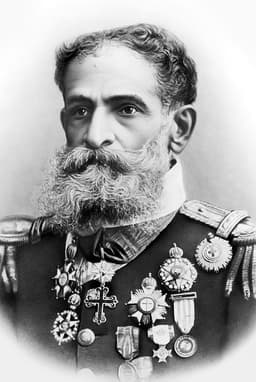
Deodoro da Fonseca
General · Modern
48.8Total
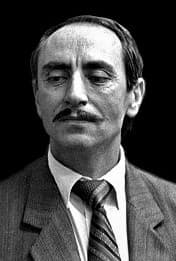
Dzhokhar Dudayev
General · Modern
52.0Total
Basic Information
Born
1827
1944
Died
1892
—
Era
Modern
Modern
Nationality
Brazil
Chechnya
Occupation
General
General
Civilization
Western
Western
Score Comparison
Military (10%)
50.0
46.7
Political (20%)
45.1
45.1
Influence (20%)
54.1
57.2
Legacy (20%)
44.2
47.5
Leadership (15%)
57.6
57.6
Strategy (15%)
38.6
57.5
TOTAL
48.8
52.0
Deodoro da Fonseca — Complete Timeline
1889 AD
Proclamation of the Brazilian RepublicPolitical Action
Deodoro da Fonseca led a military coup that overthrew Emperor Pedro II on November 15, 1889. He proclaimed the Republic of the United States of Brazil, ending 67 years of imperial rule.
CoupRepublic
Impact: globalprogressive
1891 AD
Election as First President of BrazilPolitical Action◆ Major
Deodoro da Fonseca was elected the first President of Brazil by the Constituent Congress on February 25, 1891. He took office under the new republican constitution, but his rule was brief and authoritarian.
ElectionPresidency
Impact: national
Dissolution of the National CongressPolitical Action◆ Major
Facing political opposition, Deodoro da Fonseca dissolved the National Congress on November 3, 1891, and declared a state of siege. This authoritarian act triggered a naval revolt and his eventual resignation.
AuthoritarianismPolitical Crisis
Impact: nationaldestructive
Resignation from the PresidencyPolitical Action◆ Major
Deodoro da Fonseca resigned the presidency on November 23, 1891, after a naval rebellion threatened his government. He handed power to Vice President Floriano Peixoto, ending his 9-month rule.
ResignationPolitical Crisis
Impact: nationaltragic
Dzhokhar Dudayev — Complete Timeline
1991 AD
Proclaimed Independence of ChechnyaPolitical Action
Dzhokhar Dudayev declared the independence of the Chechen Republic of Ichkeria from the Soviet Union. He was elected president in a controversial election. This act triggered the First Chechen War with Russia.
ChechnyaIndependenceIchkeria
Impact: regionalconstructive
1994 AD
First Chechen War BeginsWar
Russian forces invaded Chechnya to suppress the independence movement. Dudayev led the Chechen resistance, using guerrilla tactics. The war resulted in heavy casualties and destruction but failed to defeat the Chechen forces.
Chechen WarRussiaInvasion
Impact: regionaltragic
1996 AD
Assassination by Russian MissileWar
Dudayev was killed by a Russian guided missile while using a satellite phone near Grozny. His death was a major blow to the Chechen resistance but did not end the war. He was succeeded by Aslan Maskhadov.
AssassinationChechnyaRussia
Impact: regionaltragic
Expert Analysis
Deodoro da Fonseca vs Dzhokhar Dudayev
# The General Who Became President: Two Paths from the Barracks to Power
In the spring of 1996, a former Soviet Air Force general sat in a farmhouse near the Chechen village of Gekhi-Chu, speaking into a satellite phone. Thousands of miles away, in the winter of 1891, a Brazilian field marshal stood in the imperial palace of Rio de Janeiro, watching his country's parliament dissolve before his eyes. Both men had seized history by the throat, but their fates could not have diverged more sharply. Dzhokhar Dudayev would die by a Russian missile moments after that phone call. Deodoro da Fonseca would resign his presidency in disgrace, but live to see his republic endure. What drove these two generals—both men of the sword who reached for the scepter—to such different ends?
Origins
Dzhokhar Dudayev was born in 1944 into a world of ashes. His family, like hundreds of thousands of Chechens, had been deported to Central Asia on Stalin's orders, accused of collaboration with the Nazis. He grew up in exile, speaking Russian as his first language, learning the ways of the Soviet military machine that would become his ladder to power. By the time he graduated from the Tambov Higher Military Aviation School, he had shed his Chechen identity for a Soviet one—or so it seemed. But the memory of exile never left him.
Deodoro da Fonseca, born in 1827, came from a very different world. His family were military aristocrats in the Brazilian Empire, a vast, slave-owning monarchy that had peacefully broken from Portugal. He entered the army at fourteen, fought in the Paraguayan War, and rose through the ranks of an institution that was itself a pillar of the state. Unlike Dudayev, Fonseca was not shaped by trauma but by tradition. The Brazilian Empire had its flaws, but it had never exterminated his people.
The difference in their origins explains everything. Dudayev's nationalism was born of genocide; Fonseca's republicanism was born of boredom with a monarchy that had grown stale.
Rise to Power
Dudayev rose through the Soviet military system with remarkable speed. He became the first Chechen to reach the rank of major general, commanding a strategic bomber division in Estonia. When the Soviet Union began to crack in 1991, he made a stunning calculation: he would return to Chechnya and lead its independence movement. In October of that year, he declared the Chechen Republic of Ichkeria independent and was elected president in a landslide. His path was sudden, violent, and personal. He was not a politician who became a general; he was a general who decided the time had come to be a politician.
Fonseca's rise was slower and more institutional. He had been a loyal servant of the empire for decades, but by 1889, the monarchy had lost its grip. The abolition of slavery in 1888 had alienated the planter class, and the army—once the emperor's loyal tool—had grown restless. On November 15, 1889, Fonseca led a bloodless coup, marching troops through Rio de Janeiro and proclaiming the republic. He was not a revolutionary in the Chechen sense. He was a man who stepped into a vacuum, almost reluctantly, because someone had to.
Leadership & Governance
Here the two generals diverge most sharply. Dudayev's leadership was guerrilla by necessity, visionary by design. His military score of 56.3 reflects a man who was not a great strategist in the conventional sense—he could not match Russian firepower—but who understood that a small nation's survival depended on will and sacrifice. He governed Chechnya with a mix of charisma and chaos, trying to build a state while fighting a war. His political score of 64.3 suggests a man who was more of a symbol than an administrator. He issued decrees, appointed ministers, but the state he imagined never fully materialized.
Fonseca, by contrast, was a political animal. His political score of 77.9 is the highest in his profile, and for good reason. He understood that a republic needed institutions, not just a strongman. But he also had a temper. When the Congress refused to give him the powers he wanted, he dissolved it on November 3, 1891, declaring a state of siege. It was a disastrous miscalculation. The navy rebelled, and within three weeks, Fonseca resigned. His leadership score of 70.0 suggests a man who could inspire loyalty but could not manage the messy compromises of democracy.
Triumph & Tragedy
Dudayev's greatest moment was also his last. From 1994 to 1996, he led the Chechen resistance against a massive Russian invasion, turning Grozny into a symbol of defiance. His forces inflicted devastating casualties on the Russian army, humiliating a superpower. But on April 21, 1996, Russian intelligence tracked his satellite phone signal and fired a guided missile. He died instantly. His tragedy is that he never saw the peace that followed—the Khasavyurt Accord, signed later that year, effectively recognized Chechen independence.
Fonseca's triumph was the republic itself. He ended the Brazilian Empire with a single decree, and though his presidency was brief and chaotic, he handed power to his successor peacefully. His tragedy was personal: he was a man who wanted to be a liberator but found himself a dictator by accident. He died in 1892, just months after his resignation, a broken figure.
Character & Destiny
Dudayev was a romantic nationalist, a man who believed that a small nation could defy a great power through sheer will. He was also a pragmatist, using Soviet military training to fight a Soviet-style war. But his romanticism was his undoing. He trusted too much in the power of symbols—the Chechen flag, the satellite phone—and not enough in the realities of Russian power.
Fonseca was a conservative revolutionary. He wanted change, but he wanted order more. He dissolved Congress because he could not tolerate chaos, but in doing so, he created the very chaos he feared. His character was that of a man caught between two worlds: the old empire he had overthrown and the new republic he could not quite control.
Legacy
Dudayev's legacy is a double-edged sword. In Chechnya, he is a martyr and a founding father, his face on posters and his name on streets. But the Chechen independence he fought for has not survived. Today, Chechnya is ruled by a Russian-backed strongman, and Dudayev's dream is a memory. His influence score of 73.2 suggests a man who inspired a movement but could not build a lasting state.
Fonseca's legacy is more ambiguous. He is remembered as the first president of Brazil, but also as a man who nearly destroyed the republic he created. His legacy score of 60.6 reflects a figure who is honored but not beloved. The Brazilian Republic survived him, but not because of him—rather, in spite of him.
Conclusion
Two generals, two republics, two fates. Dudayev died fighting for a nation that would never be born; Fonseca resigned from a nation that would never die. The difference lies not in their courage or their vision, but in the soil they stood on. Dudayev's Chechnya was a small, traumatized nation surrounded by enemies; Fonseca's Brazil was a vast, stable continent waiting for a new form of government. One man's tragedy was that he had to fight for everything; the other's was that he had to fight for nothing at all. In the end, both discovered that the hardest part of leading a revolution is not taking power—it is knowing what to do with it once you have it.
Rankings
🥇
Dzhokhar DudayevLeader
Mil: 46.7Pol: 45.1Inf: 57.2
52.0
🥈
Deodoro da Fonseca
Mil: 50.0Pol: 45.1Inf: 54.1
48.8
+3.2 behind
How This Comparison Works
Algorithm
Each figure is scored on 6 dimensions (0—100 scale) based on structured historical data: Military (10%), Political (20%), Influence (20%), Legacy (20%), Leadership (15%), Strategy (15%). The weighted total produces the final ranking.
Data Sources
Scores are computed from structured sub-indicators in the database. Scale factors adjust for era (Ancient ×0.85, Modern ×1.0) and civilization size (Eastern ×1.05, Other ×0.80) to account for differences in population and military scale.
Maximum 3 Figures
Comparisons are limited to 2—3 figures to ensure readability and statistical meaningfulness.
Error Margins
±5 points per dimension — Sub-scores are derived from historical records with inherent uncertainty. Two figures within 5 points on a dimension should be considered roughly equivalent in that area.
Total Score Accuracy
±3 points overall — The weighted combination of 6 dimensions produces a total score with approximately ±3 points of uncertainty. Differences of less than 3 points are not statistically significant— the figures are effectively tied.
Known Limitations
- Historical records are incomplete and uneven across civilizations
- Figures from oral-tradition societies may be underrepresented
- Occupation labels can misclassify multi-role figures
- Scores measure capability and impact, not moral character
- Quantitative scoring is a comparison tool, not absolute truth
Capability Radar
Military (10%) — Battles & Warfare
Battles
20
35
Win Rate
25
30
Expansion
10
20
Political (20%) — Governance & Reform
Reform
40
35
Diplomacy
25
30
Economy
15
15
Influence (20%) — Cultural & Global Reach
Cultural
20
40
Global
15
35
Legacy (20%) — Historical Impact
Historical
35
45
Longevity
20
30
Leadership (15%) — Power & Stability
Tenure
30
30
Stability
10
10
Strategy (15%) — Tactics & Innovation
Strategy
25
50
Tactics
20
55
Reform
15
40
Similar Comparisons
Comments & Discussion
Deodoro's Folly6/16/2026
The critical difference here isn't just about drones vs. mounted cavalry; it's about institutional decay. Dudayev walked into a vacuum left by the USSR's collapse – a total system failure. Fonseca seized power from a stable, albeit anachronistic, empire. He was a figurehead blowhard who couldn't even manage a financial crisis, whereas Dudayev at least forced Russia to bleed for years in Grozny. One was a tragic miscalculation; the other was a doomed consequence. Fonseca was just a loud uniform.
弹片与勋章6/16/2026
从军事素养看,杜达耶夫是真正的战术家,他在1994-1995年格罗兹尼巷战中用临时拼凑的车臣武装打残了俄军装甲部队,这是现代战争经典。而丰塞卡?他1889年政变靠的是喊口号和骑兵游街,真打起仗来,巴西那场海军叛乱他就差点翻船。一个用导弹和卫星电话指挥游击战,一个拿羽毛笔和内战余威搞政变——根本不在一个段位上。
The Revanchist's Mirror6/16/2026
Let's talk about identity. Dudayev was a Soviet Air Force general who consciously *reverted* to his Chechen nationalism after the USSR dissolved. Fonseca was an imperial Brazilian officer who staged a coup to turn his master's empire into a "Republic" that looked exactly like the old one—minus the crown. Dudayev wanted to burn the old system; Fonseca just wanted a different hat. One was an authentic rebellion, the other a palace reshuffle. That's why Dudayev's legacy lives in blood and memory, w
命运的分岔口6/16/2026
关键是“不可逆性”。杜达耶夫1996年死于俄军精准打击后,车臣抵抗并未停止,反而激化成更惨烈的恐怖主义循环。而丰塞卡1891年辞职后,巴西平稳过渡给军政府——他那场动乱就像南美老男人的一场牌局。一个死成圣战符号,一个活成历史笑话。所以我站杜达耶夫:哪怕结局悲壮,他至少改变了高加索的地缘格局;丰塞卡连巴西的马路名都没资格长久保留。
Fact-Checker's Rebuttal6/16/2026
Except the "analysis" fetishizes Dudayev's dramatic death while ignoring a key detail: Fonseca's coup directly abolished slavery in Brazil (1888 under Princess Isabel, sure, but the Republic solidified abolition). Dudayev's Chechen republic? It legalized Sharia law, criminalized women's rights, and facilitated slave markets in Grozny. So while one "general" toppled a monarchy, the other toppled any pretense of civil order. Fonseca's