Loading...
Charles de Gaulle vs Yuan Shikai
Charles de Gaulle leads by 8.2 pts · 2 figures compared
…
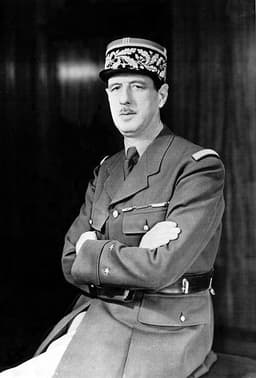
Charles de Gaulle
Politician · Modern
68.2Total
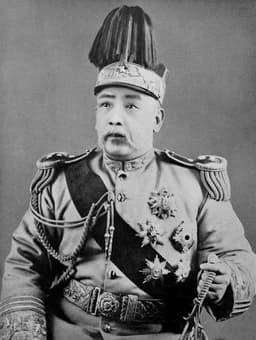
Yuan Shikai
Politician · Modern
60.0Total
Basic Information
Born
1890
1859
Died
1970
1916
Era
Modern
Modern
Nationality
France
China
Occupation
Politician
Politician
Civilization
Western
Eastern
Score Comparison
Military (10%)
55.0
45.0
Political (20%)
75.0
72.0
Influence (20%)
65.0
57.2
Legacy (20%)
68.0
54.0
Leadership (15%)
78.0
72.0
Strategy (15%)
65.0
61.2
TOTAL
68.2
60.0
Charles de Gaulle — Complete Timeline
1940 AD
Appeal of 18 June 1940Political Action
From London, de Gaulle broadcast a radio appeal urging French resistance against Nazi occupation. He called on French soldiers and citizens to continue the fight, founding the Free French Forces and becoming the symbol of French defiance.
World War IIResistanceLeadership
Impact: nationalconstructive
1958 AD
Founding of the Fifth RepublicPolitical Action
De Gaulle returned to power during the Algerian crisis and oversaw the drafting of a new constitution. The Fifth Republic established a strong executive presidency, replacing the unstable parliamentary system of the Fourth Republic.
ConstitutionGovernment ReformPolitical System
Impact: nationalconstructive
1962 AD
End of the Algerian WarPolitical Action◆ Major
De Gaulle negotiated the
DecolonizationPeace TreatyAlgeria
Impact: regionalconstructive
1968 AD
May 1968 CrisisPolitical Action◆ Major
Mass student protests and general strikes paralyzed France, challenging de Gaulle's government. De Gaulle briefly fled to Germany, then returned to dissolve the National Assembly and call elections, which his party won, but his authority was weakened.
ProtestPolitical CrisisSocial Unrest
Impact: nationaldestructive
1969 AD
Resignation as PresidentPolitical Action
De Gaulle resigned after losing a referendum on regional reform and Senate restructuring. The defeat marked the end of his political career, as he withdrew from public life and died the following year.
ResignationPolitical DefeatReferendum
Impact: nationaltragic
Yuan Shikai — Complete Timeline
1901 AD
Command of the Beiyang ArmyReform◆ Major
Yuan Shikai took command of the Beiyang Army, the most modern military force in late Qing China. He expanded and trained the army, which became the basis for his political power and later dominated Chinese politics.
Military reformBeiyang Army
Impact: national
1912 AD
Appointed First President of the Republic of ChinaPolitical Action
Yuan Shikai became the first president of the Republic of China after negotiating the abdication of the Qing emperor. He used his control of the Beiyang Army to pressure the revolutionary government into accepting his leadership.
PresidencyRepublic of China
Impact: national
1915 AD
Declaration of the Empire of ChinaPolitical Action◆ Major
Yuan Shikai declared himself emperor of the Empire of China, attempting to restore the monarchy. This move sparked widespread opposition from provincial leaders and foreign powers, leading to the collapse of his regime.
Monarchy restorationPolitical crisis
Impact: nationaldestructive
Signing of the Twenty-One DemandsPolitical Action◆ Major
Yuan Shikai accepted most of Japan's Twenty-One Demands, which expanded Japanese influence in China. The agreement granted Japan economic rights in Manchuria and Shandong, and was seen as a national humiliation.
DiplomacyJapanese imperialism
Impact: globaltragic
1916 AD
Death and Collapse of the Beiyang GovernmentPolitical Action◆ Major
Yuan Shikai died of uremia, leaving no clear successor. His death led to the fragmentation of the Beiyang Army into warlord factions, plunging China into a period of civil war and political instability.
Warlord eraPolitical fragmentation
Impact: nationaltragic
Expert Analysis
Charles de Gaulle vs Yuan Shikai
# The General and the Strongman
In the spring of 1969, Charles de Gaulle stood alone in his country home at Colombey-les-Deux-Églises, having just resigned the presidency of France after losing a referendum on regional reform. Half a century earlier and half a world away, in the summer of 1916, Yuan Shikai lay dying in Beijing, his body ravaged by uremia and his dream of a new imperial dynasty crumbling around him. Two men, two endings, two nations. One would be remembered as the savior of modern France; the other as the gravedigger of republican China. What separates a founding father from a failed emperor?
Origins
Charles de Gaulle was born in 1890 into a devoutly Catholic, patriotic family in Lille. His father taught philosophy and history, instilling in young Charles a sense of France as a sacred, eternal entity. The humiliation of the Franco-Prussian War hung over his childhood like a shadow. De Gaulle grew up believing that France could only be great through strength, discipline, and a leader who embodied the nation’s will.
Yuan Shikai, born in 1859 in Henan province, came from a different world—the twilight of the Qing Dynasty, an empire rotting from within. His family had minor military connections, and Yuan rose through the ranks not by ideology but by pragmatism. He learned early that power in late imperial China flowed through networks of loyalty, patronage, and the barrel of a gun. While de Gaulle read philosophy and dreamed of glory, Yuan studied the art of survival.
Rise to Power
De Gaulle’s path was one of defiance. When France fell to Nazi Germany in 1940, he was a little-known brigadier general. On June 18, he broadcast from London a radio appeal that would define his life: France had lost a battle, but not the war. From that moment, he was the voice of resistance—a man without an army, without a country, but with an unshakable idea of France. His turning point came in 1958, when the Algerian crisis brought him back from political exile. He wrote a new constitution, founded the Fifth Republic, and became its first president.
Yuan Shikai’s rise was more calculated. In 1901, he took command of the Beiyang Army, the most modern military force in China. He trained it, equipped it, and made it personally loyal to him. When the Qing Dynasty collapsed in 1912, Yuan was the indispensable man. He negotiated the abdication of the child emperor Puyi and became the first president of the Republic of China. Where de Gaulle had moral authority, Yuan had troops.
Leadership & Governance
De Gaulle governed with a vision of national grandeur. He ended the Algerian War in 1962 through the Évian Accords, a decision that horrified the French far right but liberated France from a colonial nightmare. He pursued an independent foreign policy, withdrew France from NATO’s military command, and vetoed British entry into the European Common Market. His style was aloof, almost monarchical. “I am France,” he seemed to say, and many French believed him.
Yuan Shikai governed as a strongman, not a visionary. He maintained order through the Beiyang Army, but he had no grand plan for China’s modernization beyond personal power. In 1915, facing Japan’s Twenty-One Demands, he accepted most of them, granting Japan extensive influence in Manchuria and Shandong. It was a pragmatic move—he had no navy to resist—but it branded him as a traitor to Chinese nationalism. That same year, he made his fatal error: he declared himself emperor of a new dynasty, the Empire of China.
Triumph & Tragedy
De Gaulle’s greatest moment was the founding of the Fifth Republic, a system that gave France stability and strong executive leadership for decades. His tragedy came in May 1968, when student protests and a general strike paralyzed France. De Gaulle, old and tired, briefly fled to Germany to consult with French generals. He returned, called elections, and won—but the mystique was broken. He resigned a year later, a lonely figure who had outlived his era.
Yuan Shikai’s triumph was the creation of the Beiyang Army, the most capable military force in China. But his tragedy was his own ambition. The declaration of empire in 1915 sparked immediate revolt. Provinces declared independence; his own generals abandoned him. He was forced to cancel the monarchy in March 1916, and died two months later, a broken man. His death left China without a center, and the Beiyang Army fragmented into warlord factions that would tear the country apart for a decade.
Character & Destiny
De Gaulle was a man of iron conviction. He believed in France as a transcendent idea, and he sacrificed everything—his career, his safety, his popularity—for that belief. His aloofness was not arrogance but a form of statesmanship: he believed that a leader must stand above the crowd to see the horizon.
Yuan Shikai was a man of iron ambition. He believed in power as a practical tool, not a moral calling. He had no ideology beyond self-preservation and self-advancement. Where de Gaulle asked “What does France need?”, Yuan asked “What do I need to survive?” The difference in their outcomes was not luck but character.
Legacy
De Gaulle is remembered as the father of modern France. The Fifth Republic endures. His name adorns airports, streets, and the aircraft carrier that still projects French power. He is honored as the man who restored French dignity after occupation and defeat.
Yuan Shikai is remembered as a failure—the man who sold out China to Japan, who tried to restore the monarchy, who left a vacuum that warlords filled. His legacy is a cautionary tale: that power without purpose, ambition without vision, cannot build a nation.
Conclusion
Both men stood at the crossroads of history. Both held the fate of their nations in their hands. De Gaulle chose to lead; Yuan Shikai chose to rule. One built a republic that lasted; the other destroyed one that might have been. In the end, the difference between a founding father and a failed emperor is not talent or opportunity, but the answer to a single question: Do you serve the nation, or does the nation serve you?
Rankings
🥇
Charles de GaulleLeader
Mil: 55.0Pol: 75.0Inf: 65.0
68.2
🥈
Yuan Shikai
Mil: 45.0Pol: 72.0Inf: 57.2
60.0
+8.2 behind
How This Comparison Works
Algorithm
Each figure is scored on 6 dimensions (0—100 scale) based on structured historical data: Military (10%), Political (20%), Influence (20%), Legacy (20%), Leadership (15%), Strategy (15%). The weighted total produces the final ranking.
Data Sources
Scores are computed from structured sub-indicators in the database. Scale factors adjust for era (Ancient ×0.85, Modern ×1.0) and civilization size (Eastern ×1.05, Other ×0.80) to account for differences in population and military scale.
Maximum 3 Figures
Comparisons are limited to 2—3 figures to ensure readability and statistical meaningfulness.
Error Margins
±5 points per dimension — Sub-scores are derived from historical records with inherent uncertainty. Two figures within 5 points on a dimension should be considered roughly equivalent in that area.
Total Score Accuracy
±3 points overall — The weighted combination of 6 dimensions produces a total score with approximately ±3 points of uncertainty. Differences of less than 3 points are not statistically significant— the figures are effectively tied.
Known Limitations
- Historical records are incomplete and uneven across civilizations
- Figures from oral-tradition societies may be underrepresented
- Occupation labels can misclassify multi-role figures
- Scores measure capability and impact, not moral character
- Quantitative scoring is a comparison tool, not absolute truth
Capability Radar
Military (10%) — Battles & Warfare
Battles
60
45
Win Rate
55
55
Expansion
20
50
Political (20%) — Governance & Reform
Reform
95
55
Diplomacy
90
70
Economy
70
50
Influence (20%) — Cultural & Global Reach
Cultural
70
40
Global
80
35
Legacy (20%) — Historical Impact
Historical
85
65
Longevity
75
40
Leadership (15%) — Power & Stability
Tenure
85
60
Stability
75
30
Strategy (15%) — Tactics & Innovation
Strategy
85
65
Tactics
70
60
Reform
80
80
Similar Comparisons
Comments & Discussion
No comments yet. Be the first to share your thoughts!