Loading...
Cesare Borgia vs Feng Guozhang
Cesare Borgia leads by 11.1 pts · 2 figures compared
…
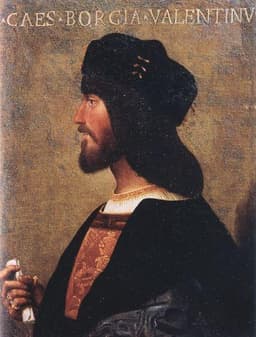
Cesare Borgia
General · Medieval
60.2Total
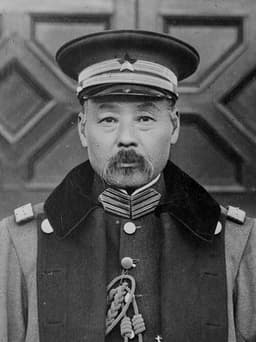
Feng Guozhang
General · Modern
49.1Total
Basic Information
Born
1475
1859
Died
1507
1919
Era
Medieval
Modern
Nationality
Italy
China
Occupation
General
General
Civilization
Western
Eastern
Score Comparison
Military (10%)
67.5
30.0
Political (20%)
68.0
61.3
Influence (20%)
68.0
54.9
Legacy (20%)
40.0
45.8
Leadership (15%)
64.0
40.0
Strategy (15%)
66.3
57.5
TOTAL
60.2
49.1
Cesare Borgia — Complete Timeline
1493 AD
Appointment as CardinalPolitical Action◆ Major
Cesare Borgia was appointed cardinal by his father, Pope Alexander VI. This position gave him significant power within the Church and access to papal resources. He used his cardinalate to advance his family's political interests in Italy.
CardinalNepotismPapacy
Impact: regional
1498 AD
Resignation from the CardinalatePolitical Action◆ Major
Cesare Borgia resigned as cardinal to pursue a military and political career. He became the first person to voluntarily leave the College of Cardinals. This move allowed him to focus on conquering territories in the Romagna region of Italy.
ResignationMilitaryRomagna
Impact: regional
1499 AD
Conquest of the RomagnaWar◆ Major
Cesare Borgia, with French support, launched a campaign to conquer the cities of the Romagna. He captured Imola, Forl
ConquestRomagnaMachiavelli
Impact: regional
1503 AD
Fall from PowerPolitical Action
After the death of Pope Alexander VI, Cesare Borgia lost his political support. He was captured by his enemies and imprisoned in Spain. His territories in Italy quickly collapsed. This sudden fall demonstrated the fragility of his power base.
FallImprisonmentCollapse
Impact: regionaltragic
1507 AD
Death in BattleWar
Cesare Borgia was killed in a skirmish near Viana, Navarre, while serving as a mercenary captain. His death ended any chance of restoring his former power. He died at age 31, having failed to regain his Italian territories.
DeathMercenaryNavarre
tragic
Feng Guozhang — Complete Timeline
1912 AD
Command of the Beiyang ArmyPolitical Action◆ Major
Feng Guozhang became a key commander of the Beiyang Army under Yuan Shikai. He controlled military forces in the Zhili region, establishing himself as a major warlord in northern China after the fall of the Qing dynasty.
Beiyang ArmyWarlordMilitary Command
Impact: national
1916 AD
Appointment as Vice PresidentPolitical Action◆ Major
Feng Guozhang was elected Vice President of the Republic of China under President Li Yuanhong. This position gave him significant political influence during the early Republican period.
Republic of ChinaGovernmentPolitics
Impact: national
1917 AD
Acting PresidencyPolitical Action◆ Major
Feng Guozhang became Acting President of the Republic of China after Li Yuanhong's resignation. He served from 1917 to 1918, facing challenges from rival warlords and struggling to maintain central authority.
Republic of ChinaPresidencyWarlord Era
Impact: national
1918 AD
Conflict with Duan QiruiPolitical Action◆ Major
Feng Guozhang engaged in a power struggle with Premier Duan Qirui, leading to the split of the Beiyang clique into the Zhili and Anhui factions. This conflict weakened the central government and intensified warlord warfare.
Beiyang CliquePower StruggleWarlord Era
Impact: nationaldestructive
Expert Analysis
Feng Guozhang vs Cesare Borgia
# The Prince and the President: Two Paths Through Chaos
On a dusty road in Navarre, Spain, in March 1507, a small skirmish erupted between a handful of soldiers and a larger force. Among the fallen lay Cesare Borgia, once the most feared man in Italy, now a mercenary captain bleeding out in the mud. Three centuries later and half a world away, in Beijing in 1919, Feng Guozhang died in his bed, a former president of China who had outlived his power but not his reputation. Both men commanded armies, both maneuvered through eras of collapse and opportunity, and both left behind a question that haunts history: What does it take to hold power when the world is breaking apart?
Origins
Cesare Borgia was born into the storm of Renaissance Italy, a world of warring city-states, papal intrigue, and the first stirrings of modern politics. His father, Rodrigo Borgia, became Pope Alexander VI in 1492, and Cesare was shaped from childhood by the understanding that family was the only currency that mattered. He was made a cardinal at eighteen, a position of immense ecclesiastical power, but his true inheritance was not the collar of the church—it was the ambition of a dynasty.
Feng Guozhang came of age in a very different kind of collapse. Born in 1859, he witnessed the slow death of the Qing Dynasty, the humiliation of foreign invasions, and the desperate struggle of Chinese reformers to find a path between tradition and modernity. Where Borgia grew up in a world of poison and velvet, Feng grew up in a world of treaties and gunboats. Both men understood that power was up for grabs, but they understood it in languages that could not have been more different.
Rise to Power
Cesare Borgia’s rise was audacious. In 1498, he did what no cardinal had ever done: he resigned his sacred office. It was a stunning move, a public declaration that he would not be bound by the rules of others. With French support and his father’s blessing, he launched a campaign to conquer the Romagna, the unruly territories of central Italy. He captured Imola, Forlì, and a string of cities, not just by force but by cunning. He understood that fear was a faster weapon than loyalty.
Feng Guozhang’s rise was slower, more methodical. He rose through the ranks of the Beiyang Army, the most modern military force in China, under the mentorship of Yuan Shikai. By 1912, he commanded key forces in the Zhili region. His power came not from a single dramatic stroke but from careful cultivation of relationships and a reputation for reliability. When the Qing Dynasty fell and the Republic of China was born in 1912, Feng was positioned not as a revolutionary but as a stabilizer—a man who could hold the pieces together.
Leadership & Governance
Here the two men diverge most sharply. Cesare Borgia governed as an artist of terror. He appointed the ruthless Remirro de Orco to pacify the Romagna with brutal efficiency, then, in a stroke of theatrical genius, had Remirro executed and displayed in the town square—splitting the blame for the cruelty while claiming the gratitude for its end. Niccolò Machiavelli watched this and was awestruck. Borgia understood that power required both the lion’s force and the fox’s cunning.
Feng Guozhang governed as a negotiator. When he became Acting President of the Republic of China in 1917, after Li Yuanhong’s resignation, he faced a nation fractured by warlords, foreign powers, and ideological conflict. He did not try to crush his rivals. Instead, he played the game of politics: forming coalitions, making deals, and struggling to hold a fragile unity together. His conflict with Premier Duan Qirui in 1918 split the Beiyang clique into the Zhili and Anhui factions—a division that would define Chinese politics for a decade. Feng’s military score of 62.6 and political score of 81.7 tell the story: he was a politician first, a general second.
Triumph & Tragedy
Cesare Borgia’s triumph was the conquest of the Romagna. For a few years, he built a state that was efficient, centralized, and feared. His tragedy came in 1503, when his father died suddenly, possibly of poison. Without the Pope’s protection, Borgia’s allies evaporated, his enemies closed in, and he was captured and imprisoned. He escaped, but his power was gone. He died four years later in an anonymous skirmish, his dream of a unified Italy buried with him.
Feng Guozhang’s triumph was reaching the presidency itself—a remarkable ascent for a man from a provincial military background. His tragedy was that the presidency meant nothing. He could not unite China, could not stop the warlord era, could not prevent the chaos that would eventually give rise to the Communist victory. He died in 1919, the year of the May Fourth Movement, which would reshape Chinese politics in ways he never anticipated.
Character & Destiny
Cesare Borgia was driven by ambition so naked it seemed almost innocent. He believed that a man of will could shape the world. Machiavelli immortalized him as the model for *The Prince*—the ruler who must be willing to be cruel, deceptive, and ruthless in pursuit of order. But Borgia’s fatal flaw was his dependence on his father. He built a state on borrowed power, and when the lender died, the debt came due.
Feng Guozhang was driven by a quieter ambition—not to conquer, but to hold. He was a survivor in an era of destruction. His leadership score of 87.3 reflects a man who knew how to manage people, but his strategy score of 72.0 suggests he lacked the vision to transform China. He was a steward, not a founder.
Legacy
Cesare Borgia’s legacy is paradoxical. He failed utterly in his own time, yet he became the archetype of the modern political leader—the prince who must know how to enter evil. Machiavelli’s *The Prince* is still read in every school of power, and Borgia’s ghost haunts the corridors of realpolitik.
Feng Guozhang’s legacy is more obscure but no less important. He represents the tragedy of Chinese republicanism—the attempt to build a modern state on a foundation of warlord loyalties. He is remembered as a competent administrator in a time when competence was not enough.
Conclusion
One died in battle, the other in bed. One inspired a book, the other a footnote. But both Cesare Borgia and Feng Guozhang faced the same question: In an age of collapse, can a single man impose order? Borgia answered with fire and steel; Feng answered with patience and politics. Neither succeeded, but their failures illuminate the limits of power itself. The prince and the president—both reached for heaven and found only the mud of history.
Rankings
🥇
Cesare BorgiaLeader
Mil: 67.5Pol: 68.0Inf: 68.0
60.2
🥈
Feng Guozhang
Mil: 30.0Pol: 61.3Inf: 54.9
49.1
+11.1 behind
How This Comparison Works
Algorithm
Each figure is scored on 6 dimensions (0—100 scale) based on structured historical data: Military (10%), Political (20%), Influence (20%), Legacy (20%), Leadership (15%), Strategy (15%). The weighted total produces the final ranking.
Data Sources
Scores are computed from structured sub-indicators in the database. Scale factors adjust for era (Ancient ×0.85, Modern ×1.0) and civilization size (Eastern ×1.05, Other ×0.80) to account for differences in population and military scale.
Maximum 3 Figures
Comparisons are limited to 2—3 figures to ensure readability and statistical meaningfulness.
Error Margins
±5 points per dimension — Sub-scores are derived from historical records with inherent uncertainty. Two figures within 5 points on a dimension should be considered roughly equivalent in that area.
Total Score Accuracy
±3 points overall — The weighted combination of 6 dimensions produces a total score with approximately ±3 points of uncertainty. Differences of less than 3 points are not statistically significant— the figures are effectively tied.
Known Limitations
- Historical records are incomplete and uneven across civilizations
- Figures from oral-tradition societies may be underrepresented
- Occupation labels can misclassify multi-role figures
- Scores measure capability and impact, not moral character
- Quantitative scoring is a comparison tool, not absolute truth
Capability Radar
Military (10%) — Battles & Warfare
Battles
55
45
Win Rate
60
40
Expansion
55
35
Political (20%) — Governance & Reform
Reform
40
30
Diplomacy
55
45
Economy
35
25
Influence (20%) — Cultural & Global Reach
Cultural
55
30
Global
60
20
Legacy (20%) — Historical Impact
Historical
70
40
Longevity
65
25
Leadership (15%) — Power & Stability
Tenure
45
55
Stability
30
20
Strategy (15%) — Tactics & Innovation
Strategy
60
55
Tactics
65
50
Reform
50
40
Similar Comparisons
Comments & Discussion
BorgiaButcher6/16/2026
Cesare Borgia was a tactical genius but a strategic disaster. He conquered Romagna in a year, but alienated every ally with his brutality. Feng Guozhang, for all his flaws, kept the Beiyang Army loyal through patronage and pragmatism—a skill Borgia never mastered. Power isn’t just about taking; it’s about keeping. Borgia died a hired gun, while Feng died a president. That’s not luck, that’s governance.
数据屠夫6/16/2026
把所有数据拉出来看,冯国璋执政时北洋财政赤字减少近30%,而切萨雷的税收体系全靠教皇父亲输血。把宗教赞助去掉,他的所谓“统治”就是一场庞氏骗局。冯的货币改革至少稳住了华北经济,切萨雷连一年预算表都拿不出来。别跟我谈权谋,看数字说话。
MediciGhost6/16/2026
You’re gravely underestimating Borgia’s modernity. His use of legates as provincial governors and his systematic dismantling of feudal baronies directly inspired Macchiavelli’s concept of a centralized prince. Feng, by contrast, ruled through warlord patronage—backward, brittle, and destined to fracture. Borgia built statecraft from scratch; Feng inherited a corpse.
分省考据狂6/16/2026
说冯是“总统”先查查历史:1917年他只是代总统,实权连段祺瑞都不如。切萨雷至少是教皇钦定的公爵,有明确封地和法理基础。冯在直皖两系之间反复横跳,最后连北洋老本都守不住,而切萨雷虽败犹死战至最后。一个倒在战场上,一个倒在病榻上,哪个更值得记住?