Loading...
Carlos Manuel de Cespedes vs Zhang Xianzhong
Carlos Manuel de Cespedes leads by 3.3 pts · 2 figures compared
…
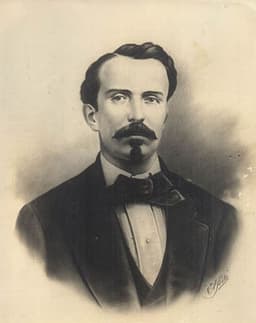
Carlos Manuel de Cespedes
Revolutionary · Modern
44.4Total

Zhang Xianzhong
Revolutionary · Modern
41.1Total
Basic Information
Born
1819
1606
Died
1874
1647
Era
Modern
Modern
Nationality
Cuba
China
Occupation
Revolutionary
Revolutionary
Civilization
Western
Eastern
Score Comparison
Military (10%)
50.0
55.0
Political (20%)
27.9
35.0
Influence (20%)
58.0
44.8
Legacy (20%)
50.0
40.0
Leadership (15%)
30.0
35.4
Strategy (15%)
36.8
38.3
TOTAL
44.4
41.1
Carlos Manuel de Cespedes — Complete Timeline
1868 AD
Grito de Yara (1868)Political Action
Carlos Manuel de C
IndependenceRevolutionTen Years' War
Impact: nationalprogressive
1869 AD
President of the Republic in Arms (1869)Political Action◆ Major
Céspedes was elected President of the Republic of Cuba in Arms by the Assembly of Guáimaro. He led the rebel government during the early years of the Ten Years' War, advocating for independence and the abolition of slavery. His leadership was marked by internal divisions.
PresidencyRebel GovernmentWar
Impact: national
1873 AD
Deposed and Killed (1873-1874)Political Action◆ Major
Céspedes was deposed as president by the rebel assembly in 1873 due to disagreements over military strategy and political direction. He was killed in a skirmish with Spanish troops in 1874. His death made him a martyr for Cuban independence.
DepositionDeathMartyr
Impact: nationaltragic
Zhang Xianzhong — Complete Timeline
1630 AD
Launched Rebellion in ShaanxiWar◆ Major
Zhang Xianzhong joined a peasant rebellion in Shaanxi province during the late Ming dynasty. He quickly rose to become a major rebel leader, gathering a large army and establishing a base of operations in the region.
Ming DynastyRebellionShaanxi
Impact: regionaldestructive
1644 AD
Captured and Sacked ChengduWar◆ Major
Zhang Xianzhong captured the city of Chengdu, the capital of Sichuan province. He then proclaimed the Daxi dynasty and made Chengdu his capital. The capture was accompanied by widespread destruction and massacres of the local population.
Ming-Qing TransitionSichuanMassacre
Impact: regionaldestructive
Proclaimed the Daxi DynastyPolitical Action◆ Major
Zhang Xianzhong proclaimed the Daxi (Great Western) dynasty in Sichuan. He established a government and minted his own coinage. His rule was characterized by extreme violence, including the systematic killing of scholars, officials, and civilians.
Daxi DynastyProclamationSichuan
Impact: regionaldestructive
1647 AD
Killed in Battle Against Qing ForcesWar◆ Major
Zhang Xianzhong was killed in battle against Qing forces in Xichong, Sichuan. His death led to the collapse of the Daxi dynasty. The Qing conquest of Sichuan was completed shortly after, but the province had been devastated by years of warfare.
Qing DynastyBattleDeath
Impact: regionaltragic
Expert Analysis
Carlos Manuel de Cespedes vs Zhang Xianzhong
# The Rebel and the Father: Two Paths to Revolution
On a summer day in 1644, the gates of Chengdu swung open to admit a man who would become one of history's most feared figures. Zhang Xianzhong rode into the Sichuan capital not as a liberator but as a conqueror, his peasant army having carved a bloody path across China's heartland. Half a world away and two centuries later, on October 10, 1868, Carlos Manuel de Céspedes stood before his sugar plantation in eastern Cuba and issued a very different kind of declaration—the Grito de Yara, a call not to plunder but to nationhood. Both men led revolutions against crumbling empires. Both would die violently. Yet their legacies could not be more different: one remembered as a butcher, the other as a founding father. What explains this stark divergence?
Origins
Zhang Xianzhong was born in 1606 into the chaos of a dying dynasty. The Ming Empire, once the world's most sophisticated civilization, was collapsing under the weight of corruption, famine, and climate disaster. Zhang grew up as a commoner in Shaanxi province, a region devastated by drought and banditry. His world offered no education, no property, no path to advancement—only survival. When a massive peasant rebellion erupted in 1630, Zhang joined not out of ideology but desperation. He was a product of his environment: a world where violence was the only currency.
Carlos Manuel de Céspedes, born in 1819, came from the opposite end of the social spectrum. His family was among Cuba's wealthiest landowners, and he received a European education, studying law in Spain and traveling across the continent. He returned to Cuba a man of letters, owning a sugar plantation and slaves—a contradiction that would haunt him. Where Zhang's world was collapsing, Céspedes's was rigidly stratified under Spanish colonial rule. His rebellion would spring not from starvation but from Enlightenment ideals.
Rise to Power
Zhang's rise was meteoric and brutal. Within months of joining the rebellion in 1630, he distinguished himself through sheer ferocity, leading bands of raiders across central China. He was one of several rebel chieftains, but his willingness to massacre entire cities set him apart. By 1644, as the Ming capital fell to a rival rebel leader, Zhang turned his attention to Sichuan. His capture and sacking of Chengdu that year was total: he slaughtered much of the city's population and proclaimed himself emperor of the Daxi (Great Western) dynasty. His path was one of destruction, not construction.
Céspedes's rise was political and deliberate. On October 10, 1868, he freed his slaves and declared Cuban independence from Spain—an act that transformed him from a wealthy planter into a revolutionary leader. Unlike Zhang, who seized power through conquest, Céspedes was elected President of the Republic in Arms by the Assembly of Guáimaro in 1869. His authority came from consent, not fear. This difference was fundamental: Zhang ruled by the sword; Céspedes governed by assembly.
Leadership & Governance
Zhang's rule over Sichuan was a reign of terror. He minted his own coins and established a rudimentary administration, but his governance consisted largely of systematic slaughter. Historical accounts, while possibly exaggerated, describe massacres that depopulated vast areas of Sichuan. His military score of 63.4 reflects competence in battle, but his leadership score of 34.5 reveals the truth: he could destroy but could not build. He treated his subjects as enemies and his own officers as rivals. His strategy score of 45.9 suggests he lacked the vision to consolidate power beyond immediate conquest.
Céspedes governed differently. His political score of 53.3 and leadership score of 43.4 show a man who struggled with the practicalities of war but understood the importance of institutions. He wrote a constitution, established a congress, and attempted to create a functioning government in exile. His military score of 34.0 reveals his weakness: he was a lawyer and planter, not a general. The Ten Years' War he started would drag on without decisive victory. Yet his influence score of 72.8 and legacy score of 68.9 demonstrate that his failure in battle mattered less than his success in planting the seed of nationhood.
Triumph & Tragedy
Zhang's greatest triumph was his conquest of Sichuan—a military achievement that briefly made him emperor. His tragedy was that he could not hold what he had seized. When Qing forces finally cornered him in 1647, he was killed in battle at Xichong. His dynasty collapsed within days. His total score of 49.1 reflects a figure who was neither great nor insignificant—a footnote in the Ming-Qing transition, remembered only for his cruelty.
Céspedes's triumph was the Grito de Yara itself—a declaration that would inspire generations of Cuban revolutionaries. His tragedy came later: deposed in 1873 by his own assembly for refusing to compromise on strategy, he was killed by Spanish forces in 1874 while trying to escape. Unlike Zhang, who died fighting, Céspedes died abandoned by his own people. His total score of 56.2 is modest, but his influence far exceeds it.
Character & Destiny
Zhang was shaped by scarcity and violence. He trusted no one and inspired only fear. His personality—paranoid, ruthless, short-sighted—turned potential allies into victims and potential victories into massacres. He could not imagine a world beyond conquest, and so he died without building one.
Céspedes was shaped by privilege and ideas. He freed his slaves, wrote constitutions, and believed in democracy even when it cost him power. His personality—idealistic, stubborn, principled—made him a poor commander but a great symbol. He could not win the war, but he gave Cuba a cause.
Legacy
Zhang's legacy is a cautionary tale. In China, he is known as a monster, blamed for the depopulation of Sichuan. His name appears in history books as an example of what happens when revolution lacks vision. His legacy score of 56.0 is surprisingly high, but it is the legacy of a villain.
Céspedes's legacy is that of a founding father. His Grito de Yara is celebrated as the birth of the Cuban nation. Statues of him stand across the island, and his face appears on currency. He failed to win independence, but he started the process that would succeed in 1898. His legacy score of 68.9 reflects this: he is remembered not for his failures but for his courage.
Conclusion
Two rebels, two empires, two outcomes. Zhang Xianzhong and Carlos Manuel de Céspedes both rose against decaying orders, but they represent opposite poles of revolutionary possibility. Zhang's revolution was a fire that consumed everything, leaving only ash. Céspedes's revolution was a seed that took decades to grow. The difference lay not in their circumstances but in their vision: Zhang saw only what he could destroy; Céspedes saw what he could build. In the end, history remembers not the destroyers but the builders—even those who failed.
Rankings
🥇
Carlos Manuel de CespedesLeader
Mil: 50.0Pol: 27.9Inf: 58.0
44.4
🥈
Zhang Xianzhong
Mil: 55.0Pol: 35.0Inf: 44.8
41.1
+3.3 behind
How This Comparison Works
Algorithm
Each figure is scored on 6 dimensions (0—100 scale) based on structured historical data: Military (10%), Political (20%), Influence (20%), Legacy (20%), Leadership (15%), Strategy (15%). The weighted total produces the final ranking.
Data Sources
Scores are computed from structured sub-indicators in the database. Scale factors adjust for era (Ancient ×0.85, Modern ×1.0) and civilization size (Eastern ×1.05, Other ×0.80) to account for differences in population and military scale.
Maximum 3 Figures
Comparisons are limited to 2—3 figures to ensure readability and statistical meaningfulness.
Error Margins
±5 points per dimension — Sub-scores are derived from historical records with inherent uncertainty. Two figures within 5 points on a dimension should be considered roughly equivalent in that area.
Total Score Accuracy
±3 points overall — The weighted combination of 6 dimensions produces a total score with approximately ±3 points of uncertainty. Differences of less than 3 points are not statistically significant— the figures are effectively tied.
Known Limitations
- Historical records are incomplete and uneven across civilizations
- Figures from oral-tradition societies may be underrepresented
- Occupation labels can misclassify multi-role figures
- Scores measure capability and impact, not moral character
- Quantitative scoring is a comparison tool, not absolute truth
Capability Radar
Military (10%) — Battles & Warfare
Battles
30
55
Win Rate
25
50
Expansion
10
60
Political (20%) — Governance & Reform
Reform
40
5
Diplomacy
25
10
Economy
15
5
Influence (20%) — Cultural & Global Reach
Cultural
60
20
Global
50
15
Legacy (20%) — Historical Impact
Historical
65
35
Longevity
55
25
Leadership (15%) — Power & Stability
Tenure
30
30
Stability
10
5
Strategy (15%) — Tactics & Innovation
Strategy
25
40
Tactics
20
45
Reform
15
10
Similar Comparisons
Comments & Discussion
No comments yet. Be the first to share your thoughts!