Loading...
Carlos Manuel de Cespedes vs Napoleon Bonaparte
Napoleon Bonaparte leads by 26.5 pts · 2 figures compared
…
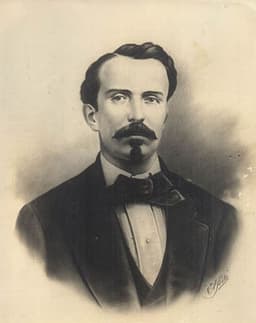
Carlos Manuel de Cespedes
Revolutionary · Modern
44.4Total

Napoleon Bonaparte
General · Modern
70.9Total
Basic Information
Born
1819
1769
Died
1874
1821
Era
Modern
Modern
Nationality
Cuba
France
Occupation
Revolutionary
General
Civilization
Western
Western
Score Comparison
Military (10%)
50.0
94.0
Political (20%)
27.9
72.0
Influence (20%)
58.0
40.0
Legacy (20%)
50.0
80.0
Leadership (15%)
30.0
78.0
Strategy (15%)
36.8
90.0
TOTAL
44.4
70.9
Carlos Manuel de Cespedes — Complete Timeline
1868 AD
Grito de Yara (1868)Political Action
Carlos Manuel de C
IndependenceRevolutionTen Years' War
Impact: nationalprogressive
1869 AD
President of the Republic in Arms (1869)Political Action◆ Major
Céspedes was elected President of the Republic of Cuba in Arms by the Assembly of Guáimaro. He led the rebel government during the early years of the Ten Years' War, advocating for independence and the abolition of slavery. His leadership was marked by internal divisions.
PresidencyRebel GovernmentWar
Impact: national
1873 AD
Deposed and Killed (1873-1874)Political Action◆ Major
Céspedes was deposed as president by the rebel assembly in 1873 due to disagreements over military strategy and political direction. He was killed in a skirmish with Spanish troops in 1874. His death made him a martyr for Cuban independence.
DepositionDeathMartyr
Impact: nationaltragic
Napoleon Bonaparte — Complete Timeline
1799 AD
Coup of 18 BrumaireOther◆ Major
Napoleon Bonaparte, with support from his brother Lucien and key political figures, overthrew the Directory in a bloodless coup. He established the Consulate with himself as First Consul, effectively becoming the ruler of France. This event ended the French Revolution's most unstable period.
French RevolutionCoupRise to Power
Impact: regional
1804 AD
Promulgation of the Napoleonic CodeOther◆ Major
Napoleon enacted the Civil Code of the French, known as the Napoleonic Code, a comprehensive set of laws that replaced the fragmented feudal legal systems. The code established legal equality, protected property rights, and secularized law. It became the basis for legal systems in many European and world countries.
Legal ReformNapoleonic CodeCivil Law
Impact: globalconstructive
1805 AD
Battle of AusterlitzWar◆ Major
Napoleon's Grande Arm
Napoleonic WarsBattleDecisive Victory
Impact: global
1812 AD
Invasion of RussiaWar◆ Major
Napoleon led the Grande Arm
Napoleonic WarsInvasionDisaster
Impact: globaldestructive
1815 AD
Battle of WaterlooWar◆ Major
Napoleon's French army was defeated by the combined forces of the Duke of Wellington's Anglo-Allied army and Gebhard Leberecht von Bl
Napoleonic WarsBattleFinal Defeat
Impact: globaldestructive
Expert Analysis
carlos-manuel-de-cespedes-vs-napoleon-bonaparte
# The Emperor and the Planter: Two Paths to Revolution
On an autumn morning in 1868, a wealthy sugar planter named Carlos Manuel de Céspedes stood before his slaves on the eastern edge of Cuba and offered them a choice: remain in chains under Spanish rule, or join him in a fight for freedom. He freed them on the spot. That same year, across the Atlantic, Napoleon Bonaparte had been dead for nearly half a century—but his shadow still stretched over Europe, a reminder of what one man could achieve with an army and a vision. How is it that one man conquered a continent and reshaped the modern world, while another, with equal passion for liberation, ended his life deposed and forgotten, a martyr to a cause that would take thirty more years to win?
Origins
Napoleon Bonaparte was born in 1769 on the island of Corsica, a Mediterranean backwater that had just been conquered by France. His family was minor nobility, poor but proud, and young Napoleon grew up speaking Italian-accented French, mocked by his classmates at military school. This outsider status forged in him a ruthless ambition: he would prove himself not by birth, but by brilliance. The French Revolution, which erupted when he was twenty, shattered the old order and opened doors that had been locked to men of his station. He walked through them.
Céspedes, born in 1819, came from a different world. His family was among Cuba’s planter elite, wealthy landowners who sent him to study law in Spain and travel across Europe. He was a man of ideas—a Mason, a liberal, a believer in Enlightenment principles. But Cuba in the mid-nineteenth century was a slave society, its economy built on sugar and human bondage. When Céspedes returned home, he saw a colony ruled by a decaying Spanish empire, its people divided by race and class. His revolution would not be a bid for personal power, but a desperate gamble to create a nation.
Rise to Power
Napoleon’s ascent was meteoric. In 1793, at just twenty-four, he drove the British out of Toulon and was promoted to brigadier general. By 1796 he commanded the Army of Italy, where his lightning campaigns humiliated the Austrians and made him a hero. In 1799 he seized power in a coup, becoming First Consul of France. By 1804 he crowned himself Emperor. Each step was calculated, each victory a stepping stone. He understood that in revolutionary France, legitimacy came from success.
Céspedes’s rise was slower, more tragic. For decades, Cuban separatists had plotted and failed. When Céspedes issued the *Grito de Yara* on October 10, 1868, from his plantation *La Demajagua*, he was not a general but a landowner with a few hundred poorly armed followers. He had no military experience, no foreign support, no clear strategy. What he had was moral authority: by freeing his slaves, he committed an act that could not be undone. The Ten Years’ War had begun.
Leadership & Governance
Napoleon governed as he fought: with speed, clarity, and total control. His Napoleonic Code, enacted in 1804, standardized French law across a fragmented nation, enshrining equality before the law while limiting women’s rights and restoring slavery in the colonies. He centralized the state, created a system of lycées, and rewarded talent over birth. His military genius lay in his ability to concentrate forces at the decisive point—as at Austerlitz in 1805, where he crushed the Russian and Austrian armies. But his political wisdom was flawed: he conquered too much, trusted too few, and never learned to compromise.
Céspedes, elected President of the Republic of Cuba in Arms in 1869 by the Assembly of Guáimaro, faced a different challenge. He had to hold together a rebel coalition of planters, peasants, free Blacks, and former slaves—each with conflicting visions. His military scores, 34 for military and 48.6 for strategy, reflect his weakness: he was a politician, not a soldier. He argued for a centralized command and a conventional army, but his generals preferred guerrilla warfare. He was deposed in 1873 by his own assembly, which accused him of authoritarianism and strategic incompetence. He died the next year, shot by Spanish soldiers, alone in the jungle.
Triumph & Tragedy
Napoleon’s greatest triumph was Austerlitz, where he annihilated the Third Coalition. His greatest tragedy was the invasion of Russia in 1812, a catastrophic overreach that cost him half a million men. He was exiled to Elba, returned, and was finally defeated at Waterloo in 1815. His tragedy was hubris—the belief that his will could bend the world.
Céspedes’s triumph was the *Grito de Yara* itself, a spark that ignited a war. His tragedy was that he could not finish it. The Ten Years’ War ended in 1878 with the Pact of Zanjón, which granted reforms but not independence. Céspedes was dead, his dream deferred. Yet his sacrifice made him the *Padre de la Patria*, the father of a nation that would not be born until 1898, with American help.
Character & Destiny
Napoleon was a man of iron will and endless energy, but also of deep insecurity. He needed to conquer, to prove his worth. His personality drove him to dominate Europe, but it also drove him to fall. “Glory is fleeting,” he once said, “but obscurity is forever.” He chose glory, and got both.
Céspedes was a man of principle, not of power. He could have fled, or compromised, or bargained with Spain. Instead, he gave up everything—his wealth, his family, his life—for an idea. His personality was that of a martyr, not a conqueror. And martyrs rarely win battles.
Legacy
Napoleon’s legacy is written in the laws, borders, and institutions of modern Europe. He is remembered as a genius and a tyrant, a liberator and a dictator. His scores—94 military, 93 strategy, 75 political—reflect a man who changed the world, even if he could not hold it.
Céspedes’s legacy is more intimate. He is a statue in Havana, a name on school buildings, a symbol of Cuban resistance. His scores—34 military, 53.3 political, 72.8 influence—tell the story of a man who failed in his own time but succeeded in history. He did not win the war, but he made victory possible.
Conclusion
Standing on his plantation in 1868, Céspedes could not have known that his war would drag on for a decade, that he would be betrayed by his own comrades, that Cuba would not be free until long after his death. And Napoleon, standing on the hill at Austerlitz in 1805, could not have known that his empire would crumble in ten years. Both men were driven by the same force—the belief that a single person could change the course of history. One conquered an empire. The other planted a seed. In the end, which is greater: the blaze or the spark?
Rankings
🥇
Napoleon BonaparteLeader
Mil: 94.0Pol: 72.0Inf: 40.0
70.9
🥈
Carlos Manuel de Cespedes
Mil: 50.0Pol: 27.9Inf: 58.0
44.4
+26.5 behind
How This Comparison Works
Algorithm
Each figure is scored on 6 dimensions (0—100 scale) based on structured historical data: Military (10%), Political (20%), Influence (20%), Legacy (20%), Leadership (15%), Strategy (15%). The weighted total produces the final ranking.
Data Sources
Scores are computed from structured sub-indicators in the database. Scale factors adjust for era (Ancient ×0.85, Modern ×1.0) and civilization size (Eastern ×1.05, Other ×0.80) to account for differences in population and military scale.
Maximum 3 Figures
Comparisons are limited to 2—3 figures to ensure readability and statistical meaningfulness.
Error Margins
±5 points per dimension — Sub-scores are derived from historical records with inherent uncertainty. Two figures within 5 points on a dimension should be considered roughly equivalent in that area.
Total Score Accuracy
±3 points overall — The weighted combination of 6 dimensions produces a total score with approximately ±3 points of uncertainty. Differences of less than 3 points are not statistically significant— the figures are effectively tied.
Known Limitations
- Historical records are incomplete and uneven across civilizations
- Figures from oral-tradition societies may be underrepresented
- Occupation labels can misclassify multi-role figures
- Scores measure capability and impact, not moral character
- Quantitative scoring is a comparison tool, not absolute truth
Capability Radar
Military (10%) — Battles & Warfare
Battles
30
95
Win Rate
25
90
Expansion
10
95
Political (20%) — Governance & Reform
Reform
40
95
Diplomacy
25
80
Economy
15
85
Influence (20%) — Cultural & Global Reach
Cultural
60
85
Global
50
90
Legacy (20%) — Historical Impact
Historical
65
95
Longevity
55
90
Leadership (15%) — Power & Stability
Tenure
30
85
Stability
10
70
Strategy (15%) — Tactics & Innovation
Strategy
25
95
Tactics
20
98
Reform
15
92
Similar Comparisons
Comments & Discussion
No comments yet. Be the first to share your thoughts!