Loading...
Bipin Rawat vs Prem Tinsulanonda
Prem Tinsulanonda leads by 2.2 pts · 2 figures compared
…
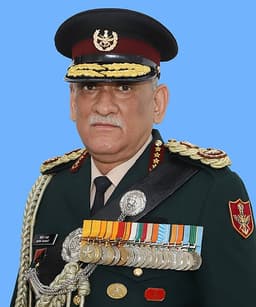
Bipin Rawat
General · Modern
55.0Total
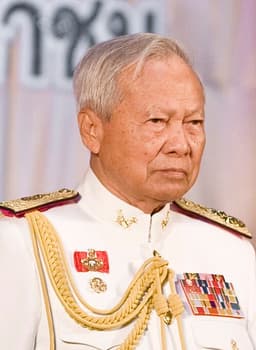
Prem Tinsulanonda
General · Modern
57.2Total
Basic Information
Born
1958
1920
Died
—
—
Era
Modern
Modern
Nationality
India
Thailand
Occupation
General
General
Civilization
Indian
Eastern
Score Comparison
Military (10%)
40.0
50.0
Political (20%)
68.0
59.3
Influence (20%)
59.0
54.9
Legacy (20%)
45.0
47.5
Leadership (15%)
62.0
78.0
Strategy (15%)
55.0
60.0
TOTAL
55.0
57.2
Bipin Rawat — Complete Timeline
2016 AD
Led Counter-Insurgency Operations in KashmirWar
As Army Chief, Rawat oversaw intensified counter-insurgency operations in Kashmir following the 2016 unrest. He advocated for a tough approach against militants, leading to increased military presence.
KashmirCounter-insurgencyMilitary Operations
Impact: regional
Served as Chief of Army StaffPolitical Action◆ Major
Rawat was appointed Chief of Army Staff in 2016. He oversaw operations in Jammu and Kashmir, including the 2016 surgical strikes across the Line of Control, and focused on counter-insurgency.
Army ChiefSurgical StrikesCounter-insurgency
Impact: national
2019 AD
Appointed First Chief of Defence Staff of IndiaPolitical Action
General Bipin Rawat was appointed as India's first Chief of Defence Staff (CDS), a new position created to integrate the three armed services. He was tasked with improving jointness and military efficiency.
CDSMilitary ReformIntegration
Impact: nationalconstructive
2021 AD
Died in Helicopter CrashOther◆ Major
General Rawat, his wife, and 11 others died in a helicopter crash in Tamil Nadu. The crash occurred while he was traveling to a military event, and an inquiry attributed it to weather and pilot error.
DeathAccidentHelicopter Crash
Impact: nationaltragic
Prem Tinsulanonda — Complete Timeline
1980 AD
Appointed Prime Minister after a coupPolitical Action◆ Major
Prem Tinsulanonda was appointed Prime Minister of Thailand by the military after a coup. He served for over eight years, overseeing a period of political stability and economic growth.
Prime MinisterMilitary RuleStability
Impact: national
1981 AD
Survived a coup attemptPolitical Action◆ Major
Prem survived a coup attempt by military officers loyal to the 'Young Turks' faction. The coup failed due to lack of support and the loyalty of key military units, allowing Prem to remain in power.
Coup AttemptPolitical CrisisMilitary
Impact: national
1988 AD
Resigned as Prime MinisterPolitical Action◆ Major
Prem resigned as Prime Minister after the general election, handing over power to a civilian government led by Chatichai Choonhavan. His resignation marked a rare peaceful transition of power in Thai politics.
ResignationDemocratic TransitionPeaceful
Impact: nationalconstructive
2016 AD
Appointed Regent of ThailandPolitical Action
After the death of King Bhumibol, Prem was appointed Regent of Thailand until the ascension of King Maha Vajiralongkorn. He served as a key figure in the transition of the monarchy.
RegentMonarchyTransition
Impact: national
Expert Analysis
Prem Tinsulanonda vs Bipin Rawat
# The General as Statesman: Prem Tinsulanonda and Bipin Rawat
On a sweltering April morning in 1981, a frail-looking man in a crisp white uniform stood before a television camera in Bangkok. Prem Tinsulanonda, then sixty-one, had just survived a coup attempt by the Young Turks, a faction of disgruntled military officers who had seized several government buildings. The prime minister’s response was not a call to arms but a quiet appeal to the nation’s loyalty to the throne. Within hours, the coup collapsed, its leaders fleeing into exile. Four decades later, on a misty December afternoon in 2021, another general, Bipin Rawat, boarded an Indian Air Force helicopter in Tamil Nadu. He was on his way to address students at the Defence Services Staff College. The helicopter never arrived. The crash that killed Rawat, his wife, and eleven others sent shockwaves through a nation that had come to see him as the architect of a new era in military integration. These two generals, both towering figures in their nations' modern histories, took radically different paths from soldier to statesman—one became a kingmaker who shaped Thailand’s fragile democracy, the other a reformer who died before his vision could fully unfold.
Origins
Prem Tinsulanonda was born in 1920 in Songkhla, a southern Thai province, into a family of Chinese descent that had long served the Siamese bureaucracy. His father was a minor official, his mother a teacher. The young Prem grew up in the shadow of absolute monarchy, a world that was already crumbling. By the time he joined the military academy in the 1930s, Thailand had become a constitutional monarchy, but the army remained the true arbiter of power. Prem’s rise was slow and methodical—he served in the cavalry, then in logistics, never commanding troops in battle. His genius lay not in warfare but in the politics of the officer corps, where he cultivated a reputation for integrity and loyalty to the crown.
Bipin Rawat, born in 1958 in Pauri Garhwal, a hill district of Uttarakhand, came from a military family. His father had served in the Indian Army, and the young Rawat absorbed the ethos of service and sacrifice from childhood. He joined the National Defence Academy, the elite cradle of India’s officer class, and was commissioned into the 5th Battalion of the 11th Gorkha Rifles. Unlike Prem, Rawat saw combat—he served in the 1987 Sino-Indian border skirmish, in counter-insurgency operations in Kashmir, and in the 1999 Kargil War. His path was forged in the crucible of fire, not in the corridors of political intrigue.
Rise to Power
Prem’s ascent to the premiership in 1980 was a product of Thailand’s turbulent politics. After a decade of military coups and fragile civilian governments, the army high command needed a leader who could stabilize the country. Prem, then Army Commander-in-Chief, was the compromise candidate—a general who was not obviously ambitious, who had no personal faction, and who enjoyed the trust of King Bhumibol Adulyadej. He was appointed prime minister in March 1980, after a bloodless coup, and immediately set about building a coalition of military, bureaucratic, and business elites. His survival of the 1981 coup attempt cemented his authority. He did not purge his enemies; he simply outlasted them.
Rawat’s rise was more conventional but equally dramatic. He was appointed Chief of Army Staff in 2016, at a time when India was grappling with a surge in cross-border terrorism from Pakistan. Rawat made headlines by advocating a tough line—he oversaw the 2016 surgical strikes across the Line of Control, a bold operation that was both a military success and a political statement. In 2019, Prime Minister Narendra Modi created the post of Chief of Defence Staff, a long-demanded reform to integrate the army, navy, and air force. Rawat was the natural choice. He became not just the first CDS but the face of a new, assertive military doctrine for a rising India.
Leadership & Governance
Prem’s leadership style was that of a bridge-builder. He governed through consensus, not command. During his eight years as prime minister, he navigated Thailand through economic growth and political stability, but he never sought to transform the country. His reforms were incremental: he strengthened the role of the monarchy as a unifying institution, encouraged foreign investment, and kept the military in check by giving it a seat at the table. His military score of 33.7 reflects his lack of battlefield experience, but his political score of 68.8 and leadership score of 89.0 reveal a master of the art of governance. He understood that in Thailand, power was not about winning wars but about managing relationships.
Rawat was the opposite. He was a reformer with a vision of a unified military—one that could fight modern wars across domains. As CDS, he pushed for the creation of joint theater commands, streamlined procurement, and broke down the silos between the army, navy, and air force. His military score of 45.8 and strategy score of 71.7 reflect a general who thought in terms of doctrine and structure. But he was also a political figure, with a score of 70.3, who did not hesitate to speak his mind. He once said, "We have to be prepared for a two-front war," a statement that alarmed diplomats but resonated with a public weary of border tensions. His leadership was assertive, sometimes controversial, and always purposeful.
Triumph & Tragedy
Prem’s greatest moment was not a battle but a resignation. In 1988, after winning a general election, he voluntarily stepped down as prime minister and handed power to a civilian government led by Chatichai Choonhavan. In a region where generals cling to power, this was extraordinary. Prem could have stayed; the military would have supported him. Instead, he chose to honor the democratic process. His tragedy was that the democracy he nurtured was fragile—within three years, another coup would overthrow the very government he had helped create.
Rawat’s triumph was the creation of the CDS post itself. He had achieved what generations of Indian generals had only dreamed of: a unified command structure that could coordinate air, land, and sea operations. His tragedy was that he died before he could see it through. The helicopter crash on December 8, 2021, cut short a career that was still in its prime. The investigation into the crash raised questions about safety and protocol, but the deeper tragedy was the loss of a leader who had the rare combination of vision and authority to push through reform.
Character & Destiny
Prem was a man of quiet ambition. He cultivated an image of humility—he lived simply, never married, and was known as "the bachelor prime minister." His loyalty to the king was absolute; he saw himself as a steward of the monarchy, not a ruler. This character shaped his destiny: he became regent of Thailand after King Bhumibol’s death in 2016, the ultimate symbol of his role as a guardian of the throne. He died at the age of 103, a living link to an era when generals could be statesmen.
Rawat was a man of fierce conviction. He was known for his blunt speeches, his impatience with bureaucracy, and his willingness to take risks. His character shaped his destiny: he was the right general for a moment when India was asserting itself on the global stage. But his bluntness also made enemies, and his death left a vacuum in India’s military reform that has yet to be filled.
Legacy
Prem is remembered in Thailand as a stabilizing force—a general who used power to preserve, not to dominate. His legacy is the Thai monarchy’s continued centrality in national life, a structure he helped reinforce. But critics note that his long tenure also entrenched military influence in politics, a pattern that would haunt Thailand for decades.
Rawat’s legacy is unfinished. He is celebrated as a visionary who laid the groundwork for military integration, but the joint theater commands he championed remain incomplete. His death elevated him to the status of a martyr for reform, a symbol of what might have been.
Conclusion
Standing at the crossroads of soldier and statesman, Prem Tinsulanonda and Bipin Rawat embody two answers to the same question: what does a general owe his country? Prem chose to govern by stepping back, to lead by not leading. Rawat chose to charge forward, to build even as he fought. One lived to see his legacy slowly fade into the background of a nation’s memory; the other died before his could fully take shape. In their different paths, they remind us that the greatest generals are not always those who win wars, but those who understand that true power lies in knowing when to wield it—and when to let it go.
Rankings
🥇
Prem TinsulanondaLeader
Mil: 50.0Pol: 59.3Inf: 54.9
57.2
🥈
Bipin Rawat
Mil: 40.0Pol: 68.0Inf: 59.0
55.0
+2.2 behind
How This Comparison Works
Algorithm
Each figure is scored on 6 dimensions (0—100 scale) based on structured historical data: Military (10%), Political (20%), Influence (20%), Legacy (20%), Leadership (15%), Strategy (15%). The weighted total produces the final ranking.
Data Sources
Scores are computed from structured sub-indicators in the database. Scale factors adjust for era (Ancient ×0.85, Modern ×1.0) and civilization size (Eastern ×1.05, Other ×0.80) to account for differences in population and military scale.
Maximum 3 Figures
Comparisons are limited to 2—3 figures to ensure readability and statistical meaningfulness.
Error Margins
±5 points per dimension — Sub-scores are derived from historical records with inherent uncertainty. Two figures within 5 points on a dimension should be considered roughly equivalent in that area.
Total Score Accuracy
±3 points overall — The weighted combination of 6 dimensions produces a total score with approximately ±3 points of uncertainty. Differences of less than 3 points are not statistically significant— the figures are effectively tied.
Known Limitations
- Historical records are incomplete and uneven across civilizations
- Figures from oral-tradition societies may be underrepresented
- Occupation labels can misclassify multi-role figures
- Scores measure capability and impact, not moral character
- Quantitative scoring is a comparison tool, not absolute truth
Capability Radar
Military (10%) — Battles & Warfare
Battles
45
20
Win Rate
50
25
Expansion
30
10
Political (20%) — Governance & Reform
Reform
55
55
Diplomacy
50
60
Economy
30
50
Influence (20%) — Cultural & Global Reach
Cultural
35
30
Global
30
30
Legacy (20%) — Historical Impact
Historical
40
40
Longevity
20
35
Leadership (15%) — Power & Stability
Tenure
40
65
Stability
45
60
Strategy (15%) — Tactics & Innovation
Strategy
65
30
Tactics
60
30
Reform
75
35
Similar Comparisons
Comments & Discussion
No comments yet. Be the first to share your thoughts!