Loading...
This comparison has not been analyzed yet.
One-time AI generation (~1 minute). Scores and timeline are already available below.
Bhagat Singh vs Juhayman al-Otaybi
Bhagat Singh leads by 2.6 pts · 2 figures compared
…
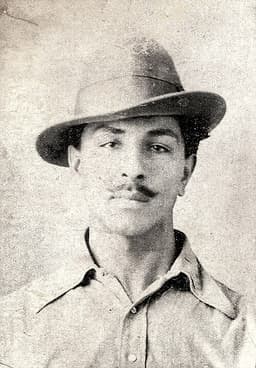
Bhagat Singh
Revolutionary · Modern
46.8Total

Juhayman al-Otaybi
Revolutionary · Modern
44.2Total
Basic Information
Born
1907
1936
Died
1931
—
Era
Modern
Modern
Nationality
India
Saudi Arabia
Occupation
Revolutionary
Revolutionary
Civilization
Indian
Middle Eastern
Score Comparison
Military (10%)
30.0
39.9
Political (20%)
25.0
35.0
Influence (20%)
61.0
45.5
Legacy (20%)
50.0
35.0
Leadership (15%)
65.0
62.6
Strategy (15%)
25.0
54.3
TOTAL
46.8
44.2
Bhagat Singh — Complete Timeline
1928 AD
Killing of John SaundersPolitical Action◆ Major
Bhagat Singh and his associates killed British police officer John Saunders in Lahore, mistaking him for James Scott, who had ordered the lathi charge that killed Lala Lajpat Rai. This act of revenge escalated the revolutionary movement.
AssassinationRevolutionary Action
Impact: national
1929 AD
Central Legislative Assembly BombingPolitical Action◆ Major
Bhagat Singh and Batukeshwar Dutt threw bombs in the Central Legislative Assembly in Delhi to protest the Public Safety Bill and Trade Disputes Act. They were arrested and used the trial to propagate revolutionary ideas.
ProtestRevolutionary Action
Impact: national
Hunger Strike in JailPolitical Action◆ Major
Bhagat Singh and fellow prisoners went on a 116-day hunger strike in Lahore jail demanding better treatment for political prisoners. The strike drew national attention and forced the British to make concessions.
ProtestPrison Reform
Impact: national
1931 AD
Execution by HangingPolitical Action◆ Major
Bhagat Singh was executed by hanging at Lahore jail at age 23, along with Rajguru and Sukhdev. His execution sparked widespread protests and made him a martyr for the Indian independence movement.
ExecutionMartyrdom
Impact: nationaltragic
Juhayman al-Otaybi — Complete Timeline
1978 AD
Publication of 'The Seven Letters'Cultural
Juhayman al-Otaybi wrote a series of letters criticizing the Saudi royal family for corruption, Westernization, and deviation from Islamic principles. These letters circulated underground and helped mobilize his followers for the Grand Mosque seizure.
IdeologyPropagandaReligious Criticism
Impact: nationaldestructive
1979 AD
Grand Mosque SeizureWar
Juhayman al-Otaybi led a group of armed followers in seizing the Grand Mosque in Mecca, declaring his brother-in-law as the Mahdi. The siege lasted two weeks, resulting in hundreds of deaths before Saudi forces recaptured the mosque with French assistance.
Religious ExtremismCrisisTerrorism
Impact: globaldestructive
1980 AD
Execution of Juhayman al-OtaybiPolitical Action◆ Major
After the Grand Mosque siege, Juhayman al-Otaybi was captured, tried, and publicly executed by beheading in Mecca along with 62 of his followers. The execution was intended to deter future challenges to the Saudi monarchy.
ExecutionJusticeDeterrence
Impact: nationaltragic
This comparison has not been analyzed yet.
One-time AI generation (~1 minute). Scores and timeline are already available below.
Rankings
🥇
Bhagat SinghLeader
Mil: 30.0Pol: 25.0Inf: 61.0
46.8
🥈
Juhayman al-Otaybi
Mil: 39.9Pol: 35.0Inf: 45.5
44.2
+2.6 behind
How This Comparison Works
Algorithm
Each figure is scored on 6 dimensions (0—100 scale) based on structured historical data: Military (10%), Political (20%), Influence (20%), Legacy (20%), Leadership (15%), Strategy (15%). The weighted total produces the final ranking.
Data Sources
Scores are computed from structured sub-indicators in the database. Scale factors adjust for era (Ancient ×0.85, Modern ×1.0) and civilization size (Eastern ×1.05, Other ×0.80) to account for differences in population and military scale.
Maximum 3 Figures
Comparisons are limited to 2—3 figures to ensure readability and statistical meaningfulness.
Error Margins
±5 points per dimension — Sub-scores are derived from historical records with inherent uncertainty. Two figures within 5 points on a dimension should be considered roughly equivalent in that area.
Total Score Accuracy
±3 points overall — The weighted combination of 6 dimensions produces a total score with approximately ±3 points of uncertainty. Differences of less than 3 points are not statistically significant— the figures are effectively tied.
Known Limitations
- Historical records are incomplete and uneven across civilizations
- Figures from oral-tradition societies may be underrepresented
- Occupation labels can misclassify multi-role figures
- Scores measure capability and impact, not moral character
- Quantitative scoring is a comparison tool, not absolute truth
Capability Radar
Military (10%) — Battles & Warfare
Battles
0
5
Win Rate
0
5
Expansion
0
5
Political (20%) — Governance & Reform
Reform
15
5
Diplomacy
5
5
Economy
0
5
Influence (20%) — Cultural & Global Reach
Cultural
55
20
Global
50
20
Legacy (20%) — Historical Impact
Historical
60
25
Longevity
55
15
Leadership (15%) — Power & Stability
Tenure
0
5
Stability
0
5
Strategy (15%) — Tactics & Innovation
Strategy
5
10
Tactics
10
15
Reform
0
5
Similar Comparisons
Comments & Discussion
No comments yet. Be the first to share your thoughts!