Loading...
Berengar II vs Louis XI of France
Louis XI of France leads by 23.3 pts · 2 figures compared
…
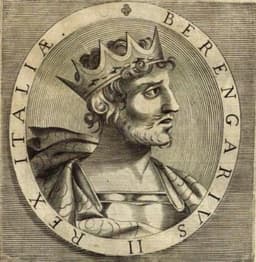
Berengar II
Emperor · Medieval
42.9Total
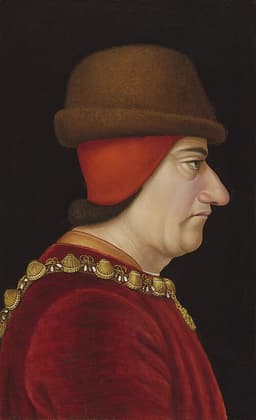
Louis XI of France
Emperor · Medieval
66.2Total
Basic Information
Born
900
1423
Died
966
1483
Era
Medieval
Medieval
Nationality
Italy
France
Occupation
Emperor
Emperor
Civilization
Western
Western
Score Comparison
Military (10%)
45.0
47.5
Political (20%)
30.8
78.0
Influence (20%)
49.4
65.0
Legacy (20%)
39.2
65.0
Leadership (15%)
51.9
78.0
Strategy (15%)
38.3
55.0
TOTAL
42.9
66.2
Berengar II — Complete Timeline
950 AD
Crowned King of ItalyPolitical Action◆ Major
Berengar II was crowned King of Italy in Pavia after the death of Lothair II. His rule was contested by the German king Otto I, who claimed the Italian throne through his marriage to Lothair's widow, Adelaide.
CoronationItalyKingship
Impact: regional
955 AD
Defeated by Otto I at the Battle of the LechfeldWar
Berengar II was defeated by Otto I at the Battle of the Lechfeld, where Otto also crushed the Magyars. This defeat forced Berengar to submit to Otto's suzerainty, reducing him to a vassal and ending independent Italian rule.
BattleOtto ISubmission
Impact: regionaltragic
962 AD
Rebellion against Otto IWar
Berengar II rebelled against Otto I's authority, attempting to regain full control of Italy. The rebellion failed, leading to Otto's second invasion of Italy and Berengar's eventual capture, solidifying Otto's control over the kingdom.
RebellionOtto IItaly
Impact: regionaldestructive
963 AD
Imprisonment by Otto IOther◆ Major
After a failed rebellion, Berengar II was captured by Otto I and imprisoned in Bamberg, Germany. He died in captivity in 966, marking the end of the independent Lombard kingdom of Italy and the beginning of direct German rule.
ImprisonmentItalyEnd of Independence
Impact: regionaltragic
Louis XI of France — Complete Timeline
1464 AD
Established the Postal ServiceReform
Louis XI established a royal postal service, creating a network of relay stations for rapid communication across France. This system improved administrative efficiency and royal control over the realm.
Postal ServiceAdministrationCommunication
Impact: nationalconstructive
1465 AD
Defeated the League of the Public WealWar◆ Major
Louis XI defeated the League of the Public Weal, a coalition of rebellious nobles led by the Duke of Burgundy and the Duke of Berry. The victory at the Battle of Montlh
Civil WarNobilityRoyal Authority
Impact: national
1469 AD
Imprisoned Cardinal BaluePolitical Action
Louis XI imprisoned his own minister, Cardinal Jean Balue, for treason after discovering his secret correspondence with Charles the Bold. Balue was held in an iron cage for over a decade, demonstrating Louis's ruthless treatment of disloyal officials.
ImprisonmentTreasonIron Cage
Impact: nationaldestructive
1474 AD
Supported the Swiss Confederacy against BurgundyWar
Louis XI provided financial and diplomatic support to the Swiss Confederacy in their war against Charles the Bold of Burgundy. This alliance contributed to Burgundy's defeat and the eventual collapse of the Burgundian state.
AllianceSwissBurgundian Wars
Impact: regionalconstructive
1475 AD
Signed the Treaty of PicquignyPolitical Action◆ Major
Louis XI signed the Treaty of Picquigny with King Edward IV of England, ending the Hundred Years' War. The treaty included a payment to Edward IV to withdraw his invading army, securing peace and saving France from invasion.
TreatyHundred Years' WarDiplomacy
Impact: regionalconstructive
1477 AD
Acquired the Duchy of BurgundyWar◆ Major
After the death of Charles the Bold at the Battle of Nancy, Louis XI seized the Duchy of Burgundy and other Burgundian territories. This acquisition significantly expanded the French crown's lands and reduced Burgundian power.
Territorial ExpansionBurgundyRoyal Domain
Impact: regionalconstructive
Expert Analysis
Origins
Berengar II, born around 900, was the grandson of Berengar I of Italy. He came from the Anscarid dynasty, a noble family with claims to the Italian throne. Little is known of his early education, but he grew up amid the turbulent politics of post-Carolingian Italy, where local nobles and foreign kings vied for control. Louis XI, born on July 3, 1423, at Bourges, was the son of Charles VII and Marie of Anjou. He was raised in the French court and received a thorough education in statecraft, but his relationship with his father was strained. Louis was known for his cunning and distrust of the nobility from an early age.
Rise to Power
Berengar II rose to power after the death of Lothair II in 950. He was crowned King of Italy in Pavia on December 15, 950, with the support of a faction of Italian nobles. However, his claim was contested by the German king Otto I, who saw Italy as part of his imperial ambitions. Berengar initially tried to secure his position by marrying his son Adalbert to Otto's widow, but this failed. In 951, Otto invaded Italy, forcing Berengar to submit. Berengar was allowed to keep his kingdom but as a vassal. Louis XI's rise was more complex. He became Dauphin in 1429 but frequently quarreled with his father. In 1440, he joined the Praguerie revolt against Charles VII. After the revolt failed, Louis was exiled to the Dauphiné, where he ruled independently. He succeeded his father on July 22, 1461, and immediately began to centralize power, reducing the influence of the nobility.
Leadership & Governance
Berengar II's leadership was marked by his attempts to maintain independence from the Holy Roman Empire. He governed through traditional feudal relationships, relying on the support of Italian nobles. However, his authority was weak; he faced constant challenges from rivals and foreign powers. His political score of 30.8 reflects his inability to consolidate power. Louis XI, by contrast, was a master of statecraft. He used diplomacy, intrigue, and strategic marriages to strengthen the French crown. He established a royal postal service in 1464 to improve communication. He also promoted commerce and industry. His political score of 78.0 indicates his effectiveness in centralizing France. Louis famously outmaneuvered the League of the Public Weal in 1465, a coalition of nobles led by Charles the Bold of Burgundy. He avoided open battle when possible, preferring negotiation and bribery.
Triumph & Tragedy
Berengar II's greatest triumph was his coronation as King of Italy, fulfilling his ambition to rule the peninsula. However, his reign was a series of failures. His rebellion against Otto I in 963 led to his capture and imprisonment in Bamberg, where he died in 966. His tragedy was that he could not resist the expanding power of the Holy Roman Empire. Louis XI's triumphs include the defeat of the League of the Public Weal, the Treaty of Picquigny in 1475 that ended English claims to French territory, and the acquisition of the Duchy of Burgundy in 1477 after Charles the Bold's death. These expanded French territory significantly. However, his reign also saw failures, such as his imprisonment of Cardinal Balue in 1469 for treason, which showed his paranoid nature. His later years were marked by fear of death and isolation.
Character & Destiny
Berengar II is often seen as a weak and indecisive ruler, unable to assert his authority. His military score of 45.0 and strategy score of 38.3 indicate his limitations as a commander. His destiny was to be the last independent king of Italy before the region became part of the Holy Roman Empire. Louis XI was known as the "Universal Spider" for his web of intrigue. He was patient, secretive, and ruthless. His leadership score of 78.0 and political score of 78.0 reflect his skill in manipulating people and events. His destiny was to unify France under a strong monarchy, laying the groundwork for the modern French state.
Legacy
Berengar II's legacy is minimal. He is remembered primarily as the last Italian king before Otto I's domination. His reign had little lasting impact; Italy remained fractured until the 19th century. His legacy score of 39.2 reflects his obscurity. Louis XI's legacy is substantial. He is considered one of the founders of modern France. His centralization of power reduced the influence of feudal nobles and expanded the royal domain. The postal service he established was a forerunner of modern systems. His reign marked the end of the Hundred Years' War and the beginning of France's rise as a major European power. His legacy score of 65.0 indicates his lasting influence.
Conclusion
Louis XI had a significantly greater impact than Berengar II. Louis scored 66.2 total, while Berengar scored 42.9, a gap of 23.3 points. Louis's political and leadership skills transformed France into a centralized state, while Berengar's weak rule led to the end of Italian independence. Louis's achievements—defeating the League of the Public Weal, acquiring Burgundy, and ending the Hundred Years' War—shaped European history for centuries. Berengar, by contrast, is a footnote in history. Thus, Louis XI is the more consequential figure.
Rankings
🥇
Louis XI of FranceLeader
Mil: 47.5Pol: 78.0Inf: 65.0
66.2
🥈
Berengar II
Mil: 45.0Pol: 30.8Inf: 49.4
42.9
+23.3 behind
How This Comparison Works
Algorithm
Each figure is scored on 6 dimensions (0—100 scale) based on structured historical data: Military (10%), Political (20%), Influence (20%), Legacy (20%), Leadership (15%), Strategy (15%). The weighted total produces the final ranking.
Data Sources
Scores are computed from structured sub-indicators in the database. Scale factors adjust for era (Ancient ×0.85, Modern ×1.0) and civilization size (Eastern ×1.05, Other ×0.80) to account for differences in population and military scale.
Maximum 3 Figures
Comparisons are limited to 2—3 figures to ensure readability and statistical meaningfulness.
Error Margins
±5 points per dimension — Sub-scores are derived from historical records with inherent uncertainty. Two figures within 5 points on a dimension should be considered roughly equivalent in that area.
Total Score Accuracy
±3 points overall — The weighted combination of 6 dimensions produces a total score with approximately ±3 points of uncertainty. Differences of less than 3 points are not statistically significant— the figures are effectively tied.
Known Limitations
- Historical records are incomplete and uneven across civilizations
- Figures from oral-tradition societies may be underrepresented
- Occupation labels can misclassify multi-role figures
- Scores measure capability and impact, not moral character
- Quantitative scoring is a comparison tool, not absolute truth
Capability Radar
Military (10%) — Battles & Warfare
Battles
35
45
Win Rate
30
50
Expansion
20
60
Political (20%) — Governance & Reform
Reform
20
80
Diplomacy
30
90
Economy
25
75
Influence (20%) — Cultural & Global Reach
Cultural
15
60
Global
10
65
Legacy (20%) — Historical Impact
Historical
20
80
Longevity
15
75
Leadership (15%) — Power & Stability
Tenure
45
85
Stability
20
70
Strategy (15%) — Tactics & Innovation
Strategy
25
70
Tactics
30
55
Reform
10
65
Similar Comparisons
Comments & Discussion
No comments yet. Be the first to share your thoughts!