Loading...
Bayinnaung vs Pedro I of Brazil
Bayinnaung leads by 14.0 pts · 2 figures compared
…
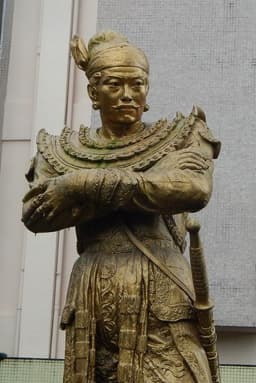
Bayinnaung
Emperor · Modern
68.6Total
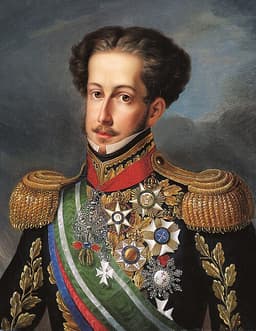
Pedro I of Brazil
Emperor · Modern
54.6Total
Basic Information
Born
1516
1798
Died
1581
1834
Era
Modern
Modern
Nationality
Myanmar
Brazil
Occupation
Emperor
Emperor
Civilization
Eastern
Western
Score Comparison
Military (10%)
77.1
55.0
Political (20%)
82.0
62.7
Influence (20%)
65.0
59.0
Legacy (20%)
55.0
50.0
Leadership (15%)
74.0
53.2
Strategy (15%)
75.0
45.0
TOTAL
68.6
54.6
Bayinnaung — Complete Timeline
1550 AD
Establishment of the Toungoo EmpirePolitical Action
King Bayinnaung ascended the throne and began a series of military campaigns that created the largest empire in Southeast Asian history. At its peak, the Toungoo empire covered modern Myanmar, Thailand, Laos, and parts of China and India.
Toungoo EmpireSoutheast AsiaImperial Expansion
Impact: regionalconstructive
1557 AD
Conquest of the Shan StatesWar◆ Major
King Bayinnaung conquered the Shan States, bringing them under Toungoo control. This expansion added significant territory and resources to the Burmese empire.
Shan StatesToungoo ExpansionBurmese Empire
Impact: regional
1569 AD
Capture of AyutthayaWar
King Bayinnaung's forces captured the Siamese capital of Ayutthaya after a long siege. He installed a vassal king and made Siam a tributary state of the Toungoo empire.
Burmese-Siamese WarAyutthayaToungoo Empire
Impact: regional
1570 AD
Administrative ReformsReform◆ Major
King Bayinnaung implemented administrative reforms to govern his vast empire, including the appointment of governors and the standardization of laws and taxes. These reforms helped maintain control over conquered territories.
GovernanceAdministrationToungoo Empire
Impact: regionalconstructive
1574 AD
Conquest of Lan XangWar◆ Major
King Bayinnaung conquered the Lao kingdom of Lan Xang (modern Laos), bringing it under Toungoo control. This further expanded the Burmese empire to its greatest territorial extent.
Lan XangToungoo ExpansionLaos
Impact: regional
Pedro I of Brazil — Complete Timeline
1822 AD
Declaration of Independence of BrazilPolitical Action
Pedro I declared Brazil's independence from Portugal on September 7, 1822, at the Ipiranga River in S
Impact: globalprogressive
Coronation as Emperor of BrazilPolitical Action◆ Major
Pedro I was crowned Emperor of Brazil on December 1, 1822, in Rio de Janeiro. The coronation formalized the new imperial government, with Pedro I as constitutional monarch, though he retained significant executive powers.
Impact: nationalconstructive
1823 AD
War of Independence of BrazilWar◆ Major
Pedro I led Brazilian forces against Portuguese loyalists in the War of Independence. Key battles occurred in Bahia, Maranh
Impact: national
Dissolution of the Constituent AssemblyPolitical Action◆ Major
Pedro I dissolved the Constituent Assembly after conflicts over the constitution's limits on imperial power. He then imposed the 1824 Constitution, which granted the emperor extensive powers, including the Moderating Power, centralizing authority.
Impact: nationaldestructive
1831 AD
Abdication of the Brazilian ThronePolitical Action
Pedro I abdicated the Brazilian throne in favor of his five-year-old son Pedro II on April 7, 1831. He returned to Portugal to claim the Portuguese throne, leaving Brazil under a regency until his son came of age.
Impact: national
Expert Analysis
Pedro I of Brazil vs Bayinnaung
The Conqueror and the Liberator
On a humid morning in 1569, King Bayinnaung of the Toungoo dynasty stood before the shattered gates of Ayutthaya, the glittering capital of Siam. His war elephants, draped in gold and iron, had trampled the last resistance. Within a decade, he would command an empire stretching from the borders of India to the shores of the South China Sea—the largest Southeast Asia had ever seen. Nearly 250 years later and half a world away, another emperor, Pedro I of Brazil, stood on the banks of the Ipiranga River in São Paulo, drew his sword, and shouted “Independência ou Morte!”—Independence or Death. One man built an empire through conquest; the other tore an empire apart to build a nation. What drove these two emperors, born into such different worlds, to such different destinies?
Origins
Bayinnaung was born in 1516, the son of a minor noble in the fractious kingdom of Toungoo. His era was one of chaos and opportunity: the great Burmese kingdom of Ava had collapsed, and rival city-states warred endlessly. Young Bayinnaung grew up in the shadow of his brother-in-law, King Tabinshwehti, learning the arts of war and statecraft in a world where only the strong survived. His was a civilization steeped in Theravada Buddhism, where kings were seen as future Buddhas, and where the Mandala system—a web of shifting alliances and vassalages—demanded constant expansion to hold power.
Pedro I, born in 1798, entered a world transformed by the Enlightenment and the Napoleonic Wars. He was the son of King John VI of Portugal, raised in the royal court of Rio de Janeiro, to which the entire Portuguese monarchy had fled in 1807 to escape Napoleon’s armies. Brazil was not a colony in the traditional sense; it was the seat of an empire. Young Pedro received a haphazard education, more interested in horses and women than books, but he absorbed the liberal ideals swirling through Europe and the Americas. His era was one of revolutions—American, French, Haitian—where the very idea of monarchy was under siege.
Rise to Power
Bayinnaung’s path to power was forged in blood. When Tabinshwehti was assassinated in 1550, the kingdom fractured. Bayinnaung, then a general, did not hesitate. He crushed the rebels, executed the usurpers, and within months had secured the throne. His rise was a matter of survival: in the Toungoo world, a weak king was a dead king. He spent the next three decades on horseback, leading armies into the Shan States in 1557, into Lan Xang in 1574, and against Ayutthaya in 1569. Each victory was not merely a conquest but a reaffirmation of his right to rule.
Pedro I’s rise was more paradoxical. In 1821, his father King John VI returned to Portugal, leaving Pedro as regent in Brazil. The Portuguese parliament, seeking to recolonize Brazil, ordered Pedro home. He refused. On September 7, 1822, at the Ipiranga River, he declared Brazil independent and, two months later, crowned himself emperor. His rise was not a conquest but a negotiation—a delicate dance between Brazilian elites who wanted autonomy, Portuguese loyalists who wanted control, and his own ambitions. He was crowned not on a battlefield but in a cathedral, with a constitution in hand.
Leadership & Governance
Bayinnaung ruled as a conqueror-king. His military genius lay in logistics and organization: he could field armies of 50,000 men across jungles and rivers, supply them for months, and coordinate sieges that lasted years. But his political wisdom was equally formidable. After conquering the Shan States in 1557, he did not destroy their rulers; he made them vassals, requiring tribute and military service while allowing local customs to continue. In Ayutthaya, he installed a puppet king and left the Siamese bureaucracy intact. His 1570 administrative reforms appointed governors to oversee provinces, standardizing taxes and laws across a realm of dozens of ethnic groups. Yet his empire was a pyramid of loyalty, not institutions. When Bayinnaung died, the pyramid crumbled.
Pedro I governed as a liberal autocrat—a contradiction that would destroy him. He granted Brazil a constitution in 1824 that guaranteed civil rights, a parliament, and limits on royal power. Yet he dissolved the Constituent Assembly in 1823 when it tried to impose stricter limits, and he frequently bypassed parliament. He fought the War of Independence in 1823 against Portuguese holdouts, leading troops personally in Bahia, but he was no great strategist—his score of 50.0 in strategy reflects a man who relied more on charisma than cunning. His political score of 60.2, compared to Bayinnaung’s 85.1, reveals a ruler who could not master the art of compromise.
Triumph & Tragedy
Bayinnaung’s greatest triumph was the empire itself—a domain that, at its peak in 1574, covered modern Myanmar, Thailand, Laos, and parts of China and India. He built pagodas, patronized Buddhist monks, and saw himself as a Chakravartin, a universal ruler. His tragedy was that he could not create institutions to outlast him. Within decades of his death in 1581, the empire shattered into warring states, and Ayutthaya regained its independence.
Pedro I’s triumph was Brazil itself. He gave the country independence without the bloody wars that ravaged Spanish America. He kept it united as a monarchy when republics were fragmenting. His tragedy was personal: he could not reconcile his Portuguese heritage with his Brazilian throne. In 1831, after years of conflict with parliament and public outrage over his affair with the Marchioness of Santos, he abdicated in favor of his five-year-old son, Pedro II. He returned to Portugal, where he died in 1834, a man without a country.
Character & Destiny
Bayinnaung was relentless, disciplined, and visionary. He once said, “A king who does not conquer is not a king.” His personality was that of a builder—not of buildings, but of order. He believed in hierarchy, loyalty, and the sword. His destiny was to expand until he could expand no more, then watch his creation dissolve.
Pedro I was impulsive, romantic, and torn. He wrote poetry, played the flute, and fell in love easily. He believed in liberty but could not share power. His destiny was to be a bridge between two worlds—the old monarchy of Europe and the new republics of the Americas—and to be crushed by both.
Legacy
Bayinnaung is remembered in Myanmar as the greatest king of the Toungoo dynasty, a national hero who unified the land. His legacy score of 73.0 reflects a figure revered but not replicated; his empire was a flash of lightning in a storm. In Thailand, he is remembered as the conqueror of Ayutthaya, a symbol of Burmese power.
Pedro I is remembered as the father of Brazilian independence, his cry at Ipiranga etched into national memory. His legacy score of 70.0 reflects a founder who gave Brazil its start but not its shape. His son, Pedro II, would reign for nearly fifty years, building the stable institutions his father could not.
Conclusion
Both men were emperors, but they ruled different worlds. Bayinnaung conquered an empire; Pedro I liberated one. One built on blood and vassalage; the other on ink and constitutions. Yet both shared a common fate: they were men of their time, shaped by forces beyond their control. Bayinnaung’s empire collapsed because it was a pyramid of loyalty; Pedro’s throne collapsed because it was a bridge between eras. In the end, the conqueror and the liberator both learned that the hardest thing to rule is not a kingdom—but yourself.
Rankings
🥇
BayinnaungLeader
Mil: 77.1Pol: 82.0Inf: 65.0
68.6
🥈
Pedro I of Brazil
Mil: 55.0Pol: 62.7Inf: 59.0
54.6
+14.0 behind
How This Comparison Works
Algorithm
Each figure is scored on 6 dimensions (0—100 scale) based on structured historical data: Military (10%), Political (20%), Influence (20%), Legacy (20%), Leadership (15%), Strategy (15%). The weighted total produces the final ranking.
Data Sources
Scores are computed from structured sub-indicators in the database. Scale factors adjust for era (Ancient ×0.85, Modern ×1.0) and civilization size (Eastern ×1.05, Other ×0.80) to account for differences in population and military scale.
Maximum 3 Figures
Comparisons are limited to 2—3 figures to ensure readability and statistical meaningfulness.
Error Margins
±5 points per dimension — Sub-scores are derived from historical records with inherent uncertainty. Two figures within 5 points on a dimension should be considered roughly equivalent in that area.
Total Score Accuracy
±3 points overall — The weighted combination of 6 dimensions produces a total score with approximately ±3 points of uncertainty. Differences of less than 3 points are not statistically significant— the figures are effectively tied.
Known Limitations
- Historical records are incomplete and uneven across civilizations
- Figures from oral-tradition societies may be underrepresented
- Occupation labels can misclassify multi-role figures
- Scores measure capability and impact, not moral character
- Quantitative scoring is a comparison tool, not absolute truth
Capability Radar
Military (10%) — Battles & Warfare
Battles
85
35
Win Rate
90
40
Expansion
92
30
Political (20%) — Governance & Reform
Reform
70
45
Diplomacy
78
50
Economy
72
30
Influence (20%) — Cultural & Global Reach
Cultural
70
40
Global
55
45
Legacy (20%) — Historical Impact
Historical
75
55
Longevity
60
50
Leadership (15%) — Power & Stability
Tenure
85
55
Stability
65
25
Strategy (15%) — Tactics & Innovation
Strategy
88
35
Tactics
80
30
Reform
75
20
Similar Comparisons
Comments & Discussion
Lion of Ava6/16/2026
Bayinnaung's empire dwarfed Pedro's Brazil by every metric—2 million square kilometers against 8 million. But here's the kicker: Bayinnaung held it together for decades through a sophisticated vassal system, while Pedro's "empire" was a paper tiger that shattered into civil war within 15 years of his abdication. True empire builders don't run from a fight.
永恒征服者6/16/2026
佩德罗一世算什么皇帝?他宣称“独立或死亡”时,巴西还是葡萄牙的殖民地,而他本人就是葡萄牙王子!这就像说你自己打败了自己。真正的征服者如莽应龙,从底层崛起,用血肉之躯和战象踏平了半个东南亚。佩德罗不过是个穿着制服的傀儡,而莽应龙才是铁与血的化身。
Data Skeptic6/16/2026
Let's talk numbers. Bayinnaung's Burma had maybe 4 million people at its peak; Pedro's Brazil had 4.5 million in 1822. Yet Bayinnaung is called a "conqueror" for taking a few walled cities. Pedro actually mobilized 100,000+ troops to fight Portugal and kept his country united. Give me a break with the elephant-worship—brains beat brawn.
怀旧史诗家6/16/2026
我站在莽应龙这边。他的帝国覆盖了今天的缅甸、泰国、老挝和柬埔寨,而佩德罗的巴西连阿根廷都打不过。莽应龙在1570年攻陷阿瑜陀耶时,展现了真正的军事天才——用战象阵突破城墙,而佩德罗只是在河边喊了个口号。历史记住了英雄,而不是喊口号的王子。
Revisionist Critique6/16/2026
Calling Bayinnaung a "future Buddha" is just post-hoc royal propaganda from a dynasty that killed millions in endless wars. Pedro I actually abolished slavery in his first decade—well, banned the slave trade anyway. Bayinnaung's "empire" was built on the backs of forcibly conscripted peasants who died building pagodas for his ego. Let's stop romanticizing bloodthirsty conquerors.