Loading...
Antonio Lopez de Santa Anna vs Shi Dakai
Shi Dakai leads by 0.7 pts · 2 figures compared
…
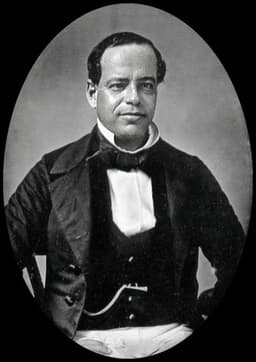
Antonio Lopez de Santa Anna
General · Modern
58.9Total
Shi Dakai
General · Modern
59.6Total
Basic Information
Born
1794
1831
Died
1876
1863
Era
Modern
Modern
Nationality
Mexico
China
Occupation
General
General
Civilization
Western
Eastern
Score Comparison
Military (10%)
70.0
76.0
Political (20%)
46.6
45.0
Influence (20%)
56.7
56.7
Legacy (20%)
58.0
54.0
Leadership (15%)
68.0
72.0
Strategy (15%)
60.0
68.1
TOTAL
58.9
59.6
Antonio Lopez de Santa Anna — Complete Timeline
1823 AD
Led the Plan of Casa Mata rebellionPolitical Action
Santa Anna, then a general, issued the Plan of Casa Mata on February 1, 1823, calling for the overthrow of Emperor Agust
RebellionOverthrowRepublic
Impact: nationalconstructive
1829 AD
Defended Mexico at the Battle of TampicoWar◆ Major
Santa Anna commanded Mexican forces that defeated a Spanish invasion force at Tampico on September 11, 1829. The victory ended Spain's last attempt to reconquer Mexico and made Santa Anna a national hero. He was hailed as the 'Hero of Tampico' and used this fame to advance politically.
VictorySpanish InvasionNational Hero
Impact: nationalconstructive
1833 AD
Became President of Mexico for the first timePolitical Action◆ Major
Santa Anna was elected President of Mexico in 1833. He quickly delegated power to Vice President Valent
PresidencyPolitical InstabilityPower
Impact: national
1836 AD
Commanded at the Siege of the AlamoWar◆ Major
Santa Anna personally led the Mexican army in the siege of the Alamo mission in San Antonio, Texas. After a 13-day siege, Mexican forces stormed the fort on March 6, 1836, killing all 180-250 Texan defenders. The battle became a symbol of Texan resistance and a rallying cry for independence.
BattleTexas RevolutionAlamo
Impact: regionaldestructive
Defeated and captured at the Battle of San JacintoWar
Santa Anna's army was surprised and routed by Texan forces under Sam Houston at the Battle of San Jacinto on April 21, 1836. Santa Anna was captured the next day. He was forced to sign the Treaties of Velasco, recognizing Texan independence, though Mexico later repudiated them.
DefeatCaptureTexas Independence
Impact: regionaltragic
1847 AD
Lost the Mexican-American WarWar
Santa Anna returned from exile to command Mexican forces during the Mexican-American War. Despite initial efforts, his army was defeated at the Battle of Cerro Gordo and later at the Battle of Chapultepec. US forces captured Mexico City on September 14, 1847, leading to the Treaty of Guadalupe Hidalgo and massive territorial losses.
Mexican-American WarDefeatTerritorial Loss
Impact: globaltragic
1853 AD
Sold La Mesilla to the United StatesPolitical Action◆ Major
During his final presidency, Santa Anna agreed to the Gadsden Purchase, selling 29,670 square miles of territory (La Mesilla) to the United States for $10 million. The sale was widely condemned in Mexico as a betrayal. This act further damaged his reputation and led to his overthrow.
Territorial CessionGadsden PurchaseBetrayal
Impact: nationaldestructive
1855 AD
Overthrown and exiled for the final timePolitical Action◆ Major
The Plan of Ayutla, led by Juan
OverthrowExileEnd of Career
Impact: nationaltragic
Shi Dakai — Complete Timeline
1851 AD
Jintian UprisingWar◆ Major
Shi Dakai joined the Taiping Rebellion at its inception in Jintian, Guangxi. As a core leader, he helped organize the rebel forces and was appointed Wing King, becoming one of the key military commanders of the Taiping Heavenly Kingdom.
Taiping RebellionUprisingMilitary Command
Impact: national
1854 AD
Battle of XiangtanWar◆ Major
Shi Dakai led Taiping forces to a major victory at Xiangtan, Hunan, defeating Qing imperial troops. This battle secured Taiping control over key territories in the Yangtze River valley and demonstrated his military skill.
Taiping RebellionBattleVictory
Impact: regional
1856 AD
Tianjing IncidentPolitical Action
Shi Dakai returned to Tianjing (Nanjing) after the internal purge of the Eastern King Yang Xiuqing and the murder of the Northern King Wei Changhui. He condemned the violence and was forced to flee, leading to a split in Taiping leadership.
Taiping RebellionInternal ConflictPurge
Impact: nationaltragic
1858 AD
Campaign in Zhejiang and FujianWar
Shi Dakai led a separate Taiping army into Zhejiang and Fujian provinces, capturing several cities. This campaign expanded Taiping influence into southeastern China but also isolated his forces from the main Taiping base.
Taiping RebellionCampaignExpansion
Impact: regional
1863 AD
Battle of Baishui RiverWar◆ Major
Shi Dakai's army was trapped and defeated by Qing forces at the Baishui River in Sichuan. He was captured and executed shortly after, marking the end of his military career and a significant loss for the Taiping cause.
Taiping RebellionBattleDefeatDeath
Impact: nationaltragic
Expert Analysis
Shi Dakai vs Antonio Lopez de Santa Anna
# The General Who Lost Everything
On a spring morning in 1836, two men stood at the pinnacle of their power, each convinced that destiny had chosen them. Antonio López de Santa Anna, the self-styled “Napoleon of the West,” surveyed the smoldering ruins of the Alamo with grim satisfaction. He had crushed the Texan rebels, taught them a lesson they would not forget. Half a world away, in the same decade, a young prodigy named Shi Dakai was earning his first laurels on battlefields that would soon make him the most feared commander in China. Both were generals. Both would lead revolutions. But one would die in exile, reviled by his own people, while the other would march into execution singing a song of defiance. The difference was not in talent—it was in the choices that character forced upon them.
Origins
Santa Anna was born in 1794 in Jalapa, Veracruz, into a Spanish colonial family of modest means. He joined the army at fifteen, a young man in a world where loyalty meant little and opportunity meant everything. Mexico was a colony straining against its chains, and Santa Anna learned early that the secret to power was not principle but timing. He served both Spanish royalists and Mexican rebels, changing sides with a pragmatism that would define his career.
Shi Dakai, born in 1831 in Guangxi, came from a different world entirely. His family was Hakka, a minority group that had long suffered discrimination under the Qing Dynasty. Well-educated and deeply Confucian, Shi was a scholar as much as a soldier. He joined the Taiping Rebellion at its beginning in 1851, not for personal advancement but because he believed in a vision: a new dynasty, a new society, a Heavenly Kingdom on earth. Where Santa Anna saw politics as a game, Shi saw it as a crusade.
Rise to Power
Santa Anna’s path to prominence was paved with rebellions. In 1823, he issued the Plan of Casa Mata, calling for the overthrow of Emperor Agustín de Iturbide. The plan succeeded, and Santa Anna became a hero. His military reputation soared in 1829 when he defeated a Spanish invasion force at the Battle of Tampico. The victory was genuine, and it made him untouchable. By 1833, he was president of Mexico.
Shi Dakai’s rise was faster and more dramatic. At the Jintian Uprising in 1851, he was already a core leader, barely twenty years old. His military brilliance emerged immediately. At the Battle of Xiangtan in 1854, he crushed Qing imperial troops with a combination of speed and tactical deception that left his enemies bewildered. The Taiping Heavenly Kingdom, led by Hong Xiuquan, recognized his genius by naming him the “Wing King”—a title that captured both his strategic reach and his soaring ambition.
Leadership & Governance
Santa Anna governed Mexico as a personal possession. He was president eleven times, each time stepping in when crisis demanded a strongman, each time stepping out when the burden of governance became tedious. He delegated power to Vice President Valentín Gómez Farías, then overthrew him when reform threatened his interests. His leadership was transactional: alliances were tools, never commitments. His military strategy was aggressive but brittle, relying on overwhelming force rather than patient maneuver.
Shi Dakai governed differently. In the territories he controlled, he implemented land reforms, reduced taxes, and promoted education. He was a rare figure in the Taiping court: a man of principle who could also compromise. His military strategy was the opposite of Santa Anna’s. He used speed, surprise, and terrain. He avoided pitched battles when possible, preferring to outmaneuver his enemies. At the Battle of Baishui River in 1863, even in defeat, his tactics were so skillful that Qing generals later studied his campaigns as textbooks.
Triumph & Tragedy
Santa Anna’s greatest moment was the Alamo in 1836. For thirteen days, his army besieged a tiny mission in San Antonio, and when the walls finally fell, he ordered no quarter. It was a tactical victory and a strategic disaster. The massacre turned the Texan rebellion into a war of vengeance. Forty-six days later, at the Battle of San Jacinto, Sam Houston’s outnumbered force surprised Santa Anna’s army during a siesta. He was captured, humiliated, and forced to sign away Texas.
Shi Dakai’s tragedy was the Tianjing Incident of 1856. The Taiping leadership tore itself apart in a bloody purge. The Eastern King, Yang Xiuqing, was murdered. The Northern King, Wei Changhui, massacred thousands. Shi Dakai returned to the capital to stop the bloodshed, but Wei turned on him, slaughtering his entire family. Shi escaped but was broken. He could have seized power—many urged him to—but he chose loyalty to the Taiping cause over personal revenge. He left the capital and led a separate army into the western provinces, a wandering king seeking a new kingdom.
Character & Destiny
Santa Anna’s character was his undoing. He was vain, impulsive, and incapable of learning from defeat. After losing Texas, he returned to power, lost the Mexican-American War in 1847, and then, in 1853, sold 29,670 square miles of territory to the United States in the Gadsden Purchase—a betrayal that Mexicans have never forgotten. He was overthrown in 1855 by the Plan of Ayutla and fled into exile, dying in 1876 in poverty and obscurity.
Shi Dakai’s character was his redemption. In 1863, trapped by Qing forces at the Baishui River in Sichuan, he could have fought to the last man. Instead, he negotiated: he would surrender if his surviving soldiers were spared. The Qing agreed, then executed him anyway. As he was led to his death, he reportedly sang a poem, accepting his fate with a calm dignity that moved even his executioners.
Legacy
Santa Anna is remembered in Mexico as a traitor and a fool. His name appears in history books as a cautionary tale: the general who lost half his country. The Alamo, which he considered his greatest victory, is now a shrine to the men he killed. His legacy is a monument to failure.
Shi Dakai is remembered in China as a tragic hero. The Taiping Rebellion ultimately failed, crushed by Qing forces in 1864, but Shi’s name survives as a symbol of loyalty, brilliance, and sacrifice. Historians rank his military score at 84.6, far above Santa Anna’s 66.3, and his strategic score at 81.6 against Santa Anna’s 59.4. The numbers tell the story: one man fought for a cause, the other for himself.
Conclusion
In the end, the difference between Santa Anna and Shi Dakai was not talent or circumstance. Both were gifted. Both faced impossible odds. But one saw power as an end in itself, while the other saw power as a means to something greater. Santa Anna died alone, a man who had everything and lost it all. Shi Dakai died singing, a man who had nothing but his honor and kept it to the end. History does not remember the winners. It remembers those who, in losing, never lost themselves.
Rankings
🥇
Shi DakaiLeader
Mil: 76.0Pol: 45.0Inf: 56.7
59.6
🥈
Antonio Lopez de Santa Anna
Mil: 70.0Pol: 46.6Inf: 56.7
58.9
+0.7 behind
How This Comparison Works
Algorithm
Each figure is scored on 6 dimensions (0—100 scale) based on structured historical data: Military (10%), Political (20%), Influence (20%), Legacy (20%), Leadership (15%), Strategy (15%). The weighted total produces the final ranking.
Data Sources
Scores are computed from structured sub-indicators in the database. Scale factors adjust for era (Ancient ×0.85, Modern ×1.0) and civilization size (Eastern ×1.05, Other ×0.80) to account for differences in population and military scale.
Maximum 3 Figures
Comparisons are limited to 2—3 figures to ensure readability and statistical meaningfulness.
Error Margins
±5 points per dimension — Sub-scores are derived from historical records with inherent uncertainty. Two figures within 5 points on a dimension should be considered roughly equivalent in that area.
Total Score Accuracy
±3 points overall — The weighted combination of 6 dimensions produces a total score with approximately ±3 points of uncertainty. Differences of less than 3 points are not statistically significant— the figures are effectively tied.
Known Limitations
- Historical records are incomplete and uneven across civilizations
- Figures from oral-tradition societies may be underrepresented
- Occupation labels can misclassify multi-role figures
- Scores measure capability and impact, not moral character
- Quantitative scoring is a comparison tool, not absolute truth
Capability Radar
Military (10%) — Battles & Warfare
Battles
65
75
Win Rate
40
70
Expansion
50
75
Political (20%) — Governance & Reform
Reform
20
50
Diplomacy
35
45
Economy
15
40
Influence (20%) — Cultural & Global Reach
Cultural
55
55
Global
50
40
Legacy (20%) — Historical Impact
Historical
60
60
Longevity
55
45
Leadership (15%) — Power & Stability
Tenure
75
55
Stability
10
35
Strategy (15%) — Tactics & Innovation
Strategy
45
80
Tactics
60
85
Reform
30
60
Similar Comparisons
Comments & Discussion
HISTORY'S SCAPEGOAT6/16/2026
Santa Anna didn't lose everything; he was set up by a nation that needed a villain. Name one Mexican general who could've held together that fractured country while fighting the US, France, and internal revolts simultaneously. His amputated leg was buried with full military honors—show me another leader who got that treatment after losing. Shi Dakai's the real failure; he let Taiping idealism blind him to Qing resilience, surrendering in 1863 when escape was still possible. Santa Anna at least k
帝国之哀6/16/2026
石达开比圣塔安纳更悲壮——我查过史料,天京事变后石达开带走十万精兵,本可自立为王,却因对洪秀全的愚忠选择西征,最终在大渡河被围。而圣塔安纳呢?在阿拉莫之后仅仅六周,圣哈辛托战役就被山姆·休斯顿以800人击败了他1400人的军队,还穿着丝绸睡袍逃跑。一个是忠诚致死,一个是贪生怕死,高下立判。|
THE ALAMO'S REVENGE6/16/2026
Skeptical of all this "victim narrative" nonsense. Both men oversaw massacres—Santa Anna at the Alamo, Shi Dakai sparing no Manchu civilians in his campaigns. But the data shows Santa Anna was a tactical disaster: he lost every major battle against the US (53% of Mexican territory gone) while Shi Dakai's Pingjiang Campaign destroyed 12 Qing battalions with only 3,000 troops. If we're ranking by battlefield efficiency, the math is clear. One was a butcher with a plan; the other was just a butcher
马背上的书生6/16/2026
作为古典军事爱好者,我注意到一个耐人寻味的细节:石达开死时32岁,圣塔安纳活到82岁,但前者留下了“烈士岂可污于贼手”的绝命诗,后者却留下了七次流亡、四次退休的荒诞记录。石达开在宝庆之战中以七万疲惫之师对抗曾国藩十二万湘军,整整坚守九十天;而圣塔安纳在塞罗戈多战役中,面对斯科特入侵,三天就弃城而逃。短命的天才永远比长寿的懦夫更值得尊敬。|
TWO TRAITORS, ONE TRUTH6/16/2026
Revisionist take: neither was a revolutionary—both were feudal warlords who failed upward. Santa Anna sold Mexico for personal debt relief (the Mesilla Treaty, 1853) while Shi Dakai's "anti-Qing" campaign conveniently allied with local gentry to preserve landholdings. Their "heroic" imagery is a 20th-century invention. The real lesson? When self-proclaimed "saviors"