Loading...
Antonio Lopez de Santa Anna vs Pedro I of Brazil
Antonio Lopez de Santa Anna leads by 4.3 pts · 2 figures compared
…
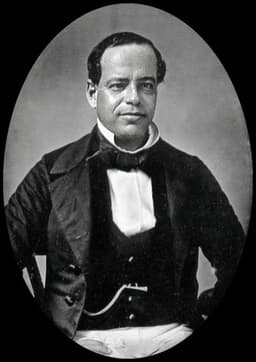
Antonio Lopez de Santa Anna
General · Modern
58.9Total
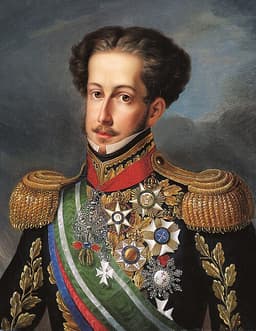
Pedro I of Brazil
Emperor · Modern
54.6Total
Basic Information
Born
1794
1798
Died
1876
1834
Era
Modern
Modern
Nationality
Mexico
Brazil
Occupation
General
Emperor
Civilization
Western
Western
Score Comparison
Military (10%)
70.0
55.0
Political (20%)
46.6
62.7
Influence (20%)
56.7
59.0
Legacy (20%)
58.0
50.0
Leadership (15%)
68.0
53.2
Strategy (15%)
60.0
45.0
TOTAL
58.9
54.6
Antonio Lopez de Santa Anna — Complete Timeline
1823 AD
Led the Plan of Casa Mata rebellionPolitical Action
Santa Anna, then a general, issued the Plan of Casa Mata on February 1, 1823, calling for the overthrow of Emperor Agust
RebellionOverthrowRepublic
Impact: nationalconstructive
1829 AD
Defended Mexico at the Battle of TampicoWar◆ Major
Santa Anna commanded Mexican forces that defeated a Spanish invasion force at Tampico on September 11, 1829. The victory ended Spain's last attempt to reconquer Mexico and made Santa Anna a national hero. He was hailed as the 'Hero of Tampico' and used this fame to advance politically.
VictorySpanish InvasionNational Hero
Impact: nationalconstructive
1833 AD
Became President of Mexico for the first timePolitical Action◆ Major
Santa Anna was elected President of Mexico in 1833. He quickly delegated power to Vice President Valent
PresidencyPolitical InstabilityPower
Impact: national
1836 AD
Commanded at the Siege of the AlamoWar◆ Major
Santa Anna personally led the Mexican army in the siege of the Alamo mission in San Antonio, Texas. After a 13-day siege, Mexican forces stormed the fort on March 6, 1836, killing all 180-250 Texan defenders. The battle became a symbol of Texan resistance and a rallying cry for independence.
BattleTexas RevolutionAlamo
Impact: regionaldestructive
Defeated and captured at the Battle of San JacintoWar
Santa Anna's army was surprised and routed by Texan forces under Sam Houston at the Battle of San Jacinto on April 21, 1836. Santa Anna was captured the next day. He was forced to sign the Treaties of Velasco, recognizing Texan independence, though Mexico later repudiated them.
DefeatCaptureTexas Independence
Impact: regionaltragic
1847 AD
Lost the Mexican-American WarWar
Santa Anna returned from exile to command Mexican forces during the Mexican-American War. Despite initial efforts, his army was defeated at the Battle of Cerro Gordo and later at the Battle of Chapultepec. US forces captured Mexico City on September 14, 1847, leading to the Treaty of Guadalupe Hidalgo and massive territorial losses.
Mexican-American WarDefeatTerritorial Loss
Impact: globaltragic
1853 AD
Sold La Mesilla to the United StatesPolitical Action◆ Major
During his final presidency, Santa Anna agreed to the Gadsden Purchase, selling 29,670 square miles of territory (La Mesilla) to the United States for $10 million. The sale was widely condemned in Mexico as a betrayal. This act further damaged his reputation and led to his overthrow.
Territorial CessionGadsden PurchaseBetrayal
Impact: nationaldestructive
1855 AD
Overthrown and exiled for the final timePolitical Action◆ Major
The Plan of Ayutla, led by Juan
OverthrowExileEnd of Career
Impact: nationaltragic
Pedro I of Brazil — Complete Timeline
1822 AD
Declaration of Independence of BrazilPolitical Action
Pedro I declared Brazil's independence from Portugal on September 7, 1822, at the Ipiranga River in S
Impact: globalprogressive
Coronation as Emperor of BrazilPolitical Action◆ Major
Pedro I was crowned Emperor of Brazil on December 1, 1822, in Rio de Janeiro. The coronation formalized the new imperial government, with Pedro I as constitutional monarch, though he retained significant executive powers.
Impact: nationalconstructive
1823 AD
War of Independence of BrazilWar◆ Major
Pedro I led Brazilian forces against Portuguese loyalists in the War of Independence. Key battles occurred in Bahia, Maranh
Impact: national
Dissolution of the Constituent AssemblyPolitical Action◆ Major
Pedro I dissolved the Constituent Assembly after conflicts over the constitution's limits on imperial power. He then imposed the 1824 Constitution, which granted the emperor extensive powers, including the Moderating Power, centralizing authority.
Impact: nationaldestructive
1831 AD
Abdication of the Brazilian ThronePolitical Action
Pedro I abdicated the Brazilian throne in favor of his five-year-old son Pedro II on April 7, 1831. He returned to Portugal to claim the Portuguese throne, leaving Brazil under a regency until his son came of age.
Impact: national
Expert Analysis
Antonio Lopez de Santa Anna vs Pedro I of Brazil
# The Emperor and the Caudillo: Pedro I of Brazil and Santa Anna of Mexico
On a sweltering September afternoon in 1822, two men stood at crossroads that would define their nations for generations. At the Ipiranga River in São Paulo, a 23-year-old prince shouted “Independence or Death!” and launched Brazil on a path toward stability. Half a continent away, a 28-year-old general was plotting rebellion against an emperor he had just helped install. Pedro I chose to build a nation; Antonio López de Santa Anna chose to feed his ambition. The difference would cost Mexico half its territory and give Brazil an empire that lasted nearly seven decades.
Origins
They were born four years apart into a world convulsed by revolution. Pedro de Alcântara arrived in 1798 as a prince of the Portuguese Braganza dynasty, his cradle rocked by the Napoleonic Wars that had driven his family to flee Lisbon for Rio de Janeiro. He grew up in a palace, tutored by scholars, groomed to rule. Santa Anna, born in 1794 in Jalapa, Veracruz, was the son of a Spanish colonial official—comfortable but not noble. While Pedro learned Latin and statecraft, Santa Anna learned horses and soldiering. The prince inherited a kingdom; the criollo officer inherited a chip on his shoulder.
Their eras shaped them differently. Pedro came of age when the Portuguese court was physically present in Brazil, giving the colony a taste of self-governance. Santa Anna came of age as Mexico’s war for independence descended into chaos—a decade of bloodletting that left no stable institutions, only rival warlords. Pedro’s world had a center; Santa Anna’s had a vacuum.
Rise to Power
Pedro’s path was straight: his father João VI returned to Portugal in 1821, leaving his son as regent. When Portuguese courts tried to reduce Brazil to colonial status, Pedro faced a simple choice—submit or secede. He chose secession, and on December 1, 1822, placed a crown on his own head. The War of Independence that followed was brief and decisive, with Pedro leading troops personally in Bahia.
Santa Anna’s rise was serpentine. He began his career fighting for Spain against Mexican insurgents, then switched sides when independence seemed inevitable. In 1823, he issued the Plan of Casa Mata, turning against Emperor Agustín de Iturbide—the very man he had helped elevate. Iturbide fell; Santa Anna rose. The pattern was set: loyalty was a tool, not a virtue. By 1833, after a decade of coups and countercoups, he became president, though he preferred to let others govern while he played the hero.
Leadership & Governance
Pedro ruled as a constitutional emperor, but he chafed at limits. When the Constituent Assembly tried to curb his power, he dissolved it in November 1823 and imposed a constitution that gave him a “moderating power”—the right to dissolve parliament, appoint judges, and veto laws. It was autocratic, but it was legal. He fought not to destroy institutions but to shape them.
Santa Anna governed as a caudillo—a personalist strongman who treated the state as his estate. He took power, delegated to Vice President Valentín Gómez Farías, then overthrew him when reforms went too far. He abolished the federal constitution in 1835, centralized authority, and crushed regional rebellions. His military genius was real but erratic: at the Battle of Tampico in 1829, he defeated a Spanish invasion and became the “Hero of Tampico.” But at the Alamo in 1836, his victory was brutal and pyrrhic, costing him the war when he was captured at San Jacinto weeks later.
Pedro’s military record was modest—he won the War of Independence but struggled against a secessionist revolt in the southern province of Cisplatina. His strategy score of 50.0 reflects a leader who preferred politics to battle. Santa Anna’s 59.4 is only slightly higher, suggesting a general who could win battles but not wars.
Triumph & Tragedy
Pedro’s greatest moment was his declaration of independence—a single act that created a nation. His tragedy was personal: his wife Leopoldina died after a miscarriage, rumored to have been caused by his mistreatment. He married Amélie of Leuchtenberg, but never recovered his popularity. In 1831, facing riots and military pressure, he abdicated in favor of his five-year-old son Pedro II and sailed for Portugal, where he died three years later at 35.
Santa Anna’s triumphs were fleeting. His defense of Tampico made him a hero. His capture of the Alamo made him a legend. But his tragedy was national: the Mexican-American War, where he returned from exile to command, only to lose battle after battle. In 1847, U.S. forces marched into Mexico City. Six years later, as his final presidency crumbled, he sold 29,670 square miles of La Mesilla to the United States—the Gadsden Purchase. He was overthrown in 1855 and fled into exile, returning only briefly before dying in poverty in 1876.
Character & Destiny
Pedro was impulsive, passionate, and romantic—a man who wrote poetry, played the flute, and fathered children with mistresses. But he had a core of duty. “I will do everything for the people,” he said, “but nothing by the people.” His authoritarianism was tempered by a genuine desire to preserve Brazil’s unity. Santa Anna was colder, more calculating, and utterly self-interested. He once described himself as “the Napoleon of the West,” but his ambition had no anchor. He changed sides so often that Mexicans coined a term—“santanismo”—meaning cynical opportunism.
Pedro’s character led him to abdicate rather than plunge Brazil into civil war. Santa Anna’s character led him to sell territory and flee. One sacrificed power for his country; the other sacrificed his country for power.
Legacy
Pedro I is remembered as the Father of the Nation, but his son Pedro II would eclipse him, ruling for 49 years and making Brazil a model of stability. The elder Pedro’s legacy is the independence he won and the dynasty he founded—a thread that connected colonial Brazil to the republic.
Santa Anna’s legacy is a warning. His military score of 66.3 and political score of 81.1 show a man who could fight and scheme but could not build. His legacy score of 65.2 reflects a nation that still blames him for the loss of Texas, California, and the Southwest. In Mexico, his name is synonymous with betrayal. In the United States, he is the villain of the Alamo. He was, in the words of one historian, “a man who loved his country too little and himself too much.”
Conclusion
Pedro I and Santa Anna both seized history by the throat, but they held it differently. Pedro grasped it as a scepter, trying to shape a kingdom; Santa Anna clutched it as a prize, trying to fill his hands. One died young, mourned; the other died old, forgotten. Their contrast is not merely personal—it is structural. Brazil had a monarchy that could channel ambition; Mexico had a vacuum that devoured it. In the end, Pedro’s Brazil survived intact, while Santa Anna’s Mexico was torn apart. The difference was not in their talents but in their purposes: one wanted to rule a nation; the other wanted to rule.
Rankings
🥇
Antonio Lopez de Santa AnnaLeader
Mil: 70.0Pol: 46.6Inf: 56.7
58.9
🥈
Pedro I of Brazil
Mil: 55.0Pol: 62.7Inf: 59.0
54.6
+4.3 behind
How This Comparison Works
Algorithm
Each figure is scored on 6 dimensions (0—100 scale) based on structured historical data: Military (10%), Political (20%), Influence (20%), Legacy (20%), Leadership (15%), Strategy (15%). The weighted total produces the final ranking.
Data Sources
Scores are computed from structured sub-indicators in the database. Scale factors adjust for era (Ancient ×0.85, Modern ×1.0) and civilization size (Eastern ×1.05, Other ×0.80) to account for differences in population and military scale.
Maximum 3 Figures
Comparisons are limited to 2—3 figures to ensure readability and statistical meaningfulness.
Error Margins
±5 points per dimension — Sub-scores are derived from historical records with inherent uncertainty. Two figures within 5 points on a dimension should be considered roughly equivalent in that area.
Total Score Accuracy
±3 points overall — The weighted combination of 6 dimensions produces a total score with approximately ±3 points of uncertainty. Differences of less than 3 points are not statistically significant— the figures are effectively tied.
Known Limitations
- Historical records are incomplete and uneven across civilizations
- Figures from oral-tradition societies may be underrepresented
- Occupation labels can misclassify multi-role figures
- Scores measure capability and impact, not moral character
- Quantitative scoring is a comparison tool, not absolute truth
Capability Radar
Military (10%) — Battles & Warfare
Battles
65
35
Win Rate
40
40
Expansion
50
30
Political (20%) — Governance & Reform
Reform
20
45
Diplomacy
35
50
Economy
15
30
Influence (20%) — Cultural & Global Reach
Cultural
55
40
Global
50
45
Legacy (20%) — Historical Impact
Historical
60
55
Longevity
55
50
Leadership (15%) — Power & Stability
Tenure
75
55
Stability
10
25
Strategy (15%) — Tactics & Innovation
Strategy
45
35
Tactics
60
30
Reform
30
20
Similar Comparisons
Comments & Discussion
Caudillo Killer6/16/2026
Pedro I had the decency to quit. After five years of chaos, he abdicated in 1831 and went back to Portugal to fight for his daughter’s throne. Compare that to Santa Anna, who squatted on power eleven times, selling out Texas and half the national territory in between naps. One left Brazil with a child-emperor and a stable regency; the other left Mexico dismembered, broke, and dancing to his tune for another two decades. Give me the quitter over the parasite any day.
帝国之耻6/16/2026
拿佩德罗一世比圣安纳简直是侮辱巴西。人家23岁就在伊皮兰加河喊出“不独立毋宁死”,亲手建立帝国,还起草了巴西第一部宪法(虽然挺专制)。圣安纳呢?1829年还在帮西班牙复辟势力打仗,后来连得克萨斯都守不住。一个创国,一个毁国,教科书都不敢这么厚脸皮对比。
Pedro's Ghost6/16/2026
The real difference isn't ambition—it's legacy. Pedro I haggled Brazil through a managed independence, preserved the monarchy as a unifying symbol, and left his five-year-old son Pedro II to rule for 58 years of relative peace. Santa Anna haggled Mexico into bankruptcy, lost 40% of its territory, and created the power vacuum that let Juárez and then Porfirio Díaz reshape the country. One man built a dynasty; the other built a cautionary tale.
枫叶旗之下6/16/2026
军事上看,圣安纳就是个过誉的赌徒。查普尔特佩克战役吹得神乎其神,实际就是他看着美军爬上城墙,自己带兵溜了。而佩德罗一世虽然在1825年阿根廷战役输得很惨,但他至少亲自上阵,还在围攻巴伊亚时展现了战术耐心。一个靠名字吓人,一个靠数据说话。别跟我提“墨西哥拿破仑”,拿破仑可没把巴黎输给美国。