Loading...
Antonio Lopez de Santa Anna vs Nguyen Cao Ky
Antonio Lopez de Santa Anna leads by 9.9 pts · 2 figures compared
…
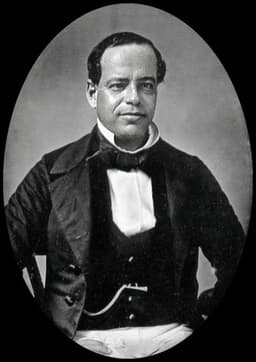
Antonio Lopez de Santa Anna
General · Modern
58.9Total
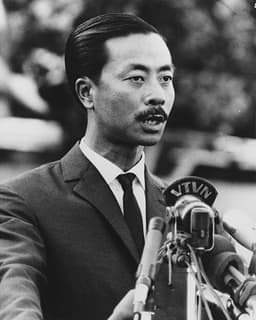
Nguyen Cao Ky
General · Modern
49.0Total
Basic Information
Born
1794
1930
Died
1876
—
Era
Modern
Modern
Nationality
Mexico
Vietnam
Occupation
General
General
Civilization
Western
Eastern
Score Comparison
Military (10%)
70.0
45.0
Political (20%)
46.6
39.4
Influence (20%)
56.7
50.2
Legacy (20%)
58.0
40.0
Leadership (15%)
68.0
67.0
Strategy (15%)
60.0
60.0
TOTAL
58.9
49.0
Antonio Lopez de Santa Anna — Complete Timeline
1823 AD
Led the Plan of Casa Mata rebellionPolitical Action
Santa Anna, then a general, issued the Plan of Casa Mata on February 1, 1823, calling for the overthrow of Emperor Agust
RebellionOverthrowRepublic
Impact: nationalconstructive
1829 AD
Defended Mexico at the Battle of TampicoWar◆ Major
Santa Anna commanded Mexican forces that defeated a Spanish invasion force at Tampico on September 11, 1829. The victory ended Spain's last attempt to reconquer Mexico and made Santa Anna a national hero. He was hailed as the 'Hero of Tampico' and used this fame to advance politically.
VictorySpanish InvasionNational Hero
Impact: nationalconstructive
1833 AD
Became President of Mexico for the first timePolitical Action◆ Major
Santa Anna was elected President of Mexico in 1833. He quickly delegated power to Vice President Valent
PresidencyPolitical InstabilityPower
Impact: national
1836 AD
Commanded at the Siege of the AlamoWar◆ Major
Santa Anna personally led the Mexican army in the siege of the Alamo mission in San Antonio, Texas. After a 13-day siege, Mexican forces stormed the fort on March 6, 1836, killing all 180-250 Texan defenders. The battle became a symbol of Texan resistance and a rallying cry for independence.
BattleTexas RevolutionAlamo
Impact: regionaldestructive
Defeated and captured at the Battle of San JacintoWar
Santa Anna's army was surprised and routed by Texan forces under Sam Houston at the Battle of San Jacinto on April 21, 1836. Santa Anna was captured the next day. He was forced to sign the Treaties of Velasco, recognizing Texan independence, though Mexico later repudiated them.
DefeatCaptureTexas Independence
Impact: regionaltragic
1847 AD
Lost the Mexican-American WarWar
Santa Anna returned from exile to command Mexican forces during the Mexican-American War. Despite initial efforts, his army was defeated at the Battle of Cerro Gordo and later at the Battle of Chapultepec. US forces captured Mexico City on September 14, 1847, leading to the Treaty of Guadalupe Hidalgo and massive territorial losses.
Mexican-American WarDefeatTerritorial Loss
Impact: globaltragic
1853 AD
Sold La Mesilla to the United StatesPolitical Action◆ Major
During his final presidency, Santa Anna agreed to the Gadsden Purchase, selling 29,670 square miles of territory (La Mesilla) to the United States for $10 million. The sale was widely condemned in Mexico as a betrayal. This act further damaged his reputation and led to his overthrow.
Territorial CessionGadsden PurchaseBetrayal
Impact: nationaldestructive
1855 AD
Overthrown and exiled for the final timePolitical Action◆ Major
The Plan of Ayutla, led by Juan
OverthrowExileEnd of Career
Impact: nationaltragic
Nguyen Cao Ky — Complete Timeline
1963 AD
Commander of South Vietnamese Air ForcePolitical Action◆ Major
Nguyen Cao Ky was appointed commander of the Republic of Vietnam Air Force. He led the air force during the Buddhist crisis and participated in the coup that overthrew President Ngo Dinh Diem.
Air ForceCoupDiem
Impact: national
1965 AD
Appointed Prime MinisterPolitical Action◆ Major
Nguyen Cao Ky became Prime Minister of South Vietnam, leading a military junta. His government intensified the war against the Viet Cong and North Vietnam, with strong US support.
Prime MinisterMilitary juntaVietnam War
Impact: national
1967 AD
Conflict with President ThieuPolitical Action
Nguyen Cao Ky ran for president but lost to Nguyen Van Thieu, becoming vice president. The two leaders had a tense relationship, with Ky later accusing Thieu of corruption and mismanagement of the war.
ElectionThieuRivalry
Impact: nationaldestructive
1975 AD
Exile after fall of SaigonPolitical Action◆ Major
Nguyen Cao Ky fled South Vietnam as Saigon fell to North Vietnamese forces. He settled in the United States, where he became a critic of the communist government and later returned to Vietnam for visits.
ExileFall of SaigonVietnam War
Impact: nationaltragic
Expert Analysis
Antonio Lopez de Santa Anna vs Nguyen Cao Ky
# The Caudillo and the Pilot: Two Generals Who Lost Their Countries
On a dusty April afternoon in 1836, Antonio López de Santa Anna, the self-styled "Napoleon of the West," was captured hiding in a marsh near the San Jacinto River, dressed in a common soldier’s uniform. He had just lost Texas. One hundred and thirty-nine years later, in April 1975, Nguyen Cao Ky, the flamboyant air force commander of South Vietnam, scrambled into a helicopter on a rooftop in Saigon as the city fell to communist forces. He had just lost a country. Both men were generals who ascended to political power in times of crisis, both fought losing wars against more powerful adversaries, and both ended their lives in exile. But the similarities end there. Santa Anna was a creature of the nineteenth century—a caudillo who built his power on personal charisma, betrayal, and a cycle of exile and return. Ky was a man of the twentieth century—a Cold War soldier whose fate was tied to an American alliance he could neither control nor escape. The difference between them is the difference between a man who shaped his own downfall and one who was swept away by history’s current.
Origins
Santa Anna was born in 1794 in Jalapa, Mexico, into a moderately well-off Spanish colonial family. He entered the Spanish army at age sixteen, a time when the old order in New Spain was beginning to crack. The wars of independence that followed gave him his first taste of glory—and his first lesson in survival. He switched sides from the Spanish to the Mexican independence movement in 1821, a pattern of opportunism that would define his career. Mexico in the early nineteenth century was a fractured land of vast distances, weak institutions, and competing regional strongmen. Santa Anna learned early that loyalty was a currency to be spent, not a principle to be kept.
Nguyen Cao Ky was born in 1930 in Son Tay, north of Hanoi, into a French colonial Vietnam. His father was a minor civil servant. Ky joined the Vietnamese National Army under French auspices, then trained as a pilot in France and Morocco. By the 1960s, he commanded the Republic of Vietnam Air Force, a force of American-supplied fighter jets and helicopters. Vietnam in the 1960s was a country torn by civil war and caught between superpowers. Ky, unlike Santa Anna, did not grow up in a world of personalist politics; he grew up in a world of ideologies and alliances. But he shared with Santa Anna a taste for dramatic uniforms, bold statements, and a belief that military force could solve political problems.
Rise to Power
Santa Anna’s rise was a series of calculated gambles. In 1823, he issued the Plan of Casa Mata, a rebellion that overthrew the short-lived Emperor Agustín de Iturbide. It was a turning point: Santa Anna had positioned himself as a kingmaker. In 1829, he became a national hero by defeating a Spanish invasion force at the Battle of Tampico. From then on, he was the indispensable man. He was elected president in 1833, but he quickly delegated power to his vice president and retired to his hacienda, only to return when crisis called. This pattern—retirement, return, betrayal, exile—repeated itself eleven times over three decades. Santa Anna was not a builder of institutions; he was a firefighter who started fires so he could put them out.
Ky’s rise was faster and more violent. In 1963, he was appointed commander of the South Vietnamese Air Force and played a key role in the Buddhist crisis, using his planes to intimidate the government of Ngo Dinh Diem. When Diem was overthrown and killed, Ky became part of the revolving door of military juntas that followed. In 1965, he became prime minister at the age of thirty-four, the youngest leader in South Vietnam’s history. He wore a black pilot’s jumpsuit and a pearl-handled revolver, projecting an image of toughness. His power rested on American support and the loyalty of his air force—a narrow base that would prove fragile.
Leadership & Governance
Santa Anna governed through personality, not policy. He was a brilliant tactical commander in small battles—Tampico, the Alamo—but a poor strategist who overextended his forces and ignored logistics. At the Alamo in 1836, he ordered an assault that cost hundreds of Mexican lives, then failed to pursue the retreating Texan army. At San Jacinto, he was caught napping in his tent while Sam Houston’s men overran his camp. As president, he sold territory—the Gadsden Purchase of 1853—to pay off debts and line his pockets. He was corrupt, vain, and short-sighted. Yet he was also politically shrewd: he understood that Mexico’s elites feared anarchy more than they hated dictatorship, and he gave them stability at a price.
Ky was a different kind of leader. He was genuinely committed to fighting communism, and he tried to build a more effective military and government. He launched campaigns against the Viet Cong, supported land reform, and attempted to stabilize the economy. But he was also a product of the junta system, where power was held by cliques of generals who distrusted one another. In 1967, he ran for president but lost to Nguyen Van Thieu, his rival. Ky became vice president, a powerless role that left him bitter. His leadership style was bold but erratic: he once threatened to bomb Hanoi if North Vietnam did not negotiate, a bluff that revealed his frustration with the limits of American support.
Triumph & Tragedy
Santa Anna’s greatest moment was the defense of Tampico in 1829, when he defeated a Spanish invasion and became a national hero. His greatest tragedy was the Mexican-American War of 1846-1847. He returned from exile to command the army, but his forces were outmatched by American technology, discipline, and leadership. He lost battle after battle—Cerro Gordo, Churubusco, Chapultepec—and finally saw Mexico City fall to U.S. forces. The war cost Mexico half its territory. Santa Anna’s personal tragedy was that he never learned from his mistakes. He kept coming back, kept losing, kept selling his country for power.
Ky’s greatest moment was his tenure as prime minister from 1965 to 1967, when he helped stabilize South Vietnam after years of chaos. He launched major military operations and kept the government functioning. His greatest tragedy was the fall of Saigon in 1975. As the North Vietnamese army closed in, Ky fled, leaving behind a country he had spent a decade trying to defend. He spent the rest of his life in exile in California, running a liquor store and writing memoirs. He died in 2011, largely forgotten.
Character & Destiny
Santa Anna was a man of boundless ego and no principles. He called himself the "Napoleon of the West" but lacked Napoleon’s strategic genius or administrative skill. He believed in his own destiny, yet he never built anything that outlasted him. His character—opportunistic, vain, reckless—shaped his decisions: he fought battles for glory, not victory; he made deals for personal gain, not national interest. His destiny was to be a cautionary tale.
Ky was a man of conviction but limited power. He believed in the cause of anti-communism, but he was a junior partner in an alliance dominated by the United States. He was brave—he flew combat missions himself—but he was also naive about the limits of military force. His character—proud, impulsive, loyal to a fault—led him to stay in a losing fight long after it was hopeless. His destiny was to be a footnote in a war that America lost.
Legacy
Santa Anna is remembered in Mexico as a traitor and a buffoon. His name is synonymous with betrayal and loss. The Alamo, which he considered a victory, became a symbol of Texan defiance and American expansion. His legacy is a warning about the dangers of personalist rule.
Ky is remembered, if at all, as a colorful figure in a tragic war. His legacy is tied to the failure of South Vietnam—a country that no longer exists. He is sometimes cited as a symbol of the futility of American intervention, a man who fought for a cause that was doomed from the start.
Conclusion
Santa Anna and Ky both lost their countries, but they lost them in different ways. Santa Anna lost Mexico piece by piece, through incompetence and corruption. Ky lost South Vietnam all at once, through a war he could not win. Santa Anna was a man of the nineteenth century, when personal ambition could still shape nations. Ky was a man of the twentieth century, when superpowers decided the fate of smaller countries. Both were generals who became politicians, but Santa Anna was a caudillo who ruled through fear, while Ky was a soldier who ruled through alliance. In the end, both were swept away—one by the forces of nationalism and revolution, the other by the tides of Cold War history. Their stories remind us that leadership is not just about power, but about purpose; not just about fighting, but about knowing when to build.
Rankings
🥇
Antonio Lopez de Santa AnnaLeader
Mil: 70.0Pol: 46.6Inf: 56.7
58.9
🥈
Nguyen Cao Ky
Mil: 45.0Pol: 39.4Inf: 50.2
49.0
+9.9 behind
How This Comparison Works
Algorithm
Each figure is scored on 6 dimensions (0—100 scale) based on structured historical data: Military (10%), Political (20%), Influence (20%), Legacy (20%), Leadership (15%), Strategy (15%). The weighted total produces the final ranking.
Data Sources
Scores are computed from structured sub-indicators in the database. Scale factors adjust for era (Ancient ×0.85, Modern ×1.0) and civilization size (Eastern ×1.05, Other ×0.80) to account for differences in population and military scale.
Maximum 3 Figures
Comparisons are limited to 2—3 figures to ensure readability and statistical meaningfulness.
Error Margins
±5 points per dimension — Sub-scores are derived from historical records with inherent uncertainty. Two figures within 5 points on a dimension should be considered roughly equivalent in that area.
Total Score Accuracy
±3 points overall — The weighted combination of 6 dimensions produces a total score with approximately ±3 points of uncertainty. Differences of less than 3 points are not statistically significant— the figures are effectively tied.
Known Limitations
- Historical records are incomplete and uneven across civilizations
- Figures from oral-tradition societies may be underrepresented
- Occupation labels can misclassify multi-role figures
- Scores measure capability and impact, not moral character
- Quantitative scoring is a comparison tool, not absolute truth
Capability Radar
Military (10%) — Battles & Warfare
Battles
65
30
Win Rate
40
35
Expansion
50
10
Political (20%) — Governance & Reform
Reform
20
20
Diplomacy
35
25
Economy
15
15
Influence (20%) — Cultural & Global Reach
Cultural
55
15
Global
50
15
Legacy (20%) — Historical Impact
Historical
60
20
Longevity
55
10
Leadership (15%) — Power & Stability
Tenure
75
40
Stability
10
10
Strategy (15%) — Tactics & Innovation
Strategy
45
30
Tactics
60
40
Reform
30
25
Similar Comparisons
Comments & Discussion
Heliogabalus of the Nueces6/16/2026
Santa Anna wasn't just corrupt, he was *predictable* – a 19th-century autocrat on repeat. The man lost Texas, then lost the Mexican-American War after selling off a third of his country to fund his own exile. Ky, at least, had the excuse of fighting for a doomed client state. Santa Anna's tragedy was purely self-inflicted: he was literally captured in disguise, wearing carpet slippers and eating raw eggs. That's not a military defeat, that's farce.
流沙飞行员6/16/2026
Nguyen Cao Ky不是败给了北越,是输给了一种更隐秘的敌人:时间。1975年4月,他爬进直升机时,手里还攥着一瓶白兰地——那个画面比任何战报都更能说明问题。南越政权不是被推倒的,而是在三年内被"西贡时刻"反复消化掉的。Ky穿着紫色丝巾喊着反共口号,但当他自己的飞行员都拒绝起飞去炸北越阵地时,所谓的"将军"不过是个飞不动的飞机驾驶员。
Archive Rat6/16/2026
Let's talk numbers: Santa Anna lost four distinct conflicts (Texas, 1836; Pastry War, 1838; Mexican-American War, 1846-48; the 1855 Ayutla Revolution). Four. He had more exiles than most generals have campaigns. Ky, by contrast, lost one war and spent the rest of his life becoming a decent wine merchant in California. One had a learning disability regarding political geography; the other just had bad geopolitical luck.
古典屠夫6/16/2026
拿Santa Anna和Ky比,就像比较流感和中弹——两种死法,但病原体完全不同。Santa Anna是19世纪的典型产物,靠"Plan of"起家:Plan of Casa Mata, Plan of Jalapa——他最爱用起义推翻自己扶持的总统,再等国民请自己复位。Ky却属于20世纪特有物种:空军将领出身的政治强人,靠美国支援和巴黎训练的黑市交易活。Santa Anna剥光了墨西哥的土地,Ky剥光了南越的黄金——但Santa至少把政权传给了一个将军,Ky却把南越传给了历史。
Desert Rose of Jalapa6/16/2026
The real difference lies in their relationship with betrayal. Santa Anna betrayed everyone – the Spanish, Iturbide, and every Mexican president from Victoria to Comonfort. He was the original "I'll be back" before Schwarzenegger. But Ky? The man actually stayed loyal to his American handlers until the end, flying combat missions when he could have defected. In a region famous for double-agents, Ky's tragedy was being too committed to one side while Santa Anna's was being committed to none. One w