Loading...
Antonio Lopez de Santa Anna vs Napoleon Bonaparte
Napoleon Bonaparte leads by 12.0 pts · 2 figures compared
…
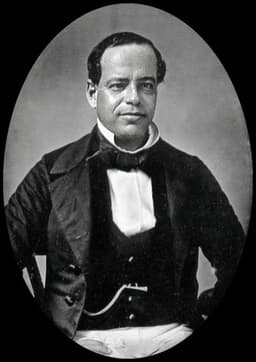
Antonio Lopez de Santa Anna
General · Modern
58.9Total

Napoleon Bonaparte
General · Modern
70.9Total
Basic Information
Born
1794
1769
Died
1876
1821
Era
Modern
Modern
Nationality
Mexico
France
Occupation
General
General
Civilization
Western
Western
Score Comparison
Military (10%)
70.0
94.0
Political (20%)
46.6
72.0
Influence (20%)
56.7
40.0
Legacy (20%)
58.0
80.0
Leadership (15%)
68.0
78.0
Strategy (15%)
60.0
90.0
TOTAL
58.9
70.9
Antonio Lopez de Santa Anna — Complete Timeline
1823 AD
Led the Plan of Casa Mata rebellionPolitical Action
Santa Anna, then a general, issued the Plan of Casa Mata on February 1, 1823, calling for the overthrow of Emperor Agust
RebellionOverthrowRepublic
Impact: nationalconstructive
1829 AD
Defended Mexico at the Battle of TampicoWar◆ Major
Santa Anna commanded Mexican forces that defeated a Spanish invasion force at Tampico on September 11, 1829. The victory ended Spain's last attempt to reconquer Mexico and made Santa Anna a national hero. He was hailed as the 'Hero of Tampico' and used this fame to advance politically.
VictorySpanish InvasionNational Hero
Impact: nationalconstructive
1833 AD
Became President of Mexico for the first timePolitical Action◆ Major
Santa Anna was elected President of Mexico in 1833. He quickly delegated power to Vice President Valent
PresidencyPolitical InstabilityPower
Impact: national
1836 AD
Commanded at the Siege of the AlamoWar◆ Major
Santa Anna personally led the Mexican army in the siege of the Alamo mission in San Antonio, Texas. After a 13-day siege, Mexican forces stormed the fort on March 6, 1836, killing all 180-250 Texan defenders. The battle became a symbol of Texan resistance and a rallying cry for independence.
BattleTexas RevolutionAlamo
Impact: regionaldestructive
Defeated and captured at the Battle of San JacintoWar
Santa Anna's army was surprised and routed by Texan forces under Sam Houston at the Battle of San Jacinto on April 21, 1836. Santa Anna was captured the next day. He was forced to sign the Treaties of Velasco, recognizing Texan independence, though Mexico later repudiated them.
DefeatCaptureTexas Independence
Impact: regionaltragic
1847 AD
Lost the Mexican-American WarWar
Santa Anna returned from exile to command Mexican forces during the Mexican-American War. Despite initial efforts, his army was defeated at the Battle of Cerro Gordo and later at the Battle of Chapultepec. US forces captured Mexico City on September 14, 1847, leading to the Treaty of Guadalupe Hidalgo and massive territorial losses.
Mexican-American WarDefeatTerritorial Loss
Impact: globaltragic
1853 AD
Sold La Mesilla to the United StatesPolitical Action◆ Major
During his final presidency, Santa Anna agreed to the Gadsden Purchase, selling 29,670 square miles of territory (La Mesilla) to the United States for $10 million. The sale was widely condemned in Mexico as a betrayal. This act further damaged his reputation and led to his overthrow.
Territorial CessionGadsden PurchaseBetrayal
Impact: nationaldestructive
1855 AD
Overthrown and exiled for the final timePolitical Action◆ Major
The Plan of Ayutla, led by Juan
OverthrowExileEnd of Career
Impact: nationaltragic
Napoleon Bonaparte — Complete Timeline
1799 AD
Coup of 18 BrumaireOther◆ Major
Napoleon Bonaparte, with support from his brother Lucien and key political figures, overthrew the Directory in a bloodless coup. He established the Consulate with himself as First Consul, effectively becoming the ruler of France. This event ended the French Revolution's most unstable period.
French RevolutionCoupRise to Power
Impact: regional
1804 AD
Promulgation of the Napoleonic CodeOther◆ Major
Napoleon enacted the Civil Code of the French, known as the Napoleonic Code, a comprehensive set of laws that replaced the fragmented feudal legal systems. The code established legal equality, protected property rights, and secularized law. It became the basis for legal systems in many European and world countries.
Legal ReformNapoleonic CodeCivil Law
Impact: globalconstructive
1805 AD
Battle of AusterlitzWar◆ Major
Napoleon's Grande Arm
Napoleonic WarsBattleDecisive Victory
Impact: global
1812 AD
Invasion of RussiaWar◆ Major
Napoleon led the Grande Arm
Napoleonic WarsInvasionDisaster
Impact: globaldestructive
1815 AD
Battle of WaterlooWar◆ Major
Napoleon's French army was defeated by the combined forces of the Duke of Wellington's Anglo-Allied army and Gebhard Leberecht von Bl
Napoleonic WarsBattleFinal Defeat
Impact: globaldestructive
Expert Analysis
antonio-lopez-de-santa-anna-vs-napoleon-bonaparte
# The Emperor and the Caudillo
In the spring of 1836, two men sat at opposite ends of a vast continent, each believing himself the master of his nation's destiny. Napoleon Bonaparte, exiled on the remote island of Saint Helena, was dictating his memoirs to a faithful companion, still trying to shape how history would remember him. Thousands of miles away in Texas, Antonio López de Santa Anna was scribbling a hasty surrender after being captured in a cotton field, his army shattered, his pride crushed. Both were generals. Both had ruled their countries. Both had tasted glory so intoxicating that they could never quite give it up. Yet one would be remembered as a titan who reshaped the Western world, the other as a cautionary tale of ambition without anchor. What made the difference?
Origins
Napoleon Bonaparte was born in 1769 on the island of Corsica, a place that had only recently become French, into a minor noble family with more pride than money. The French Revolution of 1789 tore open the old order, and Napoleon, a young artillery officer, was perfectly positioned to ride the wave. He was a child of the Enlightenment who had internalized its logic, its belief in systems, laws, and merit. His education at Brienne and the École Militaire had drilled into him not just tactics but the conviction that the world could be rationally reordered.
Santa Anna, born in 1794 in Jalapa, Mexico, came from a different world entirely. His family was Spanish colonial middle-class, respectable but not aristocratic. Mexico in the 1790s was a society cracking under the weight of caste hierarchies, a place where the word "revolution" meant terrifying chaos, not liberation. Santa Anna learned early that loyalty was a currency to be spent, not a principle to be kept. He joined the Spanish army as a cadet at sixteen, but when Mexico's independence struggle erupted, he switched sides with the ease of a man who understood that power, not ideology, was the only real game.
Rise to Power
Napoleon's ascent was meteoric but methodical. At twenty-four, he drove the British out of Toulon. At twenty-six, he saved the revolutionary government from a royalist mob with a "whiff of grapeshot." By 1796, he was commanding the Army of Italy, where his lightning campaign against the Austrians made him a legend. Each victory was a stepping stone, each battle a lesson. He did not stumble into power; he built a staircase out of his own brilliance.
Santa Anna's rise was more opportunistic. In 1823, he issued the Plan of Casa Mata, a rebellion that toppled Mexico's first emperor, Agustín de Iturbide. It was a bold move, but it revealed a pattern: Santa Anna was always better at tearing down than building up. His real breakthrough came in 1829, when he defeated a Spanish invasion force at Tampico. The victory made him the "Hero of Tampico," a national savior. But where Napoleon used such triumphs to consolidate a system, Santa Anna used them to collect accolades—and then squandered them.
Leadership & Governance
Napoleon governed with the same precision he brought to battlefields. As First Consul and later Emperor, he overhauled France's legal system with the Napoleonic Code, creating a uniform set of laws that enshrined equality before the law, property rights, and secular administration. He reformed education, centralized the bureaucracy, and stabilized the currency. His political score of 75.0 and leadership score of 80.0 reflect a man who understood that conquest without administration was just chaos. Even his enemies admired his efficiency.
Santa Anna, by contrast, governed through absence. Elected president in 1833, he promptly delegated power to his vice president and retreated to his hacienda. He would serve as president eleven times, but he rarely actually governed. His political score of 81.1 is paradoxically high because he mastered the art of political survival—shifting alliances, playing factions against each other, and always leaving himself a path to return. But his military score of 66.3 and strategy score of 59.4 tell the real story: he was a competent battlefield commander who consistently failed at the operational level. At the Alamo in 1836, he won a siege but lost a war. At San Jacinto, he was caught napping while Sam Houston's Texans overran his camp. In the Mexican-American War of 1847, he returned from exile to command, but his army was outthought and outfought at every turn.
Triumph & Tragedy
Napoleon's greatest triumph was Austerlitz in 1805, where he destroyed a combined Russian and Austrian army in a single day. It was a masterpiece of deception, timing, and nerve. His tragedy was the invasion of Russia in 1812, where he marched six hundred thousand men into a frozen graveyard. He never recovered. Exiled to Elba, he returned for a hundred days, only to meet his final defeat at Waterloo in 1815. His total score of 82.4 reflects a career of breathtaking highs and catastrophic lows.
Santa Anna's greatest moment was Tampico in 1829, when he saved Mexico from Spanish reconquest. His tragedy was the Mexican-American War, where he lost half his country's territory. In 1853, during his final presidency, he sold the Mesilla Valley to the United States in the Gadsden Purchase—a transaction that Mexicans still remember as national betrayal. His total score of 70.1 is a reminder that in history, survival is not the same as success.
Character & Destiny
Napoleon was driven by an almost supernatural confidence in his own intellect. "Impossible is a word to be found only in the dictionary of fools," he once said. That confidence built an empire, but it also blinded him. He could not stop, could not delegate, could not accept limits. His character was his destiny: a man who believed he could conquer the world, and nearly did.
Santa Anna was driven by something more mundane: the desire to be important. He called himself the "Napoleon of the West," but he lacked Napoleon's discipline. He was charming, resourceful, and endlessly resilient, but he had no vision beyond himself. He governed Mexico eleven times and left it weaker each time. His character was also his destiny: a man who could never decide whether he wanted to save his country or use it.
Legacy
Napoleon's legacy is written into the DNA of modern Europe. The Napoleonic Code influenced legal systems from France to Japan. His military innovations are still studied at war colleges. He is remembered as both a liberator and a tyrant, but never as irrelevant. His legacy score of 78.0 captures a figure who remains inescapable.
Santa Anna's legacy is a national scar. In Mexico, he is remembered as the man who lost Texas, lost the north, sold the south, and left a republic in ruins. In the United States, he is a villain in the Alamo myth. His legacy score of 65.2 is generous. He is a cautionary tale about what happens when a nation entrusts its fate to a man who loves power more than country.
Conclusion
Napoleon and Santa Anna both rose from modest beginnings to dominate their nations. Both were brilliant, ambitious, and ultimately undone by their own excess. But Napoleon built institutions that outlasted his empire, while Santa Anna left only ruins. The difference was not talent—both had plenty. It was purpose. Napoleon believed in something larger than himself, even if that something was his own legend. Santa Anna believed only in Santa Anna. In the end, that is the difference between a figure who reshapes history and one who is merely swept along by it. The Corsican who conquered Europe and the Mexican who sold his country both made their choices. History has rendered its verdict.
Rankings
🥇
Napoleon BonaparteLeader
Mil: 94.0Pol: 72.0Inf: 40.0
70.9
🥈
Antonio Lopez de Santa Anna
Mil: 70.0Pol: 46.6Inf: 56.7
58.9
+12.0 behind
How This Comparison Works
Algorithm
Each figure is scored on 6 dimensions (0—100 scale) based on structured historical data: Military (10%), Political (20%), Influence (20%), Legacy (20%), Leadership (15%), Strategy (15%). The weighted total produces the final ranking.
Data Sources
Scores are computed from structured sub-indicators in the database. Scale factors adjust for era (Ancient ×0.85, Modern ×1.0) and civilization size (Eastern ×1.05, Other ×0.80) to account for differences in population and military scale.
Maximum 3 Figures
Comparisons are limited to 2—3 figures to ensure readability and statistical meaningfulness.
Error Margins
±5 points per dimension — Sub-scores are derived from historical records with inherent uncertainty. Two figures within 5 points on a dimension should be considered roughly equivalent in that area.
Total Score Accuracy
±3 points overall — The weighted combination of 6 dimensions produces a total score with approximately ±3 points of uncertainty. Differences of less than 3 points are not statistically significant— the figures are effectively tied.
Known Limitations
- Historical records are incomplete and uneven across civilizations
- Figures from oral-tradition societies may be underrepresented
- Occupation labels can misclassify multi-role figures
- Scores measure capability and impact, not moral character
- Quantitative scoring is a comparison tool, not absolute truth
Capability Radar
Military (10%) — Battles & Warfare
Battles
65
95
Win Rate
40
90
Expansion
50
95
Political (20%) — Governance & Reform
Reform
20
95
Diplomacy
35
80
Economy
15
85
Influence (20%) — Cultural & Global Reach
Cultural
55
85
Global
50
90
Legacy (20%) — Historical Impact
Historical
60
95
Longevity
55
90
Leadership (15%) — Power & Stability
Tenure
75
85
Stability
10
70
Strategy (15%) — Tactics & Innovation
Strategy
45
95
Tactics
60
98
Reform
30
92
Similar Comparisons
Comments & Discussion
El Corso6/17/2026
This comparison fundamentally misunderstands scale. Napoleon didn't just win battles—he reorganized entire legal systems and governments. The Napoleonic Code alone influenced jurisprudence across Europe, Latin America, and even parts of North America contrast it with Santa Anna, who lost half his country's territory and sold the rest through the Gadsden Purchase. One man codified modern governance; the other bartered away land for personal power and short-term cash.
黄金指挥官6/17/2026
拿圣安娜跟拿破仑比?太抬举他了。圣安娜在阿拉莫赢了,那是因为特拉维斯坚守到最后一刻?不对,是特拉维斯选择了送死。圣安娜的真正失败在于他完全不懂战略储备。1835年墨西哥国库空虚,他却把大量军费花在个人奢靡上。反观拿破仑,哪怕是1813年莱比锡战败后,他还能重建军队打1814年战役。高下立判。
歷史偵探6/17/2026
我注意到一個關鍵細節:拿破崙在聖赫勒拿島寫回憶錄時,仍然在塑造自己的歷史形象;聖安娜被俘後寫的是投降書。這不是誰敗得更體面的問題,而是誰真正理解權力的本質。拿破崙知道歷史是由敘事建立的,所以他親自寫歷史;聖安娜呢?他連自己的逃亡路線都規劃不好,1836年還穿著農民的衣服被抓。兩個人都自戀,但一個是戰略級的自戀,一個是戰術級的自戀。
Historian8606/17/2026
Let's look at numbers: Napoleon fought over 60 battles and lost only 7. Santa Anna's record? Approximately 15 major engagements with 10 definitive losses. The casualty ratio is even worse—Napoleon's campaigns averaged about 1:1.5 killed per enemy, while Santa Anna at the Alamo had 2:1 in his favor but still couldn't secure a decisive strategic outcome. Context matters: Napoleon fought coalition armies, Santa Anna fought mostly rebel factions and American volunteers. The gap is simply not compara
Chronicler18446/17/2026
The tactical gap is enormous. Santa Anna's strength was personal bravado—he led cavalry charges personally and inspired loyalty through presence. Napoleon's genius was systemic: he created the corps d'armée system, integrated artillery and infantry into combined arms, and developed the strategy of central position. Santa Anna's "masterpiece" at the Alamo was a frontal assault that cost him 600 casualties against fewer than 200 defenders. Napoleon's Austerlitz cost 9,000 casualties against 27,000