Loading...
Afonso de Albuquerque vs Antonio Lopez de Santa Anna
Afonso de Albuquerque leads by 20.7 pts · 2 figures compared
…
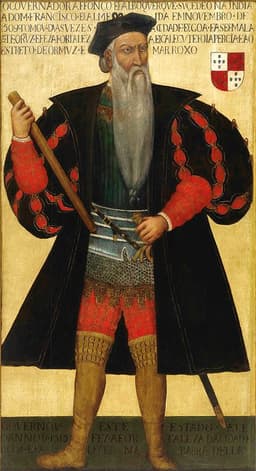
Afonso de Albuquerque
General · Medieval
79.6Total
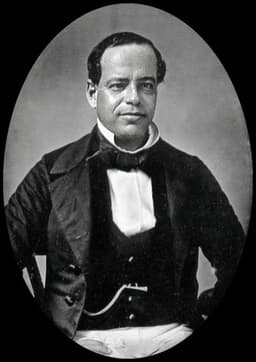
Antonio Lopez de Santa Anna
General · Modern
58.9Total
Basic Information
Born
1453
1794
Died
1515
1876
Era
Medieval
Modern
Nationality
Portugal
Mexico
Occupation
General
General
Civilization
Western
Western
Score Comparison
Military (10%)
77.5
70.0
Political (20%)
88.0
46.6
Influence (20%)
80.0
56.7
Legacy (20%)
75.0
58.0
Leadership (15%)
78.0
68.0
Strategy (15%)
82.0
60.0
TOTAL
79.6
58.9
Afonso de Albuquerque — Complete Timeline
1503 AD
First voyage to IndiaWar◆ Major
Afonso de Albuquerque led a fleet to India, establishing the first Portuguese fort at Cochin. This voyage laid the foundation for Portuguese control of the Indian Ocean trade.
ExplorationColonialismIndia
Impact: global
1510 AD
Conquest of GoaWar◆ Major
Albuquerque captured Goa from the Sultan of Bijapur. He made Goa the capital of Portuguese India, a position it held for over 400 years.
ConquestColonialismIndia
Impact: regional
1511 AD
Conquest of MalaccaWar◆ Major
Albuquerque led a Portuguese fleet to capture the strategic port of Malacca. This gave Portugal control of the spice trade route between the Indian Ocean and the Pacific.
ConquestSpice TradeSoutheast Asia
Impact: global
1513 AD
Siege of AdenWar
Albuquerque attempted to capture Aden in Yemen but failed. This failure prevented Portugal from controlling the entrance to the Red Sea and limited their influence in the region.
SiegeFailureRed Sea
Impact: regional
1515 AD
Death at seaOther◆ Major
Afonso de Albuquerque died at sea off the coast of Goa, possibly from illness or poison. His death left the Portuguese Empire in the Indian Ocean without its most capable leader.
DeathLeadershipEmpire
Impact: regionaltragic
Antonio Lopez de Santa Anna — Complete Timeline
1823 AD
Led the Plan of Casa Mata rebellionPolitical Action
Santa Anna, then a general, issued the Plan of Casa Mata on February 1, 1823, calling for the overthrow of Emperor Agust
RebellionOverthrowRepublic
Impact: nationalconstructive
1829 AD
Defended Mexico at the Battle of TampicoWar◆ Major
Santa Anna commanded Mexican forces that defeated a Spanish invasion force at Tampico on September 11, 1829. The victory ended Spain's last attempt to reconquer Mexico and made Santa Anna a national hero. He was hailed as the 'Hero of Tampico' and used this fame to advance politically.
VictorySpanish InvasionNational Hero
Impact: nationalconstructive
1833 AD
Became President of Mexico for the first timePolitical Action◆ Major
Santa Anna was elected President of Mexico in 1833. He quickly delegated power to Vice President Valent
PresidencyPolitical InstabilityPower
Impact: national
1836 AD
Commanded at the Siege of the AlamoWar◆ Major
Santa Anna personally led the Mexican army in the siege of the Alamo mission in San Antonio, Texas. After a 13-day siege, Mexican forces stormed the fort on March 6, 1836, killing all 180-250 Texan defenders. The battle became a symbol of Texan resistance and a rallying cry for independence.
BattleTexas RevolutionAlamo
Impact: regionaldestructive
Defeated and captured at the Battle of San JacintoWar
Santa Anna's army was surprised and routed by Texan forces under Sam Houston at the Battle of San Jacinto on April 21, 1836. Santa Anna was captured the next day. He was forced to sign the Treaties of Velasco, recognizing Texan independence, though Mexico later repudiated them.
DefeatCaptureTexas Independence
Impact: regionaltragic
1847 AD
Lost the Mexican-American WarWar
Santa Anna returned from exile to command Mexican forces during the Mexican-American War. Despite initial efforts, his army was defeated at the Battle of Cerro Gordo and later at the Battle of Chapultepec. US forces captured Mexico City on September 14, 1847, leading to the Treaty of Guadalupe Hidalgo and massive territorial losses.
Mexican-American WarDefeatTerritorial Loss
Impact: globaltragic
1853 AD
Sold La Mesilla to the United StatesPolitical Action◆ Major
During his final presidency, Santa Anna agreed to the Gadsden Purchase, selling 29,670 square miles of territory (La Mesilla) to the United States for $10 million. The sale was widely condemned in Mexico as a betrayal. This act further damaged his reputation and led to his overthrow.
Territorial CessionGadsden PurchaseBetrayal
Impact: nationaldestructive
1855 AD
Overthrown and exiled for the final timePolitical Action◆ Major
The Plan of Ayutla, led by Juan
OverthrowExileEnd of Career
Impact: nationaltragic
Expert Analysis
Afonso de Albuquerque vs Antonio Lopez de Santa Anna
### The Caudillo and the Conqueror
In the spring of 1836, a Mexican general stood on the blood-soaked ramparts of the Alamo, surveying a victory that felt absolute. Seventeen years earlier, on the other side of the Atlantic, a Portuguese admiral lay dying on the deck of his flagship, staring at the distant coast of India he had conquered. One man had just crushed a rebellion; the other was leaving an empire. Yet within a year, the first would be a prisoner in his own land, while the second would be remembered as the architect of a global dominion that lasted four centuries. What made the difference between the grand failure of Antonio López de Santa Anna and the enduring success of Afonso de Albuquerque? The answer lies not just in their battles, but in their souls.
### Origins
Santa Anna was born in 1794, a criollo in a Spanish colony simmering with revolutionary fervor. He was a product of the volatile early republic, a world where loyalty was fleeting and power was seized. He entered the army at fifteen, learning war not as a science but as a theater of personal ambition. Albuquerque, born in 1453 near Lisbon, came from the twilight of the Middle Ages, a time when Portugal was a small, poor kingdom obsessed with breaking the Venetian stranglehold on Asian trade. He was a nobleman of the court, educated in mathematics and strategy, and he saw war as a tool of statecraft, not self-aggrandizement. Their eras shaped their goals: one sought to rule a nation, the other to build one.
### Rise to Power
Santa Anna’s rise was a series of calculated betrayals. In 1823, he issued the Plan of Casa Mata, overthrowing the Emperor Agustín de Iturbide whom he had once served. He became a kingmaker, a man who could pivot from monarchist to republican with a single proclamation. His real ascent began in 1829, when he defeated a Spanish invasion at Tampico. The victory was genuine, but Santa Anna milked it for every drop of glory, styling himself the “Hero of Tampico.” He was elected president in 1833, then promptly abandoned the office to his liberal vice president, only to return as a conservative strongman when chaos erupted. He did not rise through patient service; he rose by making himself indispensable to every faction.
Albuquerque’s path was different. He first sailed to India in 1503, building a fort at Cochin under the orders of King Manuel I. He was a servant of the crown, not a free agent. His rise came through competence: he understood that Portugal’s empire needed bases, not just battles. In 1510, he captured Goa from the Sultan of Bijapur, not by overwhelming force but by a combination of siegecraft, naval blockade, and negotiation with local Hindu merchants who resented Muslim rule. He made Goa the capital of Portuguese India, a decision that turned a trading post into a permanent colony. Where Santa Anna manipulated men, Albuquerque built institutions.
### Leadership & Governance
Santa Anna ruled Mexico as a personal fiefdom. He was president eleven times, each time delegating the boring work of governance to others while he rode off to fight—or to his hacienda. His military talent was real but brittle: at the Alamo in 1836, he showed tactical aggression, storming the mission after a 13-day siege. But he left no reserves, no plan for the aftermath. Weeks later, at San Jacinto, his army was caught napping by Sam Houston. He was captured, and to save his life, he signed away Texas. In the Mexican-American War of 1847, he returned from exile to command again, but his armies were poorly supplied, his strategies predictable, and his political rivals more concerned with deposing him than defeating the Americans. His final act of governance was the Gadsden Purchase in 1853, selling 30,000 square miles of territory to the United States for a railway route—a transaction that made him rich and his nation poorer.
Albuquerque governed differently. After taking Malacca in 1511, he did not loot and leave; he built a fortress, minted currency, and encouraged Portuguese settlers to marry local women. He understood that an empire needed roots. He studied local customs, learned Persian and Malay, and appointed Hindus and Muslims to administrative posts. When he failed at Aden in 1513, he did not blame his subordinates; he wrote to the king asking for reinforcements. His leadership was ruthless—he burned captured pirates alive—but it was strategic. Every conquest was a node in a network: Goa controlled the Arabian Sea, Malacca the straits to the Spice Islands, and Hormuz the Persian Gulf. He was a builder, not a destroyer.
### Triumph & Tragedy
Santa Anna’s greatest moment was also his greatest illusion. The Alamo made him a hero in Mexico, but it was a tactical victory that led to a strategic disaster. He had no plan to hold Texas, and his brutality at the Alamo—executing survivors—turned the conflict into a war of extermination. His tragedy was the Mexican-American War, where he lost half his country. He was overthrown in 1855 by the Plan of Ayutla, a revolt that finally ended his career. He died in 1876, blind, impoverished, and forgotten, his only legacy a cautionary tale.
Albuquerque’s triumph was the conquest of Malacca in 1511, a city that controlled the spice trade. He had just 18 ships and 1,200 men, but he used psychological warfare—firing rockets, feinting landings—to panic the defenders. His tragedy came at sea in 1515, when he died on the voyage home, possibly poisoned. He was leaving behind an empire that stretched from East Africa to the Pacific, but he died disgraced, his rivals at court having convinced the king he was power-hungry. He never saw his creation flourish.
### Character & Destiny
Santa Anna was a narcissist. He called himself the “Napoleon of the West” and demanded to be addressed as “His Most Serene Highness.” He was charming, brave, and utterly untrustworthy. He switched sides so often that even his allies learned to hedge their bets. His character made him a survivor but a terrible leader: he could win a battle but not a war, seize power but not keep it. His destiny was to be a mirror of Mexico’s own chaos—a country that could not decide whether it was a republic, a monarchy, or a dictatorship.
Albuquerque was a pragmatist. He was harsh, devout, and single-minded. He wrote to the king, “I am not a man who seeks to please; I seek to serve.” His character made him a great builder but a poor courtier. He died believing he had failed, because the king had not rewarded him. His destiny was to create something larger than himself—an empire that outlasted his enemies, his king, and even his own reputation.
### Legacy
Santa Anna is remembered in Mexico as a traitor and a buffoon. His name is a curse. In Texas, he is the villain of the Alamo, the man who lost the war. His legacy is territorial loss and political instability. Albuquerque is remembered as the founder of the Portuguese Empire in Asia. His statue stands in Lisbon and in Goa. His legacy is the Portuguese language, the Catholic churches of Kerala, and the fusion of cultures that created modern Macau. One man’s legacy is a warning; the other’s is a foundation.
### Conclusion
Santa Anna and Albuquerque both fought for empires. But one fought for himself, and the other for an idea. Santa Anna believed that power was a prize to be won; Albuquerque believed that power was a tool to be used. In the end, the man who built for the future outlasted the man who only lived for the present. Their lives are a reminder that history does not remember the cleverest or the bravest. It remembers those who leave behind something that does not crumble when they are gone.
Rankings
🥇
Afonso de AlbuquerqueLeader
Mil: 77.5Pol: 88.0Inf: 80.0
79.6
🥈
Antonio Lopez de Santa Anna
Mil: 70.0Pol: 46.6Inf: 56.7
58.9
+20.7 behind
How This Comparison Works
Algorithm
Each figure is scored on 6 dimensions (0—100 scale) based on structured historical data: Military (10%), Political (20%), Influence (20%), Legacy (20%), Leadership (15%), Strategy (15%). The weighted total produces the final ranking.
Data Sources
Scores are computed from structured sub-indicators in the database. Scale factors adjust for era (Ancient ×0.85, Modern ×1.0) and civilization size (Eastern ×1.05, Other ×0.80) to account for differences in population and military scale.
Maximum 3 Figures
Comparisons are limited to 2—3 figures to ensure readability and statistical meaningfulness.
Error Margins
±5 points per dimension — Sub-scores are derived from historical records with inherent uncertainty. Two figures within 5 points on a dimension should be considered roughly equivalent in that area.
Total Score Accuracy
±3 points overall — The weighted combination of 6 dimensions produces a total score with approximately ±3 points of uncertainty. Differences of less than 3 points are not statistically significant— the figures are effectively tied.
Known Limitations
- Historical records are incomplete and uneven across civilizations
- Figures from oral-tradition societies may be underrepresented
- Occupation labels can misclassify multi-role figures
- Scores measure capability and impact, not moral character
- Quantitative scoring is a comparison tool, not absolute truth
Capability Radar
Military (10%) — Battles & Warfare
Battles
85
65
Win Rate
80
40
Expansion
95
50
Political (20%) — Governance & Reform
Reform
80
20
Diplomacy
85
35
Economy
80
15
Influence (20%) — Cultural & Global Reach
Cultural
70
55
Global
85
50
Legacy (20%) — Historical Impact
Historical
85
60
Longevity
80
55
Leadership (15%) — Power & Stability
Tenure
70
75
Stability
65
10
Strategy (15%) — Tactics & Innovation
Strategy
95
45
Tactics
90
60
Reform
75
30
Similar Comparisons
Comments & Discussion
No comments yet. Be the first to share your thoughts!