Loading...
Antonio Lopez de Santa Anna vs Francisco Morazan
Antonio Lopez de Santa Anna leads by 0.9 pts · 2 figures compared
…
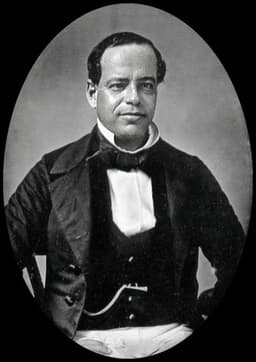
Antonio Lopez de Santa Anna
General · Modern
58.9Total
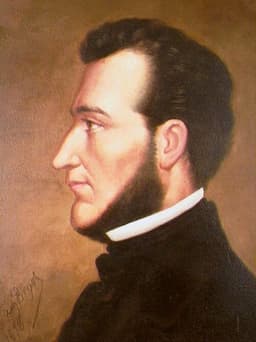
Francisco Morazan
General · Modern
58.0Total
Basic Information
Born
1794
1792
Died
1876
1842
Era
Modern
Modern
Nationality
Mexico
Honduras
Occupation
General
General
Civilization
Western
Western
Score Comparison
Military (10%)
70.0
52.5
Political (20%)
46.6
60.0
Influence (20%)
56.7
62.0
Legacy (20%)
58.0
50.0
Leadership (15%)
68.0
68.0
Strategy (15%)
60.0
55.0
TOTAL
58.9
58.0
Antonio Lopez de Santa Anna — Complete Timeline
1823 AD
Led the Plan of Casa Mata rebellionPolitical Action
Santa Anna, then a general, issued the Plan of Casa Mata on February 1, 1823, calling for the overthrow of Emperor Agust
RebellionOverthrowRepublic
Impact: nationalconstructive
1829 AD
Defended Mexico at the Battle of TampicoWar◆ Major
Santa Anna commanded Mexican forces that defeated a Spanish invasion force at Tampico on September 11, 1829. The victory ended Spain's last attempt to reconquer Mexico and made Santa Anna a national hero. He was hailed as the 'Hero of Tampico' and used this fame to advance politically.
VictorySpanish InvasionNational Hero
Impact: nationalconstructive
1833 AD
Became President of Mexico for the first timePolitical Action◆ Major
Santa Anna was elected President of Mexico in 1833. He quickly delegated power to Vice President Valent
PresidencyPolitical InstabilityPower
Impact: national
1836 AD
Commanded at the Siege of the AlamoWar◆ Major
Santa Anna personally led the Mexican army in the siege of the Alamo mission in San Antonio, Texas. After a 13-day siege, Mexican forces stormed the fort on March 6, 1836, killing all 180-250 Texan defenders. The battle became a symbol of Texan resistance and a rallying cry for independence.
BattleTexas RevolutionAlamo
Impact: regionaldestructive
Defeated and captured at the Battle of San JacintoWar
Santa Anna's army was surprised and routed by Texan forces under Sam Houston at the Battle of San Jacinto on April 21, 1836. Santa Anna was captured the next day. He was forced to sign the Treaties of Velasco, recognizing Texan independence, though Mexico later repudiated them.
DefeatCaptureTexas Independence
Impact: regionaltragic
1847 AD
Lost the Mexican-American WarWar
Santa Anna returned from exile to command Mexican forces during the Mexican-American War. Despite initial efforts, his army was defeated at the Battle of Cerro Gordo and later at the Battle of Chapultepec. US forces captured Mexico City on September 14, 1847, leading to the Treaty of Guadalupe Hidalgo and massive territorial losses.
Mexican-American WarDefeatTerritorial Loss
Impact: globaltragic
1853 AD
Sold La Mesilla to the United StatesPolitical Action◆ Major
During his final presidency, Santa Anna agreed to the Gadsden Purchase, selling 29,670 square miles of territory (La Mesilla) to the United States for $10 million. The sale was widely condemned in Mexico as a betrayal. This act further damaged his reputation and led to his overthrow.
Territorial CessionGadsden PurchaseBetrayal
Impact: nationaldestructive
1855 AD
Overthrown and exiled for the final timePolitical Action◆ Major
The Plan of Ayutla, led by Juan
OverthrowExileEnd of Career
Impact: nationaltragic
Francisco Morazan — Complete Timeline
1824 AD
Abolition of slavery in Central AmericaReform◆ Major
As a key leader in the liberal movement, Moraz
AbolitionSlaveryLiberal Reform
Impact: regionalprogressive
1827 AD
Battle of La TrinidadWar◆ Major
Morazán led a liberal army to victory against conservative forces at La Trinidad, Honduras. This battle was a key turning point in the Central American civil war, allowing Morazán to consolidate power and eventually become president of the federation.
BattleLiberal VictoryCivil War
Impact: regional
1830 AD
Presidency of the Federal Republic of Central AmericaPolitical Action
Morazán was elected president of the Federal Republic of Central America, a union of Guatemala, El Salvador, Honduras, Nicaragua, and Costa Rica. He pursued liberal reforms including separation of church and state, free trade, and land reform, facing opposition from conservatives.
Federal RepublicLiberal ReformsCentral America
Impact: regionalconstructive
1842 AD
Execution by firing squadPolitical Action
After a failed attempt to restore the Federal Republic, Moraz
ExecutionEnd of FederationLiberal Defeat
Impact: regionaltragic
Expert Analysis
Francisco Morazan vs Antonio Lopez de Santa Anna
# The Eagle and the Visionary
On a sweltering April afternoon in 1836, two men who had never met shaped the destiny of a continent. One, Antonio López de Santa Anna, watched in horror as his army disintegrated at San Jacinto, his dreams of crushing a rebellion dissolving into panic and flight. The other, Francisco Morazán, was five years into his presidency of the Federal Republic of Central America, believing he was forging a unified nation from the fragments of empire. Both were generals. Both were reformers in their own way. But one ended his life in exile, remembered as a traitor who sold his nation’s soil; the other died before a firing squad, mourned as a martyr who died for a dream. Why did their paths diverge so dramatically? The answer lies not in their abilities—which were remarkably similar—but in how they understood power, loyalty, and the fragile nature of political unity.
Origins
Santa Anna was born in 1794 in Jalapa, Mexico, into a respectable but not wealthy Spanish colonial family. His world was one of rigid hierarchy, where the Church and the military offered the only ladders to prominence. He joined the army at fifteen, learning early that loyalty was a commodity to be traded, not a principle to be kept. The chaos of Mexico’s war for independence taught him a brutal lesson: in a land without stable institutions, the man with the army was the law.
Morazán, born two years earlier in 1792 in Tegucigalpa, Honduras, grew up in a different kind of frontier. Central America was poorer, more rural, and less dominated by the grand estates and ancient hierarchies of Mexico. His father was a French-Caribbean merchant, his mother a local woman of means. Morazán educated himself in the Enlightenment ideas filtering through Spanish America—Rousseau, Montesquieu, the American and French Revolutions. He believed that reason could remake society, that constitutions could tame power, that unity was a moral imperative.
Rise to Power
Santa Anna’s ascent was a masterclass in opportunism. In 1823, he issued the Plan of Casa Mata, a rebellion that overthrew Emperor Agustín de Iturbide. He had served Iturbide faithfully until it became profitable to betray him. This pattern—rise, rebel, rule, fall, return—would define his career. He understood that in Mexico, legitimacy meant little; what mattered was the ability to march on the capital with an army.
Morazán’s rise was slower and more ideological. He emerged as a leader of the liberal faction in Central America, fighting not for personal power but for a vision: a federal republic that would abolish slavery, establish secular education, and break the power of the conservative aristocracy. His victory at the Battle of La Trinidad in 1827 was not a coup but a turning point in a civil war. When he became president of the Federal Republic in 1830, he did so as the champion of a cause, not as a caudillo for hire.
Leadership & Governance
Here lies the deepest contrast. Santa Anna governed as a personalist strongman, using the presidency as a revolving door. He was elected in 1833 but quickly handed power to his vice president, Valentín Gómez Farías, while he retreated to his hacienda. When reforms grew too radical, he returned, reversed them, and crushed his own allies. He was not a conservative or a liberal; he was a weather vane, shifting with the prevailing wind. His military genius was real—the 1829 victory at Tampico against a Spanish invasion was genuinely impressive—but it was tactical, not strategic. He could win battles but could not build a nation.
Morazán, by contrast, governed with a relentless commitment to reform. He abolished slavery in 1824, established freedom of the press, and tried to limit the power of the Church. But he governed a federation of fractious states—Guatemala, El Salvador, Honduras, Nicaragua, Costa Rica—each with its own elites, each suspicious of central authority. His political wisdom, scored at 72.0 compared to Santa Anna’s 81.1, was genuine but brittle. He believed that good ideas could overcome bad politics. He was wrong.
Triumph & Tragedy
Santa Anna’s greatest triumph was also the seed of his greatest tragedy. The Alamo, in 1836, was a brutal victory: a thirteen-day siege ending in the execution of nearly two hundred defenders. It made him a hero in Mexico—and a monster in the eyes of the world. But he squandered that triumph by pursuing a war of annihilation rather than negotiation. Three weeks later, at San Jacinto, Sam Houston’s Texans caught his army napping. Santa Anna was captured, forced to sign away Texas, and returned to Mexico in disgrace.
Morazán’s tragedy was quieter but no less profound. He spent the 1830s fighting to hold the federation together against conservative revolts, particularly in Guatemala. He won battles, but he lost the war of attrition. By 1839, the Federal Republic had collapsed into its constituent states. Morazán fled into exile, but he could not let go of his dream. In 1842, he invaded Costa Rica, hoping to restart the federation. He was captured and executed by firing squad. His last words were reportedly: “I die with the conviction that I have served my country.”
Character & Destiny
Santa Anna was a survivor. He was overthrown and exiled multiple times, but he always returned, always found a new faction to lead, always negotiated a way back. His final act of infamy came in 1853, when, as president for the last time, he sold the Mesilla Valley to the United States in the Gadsden Purchase—29,670 square miles of Mexican territory. He was overthrown again in 1855 and spent his final decades in poverty, a ghost of a once-dominant figure. He died in 1876, blind and forgotten.
Morazán was a believer. He could have compromised, could have made peace with the conservatives, could have saved his own life. But he chose conviction over survival. His execution in 1842 made him a martyr, but it also proved his failure. He could not build what he believed in.
Legacy
Santa Anna’s legacy is a cautionary tale. In Mexico, he is remembered as the man who lost half the nation’s territory—Texas, California, the Southwest—through incompetence and corruption. His military score of 66.3 and strategy score of 59.4 reflect a leader who won small battles and lost great wars. His political score of 81.1 acknowledges his cunning, but his legacy score of 65.2 shows how little he built that lasted.
Morazán’s legacy is more complicated. In Central America, he is revered as a visionary, a Simón Bolívar for the isthmus. His influence score of 76.2 reflects the enduring power of his ideas. But his legacy score of 68.9 acknowledges the tragedy: he died for a union that never came to be. Today, the nations he tried to unite are still separate, still struggling with the same divisions he fought against.
Conclusion
The difference between Santa Anna and Morazán is not one of talent but of purpose. Santa Anna used power to preserve himself; Morazán used it to pursue an ideal. One was a weather vane, the other a martyr. One sold his country’s land; the other gave his life for a dream of unity. In the end, the world remembers both—the traitor and the dreamer—and asks which is more dangerous, and which more noble. The answer, perhaps, is that both are necessary: the survivor who keeps a nation alive, and the visionary who shows it what it could become. But only one of them, in the final reckoning, was willing to die for what he believed.
Rankings
🥇
Antonio Lopez de Santa AnnaLeader
Mil: 70.0Pol: 46.6Inf: 56.7
58.9
🥈
Francisco Morazan
Mil: 52.5Pol: 60.0Inf: 62.0
58.0
+0.9 behind
How This Comparison Works
Algorithm
Each figure is scored on 6 dimensions (0—100 scale) based on structured historical data: Military (10%), Political (20%), Influence (20%), Legacy (20%), Leadership (15%), Strategy (15%). The weighted total produces the final ranking.
Data Sources
Scores are computed from structured sub-indicators in the database. Scale factors adjust for era (Ancient ×0.85, Modern ×1.0) and civilization size (Eastern ×1.05, Other ×0.80) to account for differences in population and military scale.
Maximum 3 Figures
Comparisons are limited to 2—3 figures to ensure readability and statistical meaningfulness.
Error Margins
±5 points per dimension — Sub-scores are derived from historical records with inherent uncertainty. Two figures within 5 points on a dimension should be considered roughly equivalent in that area.
Total Score Accuracy
±3 points overall — The weighted combination of 6 dimensions produces a total score with approximately ±3 points of uncertainty. Differences of less than 3 points are not statistically significant— the figures are effectively tied.
Known Limitations
- Historical records are incomplete and uneven across civilizations
- Figures from oral-tradition societies may be underrepresented
- Occupation labels can misclassify multi-role figures
- Scores measure capability and impact, not moral character
- Quantitative scoring is a comparison tool, not absolute truth
Capability Radar
Military (10%) — Battles & Warfare
Battles
65
55
Win Rate
40
60
Expansion
50
40
Political (20%) — Governance & Reform
Reform
20
70
Diplomacy
35
45
Economy
15
50
Influence (20%) — Cultural & Global Reach
Cultural
55
45
Global
50
35
Legacy (20%) — Historical Impact
Historical
60
50
Longevity
55
40
Leadership (15%) — Power & Stability
Tenure
75
55
Stability
10
30
Strategy (15%) — Tactics & Innovation
Strategy
45
55
Tactics
60
50
Reform
30
45
Similar Comparisons
Comments & Discussion
No comments yet. Be the first to share your thoughts!