Loading...
Antonio Lopez de Santa Anna vs Mohan Singh
Antonio Lopez de Santa Anna leads by 12.3 pts · 2 figures compared
…
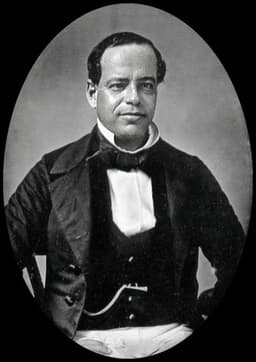
Antonio Lopez de Santa Anna
General · Modern
58.9Total
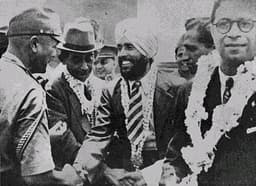
Mohan Singh
General · Modern
46.6Total
Basic Information
Born
1794
1909
Died
1876
1989
Era
Modern
Modern
Nationality
Mexico
India
Occupation
General
General
Civilization
Western
Indian
Score Comparison
Military (10%)
70.0
50.0
Political (20%)
46.6
36.5
Influence (20%)
56.7
57.2
Legacy (20%)
58.0
48.3
Leadership (15%)
68.0
36.9
Strategy (15%)
60.0
41.7
TOTAL
58.9
46.6
Antonio Lopez de Santa Anna — Complete Timeline
1823 AD
Led the Plan of Casa Mata rebellionPolitical Action
Santa Anna, then a general, issued the Plan of Casa Mata on February 1, 1823, calling for the overthrow of Emperor Agust
RebellionOverthrowRepublic
Impact: nationalconstructive
1829 AD
Defended Mexico at the Battle of TampicoWar◆ Major
Santa Anna commanded Mexican forces that defeated a Spanish invasion force at Tampico on September 11, 1829. The victory ended Spain's last attempt to reconquer Mexico and made Santa Anna a national hero. He was hailed as the 'Hero of Tampico' and used this fame to advance politically.
VictorySpanish InvasionNational Hero
Impact: nationalconstructive
1833 AD
Became President of Mexico for the first timePolitical Action◆ Major
Santa Anna was elected President of Mexico in 1833. He quickly delegated power to Vice President Valent
PresidencyPolitical InstabilityPower
Impact: national
1836 AD
Commanded at the Siege of the AlamoWar◆ Major
Santa Anna personally led the Mexican army in the siege of the Alamo mission in San Antonio, Texas. After a 13-day siege, Mexican forces stormed the fort on March 6, 1836, killing all 180-250 Texan defenders. The battle became a symbol of Texan resistance and a rallying cry for independence.
BattleTexas RevolutionAlamo
Impact: regionaldestructive
Defeated and captured at the Battle of San JacintoWar
Santa Anna's army was surprised and routed by Texan forces under Sam Houston at the Battle of San Jacinto on April 21, 1836. Santa Anna was captured the next day. He was forced to sign the Treaties of Velasco, recognizing Texan independence, though Mexico later repudiated them.
DefeatCaptureTexas Independence
Impact: regionaltragic
1847 AD
Lost the Mexican-American WarWar
Santa Anna returned from exile to command Mexican forces during the Mexican-American War. Despite initial efforts, his army was defeated at the Battle of Cerro Gordo and later at the Battle of Chapultepec. US forces captured Mexico City on September 14, 1847, leading to the Treaty of Guadalupe Hidalgo and massive territorial losses.
Mexican-American WarDefeatTerritorial Loss
Impact: globaltragic
1853 AD
Sold La Mesilla to the United StatesPolitical Action◆ Major
During his final presidency, Santa Anna agreed to the Gadsden Purchase, selling 29,670 square miles of territory (La Mesilla) to the United States for $10 million. The sale was widely condemned in Mexico as a betrayal. This act further damaged his reputation and led to his overthrow.
Territorial CessionGadsden PurchaseBetrayal
Impact: nationaldestructive
1855 AD
Overthrown and exiled for the final timePolitical Action◆ Major
The Plan of Ayutla, led by Juan
OverthrowExileEnd of Career
Impact: nationaltragic
Mohan Singh — Complete Timeline
1942 AD
Founding of the Indian National ArmyPolitical Action◆ Major
Mohan Singh founded the Indian National Army (INA) in Singapore with captured Indian soldiers from the British Indian Army. He aimed to fight alongside Japan for Indian independence, but later fell out with Japanese leadership.
Indian National ArmyWorld War IIIndependence
Impact: nationalconstructive
Dissolution of the First INAPolitical Action◆ Major
Mohan Singh dissolved the first Indian National Army after disagreements with the Japanese over its command and objectives. He was arrested by the Japanese, and the INA was later revived by Subhas Chandra Bose.
Indian National ArmyJapanese ConflictDissolution
Impact: nationaldestructive
1945 AD
Imprisonment by BritishPolitical Action
Mohan Singh was imprisoned by the British after World War II for his role in the INA. He was tried and sentenced, but later released after Indian independence, becoming a symbol of resistance.
ImprisonmentBritish EmpireINA
Impact: nationaltragic
Expert Analysis
Antonio Lopez de Santa Anna vs Mohan Singh
### The General Who Sold a Nation and the General Who Dreamed of One
On a dusty April afternoon in 1836, Antonio López de Santa Anna, the self-styled “Napoleon of the West,” was captured hiding in a marsh, dressed in a private’s uniform. He had just lost Texas. A century later, in 1942, another general—Mohan Singh—stood in Singapore and proclaimed the birth of an Indian National Army, a force that would fight for a freedom he would never see. Both men were generals. Both were nationalists. Yet one ended his career selling his country’s land, while the other ended his in obscurity, his dream realized by others. Why did two men of similar ambition walk such different paths?
### Origins
Santa Anna was born in 1794 in Jalapa, Mexico, into a colonial world on the cusp of revolution. The son of a Spanish colonial official, he grew up in a society rigidly divided by caste and class. He joined the Spanish army at sixteen, a young man of restless energy who learned early that in a land of chaos, the man with the gun made the rules. Mexico’s war for independence was not a clean break but a decade-long bloodletting, and Santa Anna, like many ambitious criollos, switched sides when it suited him. His world was one of fragile republics and caudillo strongmen, where loyalty was a currency and power a prize to be seized.
Mohan Singh, by contrast, was born in 1909 in Punjab, a province of British India. He was a Sikh from a farming family, inheriting a tradition of martial service. He joined the British Indian Army as a young officer, a loyal subject of the King-Emperor. His world was one of imperial order: drill squares, mess halls, and the unspoken promise that a man could rise through merit. But beneath this surface, the currents of Indian nationalism were stirring. Gandhi’s non-violent campaigns had already shaken the Raj. Singh’s generation knew that the empire’s days were numbered, but they did not yet know how the end would come.
### Rise to Power
Santa Anna’s rise was a masterclass in opportunism. In 1823, he issued the Plan of Casa Mata, a rebellion that toppled Emperor Agustín de Iturbide. He was not a true republican—he simply saw which way the wind blew. Over the next decade, he built a reputation as a military hero. In 1829, he defeated a Spanish invasion force at Tampico, a victory that made him the savior of the nation. The adulation was intoxicating. By 1833, he was president. But he was a reluctant ruler, preferring the title to the work. He handed power to his vice president and retreated to his hacienda, only to return when crisis called.
Mohan Singh’s rise was slower, more measured. He was a professional soldier, not a politician. His turning point came in 1942, when Japan swept through Southeast Asia. Captured at the fall of Singapore, he found himself among thousands of Indian prisoners of war. The Japanese, eager to destabilize the British, offered him a deal: raise an army of Indian soldiers to fight for Indian independence. Singh accepted. In a matter of months, he forged the Indian National Army from the ashes of defeat. It was a stunning achievement—a general without a country, building a force from nothing.
### Leadership and Governance
Santa Anna governed like a caudillo: personal, theatrical, and utterly pragmatic. He was a brilliant political actor, able to read a room and a nation. He cultivated a cult of personality, calling himself the “Benefactor of the Fatherland” and later “His Most Serene Highness.” But his rule was a revolving door of coups, exiles, and returns. He was president eleven times, each time promising reform and each time delivering only himself. His military genius was real but erratic. At the Alamo in 1836, he showed ruthless efficiency, storming the mission after a 13-day siege and ordering no quarter. But at San Jacinto weeks later, he was caught napping—literally—and his army was destroyed in eighteen minutes. He was a gambler who could win a battle but not a war.
Mohan Singh was a different kind of leader. He was an organizer, not a showman. He built the INA on a foundation of discipline and ideology, not personal charisma. He insisted that the army be independent of Japanese control, a demand that led to his downfall. When the Japanese tried to dictate terms, Singh dissolved the INA in 1942 rather than see it become a puppet. It was a principled act, but it cost him his command. He was a nationalist who believed the army belonged to India, not to Tokyo.
### Triumph and Tragedy
Santa Anna’s greatest triumph was also his greatest tragedy. The victory at the Alamo made him a legend, but the defeat at San Jacinto made him a laughingstock. He signed away Texas under duress, a humiliation that haunted him. He returned to power, lost the Mexican-American War in 1847, and then, in 1853, sold La Mesilla—29,670 square miles of land—to the United States in the Gadsden Purchase. It was the final act of a man who had traded his nation’s future for his own survival. He was overthrown in 1855 and exiled, a ghost wandering between New York and Cuba.
Mohan Singh’s tragedy was quieter. He was imprisoned by the British in 1945, tried and sentenced for treason. But his dream did not die. Subhas Chandra Bose took command of the INA, turning it into a symbol of resistance. When the British put Singh and his comrades on trial, the public outcry was so fierce that it helped push India toward independence in 1947. Singh was released, but he never led again. He had lit a fire that others carried.
### Character and Destiny
Santa Anna was a man of insatiable ego and flexible principles. He loved power but hated the work of governing. He was brave in battle but careless in strategy. His decisions were driven by a need for personal glory, not national good. That is why he sold land: it was a transaction, not a betrayal to him. He saw Mexico as his estate, not his country.
Mohan Singh was the opposite: a man of rigid honor and quiet conviction. He believed in India before he believed in himself. His decision to dissolve the INA rather than compromise with the Japanese was a choice that cost him his career but saved his soul. He was a tragic figure because he was too principled for the brutal world of war and politics.
### Legacy
Santa Anna is remembered in Mexico as the man who lost half the country. His name is a curse. In Texas, he is a villain. His legacy is a cautionary tale of what happens when a leader puts himself above his nation.
Mohan Singh is remembered as the father of the Indian National Army, a pioneer of armed resistance. His name is honored, though not as loudly as Bose’s. He is a footnote in the grand story of Indian independence, but a crucial one. He showed that Indians could fight for their own freedom.
### Conclusion
One general sold his country; the other dreamed of one. Santa Anna’s story is a warning about the corruption of power, Mohan Singh’s a testament to the power of principle. They lived in the same century of empires and revolutions, but they chose different masters. Santa Anna served himself. Mohan Singh served an idea. In the end, the idea outlasted the man, while the man outlasted the nation he betrayed.
Rankings
🥇
Antonio Lopez de Santa AnnaLeader
Mil: 70.0Pol: 46.6Inf: 56.7
58.9
🥈
Mohan Singh
Mil: 50.0Pol: 36.5Inf: 57.2
46.6
+12.3 behind
How This Comparison Works
Algorithm
Each figure is scored on 6 dimensions (0—100 scale) based on structured historical data: Military (10%), Political (20%), Influence (20%), Legacy (20%), Leadership (15%), Strategy (15%). The weighted total produces the final ranking.
Data Sources
Scores are computed from structured sub-indicators in the database. Scale factors adjust for era (Ancient ×0.85, Modern ×1.0) and civilization size (Eastern ×1.05, Other ×0.80) to account for differences in population and military scale.
Maximum 3 Figures
Comparisons are limited to 2—3 figures to ensure readability and statistical meaningfulness.
Error Margins
±5 points per dimension — Sub-scores are derived from historical records with inherent uncertainty. Two figures within 5 points on a dimension should be considered roughly equivalent in that area.
Total Score Accuracy
±3 points overall — The weighted combination of 6 dimensions produces a total score with approximately ±3 points of uncertainty. Differences of less than 3 points are not statistically significant— the figures are effectively tied.
Known Limitations
- Historical records are incomplete and uneven across civilizations
- Figures from oral-tradition societies may be underrepresented
- Occupation labels can misclassify multi-role figures
- Scores measure capability and impact, not moral character
- Quantitative scoring is a comparison tool, not absolute truth
Capability Radar
Military (10%) — Battles & Warfare
Battles
65
15
Win Rate
40
10
Expansion
50
10
Political (20%) — Governance & Reform
Reform
20
25
Diplomacy
35
30
Economy
15
10
Influence (20%) — Cultural & Global Reach
Cultural
55
30
Global
50
25
Legacy (20%) — Historical Impact
Historical
60
40
Longevity
55
30
Leadership (15%) — Power & Stability
Tenure
75
20
Stability
10
10
Strategy (15%) — Tactics & Innovation
Strategy
45
25
Tactics
60
20
Reform
30
30
Similar Comparisons
Comments & Discussion
Napoleon's Ghost6/16/2026
Comparing Santa Anna to Mohan Singh is an insult to the latter. Santa Anna was a grandstanding buffoon who lost half his country while playing dress-up as French aristocracy. Mohan Singh organized a real army from POWs under Japanese guns, risking everything for an idea. One sold territory for ego, the other traded comfort for conviction. Show me a single major battle Santa Anna won that mattered long-term—I'll wait.
TexasGrinch6/16/2026
Santa Anna gets too much flak for "selling" Mexican land, but look closer: after the Texas disaster, Mexico was broke and the US had already won the war. The Treaty of Guadalupe Hidalgo was signed under duress by a government that disowned him. Meanwhile, Mohan Singh's INA fizzled in its first real campaign at Imphal, losing 60% of its men. Both were failures in the field, but at least Santa Anna kept his country intact before losing it.
SepoyScholar6/16/2026
圣安纳像一只在悬崖边跳舞的火鸡——既虚荣又短视。他自比拿破仑,却连自己的本土防御都搞不明白。墨美战争时,他明明有地利优势,却让扎卡里·泰勒在白刃战中把他打垮。对比之下,莫汉·辛格虽然失败,但他是被英国情报局渗透瓦解的,不是因为他愚蠢。一个败于野心,一个败于体制。
加勒比铁腕6/16/2026
别把叛徒和英雄混为一谈。圣安纳晚年为了流亡补贴,公然接受美国买地费用,连墨西哥老百姓都骂他"卖国贼"。莫汉·辛格一辈子没拿过敌国一分錢,就算被日军利用,他始终觉得印度独立比个人利益重要。圣安纳的军队抢劫自己人,辛格的军队纪律严明。道义层面上,高低立判。
Perennial Loser6/16/2026
Let's be honest: Santa Anna at least held power for decades across multiple coups, while Mohan Singh couldn't sustain a single campaign. Singh surrendered to the British in 1945 without firing a decisive shot, his INA dissolved into prisoner camps. Santa Anna lost territory, sure, but he led armies for 30 years. If we're measuring generalship by leadership endurance, not morality, Santa Anna wins—which says more about the standards of failure than either man.