Loading...
Antonio Lopez de Santa Anna vs Julius Caesar
Julius Caesar leads by 23.9 pts · 2 figures compared
…
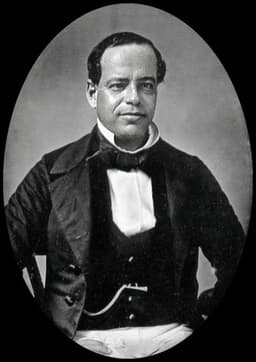
Antonio Lopez de Santa Anna
General · Modern
58.9Total

Julius Caesar
General · Ancient
82.8Total
Basic Information
Born
1794
-100
Died
1876
-44
Era
Modern
Ancient
Nationality
Mexico
Roman Republic
Occupation
General
General
Civilization
Western
Western
Score Comparison
Military (10%)
70.0
88.0
Political (20%)
46.6
78.0
Influence (20%)
56.7
85.0
Legacy (20%)
58.0
82.0
Leadership (15%)
68.0
80.0
Strategy (15%)
60.0
85.0
TOTAL
58.9
82.8
Antonio Lopez de Santa Anna — Complete Timeline
1823 AD
Led the Plan of Casa Mata rebellionPolitical Action
Santa Anna, then a general, issued the Plan of Casa Mata on February 1, 1823, calling for the overthrow of Emperor Agust
RebellionOverthrowRepublic
Impact: nationalconstructive
1829 AD
Defended Mexico at the Battle of TampicoWar◆ Major
Santa Anna commanded Mexican forces that defeated a Spanish invasion force at Tampico on September 11, 1829. The victory ended Spain's last attempt to reconquer Mexico and made Santa Anna a national hero. He was hailed as the 'Hero of Tampico' and used this fame to advance politically.
VictorySpanish InvasionNational Hero
Impact: nationalconstructive
1833 AD
Became President of Mexico for the first timePolitical Action◆ Major
Santa Anna was elected President of Mexico in 1833. He quickly delegated power to Vice President Valent
PresidencyPolitical InstabilityPower
Impact: national
1836 AD
Commanded at the Siege of the AlamoWar◆ Major
Santa Anna personally led the Mexican army in the siege of the Alamo mission in San Antonio, Texas. After a 13-day siege, Mexican forces stormed the fort on March 6, 1836, killing all 180-250 Texan defenders. The battle became a symbol of Texan resistance and a rallying cry for independence.
BattleTexas RevolutionAlamo
Impact: regionaldestructive
Defeated and captured at the Battle of San JacintoWar
Santa Anna's army was surprised and routed by Texan forces under Sam Houston at the Battle of San Jacinto on April 21, 1836. Santa Anna was captured the next day. He was forced to sign the Treaties of Velasco, recognizing Texan independence, though Mexico later repudiated them.
DefeatCaptureTexas Independence
Impact: regionaltragic
1847 AD
Lost the Mexican-American WarWar
Santa Anna returned from exile to command Mexican forces during the Mexican-American War. Despite initial efforts, his army was defeated at the Battle of Cerro Gordo and later at the Battle of Chapultepec. US forces captured Mexico City on September 14, 1847, leading to the Treaty of Guadalupe Hidalgo and massive territorial losses.
Mexican-American WarDefeatTerritorial Loss
Impact: globaltragic
1853 AD
Sold La Mesilla to the United StatesPolitical Action◆ Major
During his final presidency, Santa Anna agreed to the Gadsden Purchase, selling 29,670 square miles of territory (La Mesilla) to the United States for $10 million. The sale was widely condemned in Mexico as a betrayal. This act further damaged his reputation and led to his overthrow.
Territorial CessionGadsden PurchaseBetrayal
Impact: nationaldestructive
1855 AD
Overthrown and exiled for the final timePolitical Action◆ Major
The Plan of Ayutla, led by Juan
OverthrowExileEnd of Career
Impact: nationaltragic
Julius Caesar — Complete Timeline
58 BC
Gallic WarsWar◆ Major
Caesar, as proconsul of Gaul, launched a series of campaigns that conquered all of Gaul (modern France, Belgium, and parts of Switzerland). He fought numerous battles, including against the Helvetii, the Belgae, and the Gallic chieftain Vercingetorix. The wars brought immense wealth and a loyal army to Caesar.
Gallic WarsConquestRoman Expansion
Impact: regional
49 BC
Crossing the RubiconPolitical Action◆ Major
Caesar led Legio XIII across the Rubicon River into Italy, defying the Roman Senate's order to disband his army. This act triggered a civil war against Pompey and the Optimates, ultimately leading to Caesar's dictatorship and the end of the Roman Republic.
Roman Civil WarEnd of RepublicPower Struggle
Impact: global
48 BC
Battle of PharsalusWar◆ Major
Caesar's outnumbered army defeated the larger forces of Pompey the Great at Pharsalus in Greece. Caesar's tactical use of a reserve line to counter Pompey's cavalry charge proved decisive. Pompey fled to Egypt, where he was assassinated, leaving Caesar as the undisputed master of the Roman world.
Roman Civil WarBattleDecisive Victory
Impact: regional
44 BC
Appointment as Dictator for LifePolitical Action◆ Major
The Roman Senate appointed Caesar dictator perpetuo (dictator for life), granting him unprecedented personal power. This move concentrated military, legislative, and judicial authority in one person, effectively ending the Roman Republic's traditional system of checks and balances and alarming many senators.
DictatorshipEnd of RepublicPower Consolidation
Impact: regionaldestructive
Assassination on the Ides of MarchPolitical Action◆ Major
A group of Roman senators, led by Marcus Junius Brutus and Gaius Cassius Longinus, stabbed Caesar to death at a meeting of the Senate in the Theatre of Pompey. The assassination was intended to restore the Republic, but instead triggered another civil war that led to the rise of the Roman Empire.
AssassinationRoman PoliticsEnd of Republic
Impact: globaldestructive
Expert Analysis
antonio-lopez-de-santa-anna-vs-julius-caesar
# The Dictator's Mirror: Caesar and Santa Anna
On a March morning in 44 BCE, Julius Caesar fell beneath twenty-three dagger strokes in the Senate chamber of Rome, his blood pooling on the marble floor. Eighteen centuries later, another general-president—Antonio López de Santa Anna—slipped into exile for the last time, leaving behind a Mexico stripped of half its territory. One man's death launched an empire; the other's life became a cautionary tale. Both were military men who seized political power, yet their trajectories diverged so sharply that comparing them reveals something profound about the relationship between ambition, circumstance, and the fragile architecture of republics.
Origins
Caesar was born into the patrician Julian clan, a family claiming descent from the goddess Venus, but one that had fallen on hard political times. The Rome of his youth was a city of violent rivalries, where Marius and Sulla had turned legions against each other. Caesar learned early that in a crumbling republic, survival depended on audacity. He was a gambler by temperament, a man who once told his captors that he would return to crucify them—and did.
Santa Anna emerged from a very different world. Born in 1794 in Jalapa, Veracruz, he came of age as New Spain convulsed in its war for independence. Unlike Caesar's ancient pedigree, Santa Anna's family was criollo—Spanish-descended but not aristocratic. He joined the royalist army at fifteen, then switched sides when Iturbide's independence movement gained momentum. Where Caesar inherited a tradition of senatorial politics, Santa Anna inherited chaos: a newborn nation with no stable institutions, a weak central government, and a voracious neighbor to the north.
Rise to Power
Caesar's path was methodical and brilliant. He climbed the *cursus honorum*—quaestor, aedile, praetor—each step financed by borrowed money and cemented by alliances. His real breakthrough came in 58 BCE, when he secured command of Gaul. Over eight years, he conquered a territory larger than Italy, built a loyal army, and amassed staggering wealth. The Rubicon crossing in 49 BCE was not a gamble but a calculation: he knew his enemies in the Senate would prosecute him, so he chose war.
Santa Anna's rise was more erratic. In 1823, he issued the Plan of Casa Mata, overthrowing Emperor Agustín de Iturbide—the very man he had once supported. The pattern was set. In 1829, he became the "Hero of Tampico" by repelling a Spanish invasion, a victory that made him a national icon. By 1833, he was president, though he quickly delegated power to his vice president while retreating to his hacienda. Power for Santa Anna was not a ladder to climb but a prize to seize and then abandon, only to seize again.
Leadership & Governance
Caesar governed as a reformer. As dictator, he overhauled the calendar, extended citizenship to provincials, launched public works, and planned a codification of Roman law. His military genius lay in speed and logistics—he once wrote "Veni, vidi, vici" after a five-day campaign. His strategy at Alesia, where he besieged the Gauls while simultaneously defending against a relieving army, remains a masterpiece of siegecraft.
Santa Anna's leadership was theatrical rather than strategic. At the Alamo in 1836, he ordered "no quarter," a decision that galvanized Texan resistance. Weeks later, at San Jacinto, he was caught napping in his tent while Sam Houston's men overran his camp. His military score of 66.3 reflects a general who could inspire troops but not outthink his enemies. Politically, he cycled through eleven presidencies, each time ruling by decree, selling offices, and enriching himself. The Gadsden Purchase of 1853, where he sold 29,670 square miles for $10 million, was not a diplomatic necessity but a personal cash grab.
Triumph & Tragedy
Caesar's triumph was Gaul—the conquest that made him master of the Roman world. His tragedy was the Ides of March: he had centralized power so completely that his murder did not restore the Republic but ignited civil wars that ended it. His adopted heir, Octavian, became Augustus, the first emperor.
Santa Anna's triumph was Tampico, a genuine victory that briefly united Mexico. His tragedy was San Jacinto, where he was captured and forced to recognize Texan independence. The Mexican-American War compounded the disaster: as commander, he lost battle after battle—Cerro Gordo, Churubusco, Chapultepec—until American troops marched into Mexico City. By 1855, the Plan of Ayutla swept him away for good.
Character & Destiny
Caesar was cold, calculating, and ruthlessly ambitious, yet he showed clemency to defeated rivals—a calculated mercy that won him supporters. His personality was a paradox: a patrician who championed the people, a dictator who dreamed of reform. He died because he believed his own legend, dismissing the conspirators as "a bald-headed little fellow and a few sickly boys."
Santa Anna was vain, opportunistic, and self-serving. He styled himself the "Napoleon of the West" and demanded to be called "His Most Serene Highness." His character was shaped by Mexico's instability: every betrayal, every flip-flop, every exile was a survival tactic in a system where loyalty was a liability. He died in 1876, blind and nearly forgotten, a man who had ruled Mexico longer than anyone but left it weaker.
Legacy
Caesar's legacy is the Roman Empire itself. His name became a title—Kaiser, Tsar—and his writings, especially the *Commentaries on the Gallic War*, shaped Western military education for two millennia. He is remembered as a genius who destroyed a republic and built a civilization.
Santa Anna's legacy is the opposite: a man whose ambition accelerated Mexico's catastrophe. He is remembered in Mexican history as a traitor who sold his country, and in American history as the villain of the Alamo. His leadership score of 77.6 and legacy score of 65.2 tell the story: he was effective, but destructively so.
Conclusion
Caesar and Santa Anna are mirrors reflecting different fates for different republics. Rome survived Caesar's dictatorship to become an empire; Mexico survived Santa Anna's chaos to become a fractured nation. One man's ambition created a world power; the other's self-interest dismantled one. The difference was not talent—both were skilled—but context. Caesar inherited a system strong enough to absorb his ambition; Santa Anna inherited one too fragile to survive it. In the end, the measure of a dictator is not how he rises, but what he leaves behind when he falls.
Rankings
🥇
Julius CaesarLeader
Mil: 88.0Pol: 78.0Inf: 85.0
82.8
🥈
Antonio Lopez de Santa Anna
Mil: 70.0Pol: 46.6Inf: 56.7
58.9
+23.9 behind
How This Comparison Works
Algorithm
Each figure is scored on 6 dimensions (0—100 scale) based on structured historical data: Military (10%), Political (20%), Influence (20%), Legacy (20%), Leadership (15%), Strategy (15%). The weighted total produces the final ranking.
Data Sources
Scores are computed from structured sub-indicators in the database. Scale factors adjust for era (Ancient ×0.85, Modern ×1.0) and civilization size (Eastern ×1.05, Other ×0.80) to account for differences in population and military scale.
Maximum 3 Figures
Comparisons are limited to 2—3 figures to ensure readability and statistical meaningfulness.
Error Margins
±5 points per dimension — Sub-scores are derived from historical records with inherent uncertainty. Two figures within 5 points on a dimension should be considered roughly equivalent in that area.
Total Score Accuracy
±3 points overall — The weighted combination of 6 dimensions produces a total score with approximately ±3 points of uncertainty. Differences of less than 3 points are not statistically significant— the figures are effectively tied.
Known Limitations
- Historical records are incomplete and uneven across civilizations
- Figures from oral-tradition societies may be underrepresented
- Occupation labels can misclassify multi-role figures
- Scores measure capability and impact, not moral character
- Quantitative scoring is a comparison tool, not absolute truth
Capability Radar
Military (10%) — Battles & Warfare
Battles
65
95
Win Rate
40
92
Expansion
50
97
Political (20%) — Governance & Reform
Reform
20
90
Diplomacy
35
85
Economy
15
82
Influence (20%) — Cultural & Global Reach
Cultural
55
88
Global
50
94
Legacy (20%) — Historical Impact
Historical
60
95
Longevity
55
96
Leadership (15%) — Power & Stability
Tenure
75
75
Stability
10
60
Strategy (15%) — Tactics & Innovation
Strategy
45
94
Tactics
60
96
Reform
30
88
Similar Comparisons
Comments & Discussion
LegionLancer6/17/2026
Caesar redefined war as political theater; Santa Anna just kept losing the same script. Comparing them is like weighing gold against fool's gold—Caesar conquered Gaul with calculated brutality, while Santa Anna lost Texas because he napped during siesta at San Jacinto. One built an empire through engineering marvels like the Rhine bridge; the other sold half his country for personal gain. Santa Anna is a cautionary tale not of ambition, but incompetence dressed in epaulets.
硬核史奴6/17/2026
拿恺撒和圣安纳比,简直侮辱了罗马的元老院。圣安纳就是个靠叛变上位的投机分子,十一岁从军到老年流亡,一生反复横跳——支持西班牙、反西班牙、当独裁者、流放、回来再独裁。恺撒至少写了《高卢战记》,圣安纳连回忆录都靠枪手代笔。别把吃豆人和拿破仑放在同一张桌上。