Loading...
Antonio Lopez de Santa Anna vs Giuseppe Garibaldi
Antonio Lopez de Santa Anna leads by 3.9 pts · 2 figures compared
…
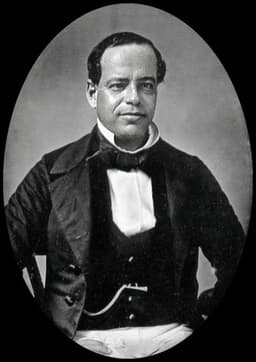
Antonio Lopez de Santa Anna
General · Modern
58.9Total
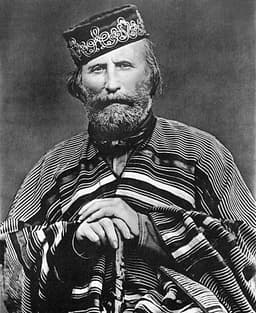
Giuseppe Garibaldi
General · Modern
55.0Total
Basic Information
Born
1794
1807
Died
1876
1882
Era
Modern
Modern
Nationality
Mexico
Italy
Occupation
General
General
Civilization
Western
Western
Score Comparison
Military (10%)
70.0
61.7
Political (20%)
46.6
54.7
Influence (20%)
56.7
40.0
Legacy (20%)
58.0
68.0
Leadership (15%)
68.0
54.2
Strategy (15%)
60.0
55.0
TOTAL
58.9
55.0
Antonio Lopez de Santa Anna — Complete Timeline
1823 AD
Led the Plan of Casa Mata rebellionPolitical Action
Santa Anna, then a general, issued the Plan of Casa Mata on February 1, 1823, calling for the overthrow of Emperor Agust
RebellionOverthrowRepublic
Impact: nationalconstructive
1829 AD
Defended Mexico at the Battle of TampicoWar◆ Major
Santa Anna commanded Mexican forces that defeated a Spanish invasion force at Tampico on September 11, 1829. The victory ended Spain's last attempt to reconquer Mexico and made Santa Anna a national hero. He was hailed as the 'Hero of Tampico' and used this fame to advance politically.
VictorySpanish InvasionNational Hero
Impact: nationalconstructive
1833 AD
Became President of Mexico for the first timePolitical Action◆ Major
Santa Anna was elected President of Mexico in 1833. He quickly delegated power to Vice President Valent
PresidencyPolitical InstabilityPower
Impact: national
1836 AD
Commanded at the Siege of the AlamoWar◆ Major
Santa Anna personally led the Mexican army in the siege of the Alamo mission in San Antonio, Texas. After a 13-day siege, Mexican forces stormed the fort on March 6, 1836, killing all 180-250 Texan defenders. The battle became a symbol of Texan resistance and a rallying cry for independence.
BattleTexas RevolutionAlamo
Impact: regionaldestructive
Defeated and captured at the Battle of San JacintoWar
Santa Anna's army was surprised and routed by Texan forces under Sam Houston at the Battle of San Jacinto on April 21, 1836. Santa Anna was captured the next day. He was forced to sign the Treaties of Velasco, recognizing Texan independence, though Mexico later repudiated them.
DefeatCaptureTexas Independence
Impact: regionaltragic
1847 AD
Lost the Mexican-American WarWar
Santa Anna returned from exile to command Mexican forces during the Mexican-American War. Despite initial efforts, his army was defeated at the Battle of Cerro Gordo and later at the Battle of Chapultepec. US forces captured Mexico City on September 14, 1847, leading to the Treaty of Guadalupe Hidalgo and massive territorial losses.
Mexican-American WarDefeatTerritorial Loss
Impact: globaltragic
1853 AD
Sold La Mesilla to the United StatesPolitical Action◆ Major
During his final presidency, Santa Anna agreed to the Gadsden Purchase, selling 29,670 square miles of territory (La Mesilla) to the United States for $10 million. The sale was widely condemned in Mexico as a betrayal. This act further damaged his reputation and led to his overthrow.
Territorial CessionGadsden PurchaseBetrayal
Impact: nationaldestructive
1855 AD
Overthrown and exiled for the final timePolitical Action◆ Major
The Plan of Ayutla, led by Juan
OverthrowExileEnd of Career
Impact: nationaltragic
Giuseppe Garibaldi — Complete Timeline
1849 AD
Defense of the Roman RepublicWar◆ Major
Garibaldi commanded the defense of the short-lived Roman Republic against French forces sent to restore papal rule. Despite heroic resistance, the republic fell, and Garibaldi led a retreat through central Italy.
Italian UnificationRoman RepublicDefense
Impact: regionaltragic
1860 AD
Expedition of the ThousandWar
Garibaldi led a volunteer force of about 1,000 men to conquer Sicily and Naples. His campaign overthrew the Bourbon monarchy and unified southern Italy with the Kingdom of Sardinia.
Italian UnificationExpeditionVolunteers
Impact: nationalconstructive
Battle of CalatafimiWar◆ Major
Garibaldi's Redshirts defeated a larger Bourbon army at Calatafimi in Sicily. The victory boosted morale and demonstrated the effectiveness of his volunteers, opening the way to Palermo.
Italian UnificationBattleSicily
Impact: regional
Battle of VolturnusWar◆ Major
Garibaldi's forces defeated the Neapolitan army at the Volturno River. The victory secured his conquest of Naples and forced King Francis II into exile, completing the unification of southern Italy.
Italian UnificationBattleNaples
Impact: regional
Cession of Sicily and Naples to Victor Emmanuel IIPolitical Action
After conquering southern Italy, Garibaldi voluntarily handed over his conquests to King Victor Emmanuel II of Sardinia. This act unified Italy under the monarchy and avoided civil war.
Italian UnificationCessionMonarchy
Impact: nationalconstructive
Expert Analysis
Antonio Lopez de Santa Anna vs Giuseppe Garibaldi
# The Redshirt and the Silver Button
In the spring of 1860, a weather-beaten Italian with a shock of graying hair and a flowing red shirt stepped onto a beach in Sicily with a thousand volunteers. He carried no ambitions for personal power, only a burning vision of a unified Italy. Fifteen years earlier and an ocean away, another general—resplendent in gold-braided uniform, his chest glittering with medals he had awarded himself—surveyed the ruins of the Alamo mission in Texas, a victory that would ultimately unravel his nation's northern territories. Giuseppe Garibaldi and Antonio López de Santa Anna both commanded armies, both reshaped their nations, yet their names evoke radically different echoes. One is remembered as a liberator; the other, as the man who lost half his country. Why?
Origins
Garibaldi was born in 1807 in Nice, then part of the French Empire, the son of a coastal fisherman. The sea taught him patience, the mountains taught him endurance, and the political ferment of the 1820s taught him that Italy was a "geographical expression"—a patchwork of foreign-controlled states—and that this was an injustice crying out for remedy. His first rebellion, a failed insurrection in Genoa in 1834, forced him into exile in South America, where he spent years fighting as a mercenary and guerrilla leader. He learned war not from textbooks but from the pampas of Uruguay and the jungles of Brazil.
Santa Anna was born in 1794 in Jalapa, Mexico, into a respectable Spanish colonial family. He entered the Spanish army as a cadet at age sixteen, and the rigid hierarchies of New Spain shaped his understanding of power: authority flowed downward, and loyalty was bought, not earned. When Mexico won independence in 1821, Santa Anna saw not a nation but an opportunity. He had no ideology beyond self-advancement. Where Garibaldi dreamed of a united homeland, Santa Anna dreamed of a grand estate called Manga de Clavo, where he could retire between presidencies—and there would be many presidencies.
Rise to Power
Garibaldi's path to prominence was forged in defeat. In 1848, revolution swept Europe, and he returned to Italy to defend the newly proclaimed Roman Republic against French forces sent to restore papal rule. The defense was hopeless—French cannons outnumbered his rifles—but Garibaldi's retreat became legend. He led four thousand men through the Apennines, his pregnant wife Anita dying in his arms, refusing to surrender even as his army dissolved. He escaped to exile again, but his reputation as a man who would fight for principle against impossible odds was sealed.
Santa Anna's rise was orchestrated by a different calculus. In 1823, he issued the Plan of Casa Mata, calling for the overthrow of Emperor Agustín de Iturbide. Iturbide fell; Santa Anna rose. In 1829, he commanded Mexican forces that defeated a Spanish invasion at Tampico, earning the title "Hero of Tampico." He became president in 1833, but quickly delegated power to his vice president and retired to his estate. He would return, leave, return again—eleven presidencies in total, each time presenting himself as the indispensable man, the only one who could save Mexico from chaos. The pattern was set: crisis, Santa Anna, betrayal, exile, return.
Leadership & Governance
Garibaldi governed through charisma and sacrifice. He paid his Redshirts from his own pocket, slept on the ground beside them, and ate the same rations. When he conquered Sicily and Naples in 1860 during the Expedition of the Thousand, he could have declared himself king. Instead, he met King Victor Emmanuel II of Sardinia near Teano and handed over his conquests with a simple handshake and the words, "I obey." He wanted unity, not power. His military genius lay in mobility and morale: at the Battle of Calatafimi, his thousand volunteers defeated a Bourbon army three times their size by charging uphill with bayonets, believing that courage could overcome cannon.
Santa Anna governed through manipulation and spectacle. He was a skilled battlefield commander—his victory at Tampico was genuine, and his siege of the Alamo demonstrated tactical competence—but his political instincts were predatory. He sold territory: first Texas after San Jacinto, then the Gadsden Purchase in 1853, accepting ten million dollars for 29,670 square miles of Mexican land. He taxed church bells, sold mining concessions, and levied "loans" that were never repaid. His leadership was a cycle of accumulation and loss. He named himself "His Most Serene Highness" and demanded to be addressed as "the Napoleon of the West." But Napoleon won battles that expanded France; Santa Anna won battles that preceded catastrophes.
Triumph & Tragedy
Garibaldi's greatest moment was the Expedition of the Thousand. In May 1860, he landed at Marsala with 1,089 volunteers. By September, he had conquered the entire Kingdom of the Two Sicilies, an army of 50,000. His victory at the Battle of Volturnus secured Naples, and he rode into the city amid cheering crowds. His tragedy was that the unification he achieved was incomplete: Rome remained under papal control until 1870, and the north dominated the south economically. He spent his final years as a farmer on Caprera, a disappointed radical who had hoped for a republic and a social revolution, not a monarchy and a conservative state.
Santa Anna's greatest moment was the Alamo. On March 6, 1836, after a thirteen-day siege, his forces stormed the mission and killed all 189 defenders. He ordered no quarter, believing terror would crush the Texan rebellion. His tragedy followed forty-six days later at San Jacinto, where Sam Houston's men surprised his army during a siesta, shouting "Remember the Alamo!" Santa Anna fled, was captured disguised as a common soldier, and signed the Treaties of Velasco, recognizing Texan independence. He lost Texas. In the Mexican-American War of 1847, he returned from exile to command again, but his army was outmaneuvered by Winfield Scott, and Mexico City fell. He lost half of Mexico's territory.
Character & Destiny
Garibaldi was a man of conviction. He believed in liberty, equality, and the brotherhood of nations. He corresponded with Abraham Lincoln, offered to fight for the Union, and refused all titles and riches. His character was his destiny: he could not betray his principles, and so his power was always limited by his integrity. He died in 1882, poor and beloved.
Santa Anna was a man of ambition. He believed in Santa Anna. He wrote in his memoirs that he had always acted for Mexico's good, but the evidence suggests he acted for his own. His character was his destiny: he could not share power, and so his power was always fragile. He died in 1876, blind, impoverished, and forgotten, in Mexico City. His last words were reportedly, "I have been a great man."
Legacy
Garibaldi is the father of Italy. His face appears on coins, his name adorns streets and squares, and his Redshirt is a symbol of liberation worldwide. His legacy is romantic, heroic, and unifying.
Santa Anna is the man who lost Texas. In Mexico, he is a cautionary tale, a symbol of corruption and betrayal. In the United States, he is a villain who died at the Alamo—except he didn't, and that confusion itself speaks to his legacy: he became a myth, but a myth of the enemy. His name is synonymous with failure.
Conclusion
Both men were products of their times: Garibaldi of the liberal nationalism that swept nineteenth-century Europe, Santa Anna of the fractured, post-colonial chaos that plagued early Latin America. One believed in something larger than himself; the other believed only in himself. One gave away power; the other could not hold onto it. Their stories remind us that history judges not by victories alone, but by what those victories served. In the end, Garibaldi built a nation. Santa Anna sold one.
Rankings
🥇
Antonio Lopez de Santa AnnaLeader
Mil: 70.0Pol: 46.6Inf: 56.7
58.9
🥈
Giuseppe Garibaldi
Mil: 61.7Pol: 54.7Inf: 40.0
55.0
+3.9 behind
How This Comparison Works
Algorithm
Each figure is scored on 6 dimensions (0—100 scale) based on structured historical data: Military (10%), Political (20%), Influence (20%), Legacy (20%), Leadership (15%), Strategy (15%). The weighted total produces the final ranking.
Data Sources
Scores are computed from structured sub-indicators in the database. Scale factors adjust for era (Ancient ×0.85, Modern ×1.0) and civilization size (Eastern ×1.05, Other ×0.80) to account for differences in population and military scale.
Maximum 3 Figures
Comparisons are limited to 2—3 figures to ensure readability and statistical meaningfulness.
Error Margins
±5 points per dimension — Sub-scores are derived from historical records with inherent uncertainty. Two figures within 5 points on a dimension should be considered roughly equivalent in that area.
Total Score Accuracy
±3 points overall — The weighted combination of 6 dimensions produces a total score with approximately ±3 points of uncertainty. Differences of less than 3 points are not statistically significant— the figures are effectively tied.
Known Limitations
- Historical records are incomplete and uneven across civilizations
- Figures from oral-tradition societies may be underrepresented
- Occupation labels can misclassify multi-role figures
- Scores measure capability and impact, not moral character
- Quantitative scoring is a comparison tool, not absolute truth
Capability Radar
Military (10%) — Battles & Warfare
Battles
65
65
Win Rate
40
70
Expansion
50
60
Political (20%) — Governance & Reform
Reform
20
40
Diplomacy
35
50
Economy
15
20
Influence (20%) — Cultural & Global Reach
Cultural
55
70
Global
50
65
Legacy (20%) — Historical Impact
Historical
60
75
Longevity
55
65
Leadership (15%) — Power & Stability
Tenure
75
30
Stability
10
25
Strategy (15%) — Tactics & Innovation
Strategy
45
60
Tactics
60
75
Reform
30
55
Similar Comparisons
Comments & Discussion
**The Butcher of the Alamo Bit6/16/2026
Comparing Santa Anna to Garibaldi is like comparing a tornado to a lighthouse. Garibaldi actually *gave* his red shirts to the people for Italy; Santa Anna *sold* his country’s silver buttons to his own pockets. The “Hero of Tampico” lost Texas, the Mexican-American War, and half the national territory, yet somehow convinced Mexicans he was a great man six times. Garibaldi inspired a nation; Santa Anna inspired a warning label.
**数据教父**6/16/2026
拿加里波第跟圣塔安纳比?这是侮辱统计学。圣塔安纳一辈子输了13场大战,从阿拉莫勉强算赢以外全是灾难,最后把墨西哥一半领土送给美国。加里波第在罗马共和国保卫战里以少敌多,乌ruguay战役只带14个人就攻下敌人阵地。光看数据——一个把国家卖得干干净净,一个帮国家拼得整整齐齐——这哪里是对手?
**The Revisionist Guillotine**6/16/2026
Sure, Garibaldi gets sainthood because he wasn’t a flamboyant dictator, but let’s not pretend he didn’t fail spectacularly for decades. He ran a pirate republic in South America that got destroyed, his Roman Republic collapsed in 1849, and his 1867 march on Rome was a fiasco. Meanwhile, Santa Anna actually *won* at the Alamo and Zempoala. The difference is narrative, not skill. Garibaldi had Cavour and Mazzini writing his publicity; Santa Anna had himself—and that’s a terrible PR department.
**黄袍加身与红衫不朽**6/16/2026
(历史爱好者视角)圣塔安纳的制服上每颗银纽扣都是他自封的勋章,前后装潢11次总统,还自称“墨西哥的拿破仑”。加里波第只穿一件破旧红衬衫,在南美放牛时练出的军事直觉,到意大利直接点燃整个民族觉醒。一个为了权位可以割让加利福尼亚和新墨西哥,一个甘愿退居卡普雷拉小岛种田。我觉得,看一个人的品格,不妨看他手里有枪时选择做什么。
**The Classicist’s Crossroads*6/16/2026
Plutarch would weep. Garibaldi’s *arete* — his virtue in service of the *polis* — echoes Cincinnatus leaving the plow to save Rome, then returning. Santa Anna’s hubris mirrors Alcibiades: brilliant, treacherous, selling Athens for personal glory. Garibaldi’s Redshirts were morally bound by *fides* to a national ideal; Santa Anna’s “invincibles” were mercenaries loyal to his vanity. The difference is not war but *virtus*. One