Loading...
Antonio Lopez de Santa Anna vs Eurico Gaspar Dutra
Antonio Lopez de Santa Anna leads by 6.2 pts · 2 figures compared
…
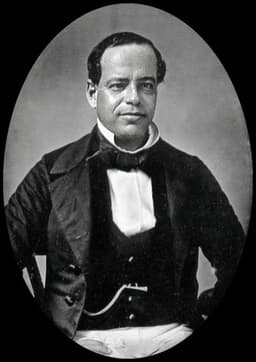
Antonio Lopez de Santa Anna
General · Modern
58.9Total

Eurico Gaspar Dutra
General · Modern
52.7Total
Basic Information
Born
1794
1883
Died
1876
1974
Era
Modern
Modern
Nationality
Mexico
Brazil
Occupation
General
General
Civilization
Western
Western
Score Comparison
Military (10%)
70.0
50.0
Political (20%)
46.6
68.0
Influence (20%)
56.7
51.8
Legacy (20%)
58.0
44.2
Leadership (15%)
68.0
62.0
Strategy (15%)
60.0
41.7
TOTAL
58.9
52.7
Antonio Lopez de Santa Anna — Complete Timeline
1823 AD
Led the Plan of Casa Mata rebellionPolitical Action
Santa Anna, then a general, issued the Plan of Casa Mata on February 1, 1823, calling for the overthrow of Emperor Agust
RebellionOverthrowRepublic
Impact: nationalconstructive
1829 AD
Defended Mexico at the Battle of TampicoWar◆ Major
Santa Anna commanded Mexican forces that defeated a Spanish invasion force at Tampico on September 11, 1829. The victory ended Spain's last attempt to reconquer Mexico and made Santa Anna a national hero. He was hailed as the 'Hero of Tampico' and used this fame to advance politically.
VictorySpanish InvasionNational Hero
Impact: nationalconstructive
1833 AD
Became President of Mexico for the first timePolitical Action◆ Major
Santa Anna was elected President of Mexico in 1833. He quickly delegated power to Vice President Valent
PresidencyPolitical InstabilityPower
Impact: national
1836 AD
Commanded at the Siege of the AlamoWar◆ Major
Santa Anna personally led the Mexican army in the siege of the Alamo mission in San Antonio, Texas. After a 13-day siege, Mexican forces stormed the fort on March 6, 1836, killing all 180-250 Texan defenders. The battle became a symbol of Texan resistance and a rallying cry for independence.
BattleTexas RevolutionAlamo
Impact: regionaldestructive
Defeated and captured at the Battle of San JacintoWar
Santa Anna's army was surprised and routed by Texan forces under Sam Houston at the Battle of San Jacinto on April 21, 1836. Santa Anna was captured the next day. He was forced to sign the Treaties of Velasco, recognizing Texan independence, though Mexico later repudiated them.
DefeatCaptureTexas Independence
Impact: regionaltragic
1847 AD
Lost the Mexican-American WarWar
Santa Anna returned from exile to command Mexican forces during the Mexican-American War. Despite initial efforts, his army was defeated at the Battle of Cerro Gordo and later at the Battle of Chapultepec. US forces captured Mexico City on September 14, 1847, leading to the Treaty of Guadalupe Hidalgo and massive territorial losses.
Mexican-American WarDefeatTerritorial Loss
Impact: globaltragic
1853 AD
Sold La Mesilla to the United StatesPolitical Action◆ Major
During his final presidency, Santa Anna agreed to the Gadsden Purchase, selling 29,670 square miles of territory (La Mesilla) to the United States for $10 million. The sale was widely condemned in Mexico as a betrayal. This act further damaged his reputation and led to his overthrow.
Territorial CessionGadsden PurchaseBetrayal
Impact: nationaldestructive
1855 AD
Overthrown and exiled for the final timePolitical Action◆ Major
The Plan of Ayutla, led by Juan
OverthrowExileEnd of Career
Impact: nationaltragic
Eurico Gaspar Dutra — Complete Timeline
1945 AD
Elected President of BrazilPolitical Action◆ Major
Eurico Gaspar Dutra was elected President of Brazil, succeeding Get
Presidency1946 RepublicElection
Impact: national
1946 AD
Promulgated the 1946 ConstitutionReform◆ Major
Dutra oversaw the promulgation of a new democratic constitution, which restored civil liberties and established a presidential system. The 1946 Constitution replaced the authoritarian 1937 Charter and marked Brazil's return to democracy.
ConstitutionDemocracyPost-Estado Novo
Impact: nationalprogressive
Implemented the 'Dutra Plan' (Plano Dutra) for Economic DevelopmentReform
Dutra launched an economic development plan focused on infrastructure, energy, and transportation. The plan aimed to modernize the Brazilian economy and reduce dependence on imports, but its implementation was limited by fiscal constraints.
Economic PlanDevelopmentInfrastructure
Impact: nationalconstructive
1947 AD
Banned the Communist PartyPolitical Action◆ Major
Dutra banned the Brazilian Communist Party (PCB) and broke diplomatic relations with the Soviet Union. This action was part of his alignment with the United States during the early Cold War and aimed to suppress leftist opposition.
Cold WarCommunist BanAnti-Communism
Impact: nationaldestructive
1950 AD
Ended Presidency and RetiredPolitical Action
Dutra completed his term and was succeeded by Get
End of TermRetirementLegacy
Impact: national
Expert Analysis
Antonio Lopez de Santa Anna vs Eurico Gaspar Dutra
# The General and the President
On a spring morning in 1836, Antonio López de Santa Anna stood before the smoldering ruins of the Alamo, his uniform immaculate, his expression triumphant. He had crushed the Texan rebels after a thirteen-day siege, and the bodies of William Travis, Jim Bowie, and Davy Crockett lay among the dead. Just over a century later, in November 1945, Eurico Gaspar Dutra walked into the presidential palace in Rio de Janeiro, a quiet soldier who had never sought personal glory but had been handed the reins of a nation emerging from dictatorship. One man would lose a third of his country's territory; the other would lay the foundations for two decades of democracy. What made the difference?
Origins
Santa Anna was born in 1794 in Jalapa, a provincial town in New Spain, into a respectable but not wealthy family. The son of a mortgage broker, he grew up in a world where the Spanish empire was beginning to crack, and opportunity beckoned for ambitious young men. He joined the army at sixteen, drawn not by ideology but by the promise of advancement. The chaos of Mexico's wars for independence taught him a brutal lesson: power belonged to whoever seized it first.
Dutra, born in 1883 in Cuiabá, deep in Brazil's interior, came from a military family with modest means. His father was a small merchant, and young Eurico entered the army as a cadet at eighteen. Brazil was then an empire, stable and vast, and the military was a profession of order, not revolution. Dutra rose slowly, methodically, through the ranks, learning that discipline and loyalty, not daring, earned respect.
Their eras shaped them profoundly. Santa Anna came of age during Mexico's violent birth, when caudillos—strongmen with personal armies—carved up the young republic. Dutra matured during Brazil's relatively peaceful transition from empire to republic, where institutions, however flawed, still held meaning.
Rise to Power
Santa Anna's ascent was meteoric and treacherous. In 1823, at just twenty-nine, he issued the Plan of Casa Mata, a rebellion that overthrew Emperor Agustín de Iturbide. He switched sides with practiced ease—first a royalist, then an imperialist, then a republican. His military score of 66.3 reflected real talent: in 1829, he defeated a Spanish invasion at Tampico, becoming the "Hero of Tampico" and the most popular man in Mexico. But his political instinct, rated at 81.1, was sharper still. He understood that in a fractured nation, the presidency was a prize to be won, held, and lost—and won again.
Dutra's rise was quieter. He served loyally under Getúlio Vargas during the Estado Novo dictatorship, never challenging his superior. When Vargas fell in 1945, the military needed a figure who could guide Brazil back to democracy without provoking chaos. Dutra, with his leadership score of 83.5, was the obvious choice. He did not seize power; it was handed to him.
Leadership & Governance
Here the contrast sharpens to its cruelest edge. Santa Anna governed as a caudillo: personal, erratic, and theatrical. He became president in 1833, then promptly delegated power to his vice president and retired to his hacienda, only to return when crisis called. He fought the Texas rebellion with ferocious energy but catastrophic strategy—his score of 59.4 in strategy is telling. At the Alamo, he won a tactical victory but lost the war, because he failed to understand that the siege was turning Americans against Mexico. At San Jacinto, on April 21, 1836, he allowed his army to be surprised while taking a siesta. Captured, he signed away Texas while a prisoner.
Dutra governed as a builder. His political score of 75.8 was solid, but his real genius lay in institutional leadership. In 1946, he promulgated a new democratic constitution, the most liberal Brazil had ever seen, restoring civil liberties and establishing a presidential system. He launched the "Dutra Plan" for economic development, investing in infrastructure, energy, and transportation. He banned the Communist Party in 1947, a controversial act that reflected Cold War pressures but also his belief in order. He was not a visionary; he was a manager. But Brazil needed a manager, not a hero.
Triumph & Tragedy
Santa Anna's greatest moment was Tampico in 1829, when he saved Mexico from Spanish reconquest. His greatest tragedy was the Mexican-American War of 1847. Recalled from exile, he commanded armies that were outnumbered, outgunned, and outgeneraled. He lost Mexico City, and then, in 1853, he sold the Mesilla Valley to the United States in the Gadsden Purchase—29,670 square miles of national territory. It was the final act of a man who had traded his country's future for his own survival.
Dutra's triumph was the peaceful transition of power in 1950. He completed his term and handed the presidency back to Vargas, a rare act in a continent where leaders clung to office. His tragedy was quieter: the Dutra Plan, while ambitious, failed to transform Brazil's economy, and his anti-communist crackdown stained his democratic credentials. But he left office with his country intact.
Character & Destiny
Santa Anna was a man of immense charisma and zero self-discipline. He loved uniforms, medals, and the sound of his own name. He was called the "Napoleon of the West," and he believed it. His personality drove him to gamble everything on dramatic gestures—the Alamo, San Jacinto, the war with America—and each gamble ended in disaster. He had eleven presidencies and five exiles. He died in 1876, blind, poor, and forgotten.
Dutra was a man of duty. He wore simple uniforms, avoided the spotlight, and believed in institutions, not personalities. He once said, "I am a soldier, not a politician." His caution saved Brazil from the cycles of caudillismo that consumed Mexico. He died in 1974, respected but not beloved.
Legacy
Santa Anna's legacy is a warning. In Mexico, he is remembered as the man who lost Texas, lost the war, and sold the north. His name is synonymous with betrayal. His legacy score of 65.2 reflects a figure who shaped history but in the worst possible way: by weakening his nation for generations.
Dutra's legacy is a foundation. He is not a hero of statues or songs, but the 1946 Constitution guided Brazil until the 1964 coup, and his democratic transition set a precedent. His legacy score of 60.6 is modest, but it understates his importance. He proved that a general could govern without becoming a dictator.
Conclusion
The difference between Santa Anna and Dutra is not talent—both were capable soldiers. It is not ambition—both wanted power. It is character. Santa Anna saw the nation as a stage for his own glory; Dutra saw it as a structure to be maintained. One man's ego cost his country half its territory; the other's discipline gave his country a decade of peace. In the end, the caudillo's tragedy is that he could never stop being a caudillo. The soldier's triumph is that he knew when to stop being a soldier.
Rankings
🥇
Antonio Lopez de Santa AnnaLeader
Mil: 70.0Pol: 46.6Inf: 56.7
58.9
🥈
Eurico Gaspar Dutra
Mil: 50.0Pol: 68.0Inf: 51.8
52.7
+6.2 behind
How This Comparison Works
Algorithm
Each figure is scored on 6 dimensions (0—100 scale) based on structured historical data: Military (10%), Political (20%), Influence (20%), Legacy (20%), Leadership (15%), Strategy (15%). The weighted total produces the final ranking.
Data Sources
Scores are computed from structured sub-indicators in the database. Scale factors adjust for era (Ancient ×0.85, Modern ×1.0) and civilization size (Eastern ×1.05, Other ×0.80) to account for differences in population and military scale.
Maximum 3 Figures
Comparisons are limited to 2—3 figures to ensure readability and statistical meaningfulness.
Error Margins
±5 points per dimension — Sub-scores are derived from historical records with inherent uncertainty. Two figures within 5 points on a dimension should be considered roughly equivalent in that area.
Total Score Accuracy
±3 points overall — The weighted combination of 6 dimensions produces a total score with approximately ±3 points of uncertainty. Differences of less than 3 points are not statistically significant— the figures are effectively tied.
Known Limitations
- Historical records are incomplete and uneven across civilizations
- Figures from oral-tradition societies may be underrepresented
- Occupation labels can misclassify multi-role figures
- Scores measure capability and impact, not moral character
- Quantitative scoring is a comparison tool, not absolute truth
Capability Radar
Military (10%) — Battles & Warfare
Battles
65
10
Win Rate
40
15
Expansion
50
10
Political (20%) — Governance & Reform
Reform
20
50
Diplomacy
35
45
Economy
15
40
Influence (20%) — Cultural & Global Reach
Cultural
55
20
Global
50
20
Legacy (20%) — Historical Impact
Historical
60
30
Longevity
55
25
Leadership (15%) — Power & Stability
Tenure
75
55
Stability
10
50
Strategy (15%) — Tactics & Innovation
Strategy
45
25
Tactics
60
20
Reform
30
30
Similar Comparisons
Comments & Discussion
Santa Ana's Ghost6/16/2026
The real difference isn't leadership style—it's whether your country lets you get away with it. Santa Anna literally sold Mexican territory to fund his own coups, then came back six times after being exiled. Dutra was a quiet bureaucrat who handed power to his successor peacefully. Mexico's tragedy wasn't a bad general; it was a system that kept rewarding a bad one. Give me Dutra's boring competence over Santa Anna's theatrical disasters any century.
历史统计员6/16/2026
数据不会骗人:Santa Anna统治墨西哥期间领土损失超过240万平方公里,而Dutra执政期间巴西面积保持稳定、GDP年增长超7%。所谓"性格差距"根本是幻觉——一个是战败后反复掌权的政治瘾君子,另一个是战后管理期稳健的过渡人物。真要比较,应该是"灾难性自负vs制度性克制"的对比,而非什么将军与总统的浪漫叙事。
The Dirt Under Their Boots6/16/2026
Let's get this straight—Santa Anna fought real wars at close quarters, leading cavalry charges at the Alamo and San Jacinto, blood and gunpowder staining his uniform. Dutra never commanded in major combat; his big moment was diplomatic backroom dealing in WWII. One man smelled powder smoke, the other smelled stale coffee at cabinet meetings. I'm not saying bloodlust makes a better leader, but comparing a battlefield commander to a desk general is like comparing jaguars and house cats.
古典学捕手6/16/2026
圣塔安纳活像罗马帝国末期的军营皇帝——反复被军队拥立、一次次倒台又一次次复辟,直到把国家玩残。他1836年甚至自封"美利坚拿破仑",这自恋程度放在罗马早就被元老院暗杀。而杜特拉更像晚期共和国的皮索,安静地执行任务、平稳移交权力。所谓民主根基不是制度问题,是要不要做卡里古拉的个人选择。
The Revisionist's Revolver6/16/2026
Everyone romanticizes Dutra as the "quiet democrat," but let's not whitewash him—he banned the Communist Party in 1947, persecuted labor unions, and ruled by emergency powers. Meanwhile, Santa Anna at least abolished slavery in Mexico (1829), even if he later abandoned the principle. One man crushed rebels at the Alamo; the other crushed dissenters in the streets of Rio. Dictators come in two flavors: theatrical and bureaucratic. Dutra was just the quieter poison.