Loading...
Andres de Santa Cruz vs Soe Win
Andres de Santa Cruz leads by 18.8 pts · 2 figures compared
…
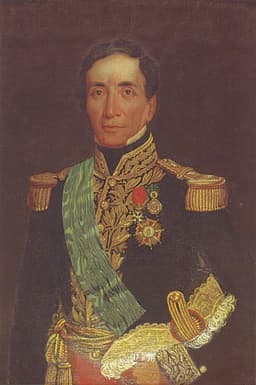
Andres de Santa Cruz
General · Modern
60.5Total
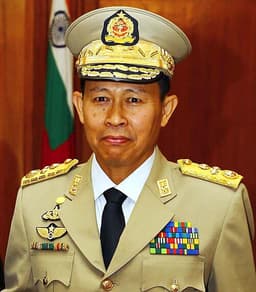
Soe Win
General · Modern
41.7Total
Basic Information
Born
1792
1947
Died
1865
—
Era
Modern
Modern
Nationality
Bolivia
Myanmar
Occupation
General
General
Civilization
Western
Eastern
Score Comparison
Military (10%)
67.5
25.9
Political (20%)
59.3
30.8
Influence (20%)
62.0
48.6
Legacy (20%)
50.0
40.0
Leadership (15%)
68.0
57.6
Strategy (15%)
66.3
36.8
TOTAL
60.5
41.7
Andres de Santa Cruz — Complete Timeline
1823 AD
Battle of ZepitaWar
Santa Cruz commanded Peruvian forces in a victory over Spanish royalists at Zepita during the Peruvian War of Independence. This battle enhanced his military reputation and contributed to the eventual liberation of Peru from Spanish rule.
Peruvian War of IndependenceBattleLiberation
Impact: regional
1826 AD
Presidency of PeruPolitical Action
Santa Cruz served as President of the Council of Government of Peru from 1826 to 1827, effectively ruling the country. His administration focused on centralizing power and organizing the state, but he was overthrown by a rebellion led by Agust
PresidencyPeruCentralization
Impact: national
1829 AD
Presidency of BoliviaPolitical Action◆ Major
Santa Cruz became President of Bolivia in 1829, serving until 1839. He implemented administrative reforms, stabilized the economy, and modernized the military, establishing Bolivia as a more coherent state after the chaos following independence.
PresidencyBoliviaReforms
Impact: nationalconstructive
1836 AD
War of the ConfederationWar◆ Major
Chile and Argentina declared war on the Peru-Bolivia Confederation, viewing it as a threat to the balance of power. Santa Cruz led the confederation's forces in a conflict that lasted until 1839, ultimately resulting in the confederation's defeat.
WarChileArgentinaConfederation
Impact: regional
Creation of the Peru-Bolivia ConfederationPolitical Action
Santa Cruz established the Peru-Bolivia Confederation, uniting Bolivia and Peru into a single state with himself as Supreme Protector. This confederation aimed to create a powerful Andean nation and challenged the regional influence of Chile and Argentina.
ConfederationUnificationAndean Power
Impact: regional
1839 AD
Battle of YungayWar
Santa Cruz's confederation forces were decisively defeated by the Chilean army at the Battle of Yungay. This defeat led to the dissolution of the Peru-Bolivia Confederation and forced Santa Cruz into exile, ending his political project.
BattleDefeatEnd of Confederation
Impact: regionaltragic
Exile and DeathPolitical Action
After the defeat at Yungay, Santa Cruz fled to Ecuador and later to France. He spent the rest of his life in exile, making unsuccessful attempts to return to power. He died in France in 1865, never regaining his former influence.
ExileDeathFailure
Impact: nationaltragic
Soe Win — Complete Timeline
2004 AD
Appointed Prime Minister of MyanmarPolitical Action◆ Major
Soe Win was appointed Prime Minister of Myanmar by the State Peace and Development Council, succeeding Khin Nyunt. He served as a key figure in the military junta's government.
Military JuntaGovernment Appointment
Impact: national
2007 AD
Saffron Revolution CrackdownPolitical Action
As Prime Minister, Soe Win oversaw the military's violent suppression of the Saffron Revolution, a series of anti-government protests led by Buddhist monks. The crackdown resulted in numerous deaths, arrests, and international condemnation.
Saffron RevolutionHuman RightsRepression
Impact: nationaldestructive
Death in OfficeOther
Soe Win died in office on October 12, 2007, from leukemia. His death occurred shortly after the Saffron Revolution crackdown, and he was succeeded by Thein Sein.
DeathSuccession
Impact: national
Expert Analysis
Andres de Santa Cruz vs Soe Win
# The Confederation and the Crackdown: Two Generals Who Defined Their Eras
On a crisp September morning in 1836, Andrés de Santa Cruz stood before a cheering crowd in Lima, proclaiming the birth of the Peru-Bolivia Confederation, a bold experiment that would redraw the map of South America. One hundred and seventy-one years later, half a world away in Myanmar, General Soe Win sat in his office in Naypyidaw, giving the orders that would send soldiers into the streets of Rangoon to crush the saffron-robed monks of the Saffron Revolution. Both men were generals. Both held supreme power. But the paths they walked—and the legacies they left—could not have been more different.
Origins
Santa Cruz was born in 1792 in Huarina, a small town on the shores of Lake Titicaca, to a Spanish father and an indigenous Aymara mother. This mixed heritage would shape his vision: he saw himself as a bridge between worlds, a man who could unite the fractured remnants of the Spanish empire into something new. He grew up in the twilight of colonial rule, absorbing the Enlightenment ideas that were sweeping across the Atlantic, and joined the royalist army as a young cadet before switching sides to fight for independence.
Soe Win was born in 1947 in Burma, a country emerging from British colonial rule into a chaotic independence. He came of age under the military dictatorship of Ne Win, a world of isolation, suspicion, and state control. Where Santa Cruz was shaped by the optimism of liberation, Soe Win was forged in the paranoia of a regime that saw every citizen as a potential enemy. He entered the military academy in the 1960s, just as the country’s democracy was being strangled in its cradle.
Rise to Power
Santa Cruz’s ascent was a story of battlefield brilliance and political maneuvering. In 1823, at the Battle of Zepita, he commanded Peruvian forces in a decisive victory over Spanish royalists, cementing his reputation as a military leader. By 1826, he was effectively ruling Peru as President of the Council of Government, though his tenure was brief. It was in 1829, when he became President of Bolivia, that his true ambition emerged. He stabilized the economy, reformed the administration, and began dreaming of a larger union.
Soe Win’s rise was quieter, more bureaucratic. He climbed the ranks of the State Peace and Development Council, the junta that had ruled Myanmar since 1988. In 2004, he was appointed Prime Minister, succeeding Khin Nyunt in a purge of moderate elements. His power came not from popular acclaim or military glory, but from his loyalty to the aging dictator Than Shwe. He was a man of the system, not a man who challenged it.
Leadership & Governance
Santa Cruz governed with a vision that was both grand and practical. He implemented a new legal code, reformed tax collection, and promoted education. His crowning achievement came in 1836 with the creation of the Peru-Bolivia Confederation, a single state that he ruled as Supreme Protector. He believed that only through unity could the former Spanish colonies resist the ambitions of larger powers like Argentina and Chile. His military score of 60.2 and political score of 60.2 reflect a balanced but not exceptional commander; his leadership score of 79.0 suggests a man who could inspire loyalty and manage complex coalitions.
Soe Win’s governance was defined by control. He oversaw a regime that suppressed dissent, censored the press, and kept the economy in a state of managed stagnation. His political score of 51.8 and military score of 44.6 indicate a leader who was neither a great strategist nor a charismatic politician. He was a caretaker of repression. When the Saffron Revolution erupted in 2007, led by Buddhist monks demanding an end to military rule, Soe Win’s response was predictable: crackdown. Soldiers fired on unarmed protesters, monasteries were raided, and thousands were arrested.
Triumph & Tragedy
Santa Cruz’s triumph was the Confederation itself—a moment when his dream of unity seemed within reach. But it was also his tragedy. Chile and Argentina, viewing the Confederation as a threat to the regional balance of power, declared war in 1836. In 1839, at the Battle of Yungay, Santa Cruz’s forces were crushed. The Confederation dissolved, and Santa Cruz fled into exile, first to Ecuador, then to France, where he died in 1865, a broken man still dreaming of what might have been.
Soe Win’s triumph, if it can be called that, was his survival in a brutal system. But his tragedy was the Saffron Revolution. The crackdown he ordered turned Myanmar into an international pariah and deepened the country’s isolation. He died in office on October 12, 2007, just weeks after the protests, from leukemia. His death was met with little mourning.
Character & Destiny
Santa Cruz was a man of grand ideas and flawed execution. His leadership score of 79.0 suggests charisma and vision, but his strategy score of 59.3 reveals a weakness in the very quality he needed most: the ability to anticipate and counter his enemies. He believed that his dream of unity would overcome all obstacles, but he underestimated the nationalism of Chile and the fear of his neighbors.
Soe Win was a man of the shadows. His leadership score of 72.6 indicates a certain competence within the confines of his system, but his influence score of 68.6 and legacy score of 56.0 reflect a leader who left no positive mark. He was a product of his environment—a regime that valued obedience over vision, repression over reform. His destiny was to be a footnote in a tragic history.
Legacy
Santa Cruz is remembered today as a visionary who nearly succeeded in uniting Peru and Bolivia. His legacy score of 68.9 places him as a figure of historical importance, debated by scholars who see him as either a unifier or a power-hungry adventurer. In Bolivia, he is honored as a reformer; in Peru, he is more ambiguous. The Confederation remains a symbol of what might have been.
Soe Win’s legacy is one of repression. His legacy score of 56.0 marks him as a minor figure in a dark period. The Saffron Revolution, though crushed, became a symbol of resistance, and the monks who faced his soldiers are remembered as martyrs. Soe Win is remembered, if at all, as the man who tried to silence them.
Conclusion
Two generals, two centuries, two worlds. Santa Cruz dreamed of building something new; Soe Win was content to maintain something old. One tried to unite; the other only divided. Their scores—67.8 total for Santa Cruz, 59.9 for Soe Win—tell part of the story, but not all. What separates them is not just skill or luck, but the quality of their ambition. Santa Cruz, for all his flaws, aimed high and left a legacy of possibility. Soe Win aimed low and left a legacy of pain. In the end, history judges not just what leaders do, but what they dare to imagine.
Rankings
🥇
Andres de Santa CruzLeader
Mil: 67.5Pol: 59.3Inf: 62.0
60.5
🥈
Soe Win
Mil: 25.9Pol: 30.8Inf: 48.6
41.7
+18.8 behind
How This Comparison Works
Algorithm
Each figure is scored on 6 dimensions (0—100 scale) based on structured historical data: Military (10%), Political (20%), Influence (20%), Legacy (20%), Leadership (15%), Strategy (15%). The weighted total produces the final ranking.
Data Sources
Scores are computed from structured sub-indicators in the database. Scale factors adjust for era (Ancient ×0.85, Modern ×1.0) and civilization size (Eastern ×1.05, Other ×0.80) to account for differences in population and military scale.
Maximum 3 Figures
Comparisons are limited to 2—3 figures to ensure readability and statistical meaningfulness.
Error Margins
±5 points per dimension — Sub-scores are derived from historical records with inherent uncertainty. Two figures within 5 points on a dimension should be considered roughly equivalent in that area.
Total Score Accuracy
±3 points overall — The weighted combination of 6 dimensions produces a total score with approximately ±3 points of uncertainty. Differences of less than 3 points are not statistically significant— the figures are effectively tied.
Known Limitations
- Historical records are incomplete and uneven across civilizations
- Figures from oral-tradition societies may be underrepresented
- Occupation labels can misclassify multi-role figures
- Scores measure capability and impact, not moral character
- Quantitative scoring is a comparison tool, not absolute truth
Capability Radar
Military (10%) — Battles & Warfare
Battles
60
10
Win Rate
55
10
Expansion
55
10
Political (20%) — Governance & Reform
Reform
65
10
Diplomacy
60
10
Economy
55
10
Influence (20%) — Cultural & Global Reach
Cultural
45
10
Global
35
10
Legacy (20%) — Historical Impact
Historical
50
20
Longevity
40
10
Leadership (15%) — Power & Stability
Tenure
60
30
Stability
40
10
Strategy (15%) — Tactics & Innovation
Strategy
65
10
Tactics
60
10
Reform
50
10
Similar Comparisons
Comments & Discussion
MACONDO'S LEGACY6/16/2026
Santa Cruz tried to build a trans-Andean union that could rival Gran Colombia—a genuinely brilliant geopolitical chess move. The Peru-Bolivia Confederation wasn't a lark; it had functioning trade routes, a unified currency, and indigenous representation. Chile and Argentina crushed it not because it was weak, but because it threatened their own expansionist ambitions. Soe Win? He's just another junta thug in the long, sad pageant of Burmese repression.
云烟破6/16/2026
数据能说话:Santa Cruz的联邦只维持了三年就被外部干涉肢解,而Soe Win的铁腕统治却让缅甸持续了半个世纪的军人阴影。一个死于流亡,一个逝于权势——这才是赤裸裸的对比。Santa Cruz的失败是理想的殉道,Soe Win的"成功"是制度的溃烂。
FACTOTUM_WRANGLER6/16/2026
Let's talk raw numbers. Santa Cruz ran a huge but fragile entity for the better part of a decade; Soe Win was at the top for less than two years as PM, serving under Than Shwe like a loyal attack dog. Santa Cruz was deposed by foreign armies—Chile, Argentina, and Peruvian dissidents literally invaded. Soe Win died of leukemia. One architect, one enforcer. Don't conflate vision with violence; that's just lazy history.
破城忆6/16/2026
军事史上,Santa Cruz是"整合之将",他用外交手腕和军事威慑把两个国家捏在一起;Soe Win则是"镇压之刃",2007年9月下令实弹射击僧侣队伍,连联合国特使都被晾在使馆里。一个在玻利维亚被视为国父级人物,一个在缅甸被列为制裁名单常客——后人自会公道评判。
PAPER_ARCHIVIST6/16/2026
The irony is thick: Santa Cruz envisioned a multiethnic confederation that would have given indigenous people real political agency, while Soe Win's regime literally banned ethnic languages in schools. Both used force, yes—Santa Cruz put down rebellions too—but the ideological chasm is enormous. Santa Cruz was a 19th-century liberal nationalist who dreamed big; Soe Win was a paranoid autocrat who only knew how to shrink the world until it fit in his fist.